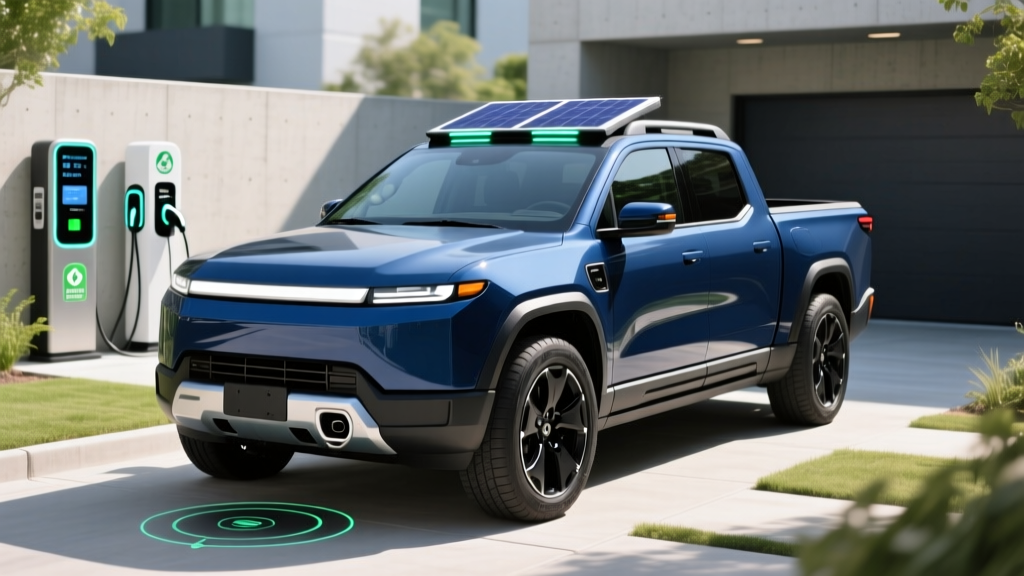
Rivian's R1T proved that a full-size electric pickup could win over truck buyers, but its $70,000-plus starting price kept it out of reach for most. The announced 2027 Rivian R2T pickup electric vehicle aims to fix that by shrinking the formula into a midsize, more affordable platform built on Rivian's next-generation R2 architecture. First unveiled in early 2025 alongside the R2 SUV, the R2T pickup variant is slated for production beginning in early 2027 at Rivian's Normal, Illinois facility — and potentially at the upcoming Georgia plant if construction timelines hold.
Because the R2T is not yet in production, every specification below reflects Rivian's announced targets, platform-level data from the R2 SUV reveal, and informed projections based on the R1T's known performance. Final EPA certification figures will not be available until late 2026 or early 2027. We'll update this profile as confirmed numbers emerge.
The 2027 Rivian R2T is not yet available for purchase. Specs cited here are preliminary targets based on Rivian's R2 platform announcements and R1T benchmarking. Treat all figures as estimates until EPA certification is published.
Projected Range, Battery, and Efficiency
Rivian confirmed that the R2 platform will use a new structural battery pack with a targeted usable capacity of approximately 85 kWh for the standard pack configuration. The company has indicated that both LFP (lithium iron phosphate) and NMC (nickel manganese cobalt) chemistries are under evaluation for different trims — a strategy similar to Tesla's approach, where LFP serves base models for cost and longevity while NMC powers longer-range variants.
For the R2T pickup specifically, Rivian's announced target is an EPA-estimated range of 300+ miles for the dual-motor AWD configuration with the larger battery option. The base single-motor RWD variant is expected to land in the 260–280 mile EPA range window.
EPA Target: ~300 miles (dual-motor AWD, large pack)
Real-world highway (70 mph): Expect ~245–270 miles based on R1T real-world testing patterns, where highway driving typically yields 15–18% below EPA stickers.
Cold-weather impact (below 32°F): Anticipate 20–30% range reduction without preconditioning, consistent with industry-wide EV behavior. A heat pump — confirmed for the R2 platform — will help mitigate cabin heating losses.
Towing scenario: If the R2T achieves a ~5,000 lb tow rating (projected), expect range to drop to roughly 140–170 miles when towing near max capacity at highway speeds.
| Spec | Base RWD (Est.) | Dual-Motor AWD (Est.) | Performance AWD (Est.) |
|---|---|---|---|
| Battery (usable) | ~75 kWh (LFP) | ~85 kWh (NMC) | ~85 kWh (NMC) |
| EPA Range Target | 260–280 mi | 300+ mi | 280–295 mi |
| Efficiency (est.) | ~33 kWh/100mi | ~35 kWh/100mi | ~36 kWh/100mi |
| MPGe (est.) | ~102 MPGe | ~97 MPGe | ~94 MPGe |
Efficiency will be critical for the R2T. The R1T's boxy aerodynamics and heavy curb weight push it to roughly 42–47 kWh/100mi in real-world driving. Rivian's R2 platform uses a more compact footprint and weight-optimized structural pack, which should yield meaningfully better efficiency — hence the projected 33–36 kWh/100mi range above. For reference, that's comparable to the Ford F-150 Lightning's efficiency but in a lighter, smaller package.
Charging Speed: DC Fast Charge and Home Level 2
Rivian has confirmed that the R2 platform will support DC fast charging at up to 200 kW peak — a significant step up from the R1T's ~190 kW peak and made possible by a new 800-volt-class electrical architecture (or an optimized 400V system with high-C-rate cells). The company's target is a 10–80% charge in approximately 25 minutes under optimal conditions at a capable DC fast charger.
Here's where real-world nuance matters: peak kW is not sustained kW. Based on R1T charging-curve behavior and comparable platforms, expect the R2T to hold its peak rate through roughly 30–40% State of Charge (SoC), then taper progressively. The 10–80% time of ~25 minutes assumes you arrive at a 250+ kW charger with a preconditioned battery. Without preconditioning — or at a 150 kW station — add 5–10 minutes.
| Charging Level | Power / Rate | Speed | Notes |
|---|---|---|---|
| Level 1 (120V) | ~1.4 kW | ~4 mi/hr | Emergency/trickle only |
| Level 2 (240V, 48A) | ~11.5 kW | ~32 mi/hr | Full overnight charge in ~9–10 hrs |
| Level 2 (240V, 60A) | ~14.4 kW | ~40 mi/hr | Requires 60A circuit; ~7.5 hrs full |
| DC Fast (250+ kW station) | Peak ~200 kW | 10–80% in ~25 min | Taper above 80%; precondition battery |
| DC Fast (150 kW station) | Capped ~150 kW | 10–80% in ~32 min | Common EA/EVgo station speed |
Rivian confirmed the R2 platform will ship with a NACS (North American Charging Standard) port natively, giving R2T owners direct access to Tesla's Supercharger network — currently the most reliable DC fast-charging network in the U.S. by a wide margin. No adapter will be needed. For home charging, Rivian is expected to offer a branded Level 2 wall connector, and the R2T will be compatible with any J1772/NACS Level 2 EVSE.
Home charging cost context: At the national average residential electricity rate of ~$0.17/kWh (per EIA data), fully charging an 85 kWh R2T battery from empty costs roughly $14.45 — translating to about $0.05–0.06 per mile. That's a fraction of the $0.15–0.18/mile fuel cost of a comparable gas-powered midsize pickup at $3.50/gallon.
Performance and Drivetrain Configurations
Rivian plans to offer the R2T in multiple drivetrain configurations, leveraging the same modular motor approach used in the R1T and R2 SUV:
- Single-Motor RWD: ~275 hp, 0–60 mph in ~6.5 seconds. Aimed at fleet buyers and cost-conscious commuters.
- Dual-Motor AWD: ~450 hp, 0–60 mph in ~4.5 seconds. The volume seller and the configuration most buyers should target.
- Performance Dual-Motor AWD: ~550+ hp, 0–60 mph in ~3.5 seconds. For buyers who want R1T-quickness in a smaller package.
These projections align with the R2 SUV's announced performance targets and represent a meaningful step below the R1T Quad-Motor's 1,025 hp — but the R2T will be lighter, so the dual-motor variant should feel brisk in everyday driving. Rivian's single-pedal driving mode with aggressive regenerative braking will carry over, and the R2T will feature multiple drive modes (All-Purpose, Sport, Snow, Off-Road, and a Tow mode with integrated trailer-light-check and blind-spot extension).
Towing capacity is projected at ~5,000 lbs for dual-motor variants — down from the R1T's 11,000-lb max, but competitive with the Ford Maverick hybrid's 4,000-lb rating and well above the Hyundai Santa Cruz's 5,000-lb max. Payload is expected around 1,400–1,500 lbs.
Pricing, Trims, and Federal Tax Credit Eligibility
Rivian CEO RJ Scaringe has publicly stated that the R2 platform will start at approximately $45,000 for the base R2 SUV. The R2T pickup, given its additional body structure and bed hardware, is projected to start slightly higher. Based on Rivian's pricing strategy and competitive positioning against the Ford Maverick, Chevrolet Colorado, and Toyota Tacoma, here's our projected trim structure:
| Trim | Drivetrain | Est. MSRP | §30D Credit Eligible? |
|---|---|---|---|
| Base | Single-Motor RWD | ~$46,000–$48,000 | Likely yes (under $80K cap) |
| Adventure | Dual-Motor AWD | ~$52,000–$55,000 | Likely yes (under $80K cap) |
| Adventure w/ Large Pack | Dual-Motor AWD | ~$58,000–$62,000 | Likely yes (under $80K cap) |
| Performance | Dual-Motor AWD (High Output) | ~$65,000–$70,000 | Likely yes (under $80K cap) |
The IRS §30D clean vehicle credit offers up to $7,500 for qualifying new EVs, but eligibility depends on multiple factors that will not be finalized for the R2T until closer to production:
- MSRP cap: Pickup trucks must be under $80,000 — all projected R2T trims clear this threshold.
- Buyer income caps: AGI must not exceed $300,000 (joint), $225,000 (head of household), or $150,000 (single) — per IRS guidelines.
- Battery component sourcing: A percentage of battery components must be manufactured or assembled in North America, and critical minerals must be sourced from the U.S. or FTA partners. These thresholds increase annually. Rivian's Georgia battery plant (partnered with SK On) and Illinois assembly suggest strong compliance potential, but final sourcing percentages are not yet confirmed.
- Point-of-sale transfer: Eligible buyers can transfer the credit to the dealer at purchase, reducing the out-of-pocket price immediately rather than waiting for a tax refund.
- FEOC restriction: Vehicles containing battery components from a "foreign entity of concern" (primarily targeting Chinese supply chains) are disqualified. Rivian's supply chain decisions through 2026–2027 will determine compliance.
Cargo, Passenger Space, and Practicality
The R2T is positioned as a midsize pickup — smaller than the R1T (which rides on a full-size platform) but larger than the Ford Maverick. Based on the R2 SUV's known dimensions and Rivian's teaser renderings, expect the following:
- Bed length: ~4.5 feet (54 inches), similar to the R1T's 54-inch bed — shorter than a Tacoma's 5- or 6-foot options but compensated by Rivian's signature Gear Tunnel (a pass-through storage compartment spanning the vehicle width between the cab and bed).
- Bed payload: ~1,400–1,500 lbs projected.
- Frunk (front trunk): Expected ~10–11 cu ft, lockable and drainable — a Rivian hallmark since the R1T.
- Passenger seating: 5-passenger capacity, two rows. Rear legroom projected at ~38 inches, competitive with the Colorado and Tacoma crew cabs.
- Total cargo volume (bed + frunk + Gear Tunnel): ~55–60 cu ft combined, offering significantly more enclosed storage than a conventional midsize pickup.
The Gear Tunnel is the R2T's practicality trump card. On the R1T, it provides 11.6 cu ft of weather-sealed storage — perfect for gear bags, coolers, or charging cables. If Rivian carries this feature to the R2T (all evidence suggests they will), it will be a genuine differentiator against the Maverick, Santa Cruz, and Colorado, none of which offer equivalent enclosed storage.
Technology, Driver Assistance, and Safety
Rivian's R2 platform debuts a next-generation electrical architecture and software stack. Confirmed and projected tech features for the R2T include:
- Infotainment: 15.6-inch center touchscreen running Rivian's proprietary OS, with wireless Apple CarPlay and Android Auto, built-in navigation with real-time charging route planning, and over-the-air (OTA) update capability.
- Driver display: Compact digital instrument cluster plus a head-up display (HUD) — a first for Rivian.
- Rivian Driver+: The company's SAE Level 2 driver-assistance suite, including adaptive cruise control, lane-centering, automatic emergency braking, blind-spot monitoring, and rear cross-traffic alert. Expect a hands-on-wheel system at launch, with a potential hands-free highway mode (similar to GM's Super Cruise or Ford's BlueCruise) arriving via OTA post-launch.
- Camp Kitchen / Gear Guard: Rivian's optional slide-out camp kitchen accessory (available for R1T) may be adapted for the R2T's Gear Tunnel, along with the Gear Guard cable lock system for securing bed cargo.
- Vehicle-to-Load (V2L): Confirmed for the R2 platform — the R2T will be able to power external devices (tools, camping equipment, tailgate setups) via built-in 120V/240V outlets, a critical feature for work-truck and outdoor use cases.
Rivian Driver+ is an SAE Level 2 system. It assists with steering and acceleration/braking but requires the driver to remain fully engaged and hands on the wheel at all times. It is not a self-driving system. Only Level 4 services like Waymo operate without a human driver, and those are limited to geofenced urban areas.
Safety ratings from the NHTSA and IIHS will not be available until production vehicles are tested, likely in mid-2027. Rivian's R1T earned an IIHS Top Safety Pick+ designation, setting a high bar for the R2 platform.
Warranty Coverage
Rivian is expected to carry over its current warranty structure to the R2 platform, potentially with enhancements to remain competitive:
| Coverage Area | Terms (Projected) |
|---|---|
| Basic Vehicle | 5 years / 60,000 miles |
| Battery Pack | 8 years / 100,000 miles (≥70% capacity retention) |
| Drive Unit(s) | 8 years / 100,000 miles |
| Corrosion | 5 years / unlimited miles |
| Roadside Assistance | 5 years / 60,000 miles |
The 8-year/100,000-mile battery warranty with a 70% capacity-retention threshold is the federal minimum standard that most automakers meet. Rivian's R1T battery degradation data has been generally positive so far, with most owners reporting less than 5% degradation in the first 30,000 miles. The R2's LFP battery option (if offered on base trims) should deliver even slower degradation — LFP chemistry typically retains 90%+ capacity after 2,000 charge cycles, which translates to well over 300,000 miles for most drivers.
Who the R2T Is For — and Who Should Look Elsewhere
- You want an electric pickup under $60,000 (after credit) with genuine off-road capability and innovative storage (Gear Tunnel, frunk).
- You need NACS native access to the Supercharger network for road trips without adapter hassles.
- Your typical daily drive is under 100 miles round-trip, and you can charge at home overnight.
- You value OTA software updates and a tech-forward ownership experience over dealership familiarity.
- You want V2L capability for job-site power or camping.
Look elsewhere if:
- You need to tow more than 5,000 lbs regularly — the R1T (11,000 lbs) or F-150 Lightning (10,000 lbs) are better choices.
- You need a 6-foot bed for plywood, lumber, or motorcycles — the R2T's ~4.5-foot bed won't accommodate 4×8 sheets flat.
- You live in a rural area with limited DC fast-charging access and no home-charging option.
- You cannot wait until early 2027 for delivery — the R1T, F-150 Lightning, and Silverado EV are available now.
Competitive Landscape: R2T vs. the Midsize Truck Market
The R2T enters a midsize pickup segment that is rapidly electrifying. Here's how it stacks up against announced and available competitors:
| Vehicle | Est. Range | Base Price | Max Tow | Status |
|---|---|---|---|---|
| Rivian R2T (AWD) | ~300 mi | ~$52,000 | ~5,000 lbs | Announced (2027) |
| Ford F-150 Lightning (Std Range) | 240 mi | ~$55,000 | 7,700 lbs | Available now |
| Chevrolet Colorado (gas baseline) | ~400 mi (gas) | ~$32,000 | 7,700 lbs | Available now |
| Ford Maverick Hybrid (gas baseline) | ~500 mi (gas) | ~$28,000 | 4,000 lbs | Available now |
| Tesla Cybertruck (AWD) | 340 mi | ~$80,000 | 11,000 lbs | Available now |
The R2T's sweet spot is clear: it undercuts the R1T and Cybertruck on price dramatically, offers more range than the F-150 Lightning Standard Range, and provides tech and storage innovation that gas-powered midsize trucks simply cannot match. The trade-off is towing capacity and bed length — if those are non-negotiable, the F-150 Lightning or R1T remain the electric answers.
Frequently Asked Questions
What is the real-world range of the 2027 Rivian R2T?
Rivian targets an EPA-estimated 300+ miles for the dual-motor AWD with the large battery pack. In real-world highway driving at 70 mph, expect roughly 245–270 miles based on typical EV highway efficiency losses. In cold weather (below 32°F), plan for 20–30% range reduction unless you precondition the battery and cabin while plugged in.
How fast does the R2T charge at home and on the road?
At a 250+ kW DC fast charger, the R2T targets a peak rate of ~200 kW, achieving 10–80% in approximately 25 minutes with a preconditioned battery. At home on a Level 2 (240V, 48A) charger, expect ~32 miles of range added per hour, meaning a full charge from empty takes roughly 9–10 hours overnight.
How much will the R2T cost after federal tax credits?
If the dual-motor Adventure trim lands at ~$52,000–$55,000 MSRP and qualifies for the full $7,500 §30D credit (subject to battery-sourcing rules and buyer income limits), the effective price could drop to approximately $44,500–$47,500. Point-of-sale transfer lets you apply this credit at purchase rather than waiting for tax season.
Does the R2T qualify for the $7,500 federal EV tax credit?
Based on projected pricing (all trims under the $80,000 pickup MSRP cap) and Rivian's North American manufacturing footprint, the R2T is positioned to qualify. However, final eligibility depends on battery component sourcing and critical-mineral requirements that are tightening annually. Confirm on fueleconomy.gov when the R2T is officially listed, and consult a tax professional regarding your income eligibility.
Is the R2T worth waiting for vs. buying an R1T or F-150 Lightning now?
If budget is your primary constraint and you don't need max towing (10,000+ lbs) or a full-size bed, the R2T's projected $45,000–$55,000 price range and NACS Supercharger access make it worth the wait. If you need a truck today or require heavy-duty capability, the R1T, F-150 Lightning, and Silverado EV are proven options available now.
What are the biggest pros and cons of the R2T?
- Sub-$55K starting price for AWD makes it the most accessible electric pickup with genuine off-road chops
- Native NACS port — no adapter needed for Tesla Superchargers
- Gear Tunnel + frunk = class-leading enclosed storage
- V2L capability for job-site and camping power
- OTA software updates keep the truck improving post-purchase
- LFP battery option may offer exceptional longevity (2,000+ cycles)
- ~4.5-foot bed is short for construction and hauling use cases
- ~5,000-lb tow rating trails F-150 Lightning and R1T significantly
- Not available until early 2027 — long wait with reservation uncertainty
- Rivian's service center network is still expanding; rural owners may face long drive for warranty work
- Final specs, pricing, and tax-credit eligibility not yet confirmed
- Base RWD model may feel underpowered for truck buyers accustomed to V6 torque
This profile will be updated as Rivian releases confirmed specifications, EPA certification data, and final pricing for the 2027 R2T pickup. Last updated based on information available through mid-2026.