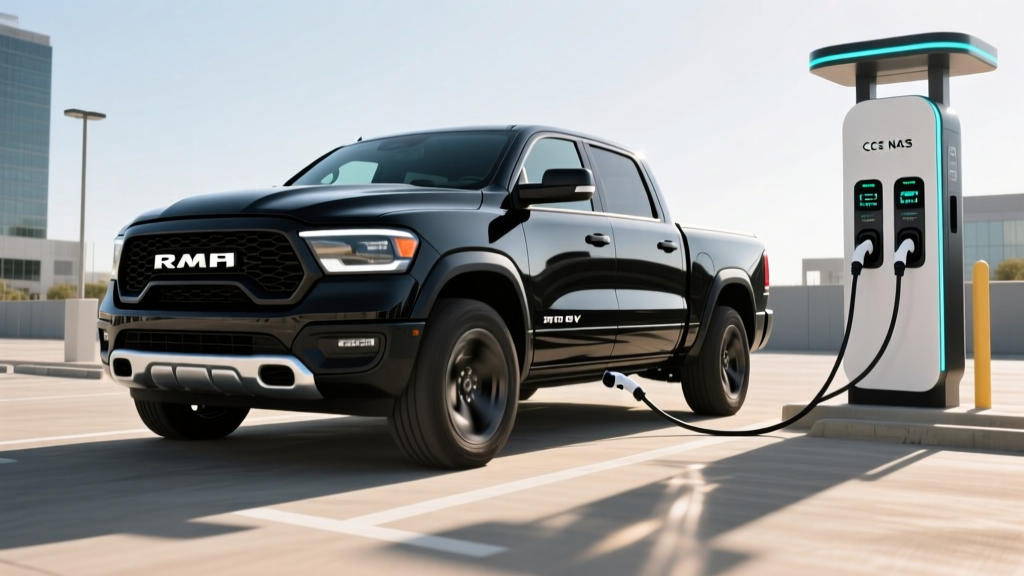
The full-size electric pickup segment has been defined by the Ford F-150 Lightning, the GMC Sierra EV, and the Chevrolet Silverado EV. Ram entered the conversation with the 1500 REV, first unveiled as a concept in 2023 and subsequently confirmed for production. Now positioned as a 2027 model-year launch, the Ram 1500 REV aims to outdo its rivals on range and platform flexibility by using Stellantis' dedicated STLA Frame architecture. With production timelines having shifted multiple times, buyers need clear, data-backed expectations before placing a reservation. Here is everything we know — and what remains preliminary — about the 2027 Ram 1500 REV.
Platform, Battery Options, and Estimated Range
The Ram 1500 REV rides on the STLA Frame platform, a body-on-frame architecture designed specifically for full-size trucks and large SUVs. Ram has confirmed two battery pack options, both using lithium-ion NMC (nickel-manganese-cobalt) chemistry chosen for its high energy density — a necessary trade-off in a truck this size where packing enough cells for 300+ miles of range requires every advantage in volumetric efficiency.
| Specification | Standard Pack | Extended-Range Pack |
|---|---|---|
| Battery Chemistry | NMC (Nickel-Manganese-Cobalt) | NMC (Nickel-Manganese-Cobalt) |
| Usable Capacity (est.) | ~168 kWh | ~229 kWh |
| EPA Est. Range (Ram Target) | Up to 350 miles | Up to 500 miles |
| Drivetrain | Dual-motor AWD | Dual-motor AWD |
Notably, Ram originally planned a range-extender (EREV) variant with a small onboard gasoline generator to supplement the battery. As of 2026, Stellantis has indicated that the EREV option has been deprioritized or delayed, with the initial launch focused on a fully battery-electric configuration. Buyers who need a backup generator for remote job sites or extended off-grid use should monitor updates closely — or consider the Ford F-150 Lightning's available Pro Power Onboard as a partial alternative.
Charging Speed: DC Fast and Level 2 Home Charging
Charging a 168–229 kWh battery pack is a physics challenge. Ram has stated that the 1500 REV will support up to 350 kW peak DC fast charging on the extended-range pack and approximately 150–170 kW on the standard pack, both via the NACS (North American Charging Standard) connector. This gives the REV access to Tesla Supercharger stalls with Magic Dock adapters as well as Electrify America, EVgo, and other networks deploying 350 kW hardware.
| Charging Level | Standard Pack (~168 kWh) | Extended-Range Pack (~229 kWh) |
|---|---|---|
| Level 1 (120V, 1.4 kW) | ~3 mi/hr added | ~3 mi/hr added |
| Level 2 (240V, 11.5 kW onboard) | ~25 mi/hr added | ~25 mi/hr added |
| Level 2 (240V, 19.2 kW capable) | ~42 mi/hr added | ~42 mi/hr added |
| DC Fast (Peak kW) | ~150–170 kW | Up to 350 kW |
| DC Fast 10–80% (est.) | ~45–55 minutes | ~25–35 minutes |
| Miles Added in 10 Min DC | ~45–55 miles | ~100–130 miles |
| Connector | NACS | NACS |
A critical detail for buyers: kW (kilowatts) measures charging power — the rate at which energy flows into the battery — while kWh (kilowatt-hours) measures total energy capacity. A 350 kW peak rate does not mean the truck charges at that speed for the entire session. DC fast charging follows a curve: the battery charges fastest between roughly 10% and 50% state of charge (SoC), then tapers significantly above 80% to protect cell longevity. With a ~229 kWh pack, even a sustained average of 250 kW from 10–80% would require roughly 38 minutes — fast for a battery this large, but not the "fill-up" speed of a gas truck.
For home charging, the standard 11.5 kW onboard charger will fully replenish the 168 kWh pack in about 15 hours — adequate for overnight charging if you plug in each evening. Specifying the available 19.2 kW onboard charger (which requires a 100-amp dedicated circuit and a hardwired Level 2 wallbox) cuts that to roughly 9 hours. For the extended-range pack, plan on 12–20 hours at home depending on your charger spec. Most owners will charge nightly between 20–80% SoC, which takes 5–8 hours on an 11.5 kW unit — well within an overnight window.
Performance, Towing, and Payload
The Ram 1500 REV is expected to use a dual-motor all-wheel-drive layout across all trims. Ram has targeted approximately 654 horsepower and 620 lb-ft of torque, with a 0–60 mph time in the mid-4-second range. That puts it squarely in F-150 Lightning territory (580 hp, 4.4 sec 0–60 for the Extended Range model) and well ahead of most gas-powered half-ton trucks.
| Metric | Estimate |
|---|---|
| Powertrain | Dual-motor AWD |
| Horsepower | ~654 hp |
| Torque | ~620 lb-ft |
| 0–60 mph | ~4.4 seconds (est.) |
| Max Towing Capacity | Up to 14,000 lbs (target) |
| Max Payload | Up to 2,700 lbs (target) |
| Bidirectional Power | V2L (vehicle-to-load) confirmed; V2H (vehicle-to-home) planned |
The 14,000-lb towing target would exceed the F-150 Lightning's 10,000-lb maximum and approach the GMC Sierra EV's 12,500-lb rating. However, towing is where electric trucks face their steepest efficiency penalty. Expect range to drop by 40–50% when towing a heavy trailer at highway speeds — a 350-mile truck becomes a 175–210-mile truck with a loaded car hauler behind it. This is physics, not a flaw specific to Ram; every electric pickup exhibits the same behavior. If your use case involves frequent heavy towing over long distances, plan your routes around DC fast charger locations and expect 45–60 minute charging stops every 150–200 miles under load.
Ram has confirmed vehicle-to-load (V2L) capability, allowing the REV to power tools, appliances, or a campsite directly from the truck's battery. Vehicle-to-home (V2H) integration, which could power essential household circuits during an outage, is planned but may require a compatible bidirectional wallbox and electrical panel integration at launch.
Interior, Cargo, and Technology
The 1500 REV is expected to offer a crew cab configuration with seating for five (or six with an available front bench). Ram's concept showcased a flat-load floor enabled by the skateboard platform, and the production version should retain generous rear-seat legroom — estimated at approximately 45 inches, competitive with the F-150 Lightning's 43.6 inches.
The bed is expected to measure approximately 5 feet 7 inches (short box), consistent with electric truck packaging that reserves space for the rear motor and battery. A front trunk (frunk) is confirmed, with Ram targeting roughly 15 cubic feet of lockable, weather-sealed front storage — enough for a large tool chest or several carry-on bags. Total bed volume with the tailgate down and load floor flat should approach the gas 1500's short-box capacity.
Technology highlights include an expected 14.5-inch center infotainment touchscreen running Uconnect 5, a 12.3-inch digital instrument cluster, and an available 10.25-inch passenger-side display. Ram's concept also previewd a removable tablet-style controller for bed functions and trailer management. Wireless Apple CarPlay and Android Auto, a head-up display, and a digital rearview mirror are all expected.
On the driver-assistance front, the REV will ship with SAE Level 2 systems including adaptive cruise control with stop-and-go, lane-centering steering, automated emergency braking, blind-spot monitoring with trailer coverage, and a hands-free active driving assist system for divided highways. This is not self-driving. The driver must remain attentive and keep hands on or near the wheel at all times. Ram's hands-free system is comparable to Ford's BlueCruise or GM's Super Cruise in capability — useful for reducing fatigue on long highway stretches, but it does not replace the driver.
Pricing, Trim Levels, and Federal Tax Credit Eligibility
Ram has not published final MSRP figures for the 2027 1500 REV, but based on STLA Frame platform cost projections and competitive positioning against the F-150 Lightning ($55,000–$96,000) and GMC Sierra EV ($78,000–$100,000+), industry estimates place the base Tradesman trim around $58,000–$62,000, with higher trims reaching into the $85,000–$95,000 range.
| Trim Level | Est. Base MSRP | Battery Pack | §30D Credit Eligibility (est.) |
|---|---|---|---|
| Tradesman | $58,000–$62,000 | Standard (~168 kWh) | Likely eligible (under $80K cap) |
| Big Horn / Laramie | $68,000–$78,000 | Standard or Extended | Eligible if under $80K MSRP |
| Limited / Tungsten | $85,000–$95,000 | Extended (~229 kWh) | Likely over $80K MSRP cap |
Federal tax credit eligibility under IRS §30D involves several hurdles that buyers must evaluate individually:
- MSRP Cap: Trucks, vans, and SUVs must have an MSRP at or below $80,000 to qualify. Higher-trim REVs with the extended-range pack will likely exceed this threshold.
- Buyer Income Limits: Modified adjusted gross income (MAGI) must not exceed $300,000 (joint filers), $225,000 (head of household), or $150,000 (single filers).
- Battery Sourcing Requirements: To receive the full $7,500 credit, the battery's critical minerals and components must meet escalating domestic-sourcing thresholds. Vehicles that fail one or both sourcing tests receive $3,750 or $0. As of 2026, these requirements are strict, and final sourcing data for the REV's NMC cells has not been published by Stellantis.
- Point-of-Sale Transfer: Eligible buyers can transfer the credit to the dealer at purchase, reducing the out-of-pocket price by up to $7,500 on the spot — rather than waiting to claim it on their tax return.
Consult a tax professional and verify your specific eligibility on the IRS website before making a purchase decision. State and local incentives may also apply; check the Alternative Fuels Data Center for your jurisdiction.
Warranty and Long-Term Battery Durability
Federal law mandates that EV batteries carry a minimum warranty of 8 years or 100,000 miles (whichever comes first), and Ram is expected to meet or exceed this standard. The STLA Frame platform's battery pack will use a liquid-cooled thermal management system to minimize degradation — the primary enemy of long-term battery health.
NMC chemistry typically retains 85–92% of original capacity after 100,000 miles under normal use patterns, based on data from similar large-pack EVs. The warranty's capacity-retention threshold — the minimum SoH (State of Health) percentage below which Ram will replace or repair the pack — has not been published but is typically set at 70% by most automakers. Ram is also expected to offer a 5-year/60,000-mile bumper-to-bumper warranty and 5-year/100,000-mile powertrain coverage, though final terms are unconfirmed.
If out-of-warranty battery replacement becomes necessary in the distant future, expect costs in the $15,000–$25,000 range for a pack of this size — a significant sum, though one that most owners will never face based on current degradation data across the industry.
How the 2027 Ram 1500 REV Stacks Up Against Competitors
| Metric | 2027 Ram 1500 REV (Est.) | Ford F-150 Lightning | GMC Sierra EV | Chevrolet Silverado EV |
|---|---|---|---|---|
| Max EPA Range | 350–500 mi (target) | 320 mi | 440 mi (Denali) | 450 mi (4WT) |
| Battery (usable kWh) | 168–229 | 98–131 | ~200+ | ~200+ |
| Peak DC Charge kW | 170–350 | 150–170 | 350 | 350 |
| Max Towing | 14,000 lbs | 10,000 lbs | 12,500 lbs | 12,500 lbs |
| Starting MSRP | $58,000–$62,000 (est.) | $55,000 | $78,000 | $57,000 |
| Availability | 2027 (announced) | On sale now | On sale now | On sale now |
The Ram 1500 REV's potential advantages are clear: a higher towing target than any rival, a class-leading 500-mile range option if certified, and competitive pricing at the base trim. Its disadvantages are equally clear: it is not yet on sale, and every specification remains preliminary. The F-150 Lightning and Silverado EV are proven, tested, and purchasable today. Buyers who need an electric truck in 2026 will have to look elsewhere; buyers willing to wait for the REV's 2027 launch may be rewarded with best-in-class range and towing — provided Ram delivers on its promises.
Consider the Ram 1500 REV if: You can wait until 2027, you need maximum towing capacity in an electric truck, and you want the longest possible range for highway-heavy commutes or road trips.
Choose the Ford F-150 Lightning if: You need an electric truck now, want a proven platform with extensive real-world ownership data, and your towing needs stay under 10,000 lbs.
Choose the Chevrolet Silverado EV if: You want competitive range (450 mi EPA on 4WT), GM's Ultium platform, and a lower starting price, and you can work with the current bed-length and configuration options.
Who the 2027 Ram 1500 REV Is For
The 1500 REV will appeal most to truck buyers who:
- Commute long distances daily and want 300+ miles of real-world range to avoid mid-week charging.
- Tow boats, trailers, or campers on weekends and need the 14,000-lb target capacity, while accepting the range penalty that heavy towing imposes.
- Have home charging access — a Level 2 wallbox is essential for a truck with a 168+ kWh battery. Without it, Level 1 trickle charging is impractical for daily use.
- Want V2L/V2H capability for job-site power or home backup during outages.
- Can wait. Production delays are a real risk. If your current truck is failing, the Lightning or Silverado EV are available today.
The REV is not the right choice for buyers who lack home charging, who frequently tow heavy loads over 300+ mile routes without reliable DC fast charger infrastructure along their corridor, or who need a truck in the next 12 months.
Frequently Asked Questions
What is the real-world range of the 2027 Ram 1500 REV?
Ram targets 350 miles (standard pack) and 500 miles (extended-range pack) on the EPA cycle. Real-world highway driving in moderate weather will likely deliver 280–310 miles and 380–430 miles respectively. Cold weather and heavy towing will reduce these figures by 20–50%. Final EPA certification is pending.
How fast does the Ram 1500 REV charge?
The extended-range pack targets up to 350 kW peak DC fast charging, with an estimated 10–80% time of 25–35 minutes on compatible chargers. The standard pack targets 150–170 kW peak, with 10–80% in roughly 45–55 minutes. Home Level 2 charging at 11.5 kW adds about 25 miles per hour; at 19.2 kW, about 42 miles per hour.
How much does the 2027 Ram 1500 REV cost after tax credits?
Base pricing is estimated at $58,000–$62,000. If eligible for the full $7,500 federal credit under §30D (meeting MSRP, income, and battery-sourcing requirements), the effective price could drop to approximately $50,500–$54,500 for the Tradesman trim. Higher trims over $80,000 MSRP will not qualify for the federal credit.
Does the Ram 1500 REV qualify for the federal EV tax credit?
Lower trims under the $80,000 MSRP cap are likely eligible, provided the buyer meets income limits and the battery satisfies critical-mineral and component-sourcing thresholds. Final sourcing data has not been published. Verify your personal eligibility at irs.gov and with a tax professional before purchasing.
Is the Ram 1500 REV worth buying vs. the F-150 Lightning or Silverado EV?
If Ram delivers on its range and towing targets at competitive pricing, the REV could be the most capable electric truck in its class. However, it is not yet on sale, and specifications remain preliminary. The F-150 Lightning and Silverado EV offer proven platforms you can buy today. If you can wait and Ram's final specs align with your needs, the REV is worth serious consideration.
What are the biggest pros and cons?
✅ Pros
- Class-leading 500-mi range target (extended pack)
- 14,000-lb towing target exceeds all current EV rivals
- NACS connector with up to 350 kW DC charging
- V2L and planned V2H bidirectional power
- Large frunk (~15 cu ft) for secure storage
- Competitive base-trim pricing (est. $58K–$62K)
❌ Cons
- Not yet on sale — 2027 launch with history of delays
- All specs are preliminary and unverified by EPA
- Extended-range pack will likely exceed $80K MSRP cap (no tax credit)
- NMC chemistry may degrade faster than LFP over 150K+ miles
- Towing cuts range by 40–50% — true of all EV trucks
- EREV range-extender option deprioritized or canceled