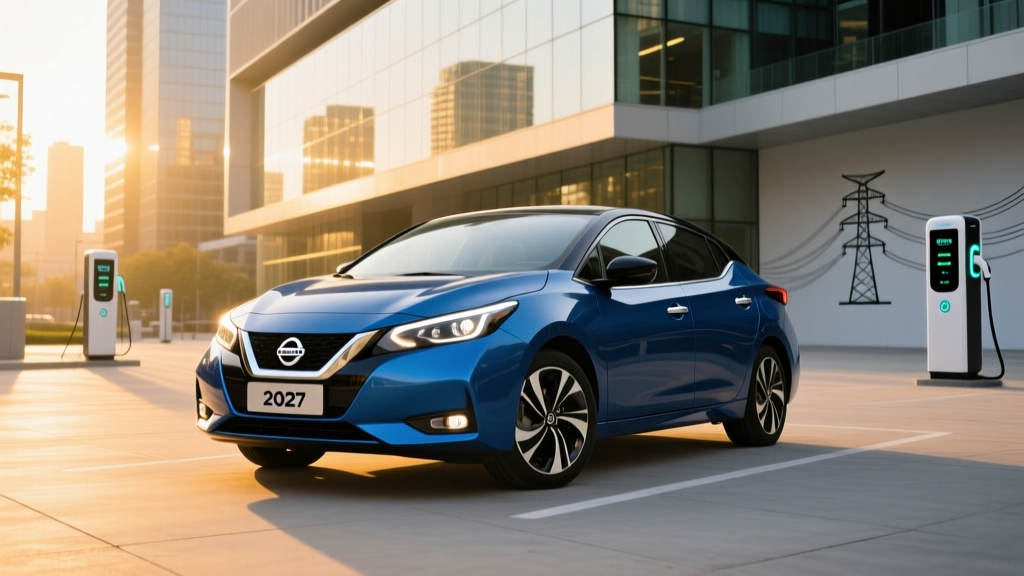
The original Nissan Leaf defined mass-market electric mobility when it launched in 2010. More than a decade later, the aging second-generation model — with its CHAdeMO connector and air-cooled battery — has fallen behind rivals. Nissan has confirmed that a next-generation Leaf is coming, and the 2027 Nissan Leaf is expected to be that long-awaited reinvention. This preview covers everything confirmed or credibly reported about the upcoming model, including estimated range, charging architecture, pricing, and tax-credit outlook — along with the limitations of pre-production information.
What We Know About the 2027 Nissan Leaf
Nissan officially confirmed in mid-2025 that the next-generation Leaf will debut as a compact crossover rather than a traditional hatchback, riding on the same CMF-EV platform that underpins the Ariya. Production is slated for Nissan's Sunderland, UK plant for European markets, with a North American variant expected from the Smyrna, Tennessee assembly line. The shift to a crossover body style reflects buyer demand: compact SUVs now outsell hatchbacks by a wide margin in the U.S. market.
Nissan has also committed to adopting the North American Charging Standard (NACS) connector for its future EVs sold in the U.S., joining Ford, GM, Rivian, and others in adopting Tesla's connector design. This is a significant departure from the CHAdeMO connector used on the current Leaf and should dramatically improve public charging access via Tesla's Supercharger network.
Estimated Range, Battery, and Efficiency
The current Leaf tops out at 212 miles of EPA range in SV Plus trim with its 62 kWh battery. Nissan has signaled that the next-gen Leaf will offer a meaningful range increase, targeting competitive figures for the compact EV crossover segment.
Standard Range (est.): ~230–250 miles EPA
Extended Range (est.): ~275–300 miles EPA
Real-world highway (70 mph): Expect approximately 15–20% reduction from EPA — roughly 190–255 miles depending on trim and battery option.
Cold-weather (below 30°F): Plan for 25–35% range reduction without preconditioning, yielding as low as 150–190 miles on the standard pack. A heat pump — expected to be standard or widely available — would mitigate this loss by roughly 10%.
EPA estimates measure combined city/highway driving under moderate conditions. Real-world results vary significantly with speed, temperature, terrain, and climate control usage.
Based on the Ariya's architecture, we anticipate two battery options:
| Spec | Standard Range (Est.) | Extended Range (Est.) |
|---|---|---|
| Battery Capacity (usable) | ~63 kWh | ~87 kWh |
| Chemistry | NMC (likely) / LFP possible | NMC |
| EPA Range (est.) | 230–250 mi | 275–300 mi |
| Efficiency (est.) | ~27–29 kWh/100mi | ~29–32 kWh/100mi |
| MPGe (est.) | ~115–120 MPGe | ~105–112 MPGe |
| Thermal Management | Liquid-cooled | Liquid-cooled |
The shift from the current Leaf's passive air-cooled battery to active liquid thermal management is arguably the most important upgrade. Air cooling led to well-documented degradation issues and "Rapidgate" — where consecutive DC fast charges would throttle speeds due to overheating. Liquid cooling solves both problems, preserving long-term battery health and enabling sustained fast-charging performance.
Nissan has not confirmed whether the standard-range model will use LFP (lithium iron phosphate) chemistry. LFP offers superior cycle life and avoids cobalt/nickel sourcing concerns (relevant for tax-credit compliance) but trades energy density for those benefits. If Nissan offers an LFP option, expect it on the base trim with slightly lower range but a potential cost advantage and the ability to regularly charge to 100% without degradation concerns.
Charging Speed: DC Fast, Level 2, and the NACS Advantage
The adoption of the NACS connector is transformational for Leaf buyers. The current Leaf's CHAdeMO connector has become increasingly marginalized as Electrify America, EVgo, and other networks prioritize CCS and NACS. With NACS, the 2027 Leaf gains access to Tesla's Supercharger network — over 25,000 stalls in North America — via native compatibility.
| Charging Level | Power / Rate | Speed | Notes |
|---|---|---|---|
| Level 1 (120V) | ~1.4 kW | ~3–4 mi/hr | Emergency/trickle only |
| Level 2 (240V, 32A) | 7.7 kW | ~22–26 mi/hr | Full charge overnight (~9–11 hrs) |
| Level 2 (240V, 48A) | 11.5 kW | ~33–38 mi/hr | Requires 60A circuit; ~7 hrs |
| DC Fast (peak) | ~130–150 kW (est.) | 10–80% in ~28–35 min | Curve tapers significantly above 80% |
For context, the Ariya peaks at approximately 130 kW on DC fast charging — respectable but below the 200+ kW peaks of the Hyundai Ioniq 5 or Kia EV6 on 800V architectures. The 2027 Leaf is expected to use a 400V system (like the Ariya), meaning peak charging rates will likely land in the 130–150 kW range rather than the 250+ kW seen on 800V competitors.
Charging curve reality check: Peak kW is not sustained kW. A 150 kW peak rate typically holds only between roughly 10–40% State of Charge (SoC), then progressively tapers. Expect the 10–80% charge to average closer to 90–110 kW over the full session. This is normal for 400V architectures and is why the 10–80% time is a more useful metric than peak kW alone.
Home charging setup: For the 11.5 kW Level 2 rate, you'll need a hardwired wall connector on a dedicated 60-amp circuit. Most homes with a 200-amp electrical panel can accommodate this. Installation costs typically range from $800 to $2,500 depending on panel proximity, conduit runs, and local permit fees. A licensed electrician should assess your panel capacity before purchase.
Performance and Drivetrain
The CMF-EV platform supports both single-motor front-wheel drive and dual-motor all-wheel drive configurations. Based on the Ariya lineup and Nissan's positioning for the Leaf as an accessible EV, expect:
| Configuration | Horsepower | Torque | 0–60 mph (est.) | Drivetrain |
|---|---|---|---|---|
| Base (Standard Range) | ~214 hp | ~221 lb-ft | ~7.5 sec | FWD, single motor |
| Mid (Extended Range) | ~238 hp | ~221 lb-ft | ~7.0 sec | FWD, single motor |
| e-4ORCE (AWD) | ~389 hp | ~443 lb-ft | ~5.0 sec | AWD, dual motor |
Nissan's e-4ORCE dual-motor AWD system, already proven in the Ariya, uses independent front and rear motors with torque vectoring to improve traction and reduce pitch during regenerative braking. It's a sophisticated system that should give the Leaf competitive all-weather capability without the efficiency penalty of traditional mechanical AWD.
Performance-wise, even the base single-motor configuration will feel responsive in daily driving thanks to instant electric torque. The e-4ORCE variant will be genuinely quick, though it will trade some range for the dual-motor setup — expect roughly 20–30 fewer EPA miles versus the equivalent FWD extended-range model.
Interior, Cargo, and Technology
The move to a crossover body style should yield meaningful interior space gains over the current Leaf hatchback. Based on the Ariya's dimensions and the CMF-EV platform's packaging efficiency, expect:
- Passenger volume: ~100–105 cu ft (vs. 92.4 cu ft in the current Leaf)
- Rear legroom: ~38–40 inches (a significant improvement over the current 33.5 inches)
- Cargo behind rear seats: ~25–30 cu ft
- Cargo with rear seats folded: ~55–65 cu ft
- Front trunk (frunk): Small storage compartment likely (~1–2 cu ft), given the CMF-EV platform's front motor space allocation in AWD models
On the technology front, Nissan has been upgrading its infotainment across the lineup. Expect the 2027 Leaf to feature:
- Dual 12.3-inch displays (instrument cluster + infotainment) in a single curved housing, consistent with Nissan's current design language
- Wireless Apple CarPlay and Android Auto (wireless CarPlay confirmed on recent Nissan models)
- ProPILOT Assist 2.0 or newer — Nissan's Level 2 driver-assistance system with adaptive cruise control, lane centering, and potentially hands-free highway driving on mapped roads (similar to GM's Super Cruise or Ford's BlueCruise). Driver supervision is required at all times — this is SAE Level 2, not autonomous driving.
- Over-the-air (OTA) updates for infotainment, battery management, and driver-assist features
- NissanConnect EV app with remote preconditioning, charge scheduling, and range monitoring
- Vehicle-to-load (V2L): Possible but unconfirmed — would allow powering external devices from the traction battery
Pricing, Trim Levels, and Federal Tax Credit
Nissan has historically positioned the Leaf as one of the most affordable EVs on the market. The current Leaf starts at $28,140 (S trim, 2025 model year). With the redesign to a crossover and added technology, expect a price increase — but Nissan will likely aim to remain undercutting key rivals like the Hyundai Ioniq 5, Kia EV6, and Tesla Model Y.
| Trim (Est.) | MSRP (Est.) | After Potential §30D Credit | Credit Eligibility |
|---|---|---|---|
| S (Standard Range, FWD) | ~$30,000–$33,000 | ~$22,500–$33,000 | Depends on sourcing & buyer income |
| SV (Extended Range, FWD) | ~$36,000–$40,000 | ~$28,500–$40,000 | Depends on sourcing & buyer income |
| SL / e-4ORCE (AWD) | ~$43,000–$48,000 | ~$35,500–$48,000 | Depends on sourcing & buyer income |
Federal tax credit (IRS §30D) — critical caveats:
- MSRP cap: The vehicle must have an MSRP at or below $55,000 (for SUVs/crossovers) to qualify. All estimated Leaf trims fall under this cap.
- Buyer income cap: Modified adjusted gross income must not exceed $150,000 (single), $225,000 (head of household), or $300,000 (joint filers).
- Battery sourcing requirements: The credit is split into two halves ($3,750 each) — one tied to critical minerals sourcing and one to battery component manufacturing. Both have escalating domestic-content thresholds that tighten annually. Nissan's Smyrna, TN battery plant may help meet component requirements, but critical-mineral sourcing depends on supply-chain agreements that are still evolving.
- Point-of-sale transfer: Under current rules, buyers can transfer the credit to the dealer at purchase, reducing the upfront price rather than waiting for a tax refund. This is a significant benefit for buyers who may not have the tax liability to use a non-refundable credit.
Always verify current eligibility at irs.gov or consult a tax professional before relying on the credit in your purchase decision. Rules change frequently, and final eligibility depends on the specific vehicle's battery supply chain at time of delivery.
Warranty and Long-Term Ownership
Nissan's EV warranty history carries baggage. Early Leaf models suffered notable battery degradation, and the 5-year/60,000-mile battery warranty on original models proved inadequate. Nissan has since improved coverage, and the current Leaf offers an 8-year/100,000-mile battery warranty with a capacity-retention threshold.
For the 2027 model, expect Nissan to match or exceed its current warranty structure and remain competitive with segment norms:
| Coverage | Term (Est.) | Notes |
|---|---|---|
| Basic / Bumper-to-Bumper | 3 yr / 36,000 mi | Industry standard |
| Powertrain | 5 yr / 60,000 mi | Covers motor, inverter |
| Battery (capacity retention) | 8 yr / 100,000 mi | Expected threshold: 70% SoH |
| Corrosion | 5 yr / unlimited mi | Standard Nissan coverage |
The switch to liquid-cooled battery thermal management is the single biggest factor in expected long-term battery health improvement. Active thermal management keeps cells within their optimal temperature window during charging, discharging, and extreme ambient conditions — dramatically reducing the calendar and cycle degradation that plagued the passively-cooled original Leaf. Based on liquid-cooled EVs from other manufacturers, expect 10–15% total degradation over 8 years / 100,000 miles under normal use, versus the 20–30%+ some early Leafs experienced in hot climates.
How It Compares: Leaf vs. Key Rivals
The 2027 Leaf enters a crowded compact EV crossover segment. Here's how preliminary specs stack up against confirmed competitors:
| Vehicle | EPA Range | Peak DC Charge | Starting MSRP | Connector |
|---|---|---|---|---|
| 2027 Nissan Leaf (est.) | 230–300 mi | ~130–150 kW | ~$30,000–$33,000 | NACS |
| Hyundai Ioniq 5 | 290–310 mi | ~240 kW (800V) | ~$42,000 | NACS |
| Kia EV6 | 274–310 mi | ~240 kW (800V) | ~$43,000 | NACS |
| Tesla Model Y | 290–320 mi | ~250 kW | ~$44,000 | NACS |
| Chevrolet Equinox EV | 315 mi | ~150 kW | ~$33,000 | NACS |
Where the Leaf can win: Price. If Nissan prices the base standard-range trim near $30,000, it undercuts most competitors by $5,000–$13,000. Combined with potential tax-credit eligibility, the Leaf could be the most affordable liquid-cooled, NACS-equipped EV crossover in the segment.
Where it may fall short: Charging speed. The expected 400V architecture and ~130–150 kW peak rate lag behind the 800V Hyundai/Kia twins (10–80% in ~18 minutes) and Tesla's V3/V4 Supercharger performance. For road-trippers who prioritize minimal charging stops, this matters. For daily commuters who charge at home overnight, it's largely irrelevant.
- Aggressive entry pricing (~$30K base)
- NACS connector = Supercharger access
- Liquid-cooled battery (fixes historic weakness)
- Crossover utility with improved cargo/rear space
- e-4ORCE AWD option for all-weather buyers
- ProPILOT Level 2 assist with potential hands-free highway mode
- 400V architecture = slower DC charging vs 800V rivals
- Range may trail Ioniq 5 / Model Y at upper trims
- Tax credit eligibility uncertain (battery sourcing)
- No confirmed V2L or bidirectional charging
- Brand perception: Leaf name carries legacy baggage
- Final specs unconfirmed until closer to launch
Who Should Consider the 2027 Nissan Leaf?
Choose the 2027 Leaf if:
- You want an affordable, practical EV crossover for daily commuting and errands
- Home Level 2 charging is available (garage or driveway with 240V access)
- You prioritize low purchase price over maximum road-trip charging speed
- You want NACS/Supercharger access without buying a Tesla
- You need more passenger and cargo space than the current Leaf hatchback offers
- You live in a region with moderate winters (or can precondition while plugged in)
Look elsewhere if:
- You frequently road-trip 300+ miles and need the fastest possible DC charging (consider Ioniq 5 or EV6 with 800V)
- You need maximum range above 320 miles (consider Tesla Model Y Long Range or Lucid Air)
- You require guaranteed full $7,500 tax credit eligibility (verify sourcing closer to delivery)
- You want a sedan/hatchback rather than a crossover (the old Leaf body style is gone)
Frequently Asked Questions
What is the real-world range of the 2027 Nissan Leaf?
Based on estimated EPA figures of 230–300 miles (depending on battery option), real-world highway driving at 70 mph will likely yield 190–255 miles. In cold weather (below 30°F), expect a further 25–35% reduction without preconditioning. The liquid-cooled battery and expected heat pump should help mitigate cold-weather losses compared to the current air-cooled Leaf.
How fast does the 2027 Leaf charge at home and on DC fast chargers?
At home on a Level 2 (240V) charger, expect 7.7 kW (~22–26 miles per hour) on a 32A circuit, or up to 11.5 kW (~33–38 miles per hour) on a 48A hardwired setup. On DC fast charging, the estimated peak rate of 130–150 kW should deliver a 10–80% charge in approximately 28–35 minutes, with the charge rate tapering significantly above 80% SoC.
Does the 2027 Nissan Leaf qualify for the $7,500 federal EV tax credit?
Eligibility under IRS §30D depends on three factors: (1) the vehicle's MSRP must be under $55,000 — all estimated trims qualify; (2) the buyer's income must be under $150K single / $300K joint; and (3) the battery must meet critical-mineral and component-sourcing requirements that tighten annually. Nissan's U.S. battery production in Smyrna, TN may help with component sourcing, but final eligibility will depend on the specific supply chain at delivery. Always check irs.gov or consult a tax professional.
Is the 2027 Leaf worth waiting for vs. buying a competitor now?
If you need a vehicle immediately, the Chevrolet Equinox EV (starting ~$33K, 315 miles range) and Hyundai Ioniq 5 are strong alternatives available today. However, if you can wait and Nissan prices aggressively near $30,000, the 2027 Leaf could offer the best value proposition in the segment — especially with NACS Supercharger access and liquid-cooled battery technology that addresses the previous generation's biggest weakness.
Will the 2027 Leaf have all-wheel drive?
Yes — Nissan's e-4ORCE dual-motor AWD system is expected to be available on higher trims, offering approximately 389 horsepower and improved all-weather traction. This will come at a price premium and a modest range reduction versus the single-motor FWD configuration.
What connector does the 2027 Nissan Leaf use?
Nissan has confirmed adoption of the NACS (North American Charging Standard) connector for its U.S.-market EVs. This replaces the CHAdeMO connector used on the current Leaf and provides native compatibility with Tesla Superchargers and the growing number of NACS-equipped public charging stations.
Sources: fueleconomy.gov (current Leaf EPA data), IRS §30D Clean Vehicle Credit, Nissan North America press releases. Final 2027 specifications subject to change; verify with Nissan before purchase.