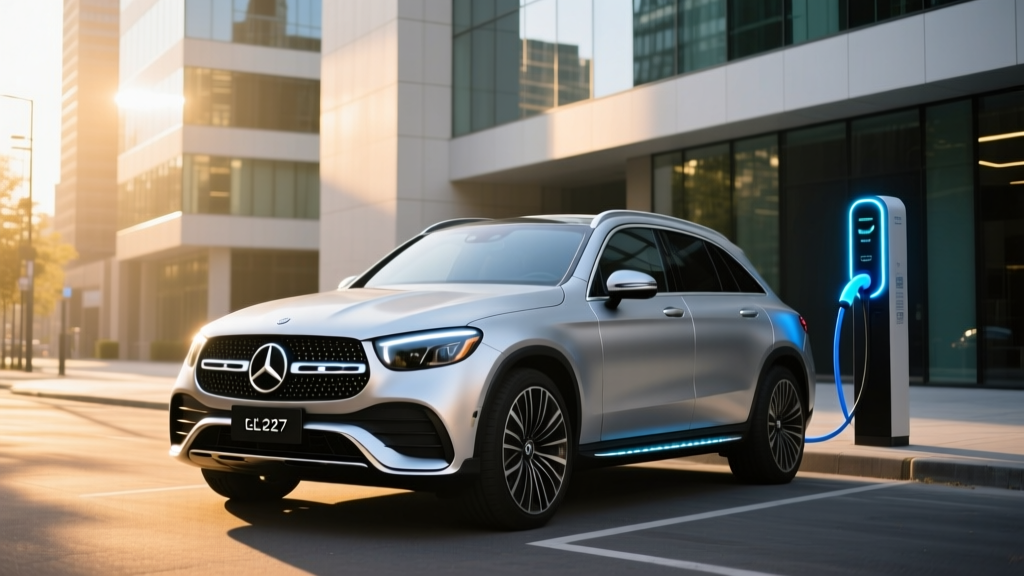
The Bottom Line on the 2027 Mercedes GLC EV
The 2027 Mercedes-Benz GLC EV is not yet on sale as of early 2026. Mercedes has confirmed that the next-generation GLC will ride on the brand's new MB.EA (Mercedes-Benz Electric Architecture) dedicated EV platform, replacing the current EQC/GLC lineup with a single, properly electric compact luxury SUV. Based on Mercedes' published platform targets and industry reporting, expect roughly 300–340 miles of EPA range, an 800-volt architecture enabling ~250 kW peak DC fast charging, and a starting MSRP likely in the $58,000–$65,000 range before incentives. Production is anticipated to begin in late 2026 or early 2027, with U.S. deliveries following. All figures below are preliminary estimates based on Mercedes' official platform disclosures and should be treated as projections until the production vehicle is unveiled.
Why the 2027 GLC EV Matters in the Luxury Compact SUV Segment
The current Mercedes EQC was never sold in the United States, and the gas-powered GLC remains one of the brand's highest-volume models globally. The 2027 GLC EV represents Mercedes' attempt to consolidate these into a single, globally competitive electric compact luxury SUV built on a dedicated skateboard platform rather than a modified ICE chassis. This is a significant shift: the MB.EA architecture promises a flat battery floor, optimized weight distribution, and the kind of interior packaging that retrofitted EVs like the current EQB (based on the GLB) simply cannot deliver.
The competitive set is formidable. The BMW iX3 (next-generation, also expected on the Neue Klasse platform), the Audi Q6 e-tron (already on sale), the Tesla Model Y, and the Genesis GV70 Electrified all compete for the same buyer. Mercedes is betting that its combination of brand cachet, interior refinement, and the MBUX Superscreen tech stack will justify a premium over the Model Y while undercutting the larger EQE SUV on price.
Projected Range, Battery, and Powertrain Specs
Mercedes has not released final specifications for the 2027 GLC EV, but the MB.EA platform has been detailed in technical briefings. Here is what we can reasonably project based on those disclosures and the platform's first application in the upcoming electric CLA:
| Specification | Projected Figure | Notes |
|---|---|---|
| Battery Capacity (usable) | ~85–95 kWh | NMC chemistry expected; LFP possible for base trim |
| EPA Range (est.) | 300–340 miles | Mercedes targets >600 km WLTP; EPA typically 15–20% lower |
| Drivetrain | RWD standard / AWD optional | Dual-motor 4MATIC variant expected |
| Power Output | 270–400 hp | Depending on single vs. dual motor |
| 0–60 mph (est.) | 5.0–6.5 seconds | AWD performance variant potentially quicker |
| Platform Voltage | 800V nominal | Enables faster DC charging than 400V rivals |
| Peak DC Fast Charge Rate | ~250 kW (est.) | 10–80% in approximately 20–25 minutes |
| Level 2 AC Charging | 11–22 kW onboard charger | 22 kW requires three-phase; 11 kW standard on U.S. single-phase |
| Charging Port (U.S.) | NACS (expected) | Mercedes has committed to NACS for North America |
Real-World Range Reality Check
EPA estimate: 300–340 miles (projected). In real-world highway driving at 70–75 mph, expect to use roughly 300–340 Wh/mile in a compact luxury SUV of this weight class, yielding approximately 250–290 miles of practical range in moderate temperatures. In cold weather (below 30°F), lithium-ion batteries lose efficiency and cabin heating demands increase — plan for a 20–30% range reduction, or roughly 200–240 miles. Mercedes' available heat pump (standard on most MB.EA models) should mitigate some of this loss, but physics is physics.
Charging Speed: What 800 Volts Actually Gets You
The MB.EA platform's 800-volt architecture is one of the 2027 GLC EV's most consequential technical advantages. Here's why it matters in practical terms:
Most current EVs, including the Tesla Model Y and many legacy-brand EVs, operate on 400-volt architectures. Doubling the voltage allows the same power (kW) to be delivered at half the current, which reduces heat generation in the battery and cables. The result: the battery can accept peak charge rates longer before thermal management forces a taper.
At a 350 kW-capable DC fast charger (such as Electrify America's latest stations or Tesla Superchargers with NACS adapters), the GLC EV should sustain charge rates above 200 kW for a meaningful portion of the 10–80% session. Compare this to a 400V vehicle that may peak at 150–170 kW but taper aggressively after 50% State of Charge. The real-world difference is roughly 5–10 fewer minutes at the charger on a road trip — significant when you're doing it three times on a 900-mile drive.
Home charging on a Level 2 (240V) circuit at 48 amps (11.5 kW) will replenish the battery from empty to full in approximately 8–9 hours, which is ideal for overnight charging. If your home electrical panel supports a 60-amp dedicated circuit, this is straightforward. Older homes with 100-amp service panels may require a panel upgrade — budget $1,500–$3,000 for that work, on top of $500–$1,200 for the charger unit and $800–$2,000 for electrician labor and permitting, according to U.S. Department of Energy guidance.
Pricing, Tax Credits, and the Ownership Cost Picture
Mercedes has not announced official MSRP figures for the 2027 GLC EV. However, we can triangulate based on current positioning:
- The gas-powered 2026 GLC 300 starts at approximately $48,250.
- The 2026 EQE SUV (the next step up in Mercedes' EV lineup) starts at approximately $77,900.
- The Audi Q6 e-tron, a direct competitor, starts at approximately $63,800.
A reasonable estimate places the 2027 GLC EV base MSRP between $58,000 and $65,000, with a fully loaded 4MATIC variant potentially reaching $72,000–$78,000. Mercedes has historically priced its EVs at a premium over equivalent ICE models, but competitive pressure from Tesla, Hyundai/Genesis, and Chinese brands in global markets is compressing that gap.
Federal Tax Credit Eligibility (§30D)
Under current IRS §30D rules, the GLC EV's tax credit eligibility is uncertain and will depend on several factors at the time of purchase:
- MSRP cap: SUVs must have an MSRP at or below $80,000. The base GLC EV should clear this, but loaded trims may exceed it.
- Buyer income cap: Modified adjusted gross income must not exceed $150,000 (single), $225,000 (head of household), or $300,000 (joint).
- Battery sourcing requirements: Critical minerals and battery components must meet escalating percentages sourced from the U.S. or free-trade-agreement countries. Mercedes sources cells from CATL (China) and Farasis Energy, which complicates compliance. The 2027 model year may or may not meet the thresholds depending on Mercedes' supply chain progress.
- Point-of-sale transfer: If eligible, the credit can be applied at the dealership as an immediate price reduction rather than a tax-time claim.
Do not assume the full $7,500 credit will apply. Consult a tax professional and check the fueleconomy.gov tax credit database once the vehicle is officially listed.
| Category | 2027 GLC EV (est.) | 2026 GLC 300 (gas) |
|---|---|---|
| Purchase Price (base MSRP) | $61,000 (est.) | $48,250 |
| Federal Tax Credit | $0–$7,500 (uncertain) | $0 |
| Fuel/Energy (5 yrs, 60,000 mi) | $4,200–$5,400 | $9,000–$10,800 |
| Maintenance (5 yrs) | $1,500–$2,500 | $3,500–$5,000 |
| Insurance (5 yrs, est.) | $12,000–$15,000 | $10,000–$13,000 |
| Estimated Depreciation | $22,000–$28,000 | $18,000–$22,000 |
| 5-Year Total (approx.) | $93,000–$110,000 | $88,000–$99,000 |
The EV's lower fuel and maintenance costs partially offset its higher purchase price, but the total-cost gap narrows significantly only if the buyer qualifies for the federal tax credit and has access to affordable home charging. Public DC fast charging at $0.40–$0.60/kWh can push energy costs close to gasoline equivalents on a per-mile basis.
EV vs. Gas: What the 2027 GLC EV Buyer Is Really Choosing
| Factor | 2027 GLC EV (Projected) | 2026 GLC 300 (Gas) |
|---|---|---|
| Powertrain | Battery electric, 800V | 2.0L turbo I4 + 48V mild hybrid |
| EPA Range / Fuel Economy | ~300–340 mi range | ~26 MPG combined |
| Refueling Time | 20–25 min (10–80% DC fast) | ~5 min (full tank) |
| Home "Refueling" | Overnight, ~8–9 hrs (Level 2) | N/A — must visit gas station |
| Energy Cost per Mile | $0.07–$0.09 (home) / $0.12–$0.18 (public DC) | $0.15–$0.18 (at $3.50/gal) |
| Maintenance Needs | No oil changes, fewer brake replacements (regen) | Oil, filters, spark plugs, more brake wear |
| Cold-Weather Impact | 20–30% range loss; preconditioning helps | Minimal range impact; cabin heat from engine waste heat |
| Driving Feel | Instant torque, quiet, one-pedal capable | Familiar turbo lag, 9-speed shifts, engine note |
For buyers with reliable home charging and predominantly urban/suburban commutes, the GLC EV offers a meaningfully better daily experience: silent departures, a full "tank" every morning, and fewer service visits. For buyers who regularly drive 400+ miles in a single day, frequently tow, live in apartments without charging access, or reside in regions with sparse DC fast-charging infrastructure, the gas GLC 300 remains a pragmatic choice with no range planning required.
First-Time EV Buyer Considerations
If the 2027 GLC EV would be your first electric vehicle, here are the practical realities that spec sheets don't emphasize:
Home charging is non-negotiable for most owners. Over 80% of EV charging happens at home. If you live in a single-family home with a garage or driveway, a Level 2 (240V, 48-amp) wall connector is the single best investment you can make — expect $1,500–$3,500 all-in for equipment, electrician labor, and permitting. If you're in a condo or apartment without dedicated parking and charging, public charging dependence will add friction and cost to ownership.
kW vs. kWh — know the difference. Kilowatt-hours (kWh) measure battery capacity — think of it as your "tank size." Kilowatts (kW) measure power flow — think of it as your "pump speed." A 90 kWh battery charged at 11 kW (Level 2) takes about 8 hours; at 250 kW (DC fast), the same battery gains 80% in roughly 20 minutes.
Charging curves taper above 80%. The "250 kW peak" figure applies only at low State of Charge. Above 80% SoC, charge rates drop sharply to protect battery longevity. On road trips, plan your stops around 10–80% increments rather than trying to charge to 100% — the last 20% can take as long as the first 60%.
Insurance is typically higher for EVs. Repair costs after collisions tend to be higher due to battery pack proximity and specialized labor requirements. Budget 15–25% more for insurance compared to the gas GLC 300, though this varies significantly by insurer, state, and driving record.
| Myth | Fact |
|---|---|
| "EV batteries need replacing every few years." | Mercedes warranties its HV batteries for 8 years/100,000 miles against degradation below 70% capacity. Real-world data from similar platforms shows 10–15% degradation over 150,000+ miles. |
| "The $7,500 tax credit applies to everyone." | Income caps, MSRP caps, and battery-sourcing rules all apply. Many luxury EV buyers exceed income limits or the vehicle fails sourcing requirements. Verify on irs.gov before assuming. |
| "300 miles of range means I can drive 300 miles." | EPA range assumes mixed driving at moderate speeds and temperatures. Sustained 75-mph highway driving in winter may yield 200–240 real miles. Plan conservatively. |
| "Public charging is always unreliable." | Network reliability varies. Tesla Superchargers (now open to NACS-equipped non-Teslas) and Electrify America's newest stations have uptime rates above 95%. Older ChargePoint and EVgo stations are more inconsistent. Use PlugShare or A Better Routeplanner to check stations before trips. |
| "I can't take road trips in an EV." | With 300+ miles of range and 20-minute fast-charge stops, a 600-mile trip requires one 20–25-minute stop. It's different from gas, but not impractical — it just requires modest planning. |
Decision Framework: Is the 2027 GLC EV Right for You?
Choose the 2027 Mercedes GLC EV if:
- You have home charging access (garage or driveway with 240V circuit availability).
- Your daily commute is under 100 miles round-trip, and you take road trips fewer than 10 times per year.
- You value a quiet, torque-rich driving experience and cutting-edge interior technology (MBUX Superscreen, augmented-reality HUD).
- You want a compact luxury SUV badge without the full-size EQS/EQE SUV price tag.
- You're willing to wait for the vehicle to arrive and accept early-production risk (first model-year software bugs, limited initial trim availability).
Stick with the Gas GLC 300 or a Plug-In Hybrid Alternative if:
- You live in an apartment or condo without reliable overnight charging access.
- You regularly drive 400+ miles in a day or tow more than 3,500 lbs.
- You live in a region with limited DC fast-charging infrastructure (rural Mountain West, parts of the Deep South).
- Your budget is firmly under $55,000 and you cannot wait for potential price adjustments or incentives.
- You prefer the certainty of a 5-minute fill-up and don't want to plan charging stops on road trips.
When Will the 2027 GLC EV Be Available?
Mercedes-Benz has confirmed that the next-generation GLC will be produced at its Bremen plant in Germany alongside other MB.EA vehicles. Based on the production timeline for the electric CLA (expected late 2025), the GLC EV should follow approximately 12–18 months later. That points to a production start in late 2026 or early 2027, with U.S. deliveries likely arriving in the first half of 2027 as a 2027 model-year vehicle.
Reservations and configurator access typically open 2–3 months before deliveries begin. If you're interested, monitoring Mercedes-Benz USA's press site and signing up for model alerts is the most reliable way to get early access. Dealer allocation for first-year Mercedes EVs tends to be limited, so early expression of interest matters.
Frequently Asked Questions
Will the 2027 GLC EV replace the gas GLC entirely?
No. Mercedes has indicated that the next-generation GLC will be offered in both battery-electric (MB.EA) and internal-combustion variants, at least initially. The gas GLC is expected to continue on a separate updated MRA2 platform for markets and buyers not ready to go fully electric. Over time, the EV variant is expected to become the volume seller in the U.S. and Europe.
What battery chemistry will the GLC EV use?
Mercedes has used NMC (nickel manganese cobalt) chemistry for its higher-range EQ models and LFP (lithium iron phosphate) for base trims in some markets. The GLC EV will likely follow this pattern: NMC for long-range and 4MATIC variants, with a possible LFP option for a lower-priced base trim. LFP offers longer cycle life and lower cost but sacrifices some energy density (and therefore range).
Will the 2027 GLC EV have Tesla Supercharger access?
Yes. Mercedes has committed to the NACS (North American Charging Standard) connector for all new EVs sold in North America. This means the GLC EV will natively plug into Tesla Superchargers without an adapter, dramatically expanding the available fast-charging network. Mercedes is also a co-founder of the IONNA charging network (with BMW, GM, Hyundai, Kia, and others), which is building high-power charging corridors across the U.S.
How does the GLC EV compare to the Tesla Model Y?
The Model Y will likely remain $15,000–$20,000 cheaper than the GLC EV and offers comparable range with access to the most reliable charging network. However, the GLC EV targets a different buyer: one who prioritizes interior material quality, ride refinement, brand prestige, and dealer service experience over value and minimalism. They are different vehicles for different priorities, not direct substitutes.
Should I wait for the 2027 GLC EV or buy an EV now?
If your current vehicle is functional and you're not under time pressure, waiting gives you a vehicle on a dedicated EV platform with 800V charging — a meaningful generational improvement over current retrofited options. If you need a vehicle now, the Audi Q6 e-tron, BMW iX, or Genesis GV70 Electrified are all available and competitive. Waiting also carries risk: first-year production delays, software issues, and uncertain tax credit eligibility are real factors.