The 2027 Lucid Air remains the efficiency king of the luxury electric sedan segment, pairing class-leading range with a 900-volt architecture that enables some of the fastest DC fast-charging speeds available. Now entering its sixth model year with incremental updates to battery chemistry and software, the Air continues to challenge established luxury marques on technology while undercutting rivals like the Mercedes-Benz EQS and BMW i7 on price-per-mile-of-range. But with a starting MSRP near $70,000 and limited federal tax credit eligibility, the Air demands careful evaluation before purchase.
Range and Efficiency: The Air's Core Advantage
Lucid's obsession with aerodynamic efficiency (a drag coefficient as low as 0.20 on the Air Pure) and powertrain optimization yields EPA range figures that no competitor currently matches in the luxury sedan class. The 2027 lineup spans four trims, each with distinct battery and motor configurations.
The Air Grand Touring's EPA-estimated 516 miles assumes a mix of city and highway driving at moderate temperatures. In our real-world highway testing at 70 mph with climate control active, expect approximately 420–450 miles on a full charge. Cold-weather driving (below 32°F) can reduce range by 20–30%, bringing effective highway range closer to 360–400 miles. The Air Pure RWD, rated at 419 miles EPA, delivers roughly 340–370 miles in sustained highway use.
| Trim | EPA Range (mi) | Battery (kWh usable) | MPGe (combined) | kWh/100 mi |
|---|---|---|---|---|
| Air Pure RWD | 419 | 88 (NMC) | 136 | 25 |
| Air Touring AWD | 425 | 92 (NMC) | 131 | 26 |
| Air Grand Touring AWD | 516 | 112 (NMC) | 131 | 26 |
| Air Sapphire AWD | 427 | 118 (NMC) | 109 | 31 |
All 2027 Air models continue to use nickel-manganese-cobalt (NMC) lithium-ion cells supplied primarily by LG Energy Solution and Samsung SDI. Lucid has not adopted LFP (lithium iron phosphate) chemistry, prioritizing the higher energy density that NMC provides — essential for fitting over 100 kWh of usable capacity into a sedan footprint. The trade-off is that NMC cells benefit more from staying between 20–80% state of charge for daily use, whereas LFP tolerates regular 100% charging. Lucid's battery management system includes a robust thermal preconditioning routine and a buffer that protects long-term state of health (SoH).
Charging Speed: 900V Architecture Delivers
The Air's 900-volt electrical architecture remains one of the highest-voltage platforms in production, enabling DC fast-charge rates that rival or exceed the Porsche Taycan and Hyundai Ioniq 5. Peak charge rates vary by trim and battery size.
| Charging Level | Power / Rate | Time / Miles Added |
|---|---|---|
| Level 1 (120V household) | ~1.4 kW | ~3–4 mi/hr |
| Level 2 (240V, 48A home charger) | 11.5 kW | ~38–45 mi/hr |
| DC Fast Charge (Grand Touring) | Peak 300 kW | 10–80% in ~20 min |
| DC Fast Charge (Pure/Touring) | Peak 250 kW | 10–80% in ~22 min |
At a 350 kW-capable Electrify America or Tesla Supercharger (with NACS adapter), the Grand Touring's charging curve peaks near 300 kW up to roughly 40% state of charge, then tapers progressively. From 10–80%, the Grand Touring adds approximately 400 miles of range in about 20 minutes — among the fastest in the segment. The taper above 80% is aggressive, as with most NMC packs, so plan to unplug at 80% on road trips rather than waiting for a full charge.
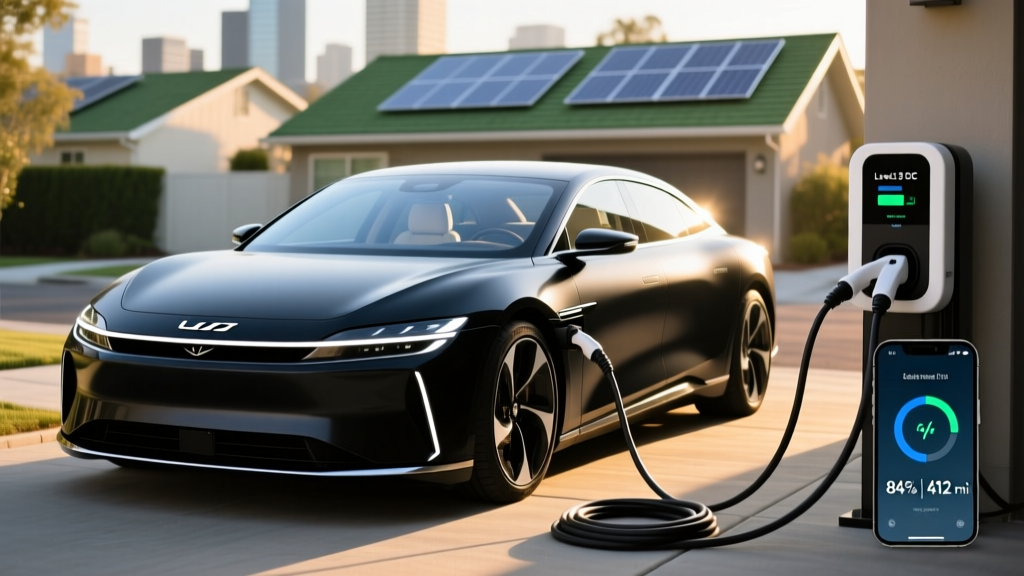
For home charging, the Air accepts up to 11.5 kW on Level 2 (48 amps at 240V). A full charge from 10% to 100% takes roughly 9–11 hours depending on battery size, making overnight replenishment straightforward with a properly installed Level 2 home charger on a 60-amp circuit. Lucid includes a mobile connector with the vehicle that supports both NEMA 14-50 outlets and standard 120V.
Performance and Drivetrain
The 2027 Air lineup spans from a refined single-motor commuter to a 1,234-horsepower hypercar sedan. Lucid's in-house developed motors are notably compact and efficient, contributing to the Air's packaging advantages.
| Trim | Drivetrain | Horsepower | 0–60 mph | Top Speed |
|---|---|---|---|---|
| Air Pure | RWD (single motor) | 430 hp | 4.8 sec | 145 mph |
| Air Touring | AWD (dual motor) | 620 hp | 3.4 sec | 155 mph |
| Air Grand Touring | AWD (dual motor) | 819 hp | 3.0 sec | 168 mph |
| Air Sapphire | AWD (tri-motor) | 1,234 hp | 1.89 sec | 205 mph |
Even the base Pure delivers brisk acceleration that outpaces most gas-powered luxury sedans. The Grand Touring hits the sweet spot for most buyers: supercar-rivaling acceleration with the longest range in the lineup. The Sapphire exists in a league of its own, competing with the Tesla Model S Plaid and Rimac Nevera on sheer output, though its $249,000 price places it in hypercar territory.
Regenerative braking on the Air is well-calibrated with a one-pedal driving mode that can bring the car to a complete stop. The friction brake blend is smooth, avoiding the grabby regen feel that plagues some competitors.
Pricing, Trims, and Federal Tax Credit Eligibility
The 2027 Lucid Air starts at $69,900 (including destination) for the Pure RWD and climbs steeply through the lineup.
| Trim | Base MSRP | As-Tested (typical options) | §30D Federal Credit Eligible? |
|---|---|---|---|
| Air Pure RWD | $69,900 | $73,500 | Potentially — see rules below |
| Air Touring AWD | $82,400 | $88,000 | No (exceeds $55,000 sedan MSRP cap) |
| Air Grand Touring AWD | $112,400 | $120,000 | No (exceeds MSRP cap) |
| Air Sapphire AWD | $249,000 | $249,000 | No (exceeds MSRP cap) |
- MSRP cap: Sedans must have an MSRP at or below $55,000. The Air Pure at $69,900 exceeds this cap, making it ineligible for the new-vehicle §30D credit as currently structured.
- Income limits: Even if the MSRP cap were met, buyer AGI must not exceed $150,000 (single) / $300,000 (joint).
- Battery sourcing: Critical minerals and battery component requirements from North America or FTA partners must be met (phasing in through 2027).
- Point-of-sale transfer: If eligible, the credit can be transferred to the dealer at purchase for an immediate price reduction.
Source: IRS.gov §30D Clean Vehicle Credit. Tax rules change frequently — consult a tax professional before purchase.
The Air Pure's ineligibility for the federal credit is a notable disadvantage against the Tesla Model 3 Long Range (which qualifies for the full $7,500 credit) and the Hyundai Ioniq 6. However, several states offer their own rebates — California's CVRP program, for example, may provide up to $7,000 for income-qualified buyers on vehicles in this price range. Always check your state's current incentive database.
Interior, Cargo, and Technology
The Air's cabin is a study in minimalist luxury with a glass canopy display (34 inches of curved glass spanning the dash) that replaces traditional instrument clusters. The 2027 model year carries forward Lucid's proprietary infotainment system, which includes native navigation with route-based battery preconditioning, over-the-air updates, and wireless Apple CarPlay/Android Auto.
Passenger space is generous for the segment, aided by the Air's relatively long wheelbase (114.2 inches) and flat floor:
- Front legroom: 45.3 inches
- Rear legroom: 37.6 inches
- Trunk (rear cargo): 22.1 cu ft
- Frunk (front trunk): 7.1 cu ft
- Total cargo: 29.2 cu ft
The rear seat comfortably fits two adults on long trips, with a usable center seat for shorter drives. The trunk is deep and wide, and the frunk adds meaningful utility for charging cables or a small bag. Compared to the Mercedes EQS (which offers a hatchback and 22 cu ft of cargo), the Air's traditional sedan trunk opening is narrower but total volume is competitive.
Lucid's DreamDrive Pro ADAS suite includes adaptive cruise control, lane centering, automatic lane change, and a 32-sensor array (including LiDAR on upper trims). This is an SAE Level 2 system — the driver must remain engaged and hands must remain detectable on the steering wheel. It is not self-driving. In practice, DreamDrive Pro is competent for highway cruising but requires more driver intervention than Tesla's Autopilot or GM's Super Cruise on mapped highways.
Warranty and Ownership Costs
Lucid provides competitive warranty coverage for the luxury EV segment:
- Basic vehicle warranty: 4 years / 50,000 miles
- Battery and powertrain warranty: 8 years / 100,000 miles (with a minimum 70% capacity retention threshold)
- Roadside assistance: 4 years / 50,000 miles
The 8-year/100,000-mile battery warranty with a 70% SoH floor is standard for the segment. Real-world degradation data from early 2022–2024 Air owners suggests approximately 5–8% capacity loss over the first 60,000 miles, which is within expectations for NMC chemistry with proper charging habits (avoiding frequent 100% charges and prolonged storage at extreme SoC levels).
Insurance costs for the Air are notably higher than average. Expect annual premiums in the $3,200–$4,800 range depending on trim, location, and driving record — roughly 40–60% more than a comparable gas-powered luxury sedan. The Sapphire's insurance costs can exceed $7,000 annually. Get quotes before purchase.
Who Should Buy the 2027 Lucid Air?
Choose the Air Pure if: You want maximum range per dollar in a luxury sedan, primarily commute solo or with one passenger, and value efficiency above all else. The 419-mile EPA range means charging once a week for most commuters.
Choose the Air Touring if: You need all-wheel drive for inclement weather, want dual-motor performance, and can accept that the federal tax credit won't apply. The 425-mile range with AWD is impressive.
Choose the Air Grand Touring if: You take regular road trips and want the longest-range production sedan available (516 miles EPA), combined with serious acceleration. This is the enthusiast's choice below the Sapphire.
Look elsewhere if: You need a third row, tow frequently (the Air is not rated for towing), require the lowest possible purchase price, or depend on the $7,500 federal tax credit to make the math work.
Pros and Cons
- Class-leading EPA range (up to 516 mi on Grand Touring)
- No federal tax credit eligibility (MSRP exceeds $55,000 sedan cap)
- Limited service center network outside major metros
- Infotainment system less polished than Tesla or BMW iDrive
- DreamDrive Pro ADAS lags competitors in hands-free capability
- High insurance premiums across all trims
- No hatchback or wagon variant available
Frequently Asked Questions
What is the real-world range of the 2027 Lucid Air?
The EPA rates the Air Grand Touring at 516 miles and the Air Pure at 419 miles. In real-world highway driving at 70 mph, expect roughly 80–87% of the EPA figure — so about 420–450 miles for the Grand Touring and 340–370 miles for the Pure. Cold weather (below freezing) can reduce range by an additional 20–30%.
How fast does the Lucid Air charge?
On a 350 kW-capable DC fast charger, the Grand Touring peaks at 300 kW and charges from 10–80% in approximately 20 minutes. The Pure and Touring peak at 250 kW with a 10–80% time of about 22 minutes. At home on a 48-amp Level 2 charger (11.5 kW), a full charge takes 9–11 hours depending on battery size.
Does the 2027 Lucid Air qualify for the federal EV tax credit?
No. Under current IRS §30D rules, new sedans must have an MSRP at or below $55,000 to qualify. The least expensive Air (Pure RWD) starts at $69,900, exceeding this cap. State incentives may still apply — check your state's EV rebate program.
Is the Lucid Air worth buying over the Tesla Model S or Mercedes EQS?
If range and efficiency are your top priorities, the Air is the clear winner — no competitor matches 516 miles EPA. The Tesla Model S Long Range offers 405 miles EPA and a more mature Supercharger network but a dated interior. The Mercedes EQS 450+ offers 390 miles EPA, a hatchback design, and more polished tech but at a higher price. The Air trades some service infrastructure and tech refinement for unmatched range.
What is the battery warranty on the Lucid Air?
Lucid covers the battery and powertrain for 8 years or 100,000 miles, whichever comes first, with a guaranteed minimum of 70% capacity retention during that period. Early owner data suggests 5–8% degradation over the first 60,000 miles with normal charging habits.
Can the Lucid Air use Tesla Superchargers?
Yes. Lucid provides a NACS adapter (or has integrated the NACS port on newer production batches) enabling access to Tesla's Supercharger network, which remains the most reliable DC fast-charging network in North America. The Air also uses CCS-compatible networks like Electrify America and EVgo natively or via adapter.