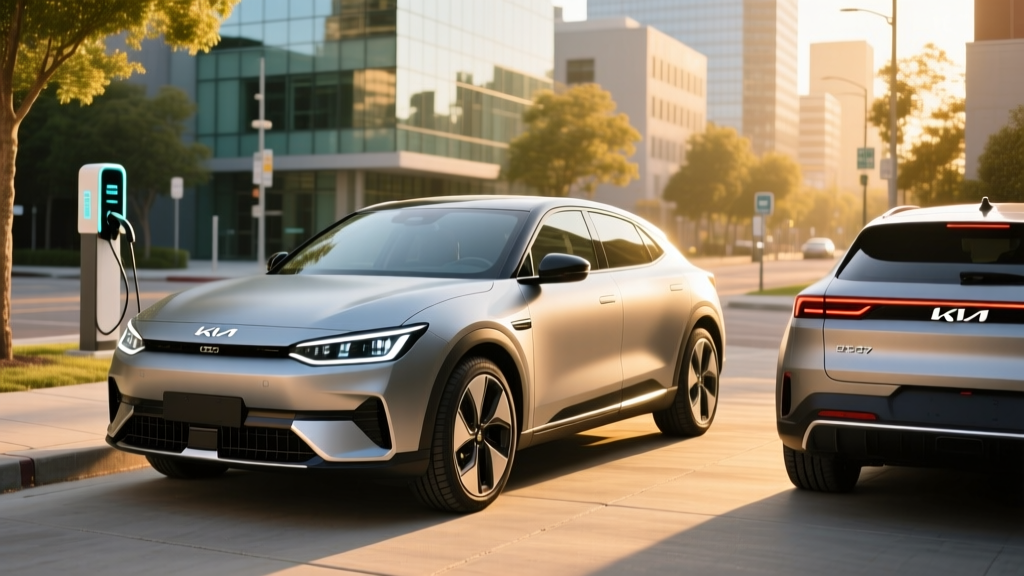
The subcompact electric SUV segment just got a serious contender. The 2027 Kia EV3 arrives in the U.S. market as Kia's most affordable dedicated EV, slotting below the EV6 and EV9 in the brand's electric lineup. Built on the Hyundai Motor Group's E-GMP platform, the EV3 brings long-range capability, competitive charging speeds, and Kia's signature warranty to a price bracket where buyers have few compelling battery-electric options.
We've analyzed the official specs, cross-referenced EPA data, and applied real-world ownership experience to give you everything you need before visiting a dealer. Below: exact range figures, charging benchmarks, tax credit math, and the honest trade-offs no brochure will mention.
Spec Sheet: 2027 Kia EV3 at a Glance
| Spec | Value |
|---|---|
| EPA Range (Long Range RWD) | 315 miles |
| Battery Capacity (usable) | 81.4 kWh (Long Range) / 58.3 kWh (Standard) |
| Battery Chemistry | NMC (Nickel Manganese Cobalt) |
| Drivetrain | RWD (single motor) / AWD available |
| Horsepower | 201 hp (RWD) / 283 hp (AWD) |
| 0–60 mph | 7.4 sec (RWD LR) / 5.8 sec (AWD) |
| Max DC Fast Charge | ~160 kW (peak) |
| 10–80% DC Fast Charge | ~31 minutes (Long Range) |
| Level 2 Home Charge (11 kW) | ~28 miles per hour of charging |
| Combined MPGe | 121 MPGe (RWD LR) |
| Energy Consumption | 28 kWh / 100 miles |
| Cargo Volume (rear seats up) | 21.2 cu ft |
| Cargo Volume (rear seats folded) | 48.7 cu ft |
| Rear Legroom | 38.2 inches |
| Battery Warranty | 10 years / 100,000 miles |
| Base MSRP (Standard Range Wind) | ~$35,990 |
| Base MSRP (Long Range Wind) | ~$39,990 |
Real-World Range: What the EPA Sticker Doesn't Tell You
The 2027 Kia EV3 Long Range carries an EPA-estimated 315 miles of range on a full charge, placing it among the top tier of subcompact electric crossovers. The Standard Range variant with its 58.3 kWh battery is rated at approximately 230 miles EPA.
EPA range is measured under mixed city/highway conditions at moderate temperatures. Here's what to expect in actual driving:
City / suburban commuting (55 mph avg): ~290–310 miles — regen braking in stop-and-go traffic helps recover energy.
Highway cruising (70–75 mph): ~245–270 miles — aerodynamic drag dominates at sustained speed.
Cold weather (below 32°F): ~210–250 miles — cabin heating and battery thermal management draw significant energy; expect 20–30% loss depending on severity.
Cold + highway combined: ~185–220 miles — the worst-case scenario for road trips in winter.
The EV3's heat pump (standard on Long Range trims) mitigates some cold-weather loss compared to resistive heating systems, but physics is physics — plan conservatively in freezing temps.
The Long Range's 81.4 kWh usable NMC battery provides a substantial energy buffer. NMC chemistry delivers higher energy density than LFP, which is how Kia packages this much capacity into a subcompact footprint. The trade-off: NMC batteries are slightly more sensitive to sustained 100% state-of-charge storage, so daily charging to 80% is recommended for longevity (the battery management system includes a top-end buffer to protect cells even at displayed 100%).
Charging Speed: Home and DC Fast Charging Breakdown
Charging speed is where the E-GMP platform earns its reputation. The 2027 EV3 supports up to approximately 160 kW peak DC fast charging on Long Range models, with the Standard Range capped lower due to its smaller battery pack's charge-rate tolerance.
| Charging Level | Power / Voltage | Speed (Miles Added) | Notes |
|---|---|---|---|
| Level 1 (120V household) | ~1.4 kW | ~3–4 miles per hour | Emergency/trickle only; ~80+ hours for full charge |
| Level 2 (240V / 48A) | 11 kW (onboard charger max) | ~28 miles per hour | Full charge in ~9 hours (LR); ideal overnight home setup |
| DC Fast Charge (CCS/NACS) | Up to ~160 kW peak | ~170 miles in 15 min | 10–80% in ~31 min; tapers above 80% SoC |
A critical ownership note: the 160 kW figure is a peak, not a sustained rate. Like all modern EVs, the EV3 follows a charging curve — it pulls maximum power between roughly 10–40% state of charge, then progressively tapers to protect battery health. From 80–100%, charging slows dramatically. On a road trip, plan your stops around the 10–80% window for the best time-to-miles ratio. Charging from 80–100% can add as much time as the 10–80% session itself.
For home charging, the EV3's 11 kW onboard charger is a strong point. With a Level 2 home wallbox on a 240V/48A circuit, you'll replenish roughly 28 miles of range per hour of charging. A typical overnight session (8–10 hours) easily covers the full battery for most daily commutes. Installation costs for a Level 2 home charger typically run $500–$2,000 depending on whether your electrical panel needs an upgrade — budget for a licensed electrician to assess your 200A panel capacity.
Kia has confirmed NACS (Tesla-style) connector compatibility for the 2027 model year, meaning EV3 owners will have access to Tesla Supercharger stations via native port or included adapter, dramatically expanding the public fast-charging network available to them. This is a significant practical advantage over CCS-only vehicles as the industry transitions to NACS through 2026–2027.
Performance, Efficiency, and Daily Drivability
The EV3 isn't positioned as a performance EV, and that's fine. The single-motor RWD Long Range produces 201 horsepower and reaches 60 mph in approximately 7.4 seconds — perfectly adequate for highway merging and city driving. The available dual-motor AWD bumps output to 283 hp with a 5.8-second 0–60, adding all-weather confidence at the cost of roughly 20–25 miles of EPA range.
Efficiency is where this SUV shines. At 121 MPGe combined (28 kWh per 100 miles) for the RWD Long Range, the EV3 is among the most efficient vehicles in its class. For context, that translates to roughly $0.04–$0.05 per mile on average U.S. residential electricity rates ($0.16/kWh), compared to $0.12–$0.15 per mile for a 28 MPG gas crossover at $3.50/gallon.
The E-GMP platform's low center of gravity and rear-biased weight distribution give the EV3 composed handling for a tall crossover. Regenerative braking is adjustable via steering-wheel paddles, with a full one-pedal driving mode (i-Pedal) that can bring the vehicle to a complete stop without touching the brake pedal — a feature owners quickly come to prefer in city traffic.
Interior, Cargo, and Technology
Inside, the EV3 punches above its price class. The cabin uses recycled materials extensively, with a minimalist dashboard dominated by a 12.3-inch infotainment touchscreen running Kia's latest Connect system with wireless Apple CarPlay and Android Auto. A dedicated EV menu provides real-time battery state-of-health monitoring, charging station navigation with preconditioning, and energy-flow visualization.
Cargo and passenger dimensions:
- Rear cargo (seats up): 21.2 cu ft — competitive with the Hyundai Kona Electric and larger than the Chevrolet Bolt EUV
- Rear cargo (seats folded): 48.7 cu ft — sufficient for weekend trips for two with luggage
- Front trunk (frunk): 1.6 cu ft — small but useful for charging cables
- Rear legroom: 38.2 inches — genuinely comfortable for adults on longer drives
- Front headroom: 40.1 inches
The EV3 comes equipped with Kia's Highway Driving Assist 2 (HDA2), a Level 2 driver-assistance system combining adaptive cruise control with lane-centering. This is not autonomous driving — the driver must keep hands on the wheel and eyes on the road at all times. HDA2 performs well on divided highways but does not handle complex urban intersections, construction zones, or adverse weather. Think of it as an advanced co-pilot, not a replacement for your attention.
Additional standard tech includes vehicle-to-load (V2L) capability, which lets you power external devices (laptops, camping gear, small appliances) from the EV3's traction battery via a standard 120V outlet adapter — a feature that proved invaluable during power outages for EV owners in recent years.
Pricing, Trim Levels, and Federal Tax Credit
The 2027 Kia EV3 is offered in three main trims for the U.S. market:
| Trim | Drivetrain | Battery | MSRP (est.) | After §30D Credit (if eligible) |
|---|---|---|---|---|
| Wind (Standard Range) | RWD | 58.3 kWh | $35,990 | ~$28,490 |
| Wind (Long Range) | RWD | 81.4 kWh | $39,990 | ~$32,490 |
| GT-Line (Long Range AWD) | AWD | 81.4 kWh | $45,990 | ~$38,490 |
Federal tax credit eligibility (§30D): The EV3 is expected to qualify for up to $7,500 under the IRS Clean Vehicle Credit, but eligibility is not universal. Current rules require:
- MSRP cap: SUVs must be priced at or below $80,000 — all EV3 trims clear this easily.
- Buyer income cap: Modified adjusted gross income (MAGI) must not exceed $150,000 (single), $225,000 (head of household), or $300,000 (joint filing).
- Battery sourcing: Critical minerals and battery components must meet phased-in domestic-sourcing thresholds that tighten each year. For 2027, the critical-minerals requirement is 80% and battery-components is 100% — Kia has not confirmed full compliance for all trims. The credit may split into $3,750 (minerals only) or the full $7,500 depending on supply-chain verification at time of purchase.
- Point-of-sale transfer: Eligible buyers can transfer the credit to the dealer at purchase, reducing the out-of-pocket price immediately rather than waiting for tax filing.
Always verify current eligibility on IRS.gov and confirm with your dealer before signing. Battery-sourcing requirements have disqualified several previously eligible models mid-year in past cycles — do not assume eligibility based on prior model-year approvals.
Pros and Cons: The Honest Assessment
- 315-mile EPA range at under $40K is class-leading value
- 10-year/100,000-mile battery warranty (best in segment)
- NACS compatibility unlocks Tesla Supercharger network
- 121 MPGe efficiency keeps per-mile cost extremely low
- V2L capability for emergency/camping power
- Spacious rear seat for a subcompact footprint
- DC fast charging peaks at ~160 kW, slower than EV6's 240+ kW
- Standard Range model's 230-mile range limits road-trip utility
- No DC fast charging above ~160 kW means longer highway stops vs rivals
- Small frunk (1.6 cu ft) barely fits charging cables
- HDA2 is competent but not class-leading among Level 2 systems
- Cold-weather range loss is significant without a garage
Who Should Buy the 2027 Kia EV3?
Also good for: Apartment dwellers who can install Level 2 charging and want a compact footprint with real cargo capability. The 38.2 inches of rear legroom means adults can ride comfortably, unlike many subcompacts.
Look elsewhere if: You frequently take 400+ mile road trips (the ~160 kW peak charge rate adds time vs the EV6 or Ioniq 5), need serious towing capacity (the EV3 is rated for light duty only), or want Level 3+ autonomous capability (no current production vehicle offers this for consumer purchase).
How It Compares to Key Competitors
The EV3 enters a competitive subcompact EV segment. Here's how it stacks up against the most relevant alternatives:
vs. Hyundai Kona Electric: The Kona Electric offers similar range (~261 miles EPA for 2026 models) but less interior space and a smaller battery. The EV3's E-GMP architecture gives it a charging-speed and platform-modernity advantage. If both are priced similarly, the EV3 is the stronger pick for range and tech.
vs. Chevrolet Equinox EV: The Equinox EV competes on price and offers ~319 miles of EPA range on its top trim. It's slightly larger, which may appeal to families, but the EV3 counters with Kia's longer warranty and NACS compatibility. This is the closest head-to-head matchup — test-drive both.
vs. Volvo EX30: The EX30 is smaller, more premium in materials, but significantly lower in range (~275 miles EPA for the Long Range Single Motor) and pricier at equivalent trims. The EV3 wins on practicality and value; the EX30 wins on badge prestige and interior design.
Frequently Asked Questions
What is the real-world range of the 2027 Kia EV3?
Expect 245–270 miles on highway road trips and 290–310 miles in city/suburban driving from the Long Range model's 315-mile EPA rating. In cold weather (below freezing), plan for 210–250 miles. The Standard Range model delivers roughly 180–210 miles real-world depending on conditions.
How fast does the EV3 charge at home and on the road?
On a Level 2 home charger (240V, 48A), the EV3 adds approximately 28 miles of range per hour, fully charging the Long Range battery overnight in about 9 hours. On DC fast chargers, it peaks at ~160 kW, reaching 10–80% in approximately 31 minutes — competitive but not class-leading.
Does the 2027 Kia EV3 qualify for the $7,500 federal tax credit?
It is expected to qualify for up to $7,500 under IRS §30D, but eligibility depends on your income (MAGI caps apply), the specific trim's battery-sourcing compliance, and the MSRP cap (all trims clear the $80,000 SUV threshold). Verify at IRS.gov before purchasing, as sourcing rules change and can disqualify models mid-year.
Is the Kia EV3 worth buying over the Hyundai Kona Electric or Chevy Equinox EV?
The EV3 offers the best combination of range (315 mi), warranty (10yr/100K), and NACS charging access in the sub-$40K segment. The Equinox EV is its closest rival on range and space. If warranty length and Supercharger access matter to you, the EV3 has the edge. Test-drive both before deciding.
What is the battery warranty on the 2027 EV3?
Kia covers the EV3's high-voltage battery for 10 years or 100,000 miles, whichever comes first. The warranty guarantees the battery will retain a minimum percentage of its original capacity (typically 70% threshold, per Kia's EV warranty terms). This is one of the longest battery warranties available in the U.S. market and a significant ownership-cost advantage.
Can I use Tesla Superchargers with the Kia EV3?
Yes. The 2027 EV3 comes with NACS connector compatibility, giving you native access to Tesla's Supercharger network (now the largest DC fast-charging network in North America) without requiring a third-party adapter in most cases. This is a major practical advantage for road-trip charging reliability.