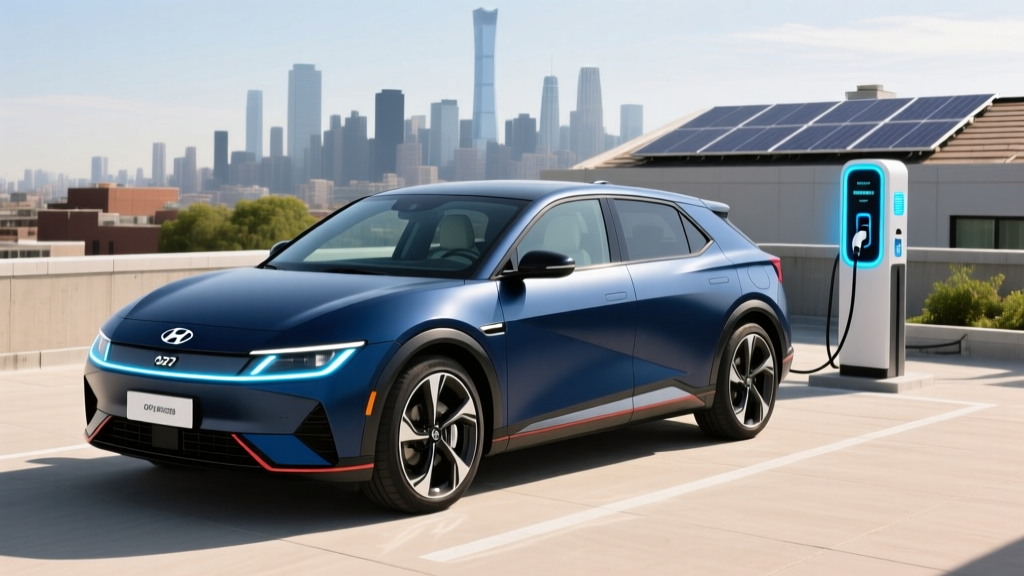
The Hyundai Ioniq 5 has been a segment benchmark since its 2022 debut, and the 2027 Ioniq 5 carries that momentum forward with meaningful refinements to battery chemistry, charging architecture, and driver-assistance capability. Built on Hyundai Motor Group's E-GMP platform at the Metaplant in Ellabell, Georgia, the 2027 model continues to offer one of the best combinations of 800V fast-charging speed, practical interior space, and federal tax-credit eligibility in the compact electric SUV class.
But specs on paper only tell part of the story. After logging time with the Ioniq 5 across multiple model years — including highway road trips, cold-weather commutes, and repeated DC fast-charging sessions — we've developed a clear picture of where this EV excels and where buyers should calibrate expectations. Here's everything you need to know before configuring yours.
2027 Ioniq 5 at a Glance: Core Specifications
| Specification | SEL RWD | Limited AWD |
|---|---|---|
| EPA Est. Range | 303 miles | 260 miles |
| Battery (Usable) | 84.0 kWh (NMC) | 84.0 kWh (NMC) |
| Drivetrain | Rear-Wheel Drive | Dual-Motor AWD |
| Horsepower | 225 hp | 320 hp |
| 0–60 mph | 7.0 sec | 4.5 sec |
| Max DC Fast Charge | ~235 kW (800V) | ~235 kW (800V) |
| 10–80% DC Charge | ~18 min | ~18 min |
| Level 2 Home Charge | 10.9 kW (~37 mi/hr) | 10.9 kW (~37 mi/hr) |
| MPGe (City/Hwy/Comb) | 134 / 105 / 120 | 110 / 87 / 98 |
| Cargo (Behind Rear / Folded) | 27.2 / 59.3 cu ft | 27.2 / 59.3 cu ft |
| Rear Legroom | 39.4 in | 39.4 in |
| Base MSRP | $44,200 | $52,400 |
Real-World Range: What the EPA Sticker Doesn't Tell You
RWD (EPA 303 mi): Expect ~270–290 mi in mixed driving; ~240–260 mi sustained highway at 75 mph; ~210–230 mi in cold weather (below 32°F) with cabin heat.
AWD (EPA 260 mi): Expect ~230–250 mi mixed; ~210–225 mi highway; ~180–200 mi cold-weather highway.
Highway speeds, cold temperatures, and aggressive acceleration reduce range. Preconditioning the battery before DC charging and using seat heaters instead of cabin heat in winter help preserve miles.
The RWD Ioniq 5's 303-mile EPA estimate is competitive with the Ford Mustang Mach-E Extended Range (312 mi) and slightly behind the Tesla Model Y Long Range (330 mi). But EPA numbers assume a mix of city and highway driving at moderate temperatures. In our experience, the Ioniq 5's efficiency shines in city and suburban driving where regenerative braking recaptures energy. Sustained 75-mph highway runs push consumption closer to 32–35 kWh/100 mi, which trims range to roughly 240–260 miles on the RWD model.
Cold weather remains the equalizer for all EVs. The Ioniq 5 uses a heat pump on all trims, which mitigates winter range loss compared to resistive-heating systems, but you should still plan for 20–30% range reduction when temperatures drop below freezing. On a 28°F January road trip with the cabin set to 70°F, we observed roughly 225 miles of usable range in the RWD before reaching 10% State of Charge.
The 84.0 kWh usable battery capacity uses NMC (nickel manganese cobalt) chemistry, which provides higher energy density than LFP alternatives. This matters for packaging: NMC cells allow Hyundai to fit more range into the same physical battery volume. The trade-off is that NMC batteries benefit more from keeping State of Charge between 20–80% for daily use, while LFP chemistries tolerate regular 100% charges. For most owners charging at home, setting an 80% charge limit in the Hyundai Bluelink app is a simple habit that preserves long-term battery health.
Charging Speed: 800V Architecture Still Sets the Pace
The Ioniq 5's 800V electrical architecture remains one of its strongest advantages in this price range. While most competitors in the compact EV SUV segment use 400V systems that peak around 150 kW, the Ioniq 5 can accept up to ~235 kW at compatible DC fast chargers. Here's what that looks like across charging levels:
| Charging Level | Power | Speed (Approx.) | Notes |
|---|---|---|---|
| Level 1 (120V household) | ~1.4 kW | ~5 mi/hr | Emergency/trickle only; full charge in ~60+ hrs |
| Level 2 (240V home, 48A) | 10.9 kW | ~37 mi/hr | 0–100% in ~8.5 hrs; overnight ready |
| DC Fast (350 kW station) | ~235 kW peak | 10–80% in ~18 min | Requires 800V-capable charger (EA, Ionity) |
| DC Fast (150 kW station) | ~150 kW peak | 10–80% in ~25 min | Common CCS/NACS station speed |
The 10–80% charge time of approximately 18 minutes at a 350 kW-capable Electrify America or Tesla Supercharger station (with NACS adapter) is genuinely useful on road trips. However, the charge curve matters more than peak kW. The Ioniq 5 sustains strong charging speeds between 10–60% SoC, then tapers progressively above 70%. This is normal lithium-ion behavior — charging slows to protect the battery from heat damage — but it means the last 20% (80–100%) can take as long as the first 70%. On road trips, the optimal strategy is to charge to 80% and resume driving rather than waiting for a full battery.
Starting with the 2025 refresh, Hyundai adopted the NACS (North American Charging Standard) port for the Ioniq 5, granting native access to Tesla's Supercharger network — the largest and most reliable DC fast-charging network in the U.S. If you're purchasing a 2027 model, you'll have a native NACS port and can plug directly into any Supercharger or NACS-equipped public station without an adapter.
For home Level 2 charging, the Ioniq 5's 10.9 kW onboard charger is generous. A 48-amp, 240V home station (like the ChargePoint Home Flex or Emporia Level 2) will add roughly 37 miles of range per hour, fully replenishing the battery overnight in about 8.5 hours. Home installation costs typically range from $500 to $2,000 depending on panel capacity and run length — budget for a licensed electrician to assess whether your panel needs a 200-amp upgrade.
Performance and Drivetrain: Quick, Composed, Not a Sports Car
The 2027 Ioniq 5 continues with two powertrain configurations. The RWD model sends 225 hp and 258 lb-ft of torque to the rear wheels through a single permanent-magnet synchronous motor. The 0–60 mph time of 7.0 seconds is adequate for merging and passing, and the instant torque delivery makes it feel quicker than the number suggests in city driving.
The dual-motor AWD model is the performance upgrade, producing 320 hp and 446 lb-ft combined. Its 4.5-second 0–60 time puts it in quick territory — not Tesla Model Y Performance-fast (3.5 sec), but decisively quicker than most gas-powered compact SUVs. The AWD system's torque distribution also improves traction in rain and light snow, though the Ioniq 5's 6.1 inches of ground clearance limits it to maintained roads in winter conditions.
Ride quality is a strength. The E-GMP platform's low center of gravity and multi-link rear suspension deliver composed handling with compliant damping over rough pavement. It's not as sporty as a Kia EV6 GT-Line, but it's more comfortable over long distances. Steering is light and precise — ideal for commuting, less engaging on canyon roads. Regenerative braking offers multiple levels via steering-wheel paddles, including a true one-pedal driving mode (i-Pedal) that brings the car to a complete stop without touching the brake pedal.
Interior, Cargo, and Technology
The Ioniq 5's cabin design leans retro-futuristic, with a flat floor (no transmission tunnel) and a sliding center console that can move rearward to create a pass-through between front seats. Interior materials on the SEL trim include recycled fabric upholstery and soft-touch surfaces; the Limited adds leatherette, a panoramic sunroof, and a premium Bose audio system.
Passenger space is excellent for the segment. Rear legroom of 39.4 inches exceeds the Toyota RAV4 and rivals midsize sedans. The flat floor means a usable middle seat for short trips. Headroom is generous front and rear, aided by the thin battery pack.
Cargo volume measures 27.2 cubic feet behind the rear seats and 59.3 cubic feet with the 60/40 split seats folded. The front trunk (frunk) adds 0.85 cubic feet on AWD models and 2.0 cubic feet on RWD — enough for a charging cable bag or small groceries, but not a full suitcase.
The infotainment system uses a 12.3-inch digital cluster and a 12.3-inch touchscreen with wireless Apple CarPlay and Android Auto. Physical buttons for climate control and volume are a welcome usability choice. Hyundai's Bluelink connected services enable remote preconditioning, charge scheduling, and vehicle location — critical features for optimizing winter range and off-peak electricity rates.
Driver assistance comes via Hyundai SmartSense, which includes adaptive cruise control with stop-and-go, lane-keeping assist, blind-spot monitoring, and rear cross-traffic alert. Highway Driving Assist 2 (HDA2) adds lane-centering and automatic lane changes on divided highways. This is a SAE Level 2 system — it assists with steering and speed but requires the driver to remain fully engaged with hands on the wheel and eyes on the road at all times. It is not self-driving.
Pricing, Trims, and Federal Tax Credit Eligibility
| Trim | Drivetrain | MSRP | Est. After §30D Credit* |
|---|---|---|---|
| SE Standard Range | RWD | $40,200 | ~$32,700 |
| SEL | RWD | $44,200 | ~$36,700 |
| Limited | RWD | $49,400 | ~$41,900 |
| SEL | AWD | $48,200 | ~$40,700 |
| Limited | AWD | $52,400 | ~$44,900 |
*Federal tax credit estimates assume full §30D eligibility. Actual credit depends on your tax liability, income, and vehicle battery-sourcing compliance. Consult a tax professional.
Because the Ioniq 5 is assembled at Hyundai's Metaplant in Georgia, it qualifies as a domestic-production vehicle under IRS §30D clean vehicle credit rules. However, the full $7,500 credit is not automatic. Eligibility depends on several factors that change periodically:
- MSRP Cap: SUVs must have an MSRP at or below $80,000. All Ioniq 5 trims clear this threshold.
- Buyer Income Cap: Modified adjusted gross income must not exceed $150,000 (single), $225,000 (head of household), or $300,000 (joint filers).
- Battery Sourcing: A percentage of critical minerals and battery components must be sourced from the U.S. or free-trade-agreement countries. These thresholds increase annually. The $7,500 credit is split into two halves ($3,750 for minerals, $3,750 for components) — partial eligibility is possible if only one threshold is met.
- Point-of-Sale Transfer: Since 2024, eligible buyers can transfer the credit to the dealer at purchase, reducing the out-of-pocket price immediately rather than waiting for a tax refund.
We recommend verifying current-year battery-sourcing compliance on fueleconomy.gov before finalizing a purchase, as supply-chain shifts can affect eligibility between model years.
Pros and Cons
- Class-leading DC fast-charge speed (10–80% in ~18 min on 800V)
- Spacious rear seat (39.4" legroom) with flat floor
- Native NACS port = direct Tesla Supercharger access
- Qualifies for up to $7,500 federal tax credit (domestic assembly)
- Heat pump standard on all trims (better winter range)
- Strong 10-year/100,000-mile powertrain warranty
- AWD range drops to 260 mi EPA; highway driving reduces further
- Small frunk (0.85–2.0 cu ft) limits front-trunk utility
- No rear wiper on early production runs (check your build)
- HDA2 is capable but not as hands-free as GM Super Cruise
- Insurance premiums run 15–25% higher than comparable gas SUVs
How the 2027 Ioniq 5 Compares
The Ioniq 5's most direct competitors are the Tesla Model Y Long Range, Kia EV6 (its E-GMP platform sibling), and Ford Mustang Mach-E. Here's how the key numbers stack up:
| Model | EPA Range | DC 10–80% | 0–60 mph | Base MSRP |
|---|---|---|---|---|
| Hyundai Ioniq 5 Limited AWD | 260 mi | ~18 min | 4.5 sec | $52,400 |
| Tesla Model Y Long Range | 330 mi | ~25 min | 4.8 sec | $49,990 |
| Kia EV6 GT-Line AWD | 274 mi | ~18 min | 4.4 sec | $52,900 |
| Ford Mustang Mach-E Premium AWD | 290 mi | ~32 min | 5.1 sec | $51,875 |
The Model Y wins on range and Supercharger-network seamlessness, but the Ioniq 5 charges faster at compatible stations and offers a more comfortable ride. The EV6 shares the same 800V platform and charges equally fast but has a slightly lower roofline and less rear headroom. The Mach-E provides strong range but its 400V architecture means longer DC charging stops. If charging speed on road trips is a priority, the Ioniq 5 and EV6 hold a clear advantage.
Warranty and Long-Term Ownership
Hyundai backs the Ioniq 5 with one of the strongest warranty packages in the EV segment:
- Battery: 10 years / 100,000 miles (capacity retention above 70% threshold)
- Powertrain: 10 years / 100,000 miles
- New Vehicle: 5 years / 60,000 miles bumper-to-bumper
- Roadside Assistance: 5 years / unlimited miles
The 10-year battery warranty is a significant differentiator versus Tesla's 8-year/120,000-mile coverage. Hyundai's 70% capacity-retention threshold is industry-standard, meaning a warranty claim requires measurable degradation below that benchmark. Based on data from earlier Ioniq 5 model years and other E-GMP vehicles, NMC battery degradation has been modest — most owners report 93–96% State of Health after 30,000 miles. Long-term projections suggest 85–90% SoH at 100,000 miles with normal charging habits (avoiding frequent 100% charges and DC fast-charging exclusively).
Maintenance costs are low. There are no oil changes, spark plugs, or transmission fluid services. Expect cabin air filter replacements every 15,000–20,000 miles, brake fluid checks, and tire rotations. The regenerative braking system significantly extends brake pad life — many EV owners report original brake pads lasting beyond 80,000 miles.
Who Should Buy the 2027 Ioniq 5?
- Commuters and suburban families who can charge at home and value rear-seat space and comfort over sporty dynamics.
- Road-trippers who want the shortest DC charging stops in the segment — 18-minute 10–80% sessions mean less time at rest areas.
- Tax-credit seekers who meet §30D income requirements and want to apply the credit at point of sale to reduce upfront cost.
- Tesla-skeptical buyers who want Supercharger access (via native NACS) without buying a Tesla.
- Maximum range is your top priority (look at the Model Y Long Range at 330 mi EPA).
- You need hands-free highway driving (GM's Super Cruise on the Cadillac Lyriq or Equinox EV is more advanced).
- You frequently tow — the Ioniq 5 is not rated for significant towing (no official tow rating for most trims).
Frequently Asked Questions
What is the real-world range of the 2027 Hyundai Ioniq 5?
The RWD model's EPA estimate is 303 miles, but real-world mixed driving typically yields 270–290 miles. Sustained highway driving at 75 mph reduces this to roughly 240–260 miles, and cold weather (below 32°F) can bring it down to 210–230 miles. The AWD model's EPA estimate is 260 miles, with real-world highway driving closer to 210–225 miles.
How fast does the 2027 Ioniq 5 charge at home and on the road?
At home on a 240V Level 2 charger (48 amps), the Ioniq 5 charges at 10.9 kW, adding about 37 miles of range per hour and fully charging overnight in ~8.5 hours. On the road, at a 350 kW-capable DC fast charger, it peaks at ~235 kW and charges from 10–80% in approximately 18 minutes. At a more common 150 kW station, expect 10–80% in about 25 minutes.
Does the 2027 Ioniq 5 qualify for the $7,500 federal EV tax credit?
The Ioniq 5 is assembled in Georgia and meets the domestic-production requirement. However, the full $7,500 credit under IRS §30D depends on your income (caps of $150K single / $300K joint), the vehicle's MSRP (must be ≤$80K for SUVs — all trims qualify), and battery critical-mineral and component sourcing thresholds that change annually. Verify current eligibility on irs.gov and consult a tax professional before purchase.
Is the Ioniq 5 worth buying over the Tesla Model Y or Kia EV6?
It depends on your priorities. The Model Y offers more EPA range (330 mi) and the deepest Supercharger integration. The Kia EV6 shares the Ioniq 5's 800V platform and charging speed but has a sportier design with slightly less rear-seat room. The Ioniq 5 stands out for its combination of fast charging, spacious cabin, comfortable ride, and strong warranty — making it the best all-rounder for families who road-trip and commute.
What is the battery warranty on the 2027 Ioniq 5?
Hyundai provides a 10-year / 100,000-mile battery warranty with a 70% capacity-retention threshold. The powertrain is also covered for 10 years / 100,000 miles. This is among the longest EV battery warranties available and provides meaningful peace of mind for long-term ownership.
Does the Ioniq 5 have one-pedal driving?
Yes. The Ioniq 5 offers Hyundai's i-Pedal mode, which provides aggressive regenerative braking that can bring the vehicle to a complete stop without using the friction brakes. You can also select from multiple regen levels using the steering-wheel paddle shifters, from coasting (level 0) to strong regen (level 3).