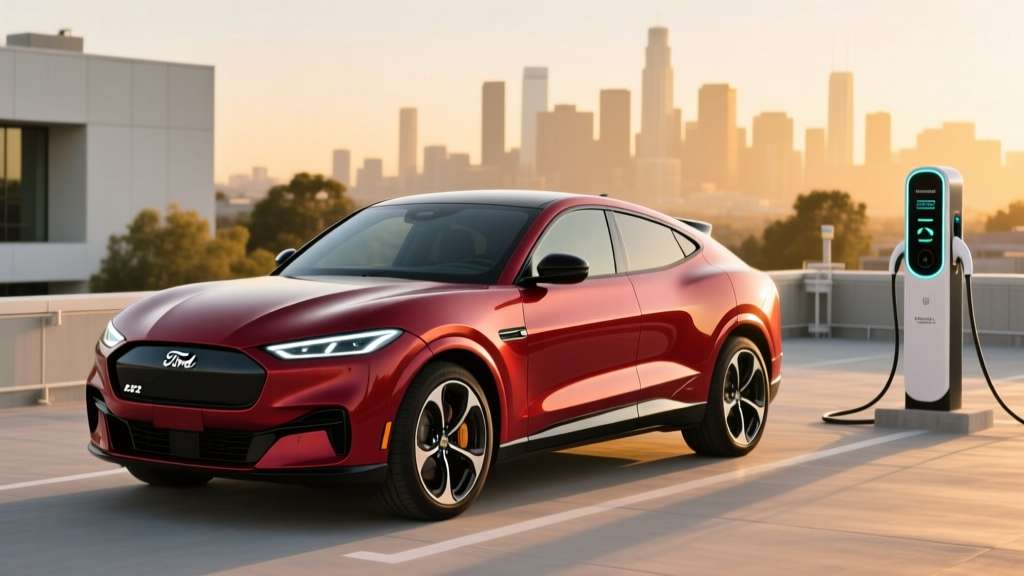
Ford's Mustang Mach-E has been one of the most compelling mainstream electric SUVs since its launch, and the upcoming 2027 Ford Mustang Mach-E is expected to bring meaningful updates to battery chemistry, charging speed, and range. As of mid-2026, Ford has not released final specifications for the 2027 model year, so the figures below represent our best projections based on Ford's confirmed product roadmap, current-gen Mach-E specs, and industry intelligence. All specs are preliminary and subject to change before the vehicle reaches dealerships.
Quick Verdict: What to Expect from the 2027 Mach-E
The 2027 Mustang Mach-E is anticipated to build on the current platform with a refreshed battery pack — potentially moving Ford's standard-range models to LFP (lithium iron phosphate) chemistry while retaining NMC (nickel manganese cobalt) for extended-range trims. Based on Ford's trajectory, expect EPA range figures between 250 and 320 miles depending on trim, DC fast charging that peaks around 150-170 kW on extended-range models, and a starting MSRP in the $42,000–$44,000 range before incentives.
The Mach-E continues to occupy a unique niche: a sporty, driver-focused electric crossover that prioritizes handling dynamics over the maximum-cargo, maximum-comfort formula of competitors like the Hyundai Ioniq 5 or Tesla Model Y. If Ford delivers on projected charging improvements and maintains competitive pricing, the 2027 model should remain a strong pick for driving enthusiasts going electric.
Projected Range, Battery, and Efficiency
Based on the current-generation Mach-E lineup and Ford's battery supply agreements, here are our projected specifications for the 2027 model year:
| Spec | Standard Range (RWD) | Extended Range (RWD) | Extended Range (AWD) | GT (AWD) |
|---|---|---|---|---|
| Battery (usable kWh) | ~70 kWh (LFP est.) | ~91 kWh (NMC) | ~91 kWh (NMC) | ~91 kWh (NMC) |
| EPA Range (est.) | ~250 mi | ~315 mi | ~295 mi | ~270 mi |
| Horsepower | 266 hp | 290 hp | 346 hp | 480 hp |
| 0-60 mph (est.) | ~6.5 sec | ~5.8 sec | ~4.8 sec | ~3.5 sec |
| MPGe (combined, est.) | ~101 MPGe | ~98 MPGe | ~93 MPGe | ~84 MPGe |
| Drivetrain | RWD, single motor | RWD, single motor | AWD, dual motor | AWD, dual motor |
Ford's efficiency figures for the Mach-E have historically lagged slightly behind Hyundai/Kia's E-GMP platform vehicles. The projected 93-101 MPGe range is respectable but not class-leading — the Ioniq 5 achieves up to 114 MPGe combined. Where the Mach-E makes up ground is in driving dynamics and the subjective quality of its steering feel, which remains a segment standout.
LFP vs. NMC: What the Chemistry Shift Means for You
If Ford follows through on moving standard-range trims to LFP chemistry, buyers gain important benefits and accept some trade-offs:
| Factor | LFP (Standard Range) | NMC (Extended Range/GT) |
|---|---|---|
| Energy density | Lower — heavier pack for same kWh | Higher — more range per pound |
| Cycle life | 3,000+ cycles — exceptional longevity | 1,000–2,000 cycles — still well beyond typical ownership |
| 100% charging | Can charge to 100% daily without degradation concerns | Best kept at 80% daily; 100% for road trips only |
| Cold-weather performance | Slightly worse range loss in freezing temps | Marginally better cold-weather retention |
| Cost | Lower — enables more affordable trims | Higher — premium for energy density |
For daily commuters who charge at home every night, LFP is a compelling choice — you'll never worry about the 80% charge limit that NMC owners use to maximize battery longevity. For road-trippers who need maximum range per charge, NMC remains the better fit.
Charging Speed: DC Fast, Level 2, and Home Setup
Charging speed remains one of the Mach-E's relative weaknesses versus competitors. Here's what we project for the 2027 model:
| Charging Level | Standard Range | Extended Range / GT |
|---|---|---|
| DC Fast Charge (peak kW) | ~115 kW | ~150–170 kW |
| 10–80% DC Fast Charge | ~35 min | ~38–42 min |
| Level 2 (240V, kW) | ~10.5 kW | ~10.5 kW |
| Level 2 Miles per Hour | ~32 mi/hr | ~28 mi/hr |
| Connector | CCS (NACS adapter available) | CCS (NACS adapter available) |
A note on kW vs. kWh: kW (kilowatts) measures charging power — how fast energy flows into the battery. kWh (kilowatt-hours) measures battery capacity — how much energy the battery stores. A 150 kW charger delivers energy faster than a 50 kW charger, but both fill the same 91 kWh battery.
The Charging Curve Reality
The peak 150–170 kW figure only applies at low states of charge (typically 10–30% SoC). As the battery fills, the charge rate tapers to protect cell health. Expect the Mach-E Extended Range to sustain roughly 100–120 kW through 50% SoC, then drop to 60–70 kW by 70%, and further to 40 kW or less above 80%. This taper is why the 10–80% time is the meaningful metric — charging from 80–100% can take as long as 10–80%.
Ford has offered a complimentary NACS adapter for Mach-E owners, enabling access to Tesla's Supercharger network — the largest and most reliable DC fast-charging network in the U.S. This is a significant practical advantage, as Tesla Superchargers consistently outperform Electrify America and other CCS networks in uptime and plug-and-charge reliability. For the 2027 model year, Ford may transition to a native NACS port, though this has not been confirmed.
For home charging, a Level 2 wall connector on a 48-amp circuit (requiring a 60-amp breaker) will deliver the full 10.5 kW, replenishing the Extended Range battery from empty in roughly 9 hours. Most owners who plug in nightly will never need DC fast charging for daily use. Expect a professional Level 2 installation to cost $800–$2,000 depending on your electrical panel's capacity and the distance from panel to charger location.
Performance, Handling, and Drivetrain
The Mach-E's driving dynamics have been its strongest differentiator against more comfort-oriented rivals. The 2027 model is expected to carry forward Ford's well-tuned electric powertrain with meaningful performance across the lineup:
- Standard Range RWD: 266 hp, 317 lb-ft torque, 0-60 in ~6.5 seconds. Adequate for commuting and merging, with the lightest curb weight in the lineup for the best efficiency.
- Extended Range RWD: 290 hp, 317 lb-ft, 0-60 in ~5.8 seconds. The sweet spot for buyers who want range and respectable acceleration.
- Extended Range AWD: 346 hp, 428 lb-ft, 0-60 in ~4.8 seconds. Dual-motor all-wheel drive adds confidence in rain and snow, at the cost of roughly 20 miles of range.
- GT: 480 hp, 634 lb-ft (with Performance Upgrade), 0-60 in ~3.5 seconds. Genuinely quick by any measure — this is where the Mustang badge earns its keep.
Ford's MagneRide adaptive suspension (available on GT and as an option on premium trims) provides a noticeable improvement in ride quality over the base setup. The Mach-E's steering remains one of the most communicative in the electric crossover segment — weighted naturally and responsive without being twitchy.
The Mach-E offers three drive modes (Whisper, Engage, Unbridled) that adjust throttle mapping, steering weight, and regenerative braking intensity. One-pedal driving is available via a dedicated button rather than being always-on, which some drivers prefer for the flexibility to coast when desired.
Pricing, Trims, and Federal Tax Credit Eligibility
Ford has not announced official 2027 Mach-E pricing. Based on the 2026 model year structure and expected adjustments, here are projected MSRPs:
| Trim | Est. Base MSRP | Est. After §30D Credit* |
|---|---|---|
| Select (Standard Range RWD) | ~$42,000 | ~$34,500 |
| Premium (Extended Range RWD) | ~$48,000 | ~$40,500 |
| Premium (Extended Range AWD) | ~$51,000 | ~$43,500 |
| GT (AWD) | ~$59,000 | ~$51,500 |
*Tax credit figures assume full $7,500 eligibility under IRS §30D rules. Eligibility is NOT guaranteed for every buyer — see checklist below.
Federal Tax Credit Eligibility Checklist (§30D)
To claim the up-to-$7,500 federal clean vehicle credit on a 2027 Mach-E, you must meet all of the following criteria. As of 2026, the credit can be transferred to the dealer at point of sale, effectively reducing your purchase price at the time of transaction.
- MSRP cap: SUVs (including the Mach-E) must have an MSRP at or below $80,000. All projected Mach-E trims fall under this cap. ✓
- Buyer income cap (modified AGI): $150,000 single / $225,000 head of household / $300,000 joint filers. If your income exceeds these limits, you are not eligible.
- Battery component sourcing: A percentage of battery components must be manufactured or assembled in North America (threshold increases annually). Ford's Michigan and Mexico battery plants position the Mach-E well, but exact 2027 compliance has not been confirmed by Ford.
- Critical minerals sourcing: A percentage of critical minerals (lithium, cobalt, nickel, etc.) must be sourced from the U.S. or free-trade-agreement countries. This threshold also increases annually and is the most common reason vehicles lose partial or full credit eligibility.
- Vehicle assembly: Must be assembled in North America. The Mach-E is built in Cuautitlán, Mexico. ✓
- Point-of-sale transfer: You can elect to transfer the credit to the dealer, reducing your out-of-pocket cost at purchase. The dealer must be registered with the IRS energy credits portal.
Critical caveat: Battery sourcing requirements tighten each year. A trim that qualifies for the full $7,500 in 2026 may qualify for only $3,750 or nothing in 2027 depending on Ford's supply chain. Always verify eligibility at fueleconomy.gov and consult a tax professional before relying on the credit in your purchase decision.
Interior, Cargo, Technology, and Safety
The Mach-E's interior balances modern minimalism with practical functionality. The 15.5-inch vertical touchscreen running Ford's SYNC 4A system remains the centerpiece, with wireless Apple CarPlay and Android Auto as standard. Physical climate controls are absent — everything routes through the touchscreen, which draws mixed reactions from owners.
Cargo and Passenger Dimensions (Projected)
- Cargo volume (rear seats up): ~29.7 cu ft
- Cargo volume (rear seats folded): ~59.7 cu ft
- Front trunk (frunk): ~4.7 cu ft (drainable, useful for wet items)
- Front legroom: ~43.3 inches
- Rear legroom: ~38.9 inches
- Seating capacity: 5 passengers
The Mach-E's cargo space trails the Tesla Model Y (~76 cu ft max) and Hyundai Ioniq 5 (~60 cu ft max) with seats folded. The frunk is a useful differentiator versus the Model Y's sealed front compartment, and the drain plug makes it practical for tailgating or hauling messy gear.
Driver Assistance and Active Safety
Ford's BlueCruise hands-free driving system is available on the Mach-E and operates on pre-mapped divided highways. BlueCruise is a SAE Level 2 driver-assistance system — it controls steering, acceleration, and braking on approved highways, but the driver must remain attentive and a cabin camera monitors eye gaze.
Standard safety features across the lineup include Ford Co-Pilot360 2.0 with automatic emergency braking, blind-spot monitoring, lane-keeping assist, rear cross-traffic alert, and evasive steering assist. The Mach-E has earned top marks from IIHS and NHTSA in prior model years, and the 2027 version is expected to maintain or improve on those ratings.
Standout Tech Features
- Phone-as-a-key: Your smartphone unlocks and starts the Mach-E automatically — no fob needed.
- OTA updates: Ford delivers over-the-air software updates that have added features post-purchase, including BlueCruise expansions and efficiency improvements.
- FordPass app: Remote preconditioning, charge scheduling, and vehicle location tracking.
- Power My Trip: Route planning that integrates charging stops and battery preconditioning for optimal DC fast-charge speeds.
Notable Drawbacks
- Touchscreen-only climate controls: No physical buttons for temperature or fan speed — a common complaint.
- Charging speed gap: At 150–170 kW peak, the Mach-E charges slower than Hyundai/Kia's E-GMP vehicles (up to 240 kW) and the Tesla Model Y (up to 250 kW).
- Rear-seat comfort: The sloping roofline reduces rear headroom for taller passengers compared to boxier competitors.
- No third-row option: Families needing seating for more than five must look elsewhere.
2027 Mach-E vs. Key Competitors
The electric midsize crossover segment is crowded. Here's how the projected 2027 Mach-E stacks up against its most direct rivals:
| Spec | Mach-E ER RWD | Tesla Model Y LR | Hyundai Ioniq 5 LR |
|---|---|---|---|
| EPA Range | ~315 mi | 330 mi | 303 mi |
| Battery (kWh) | ~91 | ~78 | 77.4 |
| Peak DC Charge (kW) | ~150–170 | 250 | 240 |
| 10–80% DC Time | ~38–42 min | ~25 min | ~18 min |
| 0–60 mph | ~5.8 sec | 5.0 sec | 5.1 sec |
| Max Cargo (cu ft) | ~59.7 | ~76 | ~60 |
| Starting MSRP | ~$42,000 | ~$44,000 | ~$42,000 |
The Mach-E's primary advantage is driving engagement — its steering feel and chassis tuning are more involving than either the Model Y or Ioniq 5. Its primary disadvantage is charging speed: the Ioniq 5's 800V architecture enables dramatically faster DC charging, and the Model Y's Supercharger network access (native, no adapter needed) provides a more seamless road-trip experience.
Warranty and Ownership Costs
Ford's EV warranty coverage for the Mach-E is expected to continue at current levels:
- Basic warranty: 3 years / 36,000 miles
- Powertrain warranty: 5 years / 60,000 miles
- Battery warranty: 8 years / 100,000 miles (with a minimum 70% capacity retention threshold)
The 8-year/100,000-mile battery warranty is mandated by the EPA for EVs sold in the U.S. and is standard across the industry. The 70% capacity retention threshold means Ford will replace or repair the battery if it degrades below 70% of original capacity within the warranty period. Based on real-world data from current Mach-E owners, degradation has been modest — most vehicles retain 90%+ capacity after 50,000 miles.
Insurance costs for the Mach-E tend to run 10–20% higher than comparable gas-powered crossovers, consistent with industry-wide EV insurance premiums. GT trims in particular attract higher rates due to performance classification. Get quotes before purchasing — your mileage will vary significantly by state, driving record, and insurer.
Who Should Buy the 2027 Ford Mustang Mach-E?
- You prioritize driving dynamics and steering feel over maximum cargo space or charging speed.
- You want a sporty-looking electric crossover that doesn't look like a generic pod.
- You plan to charge primarily at home and only need DC fast charging a few times per year.
- You value Ford's dealer network for service and support.
- You want access to Tesla Superchargers via Ford's NACS adapter.
- Fastest possible road-trip charging is a top priority (consider Ioniq 5 or Model Y).
- You need maximum cargo capacity or a third row (consider the Kia EV9 or Model Y).
- You prefer physical buttons and knobs for climate and audio controls.
- You live in an area with limited charging infrastructure and need the longest possible range (consider the Lucid Gravity or Model Y Long Range).
Frequently Asked Questions
What is the real-world range of the 2027 Ford Mustang Mach-E?
Based on current-generation data and projected specs, the Extended Range RWD should deliver approximately 260–280 miles in real-world highway driving at moderate temperatures, and 220–250 miles in cold weather (below 32°F). The EPA sticker is projected at ~315 miles for this configuration, but real-world highway driving at 70+ mph and climate control usage reduce effective range by 10–30% depending on conditions.
How fast does the 2027 Mach-E charge?
The Extended Range models are projected to peak at 150–170 kW on DC fast chargers, reaching 10–80% in approximately 38–42 minutes. At home on a Level 2 charger (10.5 kW), expect roughly 28 miles of range added per hour, or a full charge from empty in about 9 hours. The Standard Range models charge at a lower peak DC rate (~115 kW) but their smaller battery means total charge times are comparable.
Does the 2027 Mach-E qualify for the $7,500 federal EV tax credit?
It likely qualifies for at least a partial credit on most trims, but full $7,500 eligibility depends on your income, the specific trim's battery sourcing compliance, and IRS rules in effect at time of purchase. The MSRP cap ($80,000 for SUVs) is not an issue. The buyer income cap ($150K single / $300K joint) and critical-mineral sourcing requirements are the main disqualifiers. Always verify at fueleconomy.gov before purchasing and consult a tax professional.
Is the 2027 Mach-E worth buying over the Tesla Model Y or Hyundai Ioniq 5?
It depends on your priorities. The Mach-E wins on driving dynamics, steering feel, and the frunk. The Model Y wins on range, charging speed, cargo space, and Supercharger network access. The Ioniq 5 wins on DC fast-charging speed (18-minute 10–80%) and interior space efficiency. If driving engagement matters most to you, the Mach-E is the pick. If charging speed and cargo volume are paramount, the Ioniq 5 or Model Y are stronger choices.
What are the biggest pros and cons of the 2027 Mach-E?
Pros: Engaging driving dynamics, attractive styling, competitive pricing, NACS adapter for Supercharger access, useful frunk, strong safety ratings, Ford dealer service network.
Cons: Slower DC charging than rivals, touchscreen-only climate controls, less cargo space than Model Y, no third-row option, rear headroom limited by roofline, efficiency (MPGe) trails segment leaders.
When will the 2027 Mustang Mach-E be available?
Ford has not announced an exact on-sale date for the 2027 model year. Based on Ford's typical model-year rollover timing, expect the 2027 Mach-E to reach dealerships in late 2026 or early 2027. Reservations and order banks may open several months before deliveries begin.