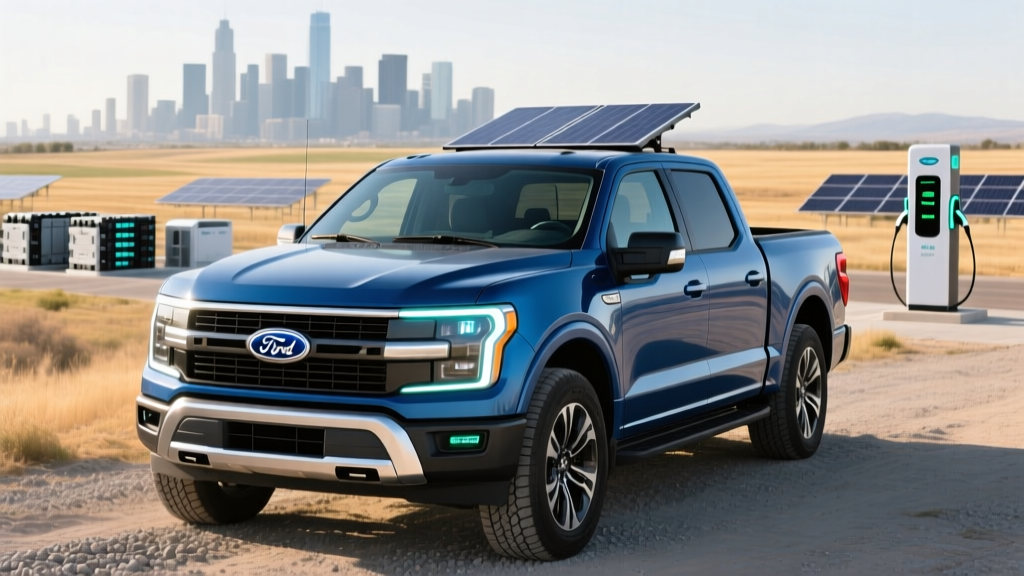
2027 Ford F-150 Thunder Lightning: The Next Generation of Electric Trucks
Ford's F-150 Lightning has been a cornerstone of the electric truck market since its debut, but the upcoming 2027 Ford F-150 Thunder Lightning represents a significant evolution. Built on Ford's next-generation electric truck architecture, the Thunder Lightning aims to address the most common criticisms of the current Lightning: highway range efficiency, charging speed, and towing-related range loss. While Ford has not yet opened order books, preliminary specifications and platform details give us a data-driven picture of what to expect.
This profile synthesizes announced platform details, supply-chain reporting, and Ford's public statements to build a spec-level preview. All figures are preliminary and subject to change before the official launch.
Expected Range and Battery Architecture
The 2027 Thunder Lightning is expected to move to an 800-volt battery architecture, a significant upgrade from the current Lightning's 400V system. This shift enables both faster DC charging and improved powertrain efficiency. Ford has signaled two battery pack options:
| Specification | Standard Range (Est.) | Extended Range (Est.) |
|---|---|---|
| Battery Chemistry | NMC (Nickel Manganese Cobalt) | NMC (High-nickel) |
| Usable Capacity | ~100 kWh | ~135 kWh |
| EPA Est. Range | ~270 miles | ~350 miles |
| Architecture | 800V | 800V |
EPA estimates are measured under controlled conditions. For the 2027 F-150 Thunder Lightning Extended Range, expect approximately 280–310 miles on mixed highway driving at 70 mph. Cold-weather operation (below 32°F) typically reduces range by 15–25% in full-size electric trucks, bringing the Extended Range pack to roughly 220–265 miles in winter conditions. Towing a 6,000-lb trailer can cut range by 40–50%, a physics constraint shared across all electric pickups. Plan road-trip charging stops accordingly.
The shift to high-nickel NMC chemistry in the Extended Range pack is aimed at improving energy density — more kWh in roughly the same physical footprint. The Standard Range pack is expected to use a conventional NMC formulation optimized for cycle life and cost. Neither pack is expected to use LFP (lithium iron phosphate), which remains more common in smaller, lighter vehicles where energy density is less critical.
Charging Speed: 800V Changes the Equation
The move to 800V is the single most impactful upgrade for daily usability. Where the current F-150 Lightning peaks at roughly 150 kW on DC fast chargers, the Thunder Lightning is expected to support substantially higher charge rates.
| Charging Level | Power / Rate | Estimated Speed |
|---|---|---|
| Level 1 (120V household) | ~1.4 kW | ~3 miles per hour |
| Level 2 (240V home, 48A) | ~11.5 kW | ~25 miles per hour |
| Level 2 (240V home, 80A) | ~19.2 kW | ~42 miles per hour |
| DC Fast Charge (peak) | ~250 kW (est.) | 10–80% in ~22 minutes (est.) |
The estimated 250 kW peak DC charge rate would place the Thunder Lightning in the upper tier of electric truck charging, comparable to the Rivian R1T's current capability and behind only the GMC Sierra EV's peak. However, peak kW is not sustained kW. Expect the charge curve to taper significantly above 80% state of charge (SoC), with the 80–100% top-up potentially adding another 20–25 minutes. For road-trip planning, plan stops around the 10–80% window for maximum efficiency.
At home on a 48-amp Level 2 circuit, the Extended Range pack (135 kWh usable) would require roughly 12 hours for a full charge — feasible for overnight replenishment. Buyers who drive more than 100 miles daily should consider upgrading to an 80-amp circuit, which cuts that to roughly 7 hours. Always consult a licensed electrician for panel capacity assessment before installation.
Performance and Drivetrain
Ford has not released official power figures, but the Thunder Lightning is expected to retain the dual-motor all-wheel-drive layout that defines the Lightning lineup. Based on platform evolution and competitive positioning:
| Performance Metric | Standard Range (Est.) | Extended Range (Est.) |
|---|---|---|
| Drivetrain | Dual-motor AWD | Dual-motor AWD |
| Horsepower | ~580 hp | ~620 hp |
| Torque | ~775 lb-ft | ~775 lb-ft |
| 0–60 mph | ~4.0 seconds | ~3.8 seconds |
| Max Towing Capacity | ~8,000 lbs | ~10,000 lbs |
| Max Payload | ~1,800 lbs | ~2,000 lbs |
The 800V architecture enables more efficient power delivery to the motors, potentially improving both acceleration and sustained highway efficiency. Ford's Pro Power Onboard — the truck's built-in generator capability — is expected to carry over with up to 9.6 kW of exportable power, sufficient for running job-site tools or backing up essential home circuits during outages (with proper transfer switch installation).
Pricing, Trims, and Federal Tax Credit Eligibility
Pricing for the 2027 F-150 Thunder Lightning is not yet confirmed, but based on the current Lightning's trajectory and Ford's positioning against the Chevrolet Silverado EV and Ram 1500 REV:
| Trim Level | Est. Base MSRP | Est. After §30D Credit* |
|---|---|---|
| Pro (Standard Range) | ~$55,000 | ~$47,500 |
| XLT (Standard Range) | ~$62,000 | ~$54,500 |
| Lariat (Extended Range) | ~$75,000 | ~$67,500 |
| Platinum (Extended Range) | ~$85,000 | ~$77,500 |
*Tax credit figures assume full $7,500 eligibility under IRS §30D. Eligibility depends on multiple factors — see checklist below.
- MSRP Cap: Trucks/vans must have an MSRP at or below $80,000
- Buyer Income Cap: Modified AGI ≤ $150,000 (single), $225,000 (head of household), $300,000 (joint)
- Battery Sourcing: Critical minerals and battery components must meet phased-in domestic/free-trade-partner sourcing thresholds
- Final Assembly: Vehicle must be assembled in North America
- Point-of-Sale Transfer: Eligible buyers can transfer the credit to the dealer for an immediate price reduction at purchase
The F-150 Thunder Lightning's Pro and XLT trims are expected to fall under the $80,000 MSRP cap. The Lariat and Platinum may exceed it depending on option packages. Battery sourcing requirements tighten annually — consult IRS.gov and a tax professional before relying on credit eligibility.
Interior, Cargo, and Technology
The Thunder Lightning is expected to retain the crew-cab-only configuration with a 5.5-foot bed, consistent with the current Lightning. Key dimensions and features (projected):
- Front headroom: ~40.8 inches
- Rear legroom: ~43.6 inches
- Bed cargo volume: ~52.8 cu ft
- Front trunk (frunk): ~14.1 cu ft (with drain plug and 400-lb payload capacity)
- Towing: Integrated trailer brake controller, Pro Trailer Hitch Assist, and onboard scale
On the technology front, the Thunder Lightning is expected to feature Ford's latest SYNC 5 infotainment system on a 15.5-inch portrait touchscreen (upper trims), with a 12-inch digital instrument cluster. Wireless Apple CarPlay and Android Auto, over-the-air updates, and Ford's BlueCruise hands-free driving system on pre-mapped divided highways should all be standard or available.
Ford BlueCruise is an SAE Level 2 driver-assistance system. It provides hands-free steering, acceleration, and braking on approved highways, but the driver must remain attentive and ready to take over at all times. A driver-facing camera monitors engagement. This is fundamentally different from Level 4 robotaxi services like Waymo, which operate without a human driver in geofenced areas. Never treat BlueCruise as a substitute for active driving.
Efficiency and Ownership Costs
Full-size electric trucks trade efficiency for capability. The current F-150 Lightning Extended Range achieves approximately 66 MPGe combined (per fueleconomy.gov), or roughly 51 kWh per 100 miles. The 800V architecture in the Thunder Lightning should improve this modestly — expect an estimated 70–74 MPGe combined for the Extended Range variant, or approximately 47–49 kWh/100 mi.
At the national average electricity rate of ~$0.17/kWh, that translates to roughly $8.00–$8.30 per 100 miles of driving. Compare this to a gas F-150 at 20 MPG combined and $3.50/gallon: $17.50 per 100 miles. The per-mile fuel savings remain substantial, though insurance premiums for electric trucks tend to run 10–20% higher than ICE equivalents due to repair costs and parts pricing.
Ford's battery warranty is expected to carry over at 8 years / 100,000 miles, covering defects and capacity loss below 70% of original capacity — consistent with industry norms and EPA-mandated minimums for emissions-related components.
Competitive Positioning: Is It Worth Waiting For?
Pros
- 800V architecture enables ~250 kW DC charging
- Pro Power Onboard for job-site and home backup use
- Massive frunk with drain and payload capacity
- BlueCruise hands-free highway driving
- Strong tow/payload numbers for an EV
- Expected §30D credit eligibility on lower trims
Cons
- Towing cuts range by 40–50% (all EV trucks)
- Upper trims likely exceed $80K MSRP credit cap
- Cold-weather range loss remains significant
- Not yet available — ordering timeline uncertain
- Efficiency trails smaller EVs substantially
- Insurance costs above ICE truck average
- Choose the Thunder Lightning if: You need a full-size truck for towing or payload, want home charging convenience, value Pro Power Onboard for work, and can wait for 2027 availability.
- Consider the Rivian R1T if: You want an available-now electric truck with adventure-focused features, a quad-motor option, and a smaller footprint for trail use.
- Consider the Chevrolet Silverado EV if: You need maximum range (up to 400+ miles EPA on the 4WT trim) and prioritize GM's Ultium charging ecosystem.
- Consider a PHEV truck if: Your towing needs are frequent and long-distance, and charging infrastructure on your routes is sparse.
Frequently Asked Questions
What is the real-world range of the 2027 Ford F-150 Thunder Lightning?
The Extended Range pack is estimated at ~350 miles EPA. In real-world highway driving at 70 mph, expect roughly 280–310 miles. In cold weather (below freezing), plan for 220–265 miles. Towing a mid-size trailer will reduce range to approximately 150–200 miles per charge.
How fast does the 2027 Thunder Lightning charge?
On a DC fast charger, the estimated peak rate is ~250 kW, with a 10–80% charge in approximately 22 minutes. At home on a 48-amp Level 2 charger, expect roughly 25 miles of range added per hour, or a full overnight charge in about 12 hours for the Extended Range pack.
Does the 2027 F-150 Thunder Lightning qualify for the federal EV tax credit?
Lower trims (Pro, XLT) are expected to fall under the $80,000 MSRP cap and should qualify for the full $7,500 §30D credit, provided the buyer meets income thresholds and the battery meets sourcing requirements. Upper trims (Lariat, Platinum) may exceed the MSRP cap depending on options. Always verify current rules at IRS.gov before purchasing.
Is the Thunder Lightning worth buying over the current F-150 Lightning?
If you can wait, the 800V architecture alone justifies it — roughly 60–70% faster DC charging and improved efficiency. The current Lightning remains a capable truck, but its ~150 kW peak charge rate is becoming a competitive disadvantage. If you need a truck now, the current model is solid; if you can wait until late 2026 or 2027, the Thunder Lightning will be a meaningfully better vehicle.
When will the 2027 F-150 Thunder Lightning be available?
Ford has not announced an official on-sale date. Based on typical model-year cadences, expect order banks to open in late 2026, with deliveries beginning in early-to-mid 2027. All specifications discussed here are preliminary and subject to change.
Can I use the Thunder Lightning to power my home?
Ford's Pro Power Onboard with Intelligent Backup Power (available on the current Lightning) allows the truck to supply up to 9.6 kW to a home through a professionally installed bidirectional charger and transfer switch. This is expected to carry over to the Thunder Lightning. A typical installation, including the charge station and electrician work, runs $5,000–$10,000 depending on panel upgrades needed.