What Undisguised 2027 Chevy Bolt EV Prototypes Tell Us
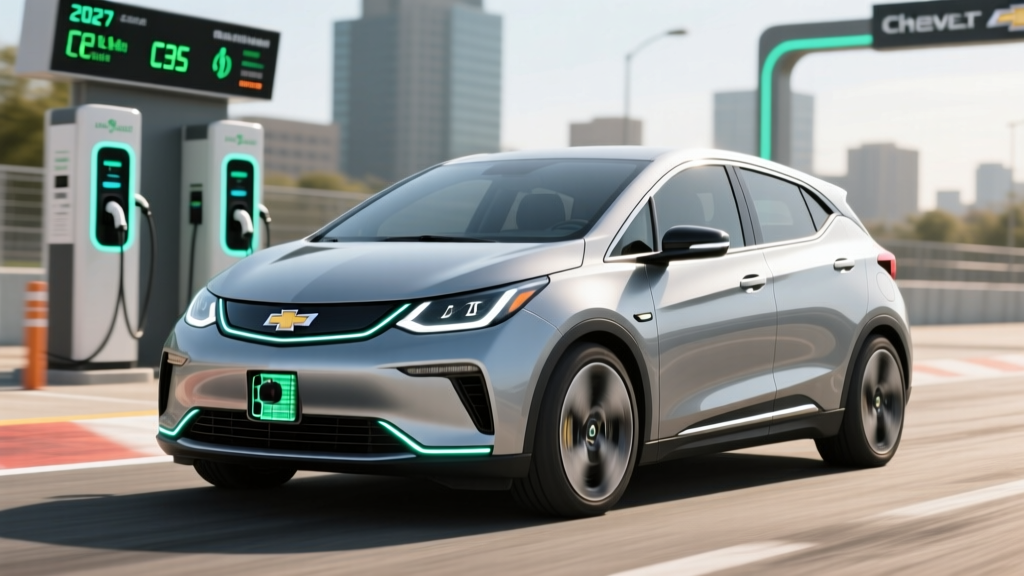
For months, heavily camouflaged mules hinted at Chevrolet's next-generation Bolt. Now, 2027 Chevy Bolt EV undisguised testing vehicles have surfaced on public roads and at charging stations, giving us the clearest look yet at the hatchback that promises to redefine the affordable EV segment. Built on GM's Ultium battery platform — a significant departure from the outgoing BEAM2 architecture — the new Bolt is shaping up to address the single biggest complaint lodged against its predecessor: painfully slow DC fast charging.
Before we break down what the prototypes reveal, a critical caveat: the 2027 Bolt EV has not been officially priced or released. Chevrolet has confirmed the model's return on Ultium, and spy photography confirms production-intent bodywork, but final EPA certifications, trim configurations, and MSRP figures remain preliminary. Everything below is sourced from undisguised prototype observations, GM's published Ultium platform capabilities, and industry analysis. Treat all numbers as informed estimates until Chevrolet publishes official specs.
Estimated Specs: What the Prototypes Suggest
The undisguised prototypes wear production body panels, finalized lighting signatures, and what appears to be a CCS/NACS-compliant charge port on the driver-side front fender — a notable shift, as GM has committed to adopting the Tesla NACS connector across its lineup. Wheelbase measurements from spy photographers suggest a modest stretch over the outgoing Bolt's 102.4-inch wheelbase, potentially unlocking more interior volume and room for a larger battery pack beneath the floor.
| Attribute | Estimated Spec | Outgoing Bolt EV (2023) |
|---|---|---|
| Battery Capacity (usable) | ~65–72 kWh (LFP) | 65 kWh (NMC) |
| EPA Range (est.) | 260–290 miles | 259 miles |
| Peak DC Fast Charge | ~150 kW (est.) | 55 kW |
| 10–80% DC Charge Time | ~28–32 minutes (est.) | ~60+ minutes |
| Level 2 Home Charging | 11.5 kW (~35 mi/hr) | 11.5 kW (~39 mi/hr) |
| Horsepower | ~200 hp (est.) | 200 hp |
| 0–60 mph | ~6.5 sec (est.) | 6.5 sec |
| Drivetrain | FWD (single motor) | FWD |
| Efficiency (est.) | ~120 MPGe / 28 kWh/100mi | 120 MPGe / 28 kWh/100mi |
| Base MSRP (est.) | $28,000–$30,000 | $26,500 (2023) |
The headline improvement is DC fast charging. The outgoing Bolt's 55 kW peak charge rate — which meant a 10–80% session dragged past the hour mark — was the model's most glaring weakness for road-trip duty. GM's Ultium platform supports significantly faster charging, and the undisguised prototypes have been spotted at Electrify America stations pulling what observers estimate to be 130–150 kW during peak charging. If Chevrolet delivers a 150 kW peak with a reasonable charge curve, the new Bolt transforms from a strictly local commuter into a viable road-trip vehicle.
Battery Chemistry: The LFP Question
Perhaps the most consequential decision GM faces with the new Bolt is battery chemistry. Industry sources and supply-chain analysis strongly suggest the 2027 Bolt will use lithium iron phosphate (LFP) cells, likely sourced from CATL or a GM-LG joint venture LFP line. Here's why that matters:
| Factor | LFP (Likely for 2027 Bolt) | NMC (Outgoing Bolt) |
|---|---|---|
| Energy Density | Lower — heavier pack for same kWh | Higher — lighter, more compact |
| Cycle Life | 3,000+ cycles — exceptional longevity | 1,000–2,000 cycles |
| Cost | Lower — no cobalt or nickel | Higher — expensive cathode materials |
| Cold-Weather Performance | Weaker — more range loss below 32°F | Better low-temp discharge |
| Recommended Charge Habit | Can charge to 100% daily safely | Best at 80% daily; 100% for trips only |
| Thermal Stability | Superior — lower runaway risk | Good, with active thermal mgmt |
For budget-minded Bolt buyers, LFP is largely a win. The lower cost enables GM's aggressive pricing target, and the ability to charge to 100% daily without degradation anxiety means the real-world usable range is effectively higher than the raw kWh number suggests. The trade-off is cold-weather performance: expect a 25–35% range reduction in sustained sub-freezing temperatures, compared to roughly 20–25% for NMC. If you live in Minnesota or Maine, this is a meaningful consideration.
Real-World Range: Beyond the EPA Sticker
EPA Estimated Range: ~260–290 miles (preliminary, not yet certified)
Real-World Expectations:
- City/commute driving (mild weather): 270–300+ miles — EVs thrive in stop-and-go with regenerative braking
- Highway cruising (70 mph, 75°F): ~220–250 miles — aerodynamic drag cuts efficiency ~15–20%
- Cold weather (20°F, mixed driving): ~175–210 miles — LFP chemistry amplifies cold-weather losses
- Cold + highway (worst case): ~155–185 miles — plan charging stops accordingly
The outgoing Bolt's 259-mile EPA rating was competitive for its price class, but real-world highway driving typically yielded 210–230 miles in moderate weather. If the 2027 model lands near 280 miles EPA, you can realistically expect 240–260 miles on a highway road trip in summer conditions — enough to space DC fast-charge stops roughly 3.5 to 4 hours apart at 70 mph. That's a livable rhythm for most drivers.
The LFP cold-weather penalty is the wildcard. Unlike the outgoing NMC Bolt, which lost roughly 20–25% of range in deep cold, LFP cells are more susceptible to low-temperature impedance. GM's Ultium platform includes active thermal management with a heat pump (observed on undisguised prototypes), which should mitigate some of this loss. But northern-climate buyers should budget for a realistic 180-mile winter range and plan accordingly.
Charging Speed: The Make-or-Break Upgrade
This is where the 2027 Bolt must deliver, and the undisguised testing evidence is encouraging. Prototypes spotted at public DC fast-charging stations appeared to sustain charge rates well above the outgoing car's 55 kW ceiling. Based on GM's Ultium architecture and observations from spy photographers monitoring charge-session displays:
| Charging Level | Power (kW) | Speed | Time / Notes |
|---|---|---|---|
| Level 1 (120V household) | ~1.4 kW | ~4 miles/hour | Overnight top-up only; ~70 hours for full charge |
| Level 2 (240V home) | 11.5 kW | ~35 miles/hour | Full charge in ~6–7 hours |
| DC Fast Charge (peak) | ~150 kW (est.) | ~350+ miles/hour (peak) | 10–80% in ~28–32 min (est.) |
| DC Fast Charge (sustained avg) | ~90–110 kW (est.) | ~250 miles/hour avg | Charge curve tapers above 80% SoC |
Understanding the charge curve: Peak kW is the maximum rate the battery accepts, typically between 10–40% State of Charge (SoC). Above ~60% SoC, the rate tapers to protect the cells, and above 80% it drops significantly. The 10–80% time is the industry-standard benchmark because charging beyond 80% on DC is so slow that it's faster to unplug and continue your trip. A ~30-minute 10–80% session at a 150 kW station means you can add roughly 150–180 miles of real-world range during a typical rest stop — a transformational improvement over the outgoing Bolt.
The undisguised prototypes also confirm what appears to be a NACS (Tesla Supercharger) charge port, consistent with GM's commitment to adopt the North American Charging Standard. This means 2027 Bolt owners will have access to Tesla's Supercharger network — currently the most reliable and widespread DC fast-charging infrastructure in the U.S. — either natively or via adapter. For Bolt buyers who were previously locked into CCS-only networks with spotty reliability, this is arguably the most important upgrade on the spec sheet.
Interior, Tech & Practicality
From the outside, the undisguised prototypes show a slightly larger five-door hatchback with a more aggressive stance, slim LED lighting, and flush door handles. The wheelbase stretch (estimated +1–2 inches) should translate to marginally improved rear-seat legroom — the outgoing Bolt's 35.5 inches of rear legroom was adequate for adults but tight for long trips.
Inside, spy photos through greenhouse glass reveal what appears to be GM's latest infotainment architecture: an 11-inch digital instrument cluster paired with a 17-inch center touchscreen (similar to the Equinox EV setup). Expect wireless Apple CarPlay and Android Auto, Google built-in for navigation and voice assistant, and a suite of driver-assistance features under the Chevy Safety Assist umbrella:
- Automatic emergency braking with pedestrian detection
- Lane-keep assist with lane-departure warning
- Adaptive cruise control (stop-and-go capable)
- Rear cross-traffic alert with braking
- HD surround vision camera
SAE Level 2 note: These driver-assistance features require continuous driver engagement. They are not autonomous driving systems. Super Cruise (GM's hands-off, eyes-on Level 2 system) may be available on higher trims, but it still requires driver attention and operates only on mapped divided highways.
Cargo volume is estimated at ~20 cubic feet behind the rear seats and ~55 cubic feet with seats folded — competitive with the Hyundai Kona Electric and slightly less than the Nissan Leaf. No front trunk (frunk) has been observed on prototypes, consistent with GM's cost-conscious approach in this segment.
Pricing, Trims & Federal Tax Credit Outlook
The outgoing Bolt EV was discontinued after 2023 with a base price of $26,500 — at the time, the cheapest new EV in America. GM has signaled the new Bolt will maintain an aggressive price position, though inflation and the Ultium platform migration will push the entry point modestly higher.
| Trim (Est.) | Est. MSRP | Est. After §30D Credit | Key Features |
|---|---|---|---|
| 1LT (Base) | $28,000–$30,000 | $20,500–$22,500 | 17" screen, Safety Assist, 11.5 kW L2 |
| 2LT | $32,000–$34,000 | $24,500–$26,500 | Heated seats/steering, adaptive cruise, 360° cam |
| Premier | $36,000–$38,000 | $28,500–$30,500 | Super Cruise, leather, premium audio |
Federal tax credit (§30D) eligibility is not guaranteed and depends on several factors that remain fluid for a 2027 model year vehicle:
- MSRP cap: The Bolt's estimated pricing falls well under the $55,000 cap for cars (and $80,000 for SUVs/trucks), so this is not a barrier.
- Buyer income limits: Adjusted gross income must not exceed $150,000 (single), $225,000 (head of household), or $300,000 (joint filers). Verify your eligibility with a tax professional.
- Battery sourcing requirements: A percentage of critical minerals and battery components must be sourced from the U.S. or free-trade-agreement partners. This threshold increases annually. If GM uses CATL-sourced LFP cells, this could jeopardize partial or full credit eligibility — a significant risk to watch.
- Point-of-sale transfer: Under current IRS rules, the credit can be transferred to the dealer at purchase, reducing your out-of-pocket cost immediately rather than waiting for a tax refund. See IRS clean vehicle credits for current rules.
- Final assembly: Must occur in North America. GM's Orion Assembly in Michigan satisfies this requirement.
The battery-sourcing question is the biggest wildcard. If GM qualifies for the full $7,500 credit, a base Bolt at ~$28,500 drops to roughly $21,000 — an extraordinary value. If sourcing rules limit the credit to $3,750 or zero, the value proposition narrows. Monitor IRS updates as the launch date approaches.
How It Stacks Up: Bolt vs. the Affordable EV Field
The 2027 Bolt won't exist in a vacuum. By its launch, it will face a crowded sub-$35,000 EV field. Here's how the estimated specs compare to key rivals (based on current or announced models):
| Spec | 2027 Bolt EV (est.) | Hyundai Kona Electric | Nissan Leaf | Tesla Model 3 RWD |
|---|---|---|---|---|
| EPA Range | 260–290 mi | 261 mi | 212 mi (SV+) | 272 mi |
| DC Fast Charge (peak) | ~150 kW | 100 kW | 100 kW (CCS) | 170 kW |
| 10–80% Time | ~30 min | ~43 min | ~45 min | ~25 min |
| Base MSRP | ~$28,000 | ~$33,000 | ~$29,000 | ~$39,000 |
| NACS Native | Yes (est.) | Adapter | No (CCS) | Yes |
- Choose the Bolt if: You want the lowest possible new-EV price point, primarily commute locally, can charge at home, and want NACS Supercharger access for occasional road trips without paying Tesla pricing.
- Choose the Kona Electric if: You need a vehicle available now, prefer Hyundai's warranty coverage, and your road trips are infrequent enough that slower charging isn't a dealbreaker.
- Choose the Model 3 if: You prioritize performance, charging speed, and tech refinement and are willing to pay $10,000+ more for it.
- Skip the Leaf: CHAdeMO charging is a dead-end standard in the U.S., and the Leaf's range and charging speed lag the field.
Warranty & Ownership Considerations
GM has not published 2027 Bolt warranty details, but based on the outgoing Bolt and current Ultium-based models (Equinox EV, Blazer EV), expect:
- Battery & propulsion warranty: 8 years / 100,000 miles (federally mandated minimum for emissions-related components; GM has historically met this across its EV lineup)
- Battery capacity retention: GM typically warrants that the battery will retain at least 70% of original capacity during the warranty period. LFP chemistry should comfortably exceed this threshold given its superior cycle life.
- Bumper-to-bumper: 3 years / 36,000 miles (GM standard)
- Roadside assistance: 5 years / 60,000 miles
Insurance costs for the outgoing Bolt were moderate by EV standards — typically $1,400–$1,800 annually depending on state and driver profile. The new Bolt's higher repair costs (Ultium platform, more sensors) may push premiums slightly higher. Get quotes before purchasing.
Pros, Cons & The Bottom Line
✅ Estimated Pros
- Potentially the cheapest new EV in America (~$28K base)
- Dramatically faster DC charging vs. outgoing Bolt (~150 kW vs. 55 kW)
- NACS/Supercharger access opens best-in-class charging network
- LFP battery offers exceptional longevity and daily 100% charging
- 260–290 mile range is sufficient for most daily and road-trip use
- Updated tech with large touchscreen and Google built-in
- Hatchback practicality with ~55 cu ft cargo capacity
❌ Estimated Cons
- LFP chemistry means greater cold-weather range loss (~30%+)
- Not yet available — expected late 2026 / early 2027 delivery
- Federal tax credit eligibility uncertain due to battery-sourcing rules
- FWD only — no AWD option for snow-belt buyers
- No frunk; cargo space trails some rivals
- Charging speed still trails Tesla Model 3 and Hyundai Ioniq 5
- Interior materials likely reflect the budget price point
The 2027 Chevy Bolt EV, as revealed through undisguised testing, appears to be exactly what the market needs: a sub-$30,000 electric hatchback with competitive range, finally-acceptable charging speed, and access to the Supercharger network. If GM executes on pricing and secures tax-credit eligibility, it could be the most compelling value in the entire EV market. The primary risks are cold-weather range (LFP's inherent weakness), battery-sourcing credit uncertainty, and the simple fact that you can't buy one yet.
Frequently Asked Questions
What is the real-world range of the 2027 Chevy Bolt EV?
Based on estimated specs, expect roughly 240–260 miles in real-world highway driving during mild weather, and 175–210 miles in cold conditions. The EPA sticker is projected at 260–290 miles, but LFP chemistry and highway speeds reduce real-world figures. City commuting with regenerative braking may match or slightly exceed the EPA number.
How fast does the 2027 Bolt charge at home and on DC fast chargers?
Estimated DC fast charging peaks at ~150 kW, achieving a 10–80% charge in approximately 28–32 minutes — a massive improvement over the outgoing Bolt's 60+ minute sessions. Home Level 2 charging at 11.5 kW adds roughly 35 miles per hour, fully replenishing the battery in 6–7 hours overnight.
How much will the 2027 Chevy Bolt cost after tax credits?
Estimated base MSRP is $28,000–$30,000. If the full $7,500 federal §30D credit applies, the effective price drops to roughly $20,500–$22,500. However, credit eligibility depends on battery-sourcing rules, buyer income limits, and MSRP caps — all subject to change. Consult IRS.gov and a tax professional before relying on credit availability.
Does the 2027 Bolt EV qualify for the $7,500 federal tax credit?
It's too early to confirm. The Bolt's MSRP is well under the $55,000 car cap, and GM's U.S. assembly satisfies the final-assembly requirement. The critical variable is battery-component and critical-mineral sourcing — particularly if LFP cells are sourced from CATL (China). Sourcing thresholds tighten annually under §30D. Monitor IRS guidance as the vehicle approaches launch.
Is the 2027 Bolt worth waiting for vs. buying a current EV now?
If you need an EV immediately and can find a competitively priced current model (Kona Electric, used Bolt, base Model 3), waiting 12+ months may not be practical. But if your timeline is flexible and you want the lowest possible new-EV price with modern charging speed and Supercharger access, the 2027 Bolt could be worth the wait. The risk: pricing and specs may shift before launch.
Will the 2027 Bolt have access to Tesla Superchargers?
Yes — GM has committed to NACS adoption, and undisguised prototypes appear to feature a NACS charge port. This means native Supercharger access without an adapter, a significant infrastructure advantage over CCS-only vehicles. For more on connector compatibility, see GM's official Chevrolet Electric resources.
Sources: EPA fuel economy data via fueleconomy.gov; IRS clean vehicle credit rules via irs.gov; GM Ultium platform specifications via Chevrolet press materials. All 2027 Bolt figures are preliminary estimates based on prototype observations and platform data — final specs will be confirmed by Chevrolet prior to launch.