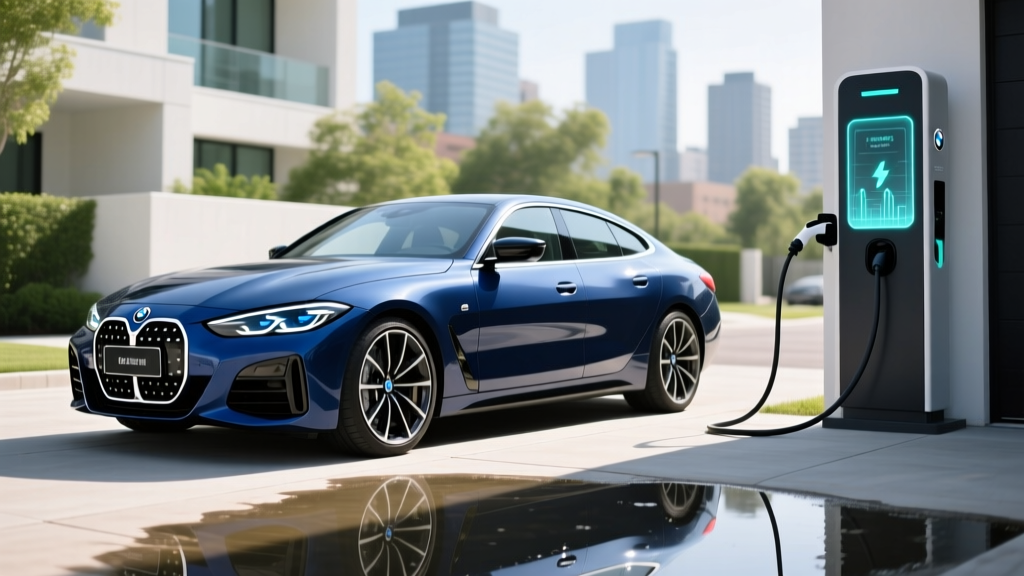
The BMW i4 has been one of the more convincing luxury electric sedans since its launch, blending BMW's trademark driving dynamics with a practical Gran Coupe body and competitive range. For the 2027 model year, BMW is preparing a mid-cycle refresh that updates styling, infotainment, and potentially battery capacity. Because the 2027 i4 has been announced but is not yet available for purchase as of early 2026, the figures below are based on BMW's preliminary disclosures, current-generation carryover data, and informed projections from the 2025–2026 i4 lineup. Final EPA certification and pricing will be confirmed closer to the on-sale date.
What's New for the 2027 BMW i4
The 2027 i4 rides on BMW's updated CLAR-based EV architecture, which the automaker has confirmed will feature revised exterior styling (new kidney grilles, slimmer LED headlights, and reworked taillights), an upgraded iDrive 9 infotainment system on a curved panoramic display, and incremental efficiency improvements through revised motor mapping and thermal management. BMW has hinted at a modest battery capacity bump for the eDrive40 and M50 trims, though the exact usable kWh figure has not been finalized in EPA documentation.
The lineup is expected to continue with three trims:
- i4 eDrive40 — single-motor, rear-wheel drive, the volume seller
- i4 xDrive40 — dual-motor, all-wheel drive, balanced performance and range
- i4 M50 — dual-motor, performance-tuned AWD, the flagship
Range, Battery, and Real-World Efficiency
The outgoing 2026 i4 eDrive40 carries an 83.9 kWh usable battery (NMC chemistry) and an EPA-estimated 307 miles of range. For 2027, BMW has indicated a target of approximately 315–330 miles EPA for the eDrive40, achieved through a combination of slightly higher usable capacity (projected ~86 kWh) and improved drivetrain efficiency. The dual-motor xDrive40 should land in the 280–295 mile EPA range, while the M50 is projected at 245–260 miles EPA.
EPA estimate: ~315–330 miles (preliminary). In mixed real-world driving, expect 270–290 miles on the highway at 70–75 mph, and 230–260 miles in sustained cold weather (below 32°F) due to cabin heating demand and increased battery resistance. City driving with regenerative braking can push closer to or slightly above the EPA sticker. These figures assume the battery is preconditioned and driven in standard comfort mode.
| Spec | eDrive40 | xDrive40 | M50 |
|---|---|---|---|
| Drivetrain | RWD (single motor) | AWD (dual motor) | AWD (dual motor) |
| Horsepower | 335 hp | 396 hp | 536 hp |
| 0–60 mph | 5.5 sec | 4.6 sec | 3.7 sec |
| Battery (usable, projected) | ~86 kWh NMC | ~86 kWh NMC | ~86 kWh NMC |
| EPA Range (projected) | 315–330 mi | 280–295 mi | 245–260 mi |
| Efficiency (est.) | ~105 MPGe / 27 kWh/100mi | ~98 MPGe / 29 kWh/100mi | ~89 MPGe / 33 kWh/100mi |
Battery chemistry remains NMC (nickel manganese cobalt), which BMW has used throughout the i4's production. NMC offers higher energy density than LFP, translating to more range in a smaller, lighter pack — a priority in a performance-oriented sedan. The trade-off is that NMC batteries benefit more from staying between 20–80% state of charge for daily use, while LFP packs tolerate regular 100% charging better. BMW's battery management system includes a robust thermal management loop to mitigate degradation.
Charging Speed: DC Fast, Level 2, and the Curve
Charging remains one of the i4's stronger suits among luxury EVs. The 2027 model is expected to retain a peak DC fast-charge rate of 205 kW on a CCS1 connector (or NACS via adapter, depending on BMW's final North American rollout of the Tesla Supercharger-compatible port). On an appropriately rated 350 kW station like Electrify America or a Tesla Supercharger V3/V4 with adapter, the i4 should achieve:
| Charging Level | Power | Speed / Time |
|---|---|---|
| Level 1 (120V household) | ~1.4 kW | ~4–5 miles per hour |
| Level 2 (240V, 48A home charger) | 11 kW (onboard charger max) | ~32–36 miles per hour; full charge in ~9 hrs |
| DC Fast Charge (peak) | 205 kW | 10–80% in ~31 minutes |
Understanding the charge curve: The 205 kW peak is achieved only at a low state of charge (around 10–20%) and with a preconditioned battery. As the battery fills past 50%, the rate tapers progressively — by 80%, expect roughly 60–70 kW. This is why the 10–80% metric matters more than peak kW alone. On a road trip, plan your DC fast stops around the 10–80% window for the fastest turnaround; charging from 80–100% adds significant time and is best done overnight on Level 2.
BMW's onboard Level 2 charger is rated at 11 kW, which is competitive for the segment. This means a home charger delivering the full 48 amps on a 240V circuit (like a BMW Wallbox or ChargePoint Home Flex) will replenish the battery in roughly 9 hours from near-empty — fast enough for daily top-ups while you sleep. A common pitfall: a standard NEMA 14-50 outlet on a 40A circuit delivers only ~9.6 kW, adding roughly 2–3 hours to a full charge versus a hardwired 48A setup. Factor in electrical panel capacity and potential upgrade costs when budgeting for home charging.
Performance and Driving Dynamics
The i4 has always prioritized driving engagement over raw acceleration, and the 2027 refresh continues that philosophy. The eDrive40's single rear motor producing 335 hp and a projected 5.5-second 0–60 time is brisk for daily commuting and highway merging. The M50, with 536 hp and a 3.7-second sprint, enters genuine sports-sedan territory, rivaling the M3 Competition on straight-line speed while delivering silent, instant torque.
BMW's adaptive M suspension (standard on M50, optional on xDrive40) and the near-50/50 weight distribution carry over. The i4's low center of gravity, courtesy of the floor-mounted battery pack, gives it cornering composure that crossovers simply cannot match. Regenerative braking offers multiple levels, including a one-pedal driving mode (B-mode) that provides aggressive deceleration, though BMW still does not offer a true one-pedal stop-and-hold like some competitors — you'll occasionally need the friction brakes at very low speeds.
Interior, Cargo, and Technology
The 2027 i4's cabin updates center on the latest iDrive 9 system running on a curved display (12.3-inch instrument cluster merged with a 14.9-inch central touchscreen). Wireless Apple CarPlay and Android Auto are standard, along with a native EV route planner that factors in battery state of charge, elevation, and charger availability. The available Driving Assistant Professional package adds adaptive cruise with stop-and-go, lane-keeping assist, and automated lane changes — this is an SAE Level 2 driver-assistance system, meaning the driver must remain fully attentive with hands on or near the wheel at all times.
| Dimension | Measurement |
|---|---|
| Front legroom | 41.5 in |
| Rear legroom | 34.5 in |
| Cargo volume (rear seats up) | 16.6 cu ft |
| Cargo volume (rear seats folded) | 45.7 cu ft |
| Frunk | None (no front trunk) |
The Gran Coupe's liftback design gives it a wide cargo opening, but the sloping roofline limits vertical space for taller items. Rear-seat passengers taller than 6 feet will notice the headroom constraint — a trade-off of the coupe-like silhouette. The absence of a frunk is a missed opportunity for additional storage, especially given that rivals like the Tesla Model 3 and Hyundai Ioniq 6 offer one.
Pricing, Trims, and Federal Tax Credit Eligibility
BMW has not released final 2027 i4 pricing. Based on 2026 carryover pricing and typical annual adjustments, projected MSRP figures are:
| Trim | Base MSRP (est.) | As-Tested (est.) | §30D Credit Eligibility |
|---|---|---|---|
| eDrive40 | ~$57,500 | ~$63,000–$68,000 | Likely eligible (under $55K sedan cap TBD — see note) |
| xDrive40 | ~$61,000 | ~$67,000–$72,000 | Subject to sedan MSRP cap |
| M50 | ~$70,000 | ~$78,000–$85,000 | Likely exceeds $55K sedan cap |
Critical tax credit caveats: Under current IRS §30D rules, new EVs classified as sedans must have an MSRP at or below $55,000 to qualify for the up-to-$7,500 federal tax credit. SUVs and trucks have a higher $80,000 cap. The i4 is classified as a sedan, which puts the eDrive40 in a precarious position — if BMW prices it above $55,000 (which appears likely), it would not qualify for the new-vehicle credit. Buyer income caps also apply: modified adjusted gross income cannot exceed $150,000 (single), $225,000 (head of household), or $300,000 (joint). Additionally, the battery must meet critical-mineral and component sourcing requirements that shift annually. Consult a tax professional and check the latest IRS guidance before assuming eligibility. The point-of-sale transfer option, if applicable, allows the credit to be applied as a down-payment reduction at the dealer.
Warranty and Long-Term Ownership
BMW's EV warranty coverage carries over:
- Basic vehicle warranty: 4 years / 50,000 miles
- Battery and powertrain: 8 years / 100,000 miles (capacity retention guaranteed above 70%)
- Corrosion protection: 12 years / unlimited miles
- Complimentary maintenance: 3 years / 36,000 miles
The 70% capacity retention threshold is standard for the industry. BMW's NMC packs have shown relatively low degradation in real-world fleet data — owners of 2022–2024 i4 models report roughly 3–5% capacity loss over the first 50,000 miles, which is within the expected range for a liquid-cooled NMC pack. A full battery replacement out of warranty is costly, estimated at $15,000–$20,000 depending on the module configuration, though this is rarely needed within the vehicle's typical ownership cycle.
How the 2027 i4 Stacks Up Against Competitors
The i4 occupies a specific niche: a luxury electric sport sedan that drives like a BMW first and an EV second. Here's how it compares to key rivals:
- Tesla Model 3 Long Range: More range (~341 mi EPA), faster DC charging (~250 kW peak), significantly more Supercharger access, and a lower starting price (~$47,500). But the Model 3's minimalist interior, ride quality, and lack of a traditional luxury badge steer some buyers to BMW.
- Mercedes-Benz CLA EV (upcoming): Mercedes' new MMA-platform electric sedan targets 2027 as well, promising over 370 miles of range and 800V architecture for faster charging. It will be the i4's most direct new rival.
- Hyundai Ioniq 6: Offers excellent range (~361 mi for the SEL RWD), 800V charging (10–80% in ~18 min), and a lower price (~$42,500). Lacks the luxury badge, interior materials, and driving refinement of the i4.
- Genesis Electrified G80: More spacious and luxurious, but heavier, less efficient, and priced significantly higher (~$80,000+). A different buyer profile.
- Engaging driving dynamics and BMW ride refinement
- Competitive 300+ mile range (eDrive40)
- Premium interior with latest iDrive 9 tech
- Liftback cargo versatility (16.6 cu ft)
- Strong Level 2 charging at 11 kW
- Available M50 performance variant
- No frunk for extra storage
- Rear headroom limited by coupe roofline
- DC fast charge peak of 205 kW trails 800V rivals
- Likely above $55K MSRP cap — no §30D credit
- One-pedal driving does not hold at a full stop
- Tax credit sourcing rules add eligibility uncertainty
Who Should Buy the 2027 BMW i4?
The 2027 i4 is best suited for:
- Luxury sedan loyalists transitioning from a BMW 3 Series or 4 Series Gran Coupe who want EV running costs without sacrificing driving engagement.
- Commuters with home charging access who value a quiet, refined cabin and don't need crossover-level cargo space.
- Performance-oriented EV buyers (M50 trim) who want M-car acceleration without the fuel bill.
It's less ideal for buyers who need maximum rear-seat space, regular road-trip fast-charging (800V rivals charge faster), or those who require the full $7,500 federal tax credit to make the math work. If your priority is value and charging speed, the Ioniq 6 or Model 3 serve better. If brand prestige, driving feel, and interior quality are paramount, the i4 remains one of the best in its class.
Frequently Asked Questions
What is the real-world range of the 2027 BMW i4?
For the eDrive40, expect approximately 270–290 miles in real-world highway driving and 230–260 miles in cold weather (below freezing), against a projected EPA estimate of 315–330 miles. City driving with regenerative braking can match or slightly exceed the EPA figure.
How fast does the 2027 i4 charge at home and on DC fast chargers?
At home on a 240V Level 2 charger (48A hardwired), the i4 charges at up to 11 kW, adding roughly 32–36 miles of range per hour and fully recharging in about 9 hours. On a DC fast charger, it peaks at 205 kW and charges from 10–80% in approximately 31 minutes, with significant tapering above 80%.
Does the 2027 BMW i4 qualify for the $7,500 federal EV tax credit?
It depends on the final MSRP and your income. Under current IRS §30D rules, sedans must have an MSRP of $55,000 or less. The eDrive40's projected base price (~$57,500) likely exceeds this cap, making it ineligible for the new-vehicle credit unless BMW adjusts pricing or the classification changes. Income caps and battery sourcing rules add further restrictions. Always verify with a tax professional.
Is the 2027 BMW i4 worth buying over the Tesla Model 3?
If you prioritize interior quality, driving dynamics, and a traditional luxury badge, the i4 is worth the premium. If you value maximum range, faster charging, Supercharger network access, and a lower price, the Model 3 Long Range is the more practical choice. They serve different buyer priorities.
Does the 2027 i4 have a front trunk (frunk)?
No. The i4 does not offer a frunk, as the space under the hood is occupied by power electronics and the HVAC system. All cargo must go in the rear liftback area (16.6 cu ft with seats up).
What is the battery warranty on the 2027 BMW i4?
BMW covers the high-voltage battery and electric powertrain for 8 years or 100,000 miles, whichever comes first. The warranty guarantees the battery will retain at least 70% of its original usable capacity during that period.
Note: All specifications, pricing, and tax credit details in this preview are based on preliminary BMW disclosures and carryover data from the 2026 model year. Final EPA-certified figures and MSRP will be confirmed when the 2027 BMW i4 goes on sale. Consult fueleconomy.gov for official EPA ratings upon release and the IRS for current tax credit rules.