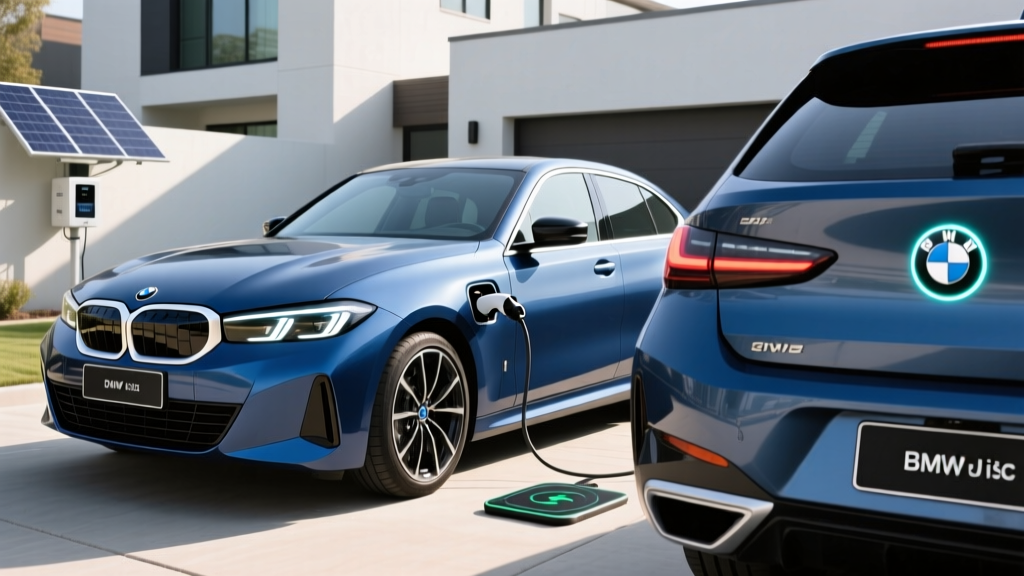
The original BMW i3 was a carbon-fiber city car that bowed out in 2021. The 2027 BMW i3 is an entirely different animal: a next-generation electric sedan built on BMW's Neue Klasse platform, positioned to compete directly with the Tesla Model 3, Hyundai Ioniq 6, and Mercedes-Benz CLA EV. As of early 2026, BMW has confirmed the Neue Klasse sedan family and revealed significant technical details about the platform's architecture, battery chemistry, and charging capabilities — but final EPA certification, U.S. pricing, and exact trim configurations remain unannounced.
This preview compiles everything confirmed or credibly estimated about the 2027 BMW i3, clearly labeling what's preliminary. If you're researching your next EV purchase and the i3 is on your radar, here's the data you need to evaluate it against the competition.
The 2027 BMW i3 (Neue Klasse) has been officially confirmed by BMW and shown in near-production concept form. U.S. specs below are estimates based on BMW's published platform data and European pre-production figures. Final EPA range, pricing, and tax-credit eligibility will be confirmed closer to the on-sale date (expected late 2026 or early 2027). This article will be updated as official data becomes available.
2027 BMW i3 Estimated Specifications at a Glance
| Specification | Estimated / Confirmed |
|---|---|
| EPA Range (est.) | ~340–380 miles (i3 50 xDrive); final EPA TBD |
| Battery (usable) | ~95 kWh, round-cell NMC (6th-gen eDrive) |
| DC Fast Charge (peak) | Up to 285 kW (confirmed by BMW) |
| 10–80% DC Charge | ~22 minutes (est., with preconditioning) |
| Level 2 AC Charge | 11 kW onboard (est. ~37 mi/hr) |
| 0–60 mph | ~4.8 sec (RWD 40); ~3.9 sec (AWD 50 xDrive) |
| Horsepower | ~300 hp (RWD 40); ~460 hp (AWD 50 xDrive) |
| Drivetrain | RWD standard; dual-motor AWD available |
| Efficiency (est.) | ~130 MPGe / 26 kWh/100 mi (combined, est.) |
| Base MSRP (est.) | ~$52,000 (i3 40 RWD); ~$62,000 (i3 50 xDrive) |
| Federal Tax Credit | TBD — subject to §30D sourcing, MSRP, and income rules |
| Battery Warranty | 8 yr / 100,000 mi (BMW standard EV warranty) |
Range and Efficiency: What the Neue Klasse Battery Delivers
BMW's sixth-generation eDrive technology represents a fundamental shift from the prismatic cells used in the current i4 and iX. The Neue Klasse platform uses round cylindrical cells (similar in form factor to Tesla's 4680 cells) manufactured in a new format BMW has specified at 46 mm diameter with varying heights. BMW claims these cells deliver 20% higher energy density compared to the current fifth-generation battery, along with improved thermal stability and faster charging capability.
The chemistry is NMC (nickel-manganese-cobalt), optimized for energy density rather than the cycle-life focus of LFP (lithium iron phosphate). This is the right call for a premium sedan targeting 350+ miles of range, though buyers who prioritize ultra-long battery lifespan over maximum range might prefer LFP-equipped competitors like the base Tesla Model 3.
Estimated EPA range: ~340–380 miles (depending on trim and drivetrain)
Real-world highway (70–80 mph): Expect ~280–320 miles. Aerodynamic efficiency helps at speed, but sustained highway driving reduces range 15–20% below EPA.
Cold-weather (below 32°F): Expect ~240–290 miles. BMW's heat pump (standard on Neue Klasse) mitigates cabin-heating losses, but battery chemistry still loses efficiency in deep cold. Preconditioning while plugged in is essential.
City/commuter driving: Likely close to or slightly above EPA thanks to aggressive regenerative braking.
The Neue Klasse platform operates on an 800-volt architecture (up from 400V in current BMW EVs), which directly enables faster charging and more efficient power delivery. For efficiency context, the current BMW i4 eDrive40 achieves 109 MPGe combined (source: EPA fueleconomy.gov). The 2027 i3's improved aero, lighter battery per kWh, and 800V system should push that figure meaningfully higher — our estimate of ~130 MPGe combined assumes roughly 26 kWh/100 mi.
Charging Speed: 800V Architecture and the 285 kW Peak
The move to 800 volts is the single biggest practical upgrade for daily EV ownership. Here's why it matters: higher voltage allows the same power (kW) to flow at lower current (amps), which reduces heat generation in the battery and cables. Less heat means the car can sustain peak charging rates longer before the battery management system throttles the charge rate to protect the cells.
BMW has confirmed a peak DC fast-charge rate of 285 kW for the Neue Klasse platform. For context, that's roughly on par with the Hyundai Ioniq 5's 350 kW peak (though sustained rates matter more than peak numbers) and significantly faster than the current BMW i4's 205 kW ceiling.
| Charge Level | Power (kW) | Speed / Time | Notes |
|---|---|---|---|
| Level 1 (120V household) | ~1.4 kW | ~5 mi/hr | Emergency/trickle only; ~68 hrs for full charge |
| Level 2 (240V home) | 11 kW (est.) | ~37 mi/hr; ~9.5 hrs 10–100% | Requires 48-amp circuit; overnight charge |
| DC Fast (peak) | 285 kW | ~22 min 10–80% (est.) | Requires 350 kW station; preconditioning essential |
| DC Fast (50 kW station) | 50 kW | ~85 min 10–80% | Older/low-power stations; plan longer stops |
Understanding the charge curve: No EV sustains its peak kW rate for the entire session. The 285 kW figure is a peak achievable roughly between 10–30% state of charge (SoC), after which the rate tapers progressively. Expect the average rate across a 10–80% session to be closer to 180–200 kW — which still yields a roughly 22-minute session, competitive with the best in class. Always use the car's built-in preconditioning (navigation to a charger triggers battery warming) to hit peak rates, especially in cold weather.
For home charging, the 11 kW onboard charger means you'll need a 48-amp Level 2 wall connector on a 60-amp dedicated circuit to maximize speed. Installation costs typically range from $800–$2,500 depending on panel proximity and local permitting — factor this into your purchase budget.
Performance and Driving Dynamics
BMW has historically prioritized driving engagement over straight-line EV drag-race numbers, and the Neue Klasse platform continues that philosophy with a rear-wheel-drive-biased architecture. Two primary powertrain configurations are expected for the U.S. market:
- i3 40 (RWD): Single rear motor, ~300 hp, ~330 lb-ft torque, 0–60 mph in approximately 4.8 seconds. This is the volume trim and the efficiency leader.
- i3 50 xDrive (AWD): Dual-motor all-wheel drive, ~460 hp, ~480 lb-ft torque, 0–60 mph in approximately 3.9 seconds. Trades some range for all-weather traction and performance.
The Neue Klasse platform uses BMW's latest iteration of its adaptive M suspension, with an anticipated lower center of gravity than the current i4 thanks to the structural battery pack integration. BMW has also confirmed a new "Heart of Joy" vehicle dynamics computer that integrates powertrain, chassis, and regenerative braking control into a single processing unit — reducing latency and improving the coherence of the driving experience.
Regenerative braking on Neue Klasse offers adjustable levels (mild, moderate, strong) plus an adaptive mode that uses radar and camera data to modulate regen based on traffic ahead. True one-pedal driving (coming to a complete stop via regen alone) is expected to be available, though BMW has historically been conservative about full stop-hold without brake application.
Interior, Cargo, and Technology
The Neue Klasse interior represents BMW's most significant cabin redesign in a decade. The headline feature is the BMW Panoramic Vision display — a full-width heads-up projection across the lower windshield that replaces the traditional instrument cluster. This is paired with a central 14.9-inch curved touchscreen running BMW iDrive 9 (or a newer iteration) with over-the-air update capability.
Passenger and cargo dimensions (estimated based on platform wheelbase):
- Wheelbase: ~114 inches (longer than current 3 Series, similar to i4)
- Rear legroom: ~36–37 inches (est. — improved over i4's tight 34.7 inches)
- Cargo (trunk): ~15–17 cu ft (est.)
- Frunk: Likely minimal or absent — BMW has historically prioritized cabin space over front-trunk storage in its EVs
Driver-assistance technology will include BMW's latest Highway Assistant (a Level 2 hands-free system on divided highways at speeds up to 85 mph, similar to GM's Super Cruise in concept). The system requires driver attention monitoring via interior camera — this is not autonomous driving. Expect adaptive cruise, lane centering, automatic emergency braking, and blind-spot intervention as standard, with automated lane-change and parking assist available in higher trims.
BMW's Highway Assistant and Driving Assistant Professional are SAE Level 2 systems. The driver must remain attentive, keep eyes on the road (or respond to monitoring prompts), and be prepared to take over instantly. These systems do not handle construction zones, unmapped roads, severe weather, or unpredictable pedestrian/cyclist behavior reliably. Never treat Level 2 assist as self-driving.
Pricing, Trims, and Federal Tax Credit Eligibility
Official U.S. pricing has not been announced as of early 2026. Based on BMW's current pricing ladder (the 2025 i4 starts at ~$52,200) and the Neue Klasse's positioning as a premium electric sedan, here are our estimated MSRP ranges:
| Trim | Est. Base MSRP | Est. As-Tested (loaded) | §30D Credit Eligibility |
|---|---|---|---|
| i3 40 (RWD) | ~$52,000 | ~$60,000 | TBD — see rules below |
| i3 50 xDrive (AWD) | ~$62,000 | ~$72,000 | TBD — see rules below |
Federal tax credit (IRS §30D) — what we know and what's uncertain:
The IRS §30D clean vehicle credit offers up to $7,500 for qualifying new EVs, but eligibility depends on multiple requirements that can change as supply chains shift:
- MSRP cap: Sedans must be under $55,000 MSRP to qualify. This means the i3 40 (RWD) at ~$52,000 base could qualify, but any options pushing it above $55,000 would disqualify it. The i3 50 xDrive at ~$62,000 would not qualify under current sedan caps.
- Buyer income cap: Modified adjusted gross income must not exceed $150,000 (single), $225,000 (head of household), or $300,000 (married filing jointly).
- Battery sourcing: A percentage of critical minerals and battery components must be sourced from the U.S. or free-trade-agreement countries. These thresholds increase annually. BMW's supply chain decisions for U.S.-market Neue Klasse batteries will determine eligibility.
- Point-of-sale transfer: If eligible, the credit can be transferred to the dealer at purchase, reducing the purchase price directly rather than waiting for a tax refund.
- Final assembly: Must occur in North America. BMW's Spartanburg, SC plant is a candidate, but Neue Klasse production may initially be in Germany (Dingolfing or Debrecen, Hungary), which would disqualify the vehicle from §30D.
Bottom line on tax credits: Do not assume the 2027 i3 will qualify for the full $7,500. The MSRP cap for sedans ($55,000) and North American final assembly requirement are significant hurdles. BMW has not confirmed U.S. production plans for the i3 sedan as of this writing. Consult a tax professional and check IRS.gov for the latest eligibility list before purchasing.
Pros and Cons: An Honest Assessment
✅ Pros
- 800V architecture enables ~285 kW peak DC charging — competitive with the fastest-charging EVs available
- Estimated 340–380 mi EPA range puts it in the top tier of electric sedans
- BMW driving dynamics and chassis tuning traditionally class-leading
- Panoramic Vision windshield HUD is a genuine tech differentiator
- Heat pump standard for cold-weather efficiency
- Over-the-air updates and latest iDrive infotainment
- 8-year/100,000-mile battery warranty
❌ Cons
- Federal tax credit eligibility uncertain (MSRP cap + assembly location risk)
- NMC chemistry means less cycle-life longevity than LFP competitors (though still 8-yr warranted)
- Frunk unlikely — BMW continues to forgo front storage
- Base price likely $52K+ even for RWD — premium over Model 3 and Ioniq 6
- Unproven first-generation Neue Klasse platform — early production risk
- BMW's U.S. DC charging network partnerships (Electrify America) have inconsistent reliability
- Final EPA numbers, pricing, and U.S. availability dates still unconfirmed
How It Stacks Up Against Key Competitors
The 2027 BMW i3 enters a crowded and competitive electric sedan segment. Here's how preliminary specs compare against the benchmarks:
| Metric | 2027 BMW i3 40 (est.) | Tesla Model 3 LR | Hyundai Ioniq 6 SEL |
|---|---|---|---|
| EPA Range | ~340–380 mi | 363 mi | 361 mi |
| Battery | ~95 kWh NMC | ~75 kWh NMC | 77.4 kWh NMC |
| Peak DC Charge | 285 kW | 250 kW | 350 kW |
| 10–80% Time | ~22 min | ~25 min | ~18 min |
| 0–60 mph | ~4.8 sec | 4.2 sec | 5.1 sec |
| Base MSRP | ~$52,000 | ~$42,000 | ~$42,500 |
| §30D Credit | Uncertain | Partial ($3,750) | Eligible (up to $7,500) |
The Tesla Model 3 remains the price-to-range benchmark, and the Ioniq 6 leads on charging speed and tax-credit certainty. The BMW i3's value proposition rests on build quality, driving refinement, cabin technology, and brand prestige — areas where BMW traditionally justifies a premium. Whether that premium is worth $10,000+ over a Model 3 Long Range is a personal calculation.
Who Should Buy the 2027 BMW i3?
The 2027 BMW i3 makes sense if you:
- Want a premium electric sedan with BMW driving dynamics and build quality
- Need 300+ miles of real-world range for regular road trips (with 285 kW charging keeping stops short)
- Value cutting-edge cabin tech (Panoramic Vision HUD, iDrive 9)
- Don't need the absolute lowest price and are willing to pay a premium for refinement
- Have reliable home Level 2 charging and access to 350 kW DC fast chargers on your common routes
Look elsewhere if you:
- Need the maximum federal tax credit — the Ioniq 6 or Model 3 offer more certainty
- Prioritize lowest total cost of ownership — Tesla and Hyundai undercut significantly on MSRP
- Want a proven platform — first-year Neue Klasse carries early-production risk
- Need a frunk or maximum cargo versatility — consider the Model 3 or a crossover EV
Frequently Asked Questions
What is the real-world range of the 2027 BMW i3?
Based on BMW's confirmed battery capacity (~95 kWh usable) and platform efficiency claims, we estimate an EPA rating of 340–380 miles depending on trim. Real-world highway driving at 70–80 mph will likely yield 280–320 miles. In sub-freezing temperatures, expect 240–290 miles without preconditioning. These are estimates pending official EPA certification.
How fast does the 2027 BMW i3 charge?
On a 350 kW DC fast charger with battery preconditioning, the i3 should peak at 285 kW and complete a 10–80% session in approximately 22 minutes. At home on a 48-amp Level 2 charger (11 kW), expect roughly 37 miles of range added per hour, or a full overnight charge in about 9.5 hours. Level 1 (120V) adds only about 5 miles per hour and is suitable only for emergency top-ups.
How much does the 2027 BMW i3 cost after tax credits?
Estimated base MSRP is ~$52,000 for the i3 40 (RWD) and ~$62,000 for the i3 50 xDrive (AWD). Federal §30D tax credit eligibility is uncertain — the sedan MSRP cap ($55,000) may allow the base RWD trim to qualify for up to $7,500, but final assembly location and battery sourcing requirements could disqualify it entirely. If the base trim qualifies and you meet income requirements, the effective price could drop to ~$44,500. Do not count on this credit until BMW confirms eligibility and the IRS lists the vehicle.
Does the 2027 BMW i3 qualify for the federal EV tax credit?
As of early 2026, this is unconfirmed. Three factors will determine eligibility: (1) final MSRP must be under $55,000 for sedans, (2) final assembly must occur in North America, and (3) battery critical minerals and components must meet escalating domestic/FTA sourcing thresholds. BMW has not confirmed U.S. assembly for the i3 sedan. Check IRS.gov's clean vehicle credit page closer to the on-sale date for the definitive answer.
Is the 2027 BMW i3 worth buying vs. the Tesla Model 3 or Hyundai Ioniq 6?
It depends on your priorities. If you value driving refinement, build quality, cabin technology, and brand prestige — and you're willing to pay a $10,000+ premium for it — the i3 is compelling. If your priority is lowest cost, maximum tax credit, or access to the Supercharger network (Tesla) or the fastest charging (Ioniq 6 at 350 kW), those competitors offer stronger value. Wait for independent reviews and official EPA numbers before committing.
When will the 2027 BMW i3 be available in the U.S.?
BMW has indicated the Neue Klasse sedan family will begin production in 2025 (Europe) with U.S. market arrival expected in late 2026 or early 2027 as a 2027 model-year vehicle. Exact timing depends on production ramp-up at BMW's facilities and U.S. homologation/EPA certification timelines.
This article reflects information available as of early 2026. Specifications, pricing, and tax-credit eligibility for the 2027 BMW i3 are preliminary and subject to change. AutoEdgeView will update this preview as BMW releases official U.S. data. Always verify current specs on BMWUSA.com and tax-credit eligibility on IRS.gov before making a purchase decision.