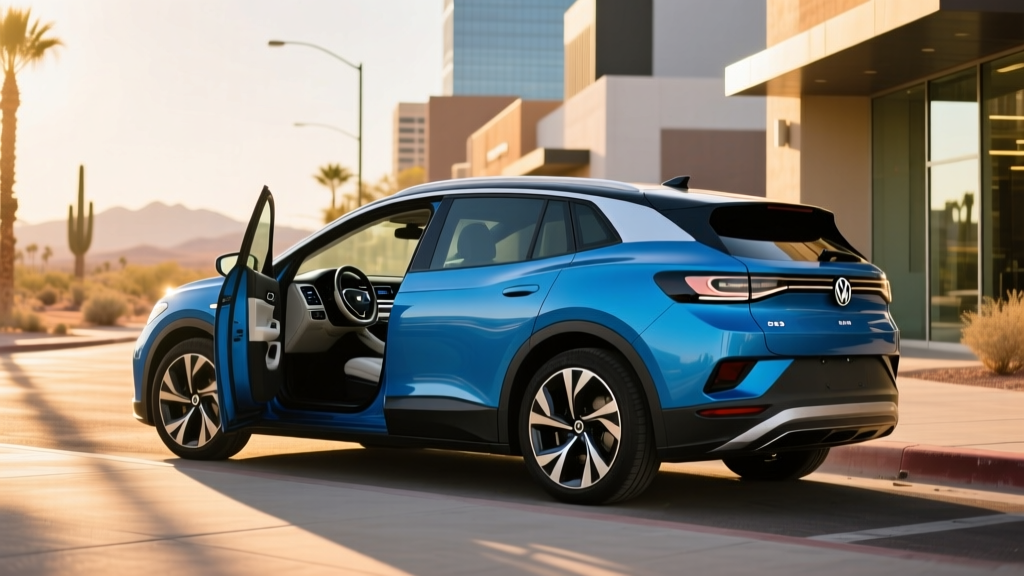
If you're researching a 2026 Volkswagen ID.4 lease in Goodyear, Arizona, you're likely weighing this electric compact SUV against rivals like the Hyundai IONIQ 5, Tesla Model Y, and Ford Mustang Mach-E. The ID.4 has matured since its 2021 U.S. debut, and the 2026 model year brings updated software (4.0), faster DC charging, and a revised trim lineup. But how does it stack up in the real world — especially under the desert heat of the West Valley?
This review covers the exact specs, real-world range expectations, charging performance, pricing with federal tax credit implications, and whether leasing the ID.4 in Goodyear is a smart move for your daily commute along I-10 or weekend trips to Prescott.
2026 VW ID.4 at a Glance: Key Specs
| Spec | Value |
|---|---|
| EPA Range (RWD) | 291 miles |
| EPA Range (AWD Pro S Plus) | 263 miles |
| Battery (usable) | 82 kWh, NMC (nickel-manganese-cobalt) |
| Max DC Fast Charge | 175 kW (CCS1 / NACS with adapter) |
| 10–80% DC Charge Time | ~28 minutes |
| Level 2 Home Charge Rate | 11 kW (~37 mi/hr) |
| 0–60 mph (RWD) | 7.7 seconds |
| 0–60 mph (AWD) | 5.4 seconds |
| Horsepower (RWD / AWD) | 282 hp / 335 hp |
| MPGe (RWD combined) | 107 MPGe |
| Efficiency | 31 kWh/100 mi |
| Cargo Volume (rear seats up/down) | 30.3 / 64.2 cu ft |
| Battery Warranty | 8 years / 100,000 miles |
| Base MSRP (Standard Range S) | $39,735 |
Real-World Range: What the EPA Number Doesn't Tell You
The 2026 ID.4 RWD carries an EPA-estimated 291 miles of range. However, expect ~240–260 miles on sustained highway driving at 70–75 mph, and ~210–230 miles in winter conditions (relevant for Goodyear residents driving to Flagstaff or the Mogollon Rim where temps drop below freezing). In Goodyear's extreme summer heat (110°F+), battery thermal management works overtime — plan for roughly 260–275 miles of real-world range with A/C running hard. (Source: fueleconomy.gov)
The 82 kWh usable NMC battery provides a solid energy buffer, but NMC chemistry is more heat-sensitive than LFP (lithium iron phosphate). In Arizona's summer, preconditioning the battery before fast charging becomes essential to maintain charging speed and long-term health. Volkswagen's thermal management system is active liquid-cooled, which helps, but parking in shade or a garage when possible will extend battery longevity.
For Goodyear commuters driving 25–40 miles round-trip to Phoenix, Glendale, or the Westgate area, even the reduced real-world range means charging just 2–3 times per week on a home Level 2 setup.
Charging Performance: DC Fast, Level 2, and Goodyear Infrastructure
| Charging Level | Power | Speed (approx.) | Use Case |
|---|---|---|---|
| Level 1 (120V) | 1.2 kW | ~4 mi/hr | Emergency / overnight trickle |
| Level 2 (240V, 48A) | 11 kW | ~37 mi/hr | Home daily charging (~8 hrs 0–100%) |
| DC Fast Charge | 175 kW peak | 10–80% in ~28 min | Road trips, public stations |
The 2026 ID.4 peaks at 175 kW on DC fast chargers — an improvement over earlier model years. However, like all EVs, the charge curve tapers significantly above 80% state of charge. You'll see 175 kW only between roughly 10–35% SoC; from 35–80%, the rate averages closer to 90–120 kW. This is normal physics (lithium-ion acceptance rate drops as cells fill), but it means a 10–90% stop will take closer to 40 minutes.
The ID.4 ships with a CCS1 connector, but Volkswagen provides a NACS adapter (or has one available) for Tesla Supercharger access — critical for road trips through rural Arizona where Supercharger stations often outnumber Electrify America or EVgo locations.
Goodyear charging landscape: Electrify America stations are accessible at Westgate Entertainment District (~12 mi) and several Phoenix metro locations. For home charging, a Level 2 installation (240V/48A) in Goodyear typically costs $800–$2,200 depending on panel proximity and whether your 200A service panel needs an upgrade. Most ID.4 owners report overnight charging from 20% to full in roughly 7–8 hours at 11 kW.
Pricing, Trims, and Federal Tax Credit Eligibility
| Trim | MSRP | Drivetrain | §30D Credit Eligible? |
|---|---|---|---|
| Standard Range S | $39,735 | RWD | Check battery sourcing* |
| Pro | $42,495 | RWD | Check battery sourcing* |
| Pro S | $46,295 | RWD | Check battery sourcing* |
| Pro S Plus | $49,995 | AWD | Check battery sourcing* |
| AWD Pro S | $49,295 | AWD | Check battery sourcing* |
*Federal §30D tax credit eligibility for 2026 depends on three moving targets: (1) buyer income caps ($150K single / $300K joint MAGI), (2) MSRP caps ($80K for SUVs — all ID.4 trims clear this), and (3) battery component and critical mineral sourcing requirements that have tightened annually. The ID.4 is assembled in Chattanooga, TN, but cell sourcing must be verified per VIN at purchase. The credit can now be transferred to the dealer at point of sale, reducing your out-of-pocket cost immediately. (Source: IRS.gov)
Leasing vs. Buying in Goodyear
Leasing the 2026 ID.4 in Goodyear has a distinct advantage: under IRS rules, leased vehicles can qualify for the $7,500 commercial clean vehicle credit (§45W) that the leasing company receives and typically passes through as a capitalized cost reduction — regardless of battery sourcing or your personal income. This "lease loophole" means you may capture the full $7,500 even if buying outright wouldn't qualify. Typical ID.4 leases in the Phoenix metro area run $349–$479/month for 36 months with $2,500–$3,999 due at signing, depending on trim and applied incentives. Always confirm whether the dealer is passing the credit through as a cap cost reduction.
Interior, Cargo, and Daily Practicality
The ID.4's cabin prioritizes function over flash. Rear legroom measures 37.6 inches — generous for a compact SUV and enough for adult passengers on longer trips. Cargo space behind the second row is 30.3 cu ft (competitive with the RAV4 Hybrid), expanding to 64.2 cu ft with seats folded. There's no frunk (front trunk), which is a missed opportunity given the rear-motor RWD layout.
The 12.9-inch infotainment screen runs VW's ID. Software 4.0, which is a marked improvement over the laggy, frustrating 2.x versions. Wireless Apple CarPlay and Android Auto are standard. However, VW's reliance on touch-capacitive sliders for volume and climate (rather than physical knobs) remains a usability complaint among owners.
Driver assistance: The ID.4 includes Travel Assist (adaptive cruise + lane centering) as standard — a competent SAE Level 2 system that requires hands on the wheel and active supervision. It's not "self-driving" and doesn't pretend to be. The system handles I-10 traffic well but requires periodic steering input confirmation.
Performance and Efficiency
The single-motor RWD ID.4 produces 282 hp and hits 60 mph in 7.7 seconds — adequate for merging and passing, though not thrilling. The dual-motor AWD variant bumps output to 335 hp with a 5.4-second 0–60 time, which feels meaningfully quicker and adds confidence in monsoon-season rain.
Efficiency for the RWD model is rated at 107 MPGe combined (31 kWh/100 mi). That's mid-pack for the segment — the IONIQ 5 RWD achieves 114 MPGe, while the heavier Model Y AWD sits around 109 MPGe. At Arizona's average residential electricity rate of ~$0.13/kWh, "fueling" the ID.4 costs roughly $4.03 per 100 miles at home — compared to ~$12.50 for a 28 MPG gas SUV at $3.50/gallon.
Pros, Cons, and the Bottom Line
- Comfortable ride quality; compliant suspension for Arizona roads
- Spacious rear seat and cargo area for the class
- Lease loophole may unlock full $7,500 credit regardless of sourcing
- Improved ID. 4.0 software over earlier model years
- Strong battery warranty (8 yr/100K mi)
- Competitive turning radius (31.5 ft) for parking
- No frunk (front trunk) for charging cables or storage
- Touch-capacitive controls frustrate some drivers
- 175 kW peak charge rate trails Hyundai/Kia's 800V architecture
- Real-world highway range drops noticeably vs. EPA
- NACS adapter required for Tesla Supercharger access
- Infotainment learning curve for first-time EV buyers
Who Should Lease the 2026 ID.4 in Goodyear?
Look elsewhere if: You prioritize maximum fast-charging speed (consider IONIQ 5 with 800V / 350 kW capability), need 300+ miles of real-world highway range, or want a frunk for charging cable storage.
Frequently Asked Questions
Does the 2026 VW ID.4 qualify for the federal EV tax credit?
It depends on your income (under $300K joint / $150K single), the specific VIN's battery sourcing compliance, and MSRP (all trims clear the $80K SUV cap). However, leasing may bypass sourcing and income restrictions through the §45W commercial credit passed to you as a cap cost reduction. Confirm with your Goodyear-area VW dealer and consult a tax professional. (IRS.gov)
What is the real-world range of the 2026 ID.4 in Arizona heat?
Expect 260–275 miles in Goodyear's summer heat with A/C running, and 240–260 miles on sustained highway drives at 70+ mph. The EPA's 291-mile figure assumes mixed driving in moderate temperatures.
How much does home charging cost for the ID.4?
At Arizona's ~$0.13/kWh average rate, a full charge (82 kWh) costs roughly $10.66 and provides 240–275 real-world miles. That's about 4 cents per mile — roughly one-third the cost of a comparable gas SUV.
Is the ID.4 better than the Hyundai IONIQ 5 or Tesla Model Y?
The ID.4 wins on ride comfort and interior space. The IONIQ 5 charges faster (800V architecture, up to 350 kW). The Model Y offers more range and Supercharger network access natively. Your choice depends on priorities: comfort vs. charging speed vs. range/infrastructure.
What's the battery warranty?
Volkswagen covers the ID.4 battery for 8 years or 100,000 miles against defects and capacity loss below 70% of original capacity — a competitive warranty in the segment.