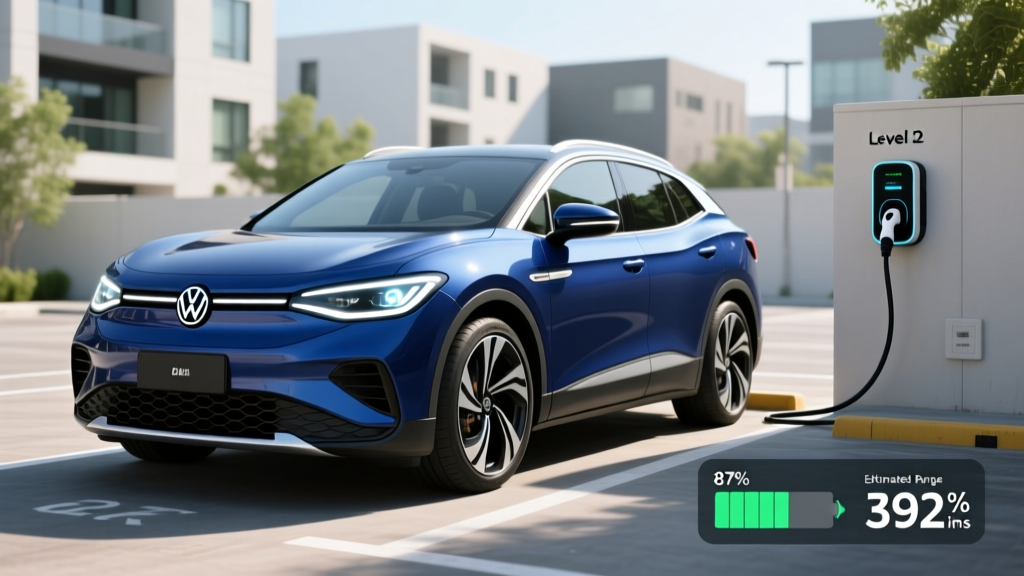
If you've been watching Volkswagen's electric crossover from the sidelines, the current wave of ID.4 lease deals might finally tip the scales. VW has been aggressively incentivizing the ID.4 through captive lease programs, often stacking manufacturer cash on top of the $7,500 federal EV tax credit that gets passed through as a capitalized-cost reduction. The result? Monthly payments that undercut comparable gas crossovers — even before you factor in fuel savings.
But a cheap lease only matters if the vehicle fits your life. Below, we break down the 2026 Volkswagen ID.4 with exact specs: EPA range, real-world highway and cold-weather expectations, DC fast-charging curves, battery chemistry, cargo dimensions, and the fine print on federal tax-credit eligibility under IRS §30D. Whether you're cross-shopping the Hyundai Ioniq 5, Kia EV6, or Tesla Model Y, this profile gives you the numbers to decide.
2026 VW ID.4: Quick Verdict
The 2026 VW ID.4 is a practical, comfort-oriented electric compact SUV that prioritizes ride quality, interior space, and straightforward ergonomics over sporty dynamics or cutting-edge performance. With up to 291 miles of EPA-estimated range on rear-wheel-drive trims, a usable 77 kWh battery (NMC chemistry), and peak DC fast-charging at 175 kW, it's a competent daily driver and road-tripper — just not a segment leader in charging speed or acceleration. Lease deals that bring the effective monthly cost below $350/month make it one of the most accessible electric SUVs on the market for families and commuters who want a traditional crossover feel with zero tailpipe emissions.
Range, Efficiency & Real-World Expectations
EPA Estimated: 291 miles (RWD Pro, 18" wheels) | 275 miles (AWD Pro S, 20" wheels)
Real-World Highway (70 mph, moderate temps): Expect ~240–255 miles on RWD; ~225–240 miles on AWD
Cold-Weather (below 32°F, cabin heat on): Expect 25–35% range reduction, dropping to ~185–220 miles depending on conditions and whether you use the heat pump (standard on AWD trims)
Efficiency: 104 MPGe combined (RWD) | 98 MPGe combined (AWD) — roughly 32–34 kWh/100 mi
The ID.4's range story is one of adequate but unremarkable. The 291-mile EPA figure on the base RWD Pro trim puts it in the middle of the compact electric SUV pack. On mixed suburban and city driving, hitting or slightly exceeding the EPA number is realistic — regenerative braking in stop-and-go traffic helps recapture energy. On sustained highway runs at 70–75 mph, however, the ID.4's boxy crossover profile creates more drag than sleeker competitors, and you'll see consumption climb to 33–36 kWh/100 mi.
Cold weather is where the ID.4 loses ground. Volkswagen does offer a heat pump on AWD trims (and it's standard on higher trims), which mitigates cabin-heating energy draw. But the NMC battery chemistry still sees meaningful capacity reduction in sub-freezing temperatures. If you live in the Upper Midwest or Northeast and regularly drive in winter, budget for 200 miles of usable range on a full charge as your worst-case planning number.
| Trim | Drivetrain | EPA Range | MPGe (Combined) | kWh/100 mi |
|---|---|---|---|---|
| Standard Range | RWD | 206 mi | 107 | 31 |
| Pro | RWD | 291 mi | 104 | 32 |
| Pro S | RWD | 275 mi | 101 | 33 |
| Pro S Plus | AWD | 263 mi | 98 | 34 |
| AWD Pro S | AWD | 275 mi | 98 | 34 |
Source: fueleconomy.gov — 2026 VW ID.4
Battery, Charging Speed & Home Setup
The 2026 ID.4 uses a 77 kWh usable lithium-ion battery pack (82 kWh gross) with NMC (nickel manganese cobalt) cell chemistry on Pro and Pro S trims. The Standard Range trim uses a smaller 62 kWh usable pack. NMC offers higher energy density than LFP (lithium iron phosphate), which keeps the pack lighter and more compact — but it also means VW recommends capping daily charging at 80% to prolong long-term battery health, reserving 100% charges for road trips.
Here's what the kW vs. kWh distinction means in practice: your battery holds kWh (energy — like gallons in a tank), while your charger delivers kW (power — like the flow rate of a hose). A higher kW charger fills the battery faster, but only up to the vehicle's maximum acceptance rate.
| Charging Level | Power (kW) | Speed (mi/hr) | Notes |
|---|---|---|---|
| Level 1 (120V household) | ~1.2 kW | ~3–4 mi/hr | Emergency/top-up only; full charge takes 60+ hours |
| Level 2 (240V home, 32A) | 7.7 kW | ~25 mi/hr | Full charge overnight (~10.5 hrs from 10%) |
| Level 2 (240V home, 48A) | 11.5 kW | ~37 mi/hr | Full charge in ~7 hrs; requires 60A circuit |
| DC Fast Charge (peak) | 175 kW | N/A | 10–80% in ~30 min; tapers significantly above 80% |
The ID.4's 175 kW peak DC fast-charging rate is the most debated spec on this vehicle. Compared to the Hyundai Ioniq 5's 240 kW (800V architecture) or the Tesla Model Y's ~250 kW peak, the ID.4 charges noticeably slower on road trips. In real-world testing at Electrify America 350 kW stations, the ID.4 peaks around 170–175 kW between 10–30% state of charge, then progressively tapers. The 10–80% charge takes approximately 28–32 minutes under ideal conditions (warm battery, preconditioned). Above 80%, charging slows dramatically — expect another 20+ minutes to go from 80–100%, which is why road-trip strategy means charging to 80% and moving on.
One ownership advantage: VW includes three years of complimentary Electrify America charging (currently 800 kWh total for recent model years — confirm exact terms with your dealer, as promotional details shift). This meaningfully offsets road-trip charging costs during the early ownership period.
For home charging, a Level 2 wall connector on a 48-amp circuit delivers the best overnight experience. Most ID.4 owners report waking up to a full battery every morning with a 32A or 48A Level 2 setup. If your home electrical panel needs an upgrade to support a 60A circuit (for 48A continuous charging), budget $1,500–$3,000 for a licensed electrician, depending on panel distance and local permitting.
Performance & Driving Dynamics
| Spec | RWD | AWD |
|---|---|---|
| Horsepower | 282 hp | 335 hp |
| Torque | 339 lb-ft | 402 lb-ft |
| 0–60 mph | ~7.7 sec | ~5.4 sec |
| Top Speed | 112 mph (electronically limited) | 112 mph |
| Towing Capacity | 2,200 lbs (braked) | 2,700 lbs (braked) |
The RWD ID.4's 282 horsepower and 7.7-second 0–60 time are adequate for merging and passing but won't excite anyone coming from a performance EV. The AWD dual-motor variant's 335 hp and 5.4-second sprint is genuinely quick and makes highway overtaking effortless. Where the ID.4 earns praise is ride quality: VW tuned the suspension for comfort over sportiness, and it absorbs potholes and expansion joints with a composure that rivals more expensive luxury crossovers. Steering is light and numb — this is not a driver's car, and that's fine for the target buyer.
Regenerative braking deserves a note: the ID.4 offers adjustable regen via steering-wheel paddles (B-mode for max regen, or paddle-selected levels). However, it does not offer true one-pedal driving to a full stop in the way a Nissan Leaf or Tesla does. You'll still use the brake pedal regularly. For some buyers, this feels more natural; for EV veterans who prefer aggressive regen, it's a minor frustration.
Interior, Cargo & Technology
The ID.4's cabin is where it makes its strongest case as a family vehicle. Rear-seat legroom measures 37.6 inches — generous for the compact SUV segment — and the flat floor (no transmission tunnel) makes the middle seat genuinely usable for a third passenger or a child seat.
| Measurement | Dimension |
|---|---|
| Front Headroom | 41.1 in |
| Rear Headroom | 38.8 in |
| Front Legroom | 41.1 in |
| Rear Legroom | 37.6 in |
| Cargo (behind rear seats) | 30.3 cu ft |
| Cargo (rear seats folded) | 64.2 cu ft |
| Front Trunk (Frunk) | None (hood houses HVAC components) |
The 30.3 cubic feet of cargo space behind the rear seats is competitive with the Toyota RAV4 and edges out the Hyundai Ioniq 5 (27.2 cu ft). However, the absence of a frunk is a missed opportunity — competitors like the Ioniq 5 and Ford Mustang Mach-E offer front trunks for charging cables or small items.
On the technology front, the ID.4 runs VW's latest infotainment software (4.0 in recent updates), which has significantly improved responsiveness and menu logic over the frustrating 3.x versions that plagued early ID.4 models. The 12.9-inch center touchscreen is large and clear, though the touch-sensitive slider controls for volume and temperature remain a common complaint — they're imprecise and unlit at night, which is baffling for a vehicle in this price range.
Driver assistance comes via VW's IQ.DRIVE suite, which includes adaptive cruise control with stop-and-go, lane-centering assist, blind-spot monitoring, and rear cross-traffic alert. This is a SAE Level 2 system — meaning the driver must remain fully engaged, with hands on the wheel and eyes on the road at all times. It is not autonomous driving. The system is competent for highway cruising but requires regular steering-wheel touch confirmation, and the lane-centering can oscillate slightly on faded lane markings.
Pricing, Lease Deals & Federal Tax Credit
| Trim | MSRP (before dest.) | Est. w/ Destination | §30D Credit Eligible? | Est. Effective Price w/ Credit |
|---|---|---|---|---|
| Standard Range | ~$38,790 | ~$40,085 | Yes (if sourcing rules met) | ~$32,585 |
| Pro | ~$43,790 | ~$45,085 | Yes | ~$37,585 |
| Pro S | ~$47,290 | ~$48,585 | Yes | ~$41,085 |
| AWD Pro S | ~$51,290 | ~$52,585 | Yes | ~$45,085 |
| AWD Pro S Plus | ~$55,290 | ~$56,585 | Yes | ~$49,085 |
Note: MSRP figures are approximate based on VW's latest pricing announcements and include the $1,295 destination charge. Confirm exact pricing with your dealer, as trims and packages shift by model year.
The reason ID.4 lease deals are so attractive right now comes down to a quirk in the federal tax-credit rules. Under IRS §30D, the $7,500 new EV tax credit is subject to buyer income caps, MSRP caps (vans/SUVs/pickups: $80,000; sedans: $55,000), and stringent battery-component and critical-mineral sourcing requirements. However, when you lease rather than buy, the credit flows to the leasing company (the lessor) under the commercial clean-vehicle credit (§45W), and most captive finance arms — including VW Credit — pass the full $7,500 through as a capitalized-cost reduction. This effectively lowers your lease payment without you needing to meet the personal income or sourcing requirements that apply to purchases.
- MSRP Cap: Vehicle MSRP must not exceed $80,000 (SUVs/vans) — all ID.4 trims qualify ✓
- Buyer Income Cap (modified AGI): $150,000 single / $225,000 head of household / $300,000 joint ✓
- Battery Component Sourcing: Must meet escalating North American manufacturing thresholds — verify current-year compliance on IRS.gov
- Critical Minerals Sourcing: Must meet escalating percentage thresholds for US or FTA-partner-sourced minerals
- Point-of-Sale Transfer: You can transfer the credit to the dealer at purchase for an immediate price reduction (rather than waiting for tax filing)
- Leasing Loophole: Lease transactions use §45W (commercial credit) — income/MSRP/sourcing restrictions may not apply to the lessee
Tax rules change frequently. Consult a tax professional and verify current eligibility at irs.gov before signing.
Typical ID.4 lease deals in 2026 have been advertised in the $299–$399/month range for 36-month terms with $2,500–$3,999 due at signing, depending on trim and regional incentives. The Pro trim tends to offer the best value proposition: you get the full 291-mile range battery, a solid feature set, and monthly payments that can undercut a comparably equipped Toyota RAV4 Hybrid lease when the $7,500 credit is applied.
Warranty & Long-Term Ownership
Volkswagen backs the ID.4 with a competitive warranty package:
| Coverage | Term |
|---|---|
| Basic Vehicle Warranty | 4 years / 50,000 miles |
| Battery & Powertrain | 8 years / 100,000 miles |
| Battery Capacity Guarantee | Minimum 70% net capacity over 8 yr / 100,000 mi |
| Roadside Assistance | 4 years / 50,000 miles |
| Corrosion Perforation | 7 years / 100,000 miles |
The 70% capacity retention guarantee over 8 years is standard for the industry and aligns with federal requirements for battery warranty coverage. Real-world degradation data from European ID.4 fleets (which have been on the road since 2021) suggests NMC packs in VW's thermal-management system degrade roughly 1–2% per year under normal use, meaning most owners will retain 88–92% capacity at the 8-year mark — well above the warranty threshold.
One lease-specific consideration: you won't own the battery or benefit from its long-term longevity since the vehicle returns to VW at lease end. However, you also avoid any risk of out-of-warranty battery replacement costs (estimated at $15,000–$20,000 if needed beyond the 8-year coverage window). For a 3-year lease, battery degradation is essentially a non-issue.
How the ID.4 Stacks Up Against Competitors
| Spec | VW ID.4 Pro (RWD) | Hyundai Ioniq 5 SE (RWD LR) | Tesla Model Y (Long Range) | Kia EV6 Wind (RWD LR) |
|---|---|---|---|---|
| EPA Range | 291 mi | 303 mi | 320 mi | 310 mi |
| Battery (usable kWh) | 77 kWh (NMC) | 77.4 kWh (NMC) | ~75 kWh (NMC) | 77.4 kWh (NMC) |
| Peak DC Fast Charge | 175 kW | ~240 kW (800V) | ~250 kW | ~240 kW (800V) |
| 10–80% DCFC Time | ~30 min | ~18 min | ~22 min | ~18 min |
| 0–60 mph | 7.7 sec | 7.0 sec | 4.8 sec | 7.2 sec |
| Cargo (behind rear seats) | 30.3 cu ft | 27.2 cu ft | 30.2 cu ft | 24.4 cu ft |
| Starting MSRP (approx.) | ~$45,085 | ~$47,500 | ~$48,000 | ~$48,500 |
The ID.4's advantages are clear: best-in-class cargo volume (tied with Model Y), lowest starting price, and a comfortable ride that none of the sportier competitors match. Its disadvantages are equally clear: slowest DC fast-charging in the group and the lowest EPA range. If you road-trip frequently and want 18-minute charging stops, the Ioniq 5 or EV6 are objectively better. If you prioritize interior space, ride comfort, and the lowest monthly lease payment, the ID.4 wins.
Who Should Lease the ID.4?
✅ Choose the ID.4 If:
- You want the lowest monthly lease payment in the electric compact SUV segment
- You primarily commute and charge at home (Level 2 overnight)
- Rear-seat space and cargo volume are priorities (child seats, strollers, groceries)
- You prefer a soft, comfortable ride over sporty handling
- You want VW dealer service infrastructure rather than Tesla's direct model
- You plan to keep the vehicle for 3 years or fewer (lease sweet spot)
❌ Look Elsewhere If:
- You take frequent 300+ mile road trips and want the fastest DC charging
- You want one-pedal driving with full regen to a stop
- Performance and quick acceleration are priorities (look at Model Y or Ioniq 5 N)
- You want a frunk for charging cable storage
- You need more than 291 miles of EPA range (Ioniq 5 LR: 303 mi; Model Y LR: 320 mi)
- You prefer a minimalist, screen-forward interior over physical buttons
Frequently Asked Questions
What is the real-world range of the 2026 VW ID.4?
In mixed city/suburban driving, expect 270–290 miles on the RWD Pro trim — close to its 291-mile EPA estimate. On sustained highway driving at 70+ mph, expect 240–255 miles. In cold weather (below 32°F), range drops to 185–220 miles depending on conditions, cabin heat usage, and whether the heat pump is active.
How fast does the ID.4 charge at home and on DC fast chargers?
On a home Level 2 charger (240V, 48A), the ID.4 adds roughly 37 miles of range per hour, fully charging in about 7 hours. On DC fast chargers, it peaks at 175 kW and charges from 10–80% in approximately 28–32 minutes. This is slower than the Ioniq 5 (~18 min) and Model Y (~22 min).
Does the VW ID.4 qualify for the $7,500 federal EV tax credit?
The ID.4 has historically qualified for the full $7,500 federal credit under §30D, as it falls under the $80,000 MSRP cap for SUVs. However, eligibility depends on current-year battery-sourcing and critical-mineral requirements set by the IRS, plus buyer income caps ($150K single / $300K joint). When leasing, the credit typically passes through as a cap-cost reduction without the buyer needing to meet income requirements. Always verify current rules at IRS.gov.
Is it better to buy or lease the ID.4?
For most buyers in 2026, leasing is the more financially attractive option. The lease structure allows VW Credit to claim the $7,500 commercial clean-vehicle credit and pass it to you as a cap-cost reduction, sidestepping the personal income and battery-sourcing restrictions that apply to purchases. You also avoid long-term depreciation risk. If you plan to keep the vehicle 8+ years and drive under 100,000 miles (staying within the battery warranty), purchasing with the point-of-sale credit transfer can also make sense.
Is the ID.4 self-driving?
No. The ID.4's IQ.DRIVE system is a SAE Level 2 driver-assistance system. It provides adaptive cruise control and lane-centering on highways, but you must keep your hands on the wheel and eyes on the road at all times. It does not navigate autonomously, change lanes without confirmation, or handle complex urban driving. Only Level 4 services like Waymo operate without a driver.
What are the biggest complaints from ID.4 owners?
The most consistent owner complaints center on: (1) the capacitive touch sliders for volume and climate that are unlit and imprecise, (2) the infotainment system's occasional sluggishness (improved in 4.0 software but not class-leading), (3) DC fast-charging speed that trails Korean and Tesla competitors, and (4) the lack of a front trunk. On the positive side, owners consistently praise ride comfort, rear-seat space, and quiet highway cruising.