The Volkswagen ID.4 occupies a specific niche in the electric-vehicle market: a practical, family-sized compact SUV that prioritizes comfort and space over headline-grabbing performance. For 2026, the ID.4 returns with incremental software and packaging updates, but its core value proposition remains the same — a roomy cabin, competitive range, and one of the longest battery warranties in the segment. This review focuses on what daily ownership actually looks like, from the VW ID.4 interior and cargo flexibility to real-world range and charging behavior.
Quick Verdict: Who the ID.4 Is For
The 2026 ID.4 is best suited for families and commuters who need five-passenger seating, generous cargo space, and predictable daily range — and who can charge at home. It is not a performance SUV, nor does it charge as quickly as Hyundai's E-GMP platform rivals. If your priority is a comfortable, well-built electric crossover with strong battery-warranty coverage and competitive pricing after incentives, the ID.4 deserves a close look.
EPA Range, Battery Specs, and Real-World Expectations
The 2026 ID.4 is available with two battery configurations across its trim lineup. The Standard Range models use a 62 kWh (usable) lithium-ion NMC (nickel-manganese-cobalt) pack, while the Pro and Pro S trims step up to an 82 kWh usable NMC battery. Volkswagen does not offer an LFP (lithium iron phosphate) option in the ID.4 — all trims use NMC chemistry, which provides higher energy density but requires more careful state-of-charge management for long-term longevity compared to LFP.
| Spec | Standard Range (RWD) | Pro (RWD) | Pro S AWD |
|---|---|---|---|
| EPA Range | 206 miles | 275 miles | 263 miles |
| Battery (Usable) | 62 kWh NMC | 82 kWh NMC | 82 kWh NMC |
| Motor | RWD, 201 hp | RWD, 282 hp | Dual-motor AWD, 335 hp |
| 0-60 mph | ~8.5 sec | ~7.2 sec | ~5.4 sec |
| Efficiency | 104 MPGe (32 kWh/100mi) | 107 MPGe (31 kWh/100mi) | 101 MPGe (33 kWh/100mi) |
| Max DC Charge Rate | 140 kW | 175 kW | 175 kW |
| 10-80% DCFC Time | ~28 min | ~28 min | ~28 min |
| Level 2 Charge Rate | 11 kW (~37 mi/hr) | 11 kW (~37 mi/hr) | 11 kW (~37 mi/hr) |
| Base MSRP | $40,790 | $45,790 | $50,290 |
Real-World Range vs. EPA Sticker
EPA estimate: 275 miles (Pro RWD) / 263 miles (Pro S AWD)
Expect in practice: 230–255 miles on highway trips at 70+ mph; 190–220 miles in sustained cold weather (below 30°F) without preconditioning. City driving with regenerative braking can match or slightly exceed EPA figures in mild conditions. The AWD Pro S trades about 12 miles of range for the traction and acceleration of a second motor — a reasonable tradeoff in snow-belt states.
Charging Speed and Behavior: DC Fast and Home Level 2
Charging is where the ID.4 shows both its strengths and its generational age. The 82 kWh Pro models peak at 175 kW on a DC fast charger — respectable, but behind the Hyundai Ioniq 5's 240 kW and the Tesla Model Y's ~250 kW capability. The Standard Range models cap at 140 kW.
| Charging Level | Power | Speed | Typical Use |
|---|---|---|---|
| Level 1 (120V) | ~1.4 kW | ~4 miles/hour | Emergency / overnight trickle |
| Level 2 (240V, 48A) | 11 kW | ~37 miles/hour | Home / workplace daily charging |
| DC Fast Charge | Up to 175 kW (Pro) | 10-80% in ~28 min | Road trips, public stations |
A critical detail many spec sheets gloss over: the charge curve. The ID.4's 175 kW peak is not sustained across the entire session. In real-world DC fast charging, you'll see peak speeds between roughly 15-50% state of charge, with a noticeable taper above 80%. If you're planning road-trip stops, plan for ~28 minutes from 10-80% — but understand that charging from 80-100% can add another 20+ minutes. For road trips, the practical strategy is to charge to 80% and go, which the ID.4 handles efficiently.
At home on a Level 2 charger (240V, 48-amp circuit), the ID.4 accepts up to 11 kW. That translates to roughly 37 miles of range per hour of charging, or a full 0-100% charge in about 7.5–8.5 hours for the 82 kWh pack — easily accomplished overnight. Volkswagen includes a compact Level 2 home charger with some trims; check with your dealer on current bundling offers.
Inside the VW ID.4 Interior: Space, Materials, and Technology
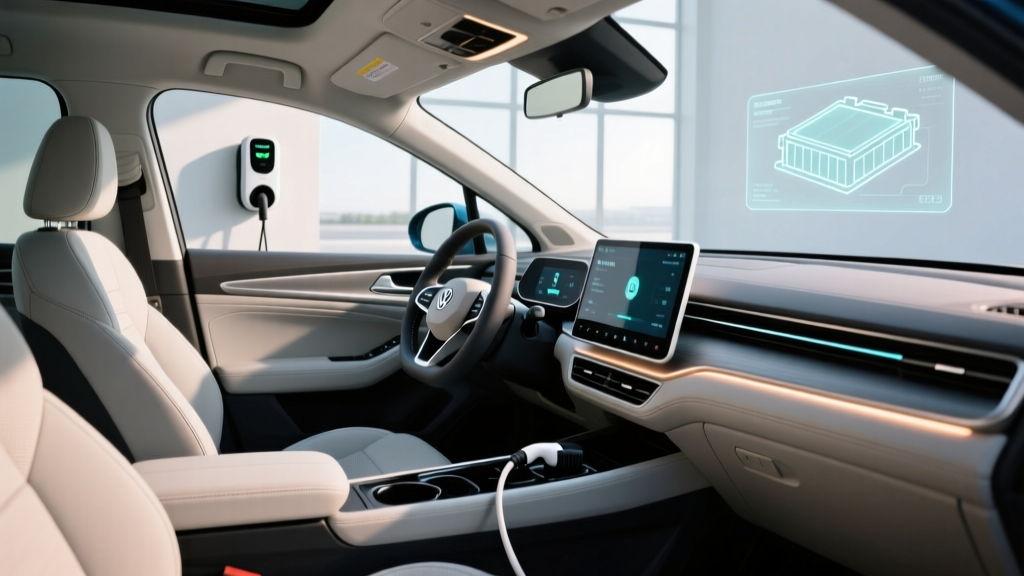
The VW ID.4 interior is where this SUV makes its strongest case against competitors. Volkswagen designed the cabin around a flat floor (a benefit of the dedicated MEB EV platform), which creates excellent rear legroom and a low step-in height. Here's what you get:
- Front headroom: 41.1 inches
- Rear legroom: 37.6 inches — competitive with the Toyota RAV4 and notably more than the Hyundai Ioniq 5's 39.4 inches in a more upright seating position
- Cargo volume (rear seats up): 30.3 cu ft
- Cargo volume (rear seats folded): 64.2 cu ft
- No front trunk (frunk): The MEB platform places ancillary components under the hood, eliminating frunk storage — a notable omission versus the Ioniq 5 and Ford Mustang Mach-E
Materials quality is solid for the class. Lower trims use cloth and synthetic leather combinations; the Pro S and top-tier trims add perforated leatherette with heated and ventilated front seats. The panoramic fixed-glass roof (standard on Pro S) creates an airy cabin feel, though it does not open.
The infotainment system centers on a 12.9-inch touchscreen (upgraded from earlier model years) running VW's ID. Software 4.0. Response times are improved over the ID.4's launch-year software, but the touch-capacitive steering wheel controls remain a common owner complaint — they lack tactile feedback and are easy to trigger accidentally. Wireless Apple CarPlay and Android Auto are standard. A 10.25-inch digital instrument cluster sits behind the wheel, displaying speed, range, and navigation prompts.
Driver assistance is handled by VW's IQ.DRIVE suite, which includes adaptive cruise control with stop-and-go, lane-centering assist, automatic emergency braking, blind-spot monitoring, and rear cross-traffic alert. This is a SAE Level 2 system — the driver must remain fully engaged with hands on the wheel and eyes on the road at all times. It is not self-driving, and it does not offer hands-free operation like GM's Super Cruise or Ford's BlueCruise on mapped highways.
Pricing, Trims, and Federal Tax Credit Eligibility
The 2026 ID.4 lineup spans five trims, starting at $40,790 (including destination) for the Standard Range and climbing to approximately $55,000 for a fully optioned Pro S Plus AWD. Here's a breakdown of key trims:
| Trim | MSRP | §30D Credit Eligibility | Est. Effective Price |
|---|---|---|---|
| Standard Range | $40,790 | Eligible (up to $7,500) | ~$33,290* |
| Pro | $45,790 | Eligible (up to $7,500) | ~$38,290* |
| Pro S | $48,290 | Eligible (up to $7,500) | ~$40,790* |
| Pro S AWD | $50,290 | Eligible (up to $7,500) | ~$42,790* |
| Pro S Plus AWD | ~$54,790 | Eligible (up to $7,500) | ~$47,290* |
*Effective price assumes full $7,500 §30D credit. Eligibility depends on buyer income, battery sourcing, and MSRP caps. See details below.
Does the ID.4 Qualify for the Federal EV Tax Credit?
As of the current tax year, the VW ID.4 qualifies for the IRS §30D Clean Vehicle Credit, which offers up to $7,500. However, eligibility is not automatic for every buyer. Under current rules, you must meet several requirements:
- MSRP cap: The vehicle's MSRP must not exceed $80,000 for SUVs — all ID.4 trims clear this easily.
- Buyer income cap: Modified adjusted gross income must not exceed $150,000 (single), $225,000 (head of household), or $300,000 (joint).
- Battery sourcing: The credit splits into two halves — $3,750 for critical-minerals sourcing and $3,750 for battery-component assembly. Volkswagen has worked to localize supply chains, but the exact credit amount ($3,750 or the full $7,500) can vary by model year and production batch. Verify the specific VIN's eligibility on fueleconomy.gov before purchase.
- Point-of-sale transfer: Eligible buyers can transfer the credit to the dealer at purchase, reducing the out-of-pocket price immediately rather than waiting for a tax refund.
Because §30D rules and battery-sourcing requirements evolve, consult a tax professional and verify on the IRS website before committing to a purchase.
Warranty Coverage and Long-Term Battery Outlook
Volkswagen provides one of the strongest battery warranties in the mainstream EV segment:
- Battery warranty: 8 years / 100,000 miles (whichever comes first), guaranteeing a minimum of 70% capacity retention
- Powertrain warranty: 8 years / 100,000 miles
- Bumper-to-bumper: 4 years / 50,000 miles
The 70% retention threshold is industry-standard (matching Tesla, Hyundai, and Ford). NMC batteries in the ID.4 typically degrade 1-2% per year under normal use, meaning most owners will see roughly 85-90% capacity after five years based on fleet degradation data from Geotab. To maximize longevity, avoid routinely charging to 100% on NMC packs — setting a daily charge limit of 80% is recommended, with 100% reserved for road-trip departures.
Pros and Cons: The Honest Assessment
Pros
- Spacious, flat-floor cabin with 37.6" rear legroom and 64.2 cu ft max cargo
- Strong 8-year/100,000-mile battery and powertrain warranty
- Competitive pricing after §30D tax credit — Pro RWD near $38K effective
- Comfortable ride quality tuned for daily commuting, not sporty pretensions
- Standard IQ.DRIVE Level 2 driver assists across all trims
- Improved infotainment responsiveness with 12.9" screen on current software
Cons
- No frunk — a missed opportunity for under-hood storage
- Touch-capacitive steering wheel controls are frustrating and imprecise
- 175 kW peak DC charging trails Hyundai/Kia's 240 kW and Tesla's ~250 kW
- Rear drum brakes (on RWD trims) may concern some buyers, though regen offsets wear
- AWD range drops to 263 miles — below some competitors
- IQ.DRIVE requires hands-on-wheel — no hands-free highway driving option
ID.4 vs. Key Competitors: Is It Worth Buying?
The ID.4's most direct rivals are the Hyundai Ioniq 5, Tesla Model Y, and Ford Mustang Mach-E. Here's how they compare on the metrics that matter:
| Attribute | 2026 VW ID.4 Pro | Hyundai Ioniq 5 (Long Range) | Tesla Model Y LR |
|---|---|---|---|
| EPA Range | 275 mi | 303 mi | 330 mi |
| Max DC Charge | 175 kW | 240 kW | ~250 kW |
| 10-80% Time | ~28 min | ~18 min | ~20 min |
| Cargo (seats up) | 30.3 cu ft | 27.2 cu ft | 30.2 cu ft |
| Rear Legroom | 37.6 in | 39.4 in | 41.6 in |
| Base MSRP | $45,790 | $46,650 | $44,990 |
| Battery Warranty | 8 yr/100K mi | 10 yr/100K mi | 8 yr/120K mi |
The ID.4 wins on cargo space versus the Ioniq 5 and offers a more traditional, comfortable ride than the Tesla. Where it falls behind is charging speed and maximum range — if road-trip efficiency is your top priority, the Ioniq 5 and Model Y are measurably faster at public chargers. But for daily commuting, school runs, and weekend errands where home charging covers 95% of your needs, the ID.4's 275-mile EPA range and roomy cabin make a compelling case, especially at its post-credit price point.
Choose the VW ID.4 If:
- You prioritize cabin space and cargo room over maximum range
- You charge primarily at home and rarely need sub-20-minute DC fast charges
- You want a traditional SUV driving feel with a comfortable, compliant ride
- Strong battery warranty coverage gives you peace of mind
Look Elsewhere If:
- You take frequent 300+ mile road trips and need the fastest possible charging
- You want hands-free highway driving (consider GM's Super Cruise vehicles)
- Maximum range per charge is your top priority (Tesla Model Y leads here)
Frequently Asked Questions
What is the real-world range of the VW ID.4?
The EPA rates the ID.4 Pro RWD at 275 miles and the Pro S AWD at 263 miles. In real-world highway driving at 70+ mph, expect 230–255 miles. In cold weather below 30°F without battery preconditioning, range can drop to 190–220 miles. City driving with regenerative braking can match or exceed EPA estimates in mild temperatures.
How fast does the ID.4 charge at home and on DC fast chargers?
On a Level 2 home charger (240V, 11 kW), the ID.4 adds roughly 37 miles of range per hour, achieving a full charge overnight in 7.5–8.5 hours. On a DC fast charger, the Pro models peak at 175 kW and charge from 10-80% in approximately 28 minutes. The Standard Range models peak at 140 kW with a similar 10-80% time due to the smaller battery.
How much does the VW ID.4 cost after the federal tax credit?
With the full $7,500 §30D credit applied at point of sale, the ID.4 Pro RWD drops from $45,790 to approximately $38,290. Eligibility requires meeting IRS income caps ($150K single / $300K joint), and the credit amount depends on battery-sourcing compliance for the specific VIN. Verify eligibility on fueleconomy.gov and consult a tax professional.
Does the VW ID.4 have a frunk?
No. The ID.4 does not have a front trunk. Volkswagen uses the under-hood space for power electronics and ancillary components on its MEB platform. If frunk storage is important to you, the Hyundai Ioniq 5, Ford Mustang Mach-E, and Tesla Model Y all offer front cargo compartments.
Is the ID.4 self-driving?
No. The ID.4's IQ.DRIVE system is classified as SAE Level 2 driver assistance. It provides adaptive cruise control and lane-centering, but the driver must keep hands on the steering wheel and eyes on the road at all times. It does not offer hands-free or eyes-off capability.
What is the ID.4's battery warranty?
Volkswagen covers the ID.4's high-voltage battery for 8 years or 100,000 miles, whichever comes first, guaranteeing at least 70% of original capacity. The powertrain carries the same 8-year/100,000-mile coverage.
Sources: EPA fueleconomy.gov, IRS §30D Clean Vehicle Credit, IIHS safety ratings.