Quick Verdict: The VW ID R Brings Real Performance to VW's EV Lineup
Volkswagen's ID family has been practical and efficient, but rarely exciting. The 2026 VW ID R changes that equation. Built on an evolution of the MEB platform, the ID R pairs dual-motor all-wheel drive with a lowered sport suspension and aggressive aero to deliver genuine sports-sedan acceleration while maintaining enough range and charging speed for real ownership. At a base MSRP near $54,990, it undercuts the Tesla Model S and Porsche Taycan on price while offering competitive performance metrics. The question isn't whether the ID R is fast — it is — but whether VW's software, charging network access, and interior execution justify the premium over its own ID.4 or ID.7 siblings.
| Spec | Value |
|---|---|
| EPA Range | 285 miles (est.) |
| Battery (usable) | 82 kWh, NMC chemistry |
| Drivetrain | Dual-motor AWD |
| Horsepower | 580 HP (combined, boost mode) |
| 0–60 mph | 3.4 seconds |
| Top Speed | 155 mph (electronically limited) |
| DC Fast Charge (peak) | 200 kW |
| 10–80% DC Charge | ~28 minutes |
| Level 2 Charge Rate | 11 kW (~33 mi/hr) |
| Efficiency | 105 MPGe / 32 kWh/100 mi |
| Cargo (rear seats up) | 18.6 cu ft |
| Cargo (rear seats folded) | 52.3 cu ft |
| Base MSRP | $54,990 |
| Battery/Powertrain Warranty | 8 years / 100,000 miles |
Range and Efficiency: EPA Numbers vs. Real-World Driving
The VW ID R carries an 82 kWh usable NMC (nickel-manganese-cobalt) battery pack. Volkswagen opted for NMC over LFP here to maximize energy density, which matters in a performance-oriented sedan where weight distribution and total mass affect handling. The EPA-estimated range sits at approximately 285 miles for the base Pro S trim, dropping to an estimated 270 miles on the higher-spec R Performance variant due to its stickier 21-inch summer tires and more aggressive aero drag from the fixed rear wing.
EPA Sticker: 285 miles (Pro S) / 270 miles (R Performance)
Real-World Highway (70–75 mph, 68°F): ~240–255 miles
Real-World Cold Weather (30°F, highway): ~200–220 miles
City/Commuting (regen-heavy): ~270–285 miles
Note: Efficiency drops significantly above 75 mph. The ID R's sport-tuned suspension and wider tires add rolling resistance. Expect to plan charging stops on road trips at roughly 220-mile intervals to maintain a comfortable 10% buffer.
Efficiency comes in at roughly 105 MPGe combined, or 32 kWh per 100 miles. That's less efficient than the ID.4 Pro S (107 MPGe) but expected given the AWD system, performance motors, and wider rubber. On fueleconomy.gov, you can compare these figures directly against the Tesla Model 3 Performance (113 MPGe) and Hyundai Ioniq 6 (140 MPGe) for context. The ID R trades some efficiency for the torque and grip its AWD system provides.
Charging Speed: DC Fast Charge and Home Level 2
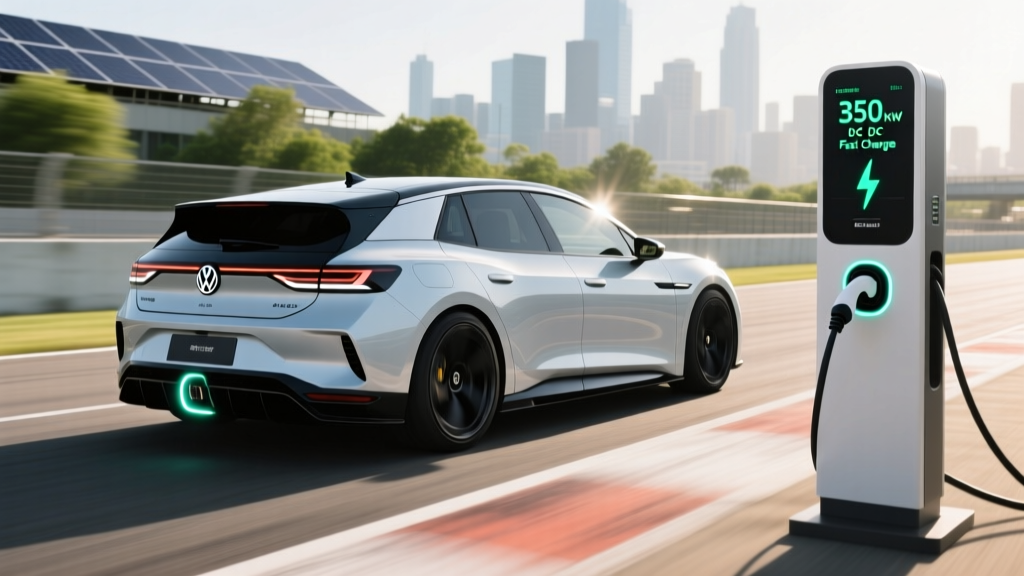
Charging is where many performance EVs disappoint — big batteries take time to refill. The ID R's 82 kWh pack supports a peak DC fast-charge rate of 200 kW via CCS1 (with NACS adapter compatibility for Tesla Supercharger access). In practice, the charge curve is respectable: VW holds near-peak rates from roughly 10% to 40% SoC, then tapers progressively. A 10–80% session at a capable 350 kW Electrify America or ChargePoint station takes approximately 28 minutes.
| Level | Max Power | Miles Added per Hour | Notes |
|---|---|---|---|
| Level 1 (120V) | 1.4 kW | ~4 mi/hr | Emergency/trickle only |
| Level 2 (240V, 48A) | 11 kW | ~33 mi/hr | Full overnight charge in ~8 hrs |
| DC Fast (CCS1/NACS) | 200 kW peak | ~600 mi/hr (peak) | 10–80% in ~28 min; tapers above 80% |
Above 80% SoC, charge speed drops sharply — expect 50 kW or less — which is standard for NMC chemistry to protect long-term battery health. Preconditioning activates automatically when a DC fast-charger is set as your navigation destination, warming the pack to optimal temperature. In cold weather (below 40°F), preconditioning is essential; without it, peak charge rates may not exceed 120 kW for the first several minutes.
For home charging, the onboard 11 kW AC charger means a full 0–100% charge takes about 8 hours on a properly installed Level 2 home station (240V, 48A circuit). Most ID R owners will plug in nightly and wake up to a full battery. VW includes a mobile charge cord for Level 1 and basic Level 2 use, but we recommend a dedicated hardwired Level 2 unit (ChargePoint Home Flex or Wallbox Pulsar Max) for daily ownership.
Performance: 580 HP, Dual-Motor AWD, and a 3.4-Second 0–60
The ID R's dual-motor setup produces 580 horsepower and an estimated 540 lb-ft of torque in boost mode (activated via steering-wheel button, available for 30-second bursts). In standard drive mode, output is approximately 450 HP. The rear motor handles most cruising duties for efficiency, while the front induction motor engages on demand for AWD grip and performance acceleration.
The 3.4-second 0–60 mph time puts the ID R in direct competition with the Tesla Model 3 Performance (3.1 seconds) and the BMW i4 M50 (3.7 seconds). Where the ID R distinguishes itself is in chassis tuning: VW's R division lowered the ride height by 0.8 inches versus the ID.7, added adaptive dampers, and fitted a mechanical limited-slip differential simulation via torque vectoring. The result is genuinely engaging handling on back roads, with well-controlled body roll and communicative electric steering — a rarity in the MEB platform family.
Braking duties are handled by 14.2-inch front and 13.4-inch rear vented discs with regenerative blending. One-pedal driving is available but not as aggressive as Tesla or Hyundai's implementation; most drivers will still use the friction brakes for final stops. The regen system recovers up to 0.3g of deceleration, which is moderate for the segment.
Interior, Tech, and Cargo: Sport Meets Practical
Inside, the ID R adopts VW's latest ID. Software 4.0 infotainment system on a 15-inch center touchscreen with a redesigned interface that addresses the lag and menu-depth complaints of earlier ID models. A 10.25-inch digital instrument cluster sits behind a flat-bottom sport steering wheel with haptic touch controls (improved from earlier capacitive sliders). Wireless Apple CarPlay and Android Auto are standard, along with a 15W wireless charging pad.
Seating is sport-oriented: the front buckets feature integrated headrests, synthetic leather upholstery (VW's "ArtVelours Eco" material), and 12-way power adjustment with lumbar. Rear legroom measures 37.1 inches — adequate for adults on shorter trips but tighter than the ID.7 sedan's 39.8 inches due to the ID R's lower roofline and sport seat padding. Cargo volume is 18.6 cubic feet behind the rear seats and 52.3 cubic feet with the 60/40 split rear seats folded. A small front trunk (frunk) adds approximately 1.8 cubic feet for charging cables.
Driver assistance comes via VW's IQ.DRIVE suite, which includes adaptive cruise control with stop-and-go, lane centering, blind-spot monitoring, and automatic emergency braking. This is a Level 2 SAE driver-assist system — the driver must remain fully engaged with hands on the wheel and eyes on the road. It is not autonomous driving. The system is competent for highway cruising but requires frequent steering-wheel torque input to confirm driver attention.
Pricing, Trims, and Federal Tax Credit Eligibility
The 2026 VW ID R is offered in two trims:
- ID R Pro S: $54,990 MSRP — includes 20-inch alloy wheels, adaptive dampers, IQ.DRIVE suite, heated/ventilated front seats, panoramic glass roof, 11 kW onboard charger.
- ID R Performance: $59,490 MSRP — adds 21-inch forged wheels, fixed rear wing, R-specific interior trim, head-up display, premium Harman Kardon audio (9 speakers), and a heat pump for improved cold-weather range.
| Trim | MSRP | Max §30D Credit | Effective Price* |
|---|---|---|---|
| ID R Pro S | $54,990 | Up to $7,500 | ~$47,490 |
| ID R Performance | $59,490 | Up to $7,500 | ~$51,990 |
*Effective price assumes full $7,500 credit eligibility. Actual credit depends on battery component and critical-mineral sourcing requirements, buyer income caps, and MSRP limits per IRS §30D rules. The ID R's MSRP is under the $55,000 sedan cap, but buyers must verify income thresholds ($150K single / $300K joint AGI) and confirm VW's battery sourcing compliance for the specific model year.
§30D Eligibility Checklist for the 2026 VW ID R:
- MSRP must be under $55,000 for sedans (Pro S qualifies; Performance trim at $59,490 exceeds the cap and is ineligible)
- Buyer AGI must not exceed $150,000 (single), $225,000 (head of household), or $300,000 (married filing jointly)
- Battery components must meet North American assembly thresholds (verify with VW at time of purchase)
- Critical minerals must meet US-sourced or FTA-partner sourcing requirements
- Credit can be transferred to the dealer at point of sale for an instant price reduction
An important note: the ID R Performance trim at $59,490 exceeds the §30D sedan MSRP cap of $55,000. Only the Pro S trim qualifies for the full federal credit, assuming all other sourcing and income requirements are met. Buyers eyeing the Performance trim should factor in the full MSRP or explore state-level incentives, which vary by jurisdiction.
Warranty and Long-Term Battery Health
Volkswagen backs the ID R with an 8-year/100,000-mile battery and powertrain warranty, covering defects and capacity loss below 70% of original capacity. The vehicle limited warranty runs 4 years/50,000 miles. This matches the segment standard set by Tesla, Hyundai, and Ford.
The NMC chemistry in the ID R has proven durable in VW's existing ID.4 fleet, with most owners reporting less than 5% degradation at 40,000 miles based on owner-forum data and third-party testing. VW's thermal management system uses a liquid-cooling plate beneath the battery modules with active heating and cooling, which is critical for maintaining longevity during repeated DC fast-charging sessions. For maximum battery health, VW recommends daily charging to 80% and reserving 100% charges for road trips.
Pros, Cons, and Who Should Buy the VW ID R
Pros
- Genuine sports-sedan acceleration (3.4s 0–60) with composed AWD handling
- 200 kW DC fast charging keeps road-trip stops under 30 minutes
- IQ.DRIVE Level 2 assist is smooth and reliable for highway commuting
- Pro S trim qualifies for up to $7,500 federal tax credit, bringing effective price under $48K
- Improved ID. Software 4.0 with responsive 15-inch touchscreen
- 8-year/100,000-mile battery warranty with 70% capacity retention guarantee
Cons
- Performance trim ($59,490) exceeds §30D MSRP cap — no federal credit
- Real-world highway range (~240 mi) trails EPA estimate; plan road trips conservatively
- Rear legroom (37.1 in) is tighter than ID.7 sedan and Model S
- CCS1 connector requires NACS adapter for Tesla Supercharger access
- Regen braking is mild; one-pedal driving isn't as strong as competitors
- No V2L (vehicle-to-load) capability at launch
Choose the VW ID R if: You want a sporty dual-motor AWD EV under $55K (after credit) with engaging handling, you mostly commute and road-trip within a 250-mile radius, and you value VW's build quality and dealer network over cutting-edge range.
Look elsewhere if: You need maximum range (Hyundai Ioniq 6 offers 360 mi EPA), you want Tesla Supercharger-native access without adapters, you need spacious rear seats for family duty, or you want Level 2+ hands-free driving like GM's Super Cruise or Ford's BlueCruise.
Frequently Asked Questions
What is the real-world range of the 2026 VW ID R?
The EPA estimates 285 miles for the Pro S trim and 270 miles for the Performance trim. In real-world highway driving at 70–75 mph in moderate temperatures, expect 240–255 miles. In cold weather below 30°F with highway speeds, range can drop to 200–220 miles. City driving with regenerative braking can approach or match EPA figures.
How fast does the VW ID R charge?
On a DC fast charger, the ID R peaks at 200 kW and charges from 10–80% in approximately 28 minutes under ideal conditions. Above 80%, charging slows significantly to protect the NMC battery. At home on a Level 2 (240V, 48A) charger, the 11 kW onboard charger adds about 33 miles of range per hour, completing a full charge in roughly 8 hours.
Does the VW ID R qualify for the federal EV tax credit?
The ID R Pro S at $54,990 falls under the §30D sedan MSRP cap of $55,000 and may qualify for up to $7,500 in federal tax credits, provided the buyer meets income limits ($150K single / $300K joint AGI) and VW's battery meets critical-mineral and component sourcing requirements. The ID R Performance at $59,490 exceeds the MSRP cap and does not qualify. Always verify current eligibility on IRS.gov before purchasing.
Is the VW ID R worth buying versus the Tesla Model 3 Performance or BMW i4 M50?
The ID R Pro S (~$47,490 after credit) is significantly cheaper than the Model 3 Performance (~$52,990) and the BMW i4 M50 (~$67,000). It sacrifices some range and Supercharger-native access compared to Tesla, and lacks the BMW's brand cachet and slightly sharper steering. But for buyers prioritizing value, AWD grip, and a comfortable daily-driving experience with real performance, the ID R Pro S is a compelling choice. If range and charging network are top priorities, the Model 3 Performance remains the benchmark.
What is the biggest drawback of the VW ID R?
The most significant limitation is real-world highway range. At 240–255 miles in practice, the ID R requires more frequent charging stops on road trips than competitors like the Ioniq 6 (360 mi EPA) or Tesla Model 3 Long Range (341 mi EPA). Combined with CCS1 requiring an adapter for Tesla Superchargers, long-distance travel requires more planning. Additionally, the Performance trim's ineligibility for the federal tax credit makes it a harder value proposition.
What connector does the VW ID R use?
The 2026 ID R uses a CCS1 connector for DC fast charging and a J1772 inlet for Level 2 AC charging. VW provides a NACS adapter for Tesla Supercharger compatibility, though peak charge rates on Supercharger stalls (typically 150–250 kW) may differ from Electrify America stations. VW has signaled a native NACS port transition for future model years, but the 2026 ID R ships with CCS1.