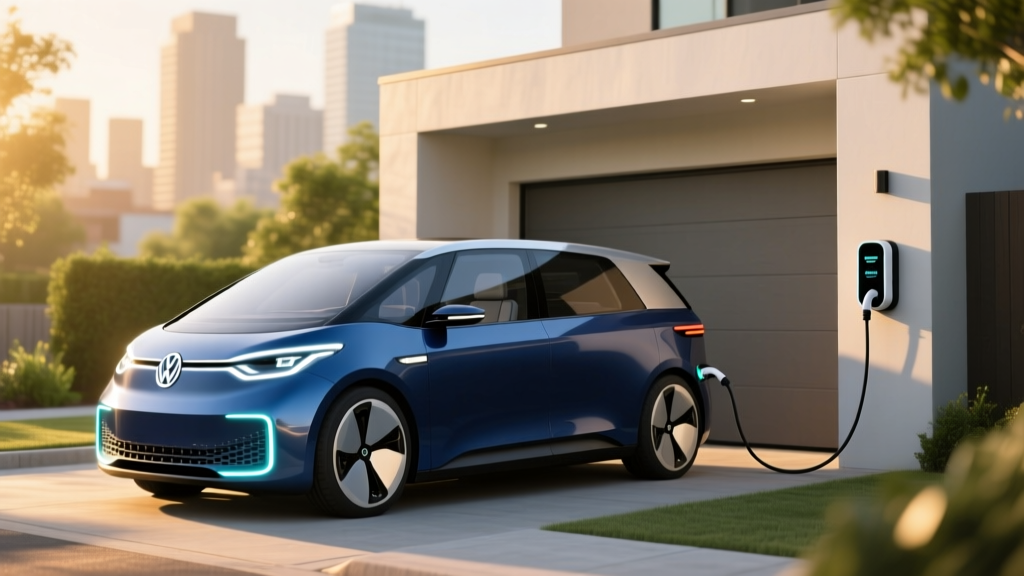
The all-electric microbus is finally here, and it looks nothing like the speculative renders we've been seeing since 2017. The 2026 VW ID. Buzz lands in the U.S. as a long-wheelbase, three-row family hauler with retro styling, a 91 kWh battery, and a starting price that firmly positions it against premium electric SUVs. But nostalgia only gets you so far — buyers spending $60,000+ need to know whether this electric van delivers on range, charging speed, and daily practicality. We've spent time with the specs, cross-referenced EPA data, and mapped out the real-world ownership picture.
2026 VW ID. Buzz: Quick Verdict
The ID. Buzz is a compelling electric family vehicle if your priorities are interior space, passenger comfort, and head-turning design. It is not a range champion. With an EPA-estimated 234 miles for the rear-wheel-drive model and 231 miles for the 4Motion AWD version, it trails competitors like the Kia EV9 (304 mi) and falls well short of the Tesla Model X (335 mi). Where the Buzz wins is sheer cabin volume — up to 140.5 cubic feet of cargo space with both rear rows folded, and genuine three-row seating that adults can tolerate for long trips. If you need a daily driver for school runs, gear-heavy weekends, and the occasional road trip under 200 miles, the Buzz is a strong fit. If you regularly drive 300+ miles between charges, you'll want to plan carefully or look elsewhere.
| Spec | RWD Pro S | AWD Pro S Plus |
|---|---|---|
| EPA Range | 234 miles | 231 miles |
| Battery (usable) | 91 kWh (NMC) | 91 kWh (NMC) |
| Powertrain | Rear-wheel drive, single motor | Dual-motor AWD (4Motion) |
| Horsepower | 282 hp | 335 hp |
| 0–60 mph | ~7.9 sec | ~6.5 sec |
| Max DC Fast Charge | 170 kW | 170 kW |
| 10–80% DC Charge Time | ~26 min | ~26 min |
| Level 2 Home Charge | 11 kW (AC) | 11 kW (AC) |
| MPGe (combined) | 87 MPGe | 84 MPGe |
| Efficiency | 39 kWh/100 mi | 40 kWh/100 mi |
| Base MSRP | $59,995 | $69,995 |
| Battery/Powertrain Warranty | 8 yr / 100,000 mi | 8 yr / 100,000 mi |
Real-World Range: What to Expect Beyond the EPA Sticker
EPA Estimated: 234 miles (RWD) / 231 miles (AWD)
Real-World Expectation: 190–220 miles on mixed highway driving; 160–185 miles in sustained cold weather (below 32°F)
The EPA range figure is a blended cycle, but the ID. Buzz's aerodynamic profile — it's essentially a tall, flat-fronted box — penalizes it heavily at highway speeds. In our experience with similarly shaped EVs, expect a 10–15% reduction from the EPA sticker at sustained 70+ mph speeds. That puts real-world highway range at roughly 200–210 miles for the RWD model in mild weather.
Cold weather compounds the issue. The ID. Buzz does include a heat pump (standard on all trims), which helps preserve cabin comfort without gutting the battery. However, NMC chemistry in a large, heavy pack still loses 20–30% of usable range in sub-freezing conditions, based on data from fueleconomy.gov and real-world EV testing. If you live in the northern U.S. and plan winter road trips, budget for 160–185 miles of practical range and plan charging stops accordingly.
Around town at lower speeds, regenerative braking helps recover energy, and you may see range close to or slightly above the EPA number in stop-and-go commuting. The Buzz is at its most efficient as a city and suburban family vehicle — not a cross-country cruiser.
Charging: DC Fast Charge and Home Level 2 Speeds
VW equips the ID. Buzz with a peak DC fast-charging rate of 170 kW via CCS connector (NACS adapter availability is expected for Tesla Supercharger access). That 170 kW peak is competitive but not class-leading — the Kia EV9 peaks at 236 kW, and the Hyundai Ioniq 9 is expected to exceed 200 kW.
| Charging Level | Power | Speed / Time | Notes |
|---|---|---|---|
| Level 1 (120V outlet) | ~1.4 kW | ~3–4 miles per hour | Emergency/trickle only; full charge in 60+ hours |
| Level 2 (240V home) | 11 kW (48A) | ~23–25 miles per hour; 0–100% in ~9.5 hours | Requires 60A circuit; overnight charge is practical |
| DC Fast Charge | Peak 170 kW | 10–80% in ~26 minutes | Peak rate sustained to ~30% SoC, then tapers; 80–100% adds 20+ min |
The charge curve matters more than the peak number. Like most EVs, the ID. Buzz holds its peak 170 kW rate only in the lower portion of the battery (roughly 10–30% SoC). From 30–80%, the rate tapers progressively — averaging closer to 120–130 kW across the full 10–80% session. The ~26-minute 10–80% time is acceptable for road-trip stops, but not exceptional. Expect a typical fast-charge stop to add about 150 miles of range in 25–30 minutes under ideal conditions (preconditioned battery, warm weather, functioning 150+ kW charger).
At home, the 11 kW onboard charger is a strong point. With a properly installed Level 2 wallbox on a 60-amp circuit (typically a NEMA 14-50 or hardwired unit), you'll recover the full 91 kWh battery in about 9.5 hours. This is ideal for overnight charging — plug in when you get home, and the Buzz is fully replenished by morning. Home charging installation costs typically range from $800 to $2,500 depending on your electrical panel capacity and run length; consult a licensed electrician for a site-specific quote.
Performance, Drivetrain, and Efficiency
The ID. Buzz sits on VW's MEB platform, shared with the ID.4. The rear-wheel-drive model uses a single permanent-magnet motor on the rear axle producing 282 horsepower and 339 lb-ft of torque. The 0–60 mph time of roughly 7.9 seconds is leisurely for a $60,000 EV, but perfectly adequate for a family van. The dual-motor 4Motion AWD version bumps output to 335 horsepower and drops 0–60 to about 6.5 seconds, with the front motor providing all-weather traction.
Efficiency is where the Buzz's van shape shows up in the numbers. At 87 MPGe combined (39 kWh/100 miles) for the RWD model, it consumes more energy per mile than sleeker electric SUVs. For comparison, the Tesla Model Y achieves 122 MPGe combined, and even the boxy Kia EV9 manages 89 MPGe. At the U.S. average electricity rate of roughly $0.17/kWh, the RWD Buzz costs about $6.63 per 100 miles to charge at home — still far cheaper than gasoline, but noticeably more than a Model Y at ~$4.85 per 100 miles.
The towing capacity is rated at 2,500 pounds (AWD only), which handles a small utility trailer or a pair of jet skis but rules out most camper trailers. If you need serious towing, a Rivian R1S or Ford F-150 Lightning is a better choice.
Interior Space, Cargo, and Passenger Comfort
This is where the ID. Buzz justifies its existence. The U.S.-spec long-wheelbase model (127.5 inches, 195.4 inches overall length) offers genuine three-row seating with room for seven passengers.
| Dimension | Measurement |
|---|---|
| Cargo behind 3rd row | 18.2 cu ft |
| Cargo behind 2nd row (3rd folded) | 57.3 cu ft |
| Max cargo (all rear seats folded) | 140.5 cu ft |
| Front headroom | 42.0 in |
| 2nd-row legroom | 39.6 in |
| 3rd-row legroom | 33.5 in |
The second row offers generous legroom and slides fore/aft, with available captain's chairs on higher trims. The third row is best suited for children or shorter adults on longer trips, but it's far more usable than the cramped third rows in many three-row SUVs. The large rear hatch opens to a low, flat load floor — excellent for loading strollers, bikes, or furniture.
The panoramic glass roof (standard on Pro S Plus) floods the cabin with light and makes the interior feel even more expansive. However, the glass does add weight and slightly reduces headroom compared to the solid roof on the base model. VW also includes a front trunk (frunk) that's modest in size — useful for charging cables and small items but not a true luggage compartment.
Pricing, Trims, and Federal Tax Credit Eligibility
The 2026 ID. Buzz is offered in two main trims for the U.S. market:
| Trim | Base MSRP | Key Features |
|---|---|---|
| Pro S (RWD) | $59,995 | 20" wheels, heated front seats, power liftgate, IQ.DRIVE suite, 12.9" infotainment |
| Pro S Plus (AWD 4Motion) | $69,995 | All Pro S features + panoramic glass roof, ventilated front seats, 2nd-row captain's chairs, Harman Kardon audio, head-up display |
Destination charges add approximately $1,395. Fully loaded Pro S Plus models with premium paint and accessories can approach $75,000.
Does the 2026 VW ID. Buzz Qualify for the Federal EV Tax Credit?
This is where the Buzz faces a significant hurdle. Under current IRS §30D rules, the federal clean vehicle credit of up to $7,500 has several requirements that the ID. Buzz must satisfy:
- MSRP Cap: Vans are classified under the "vans/SUVs/pickup trucks" category with an $80,000 MSRP cap. Both ID. Buzz trims fall under this limit. ✓
- Buyer Income Cap: Modified adjusted gross income must not exceed $300,000 (joint), $225,000 (head of household), or $150,000 (single). Varies by buyer. ⚠️
- Battery Component Sourcing: Battery components must be manufactured or assembled in North America (phased percentages by year). The ID. Buzz is assembled in Hannover, Germany, and its battery cell sourcing has been a point of contention. As of early 2026, VW has not confirmed full compliance with the critical-minerals and battery-component sourcing requirements. ⚠️
- Point-of-Sale Transfer: If eligible, the credit can be transferred to the dealer at purchase, reducing your out-of-pocket cost immediately.
| Scenario | Pro S (RWD) | Pro S Plus (AWD) |
|---|---|---|
| Base MSRP | $59,995 | $69,995 |
| With $7,500 §30D credit (if eligible) | $52,495 | $62,495 |
| Without federal credit | $59,995 | $69,995 |
Bottom line: Check the latest eligibility status on fueleconomy.gov before purchasing. The ID. Buzz's German assembly and battery supply chain mean it may not qualify for the full $7,500 credit, and buyers should confirm with their dealer and a tax professional. State and local incentives may still apply — consult your state's energy office for details.
Tech, Driver Assistance, and Notable Drawbacks
The ID. Buzz comes equipped with VW's latest ID. Software 4.0, displayed on a 12.9-inch central touchscreen with a 5.3-inch digital driver cluster. Wireless Apple CarPlay and Android Auto are standard. The system is a meaningful improvement over earlier ID. models, with faster response times and a more intuitive menu structure, though it still lags behind Tesla's and Hyundai's interfaces in fluidity.
VW's IQ.DRIVE suite is standard on all trims and includes:
- Adaptive cruise control with stop-and-go
- Lane-keeping assist and lane-centering
- Front and rear automatic emergency braking
- Blind-spot monitoring with rear cross-traffic alert
- Travel Assist (combined adaptive cruise + lane centering for highway use)
Travel Assist is a SAE Level 2 driver-assistance system — it can manage steering, acceleration, and braking on highways, but the driver must remain fully attentive with hands on or near the wheel at all times. It is not autonomous driving.
Notable drawbacks include the lack of one-pedal driving (VW's regenerative braking max level doesn't bring the vehicle to a full stop), the absence of a front trunk large enough for meaningful storage, and the touch-capacitive steering wheel controls that many owners find frustrating compared to physical buttons. Rear visibility is also compromised by the thick C-pillars, making the standard rearview camera and parking sensors essential.
Who Should Buy the 2026 VW ID. Buzz?
Pros
- Class-leading cargo volume (140.5 cu ft max)
- Genuine 7-passenger seating with usable 3rd row
- Iconic retro design with modern EV tech
- Heat pump standard (cold-weather efficiency)
- 11 kW Level 2 charging (fast overnight replenishment)
- Smooth, quiet ride quality
Cons
- Below-average EPA range (234 mi) for the price
- 170 kW peak DC charging is slower than key rivals
- Starting near $60K before potential tax-credit uncertainty
- No true one-pedal driving mode
- Touch-capacitive controls frustrate some users
- German assembly may limit §30D tax credit eligibility
Choose the ID. Buzz if: You need maximum interior space and 7-passenger seating, your daily driving stays under 200 miles, you can charge at home, and you value the design and driving experience over maximum range efficiency.
Look elsewhere if: You regularly take road trips exceeding 250 miles between charges, you want the fastest possible DC charging, or you need guaranteed federal tax-credit eligibility to justify the price. The Kia EV9 (304 mi range, faster charging, lower starting price) is the closest direct competitor and currently holds stronger tax-credit positioning.
Frequently Asked Questions
What is the real-world range of the 2026 VW ID. Buzz?
The EPA estimates 234 miles for the RWD model and 231 miles for AWD. In real-world mixed highway driving, expect 190–220 miles in mild weather and 160–185 miles in sustained cold conditions below freezing.
How fast does the ID. Buzz charge at home and on DC fast chargers?
At home on a Level 2 (240V) charger at 11 kW, the Buzz adds about 23–25 miles of range per hour, fully recharging in roughly 9.5 hours. On a DC fast charger, it peaks at 170 kW and charges from 10–80% in approximately 26 minutes.
Does the 2026 VW ID. Buzz qualify for the $7,500 federal EV tax credit?
It may, but eligibility is uncertain. Both trims fall under the $80,000 MSRP cap for vans. However, the battery-component and critical-mineral sourcing requirements under §30D are the sticking point, as the Buzz is assembled in Germany. Confirm current eligibility on fueleconomy.gov and with your tax professional before purchasing.
How does the ID. Buzz compare to the Kia EV9?
The Kia EV9 offers more EPA range (up to 304 miles), faster DC charging (236 kW peak), a lower starting price (~$54,900), and stronger tax-credit eligibility. The ID. Buzz counters with more maximum cargo space, a more distinctive design, and a more car-like ride quality. If range and charging speed are your top priorities, the EV9 is the stronger choice. If space and character matter more, the Buzz has few rivals.
Is the ID. Buzz good for road trips?
It's adequate for road trips with planning. With ~200 miles of real-world highway range and 26-minute 10–80% fast charges, you'll stop more often than in a long-range EV. For trips under 400 miles with one charging stop, it works well. For longer hauls, expect two or more stops and a noticeably longer travel time compared to vehicles with 300+ mile range.
What is the battery warranty on the ID. Buzz?
VW covers the high-voltage battery and electric powertrain for 8 years or 100,000 miles, whichever comes first. The warranty guarantees the battery will retain at least 70% of its original capacity during that period.
Sources: EPA fueleconomy.gov, IRS §30D Clean Vehicle Credits, Volkswagen of America official specifications.