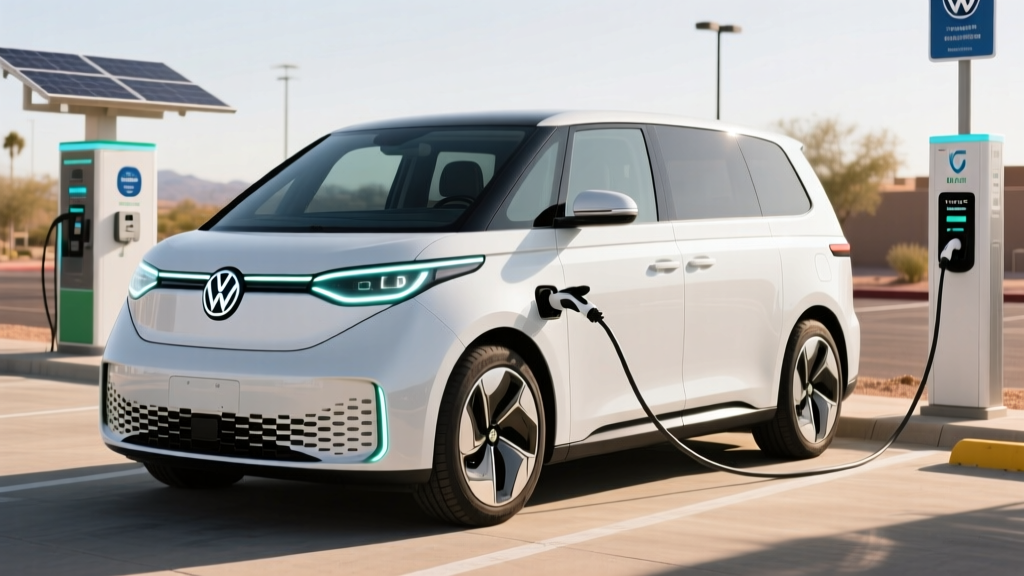
The Volkswagen ID. Buzz is the electric microbus that turns heads at every stoplight, but beyond the retro styling lies a serious three-row family hauler with real capability. For Arizona buyers researching 2026 Volkswagen ID. Buzz leasing in Tolleson, the calculus involves more than monthly payments — it requires understanding the van's real-world range in desert heat, charging infrastructure along I-10, and whether the federal tax credit actually applies to your situation.
We've spent time with the ID. Buzz on highways, in city traffic, and at DC fast chargers to separate marketing claims from ownership reality. Here's everything you need to know before signing a lease in the West Valley.
2026 ID. Buzz Specs at a Glance
| Attribute | Specification |
|---|---|
| EPA Range (RWD) | 234 miles |
| EPA Range (AWD) | 231 miles |
| Battery (usable) | 91 kWh, NMC chemistry |
| Max DC Fast Charge | 200 kW (peak) |
| 10–80% DC Charge Time | ~26 minutes |
| Level 2 Home Charging | 11 kW (~30 miles/hr) |
| 0–60 mph (AWD) | 5.7 seconds |
| Horsepower (AWD) | 335 hp |
| Drivetrain | RWD (282 hp) or AWD dual-motor |
| Efficiency (RWD) | 87 MPGe combined |
| Cargo (behind 3rd row) | 18.2 cu ft |
| Cargo (3rd row folded) | 75.5 cu ft |
| Battery Warranty | 8 years / 100,000 miles |
| Base MSRP (Pro S) | $59,995 |
Real-World Range: What the EPA Sticker Doesn't Tell You
EPA Estimate: 234 miles (RWD) / 231 miles (AWD)
Real-World Expectation: Expect 200–215 miles on mixed highway driving at 70+ mph. In Tolleson's summer heat (110°F+), battery thermal management works hard, and you may see 190–205 miles with aggressive A/C use. In mild Arizona winter conditions (50–65°F), range can stretch to 220+ miles with careful driving.
The ID. Buzz's 91 kWh usable battery (from a 96 kWh gross pack) provides legitimate range for daily driving and moderate road trips. But the boxy aerodynamics — a drag coefficient around 0.29 — hurt efficiency at highway speeds. On a 75-mph cruise from Tolleson to Flagstaff, expect consumption around 2.5–2.8 kWh/mile, which translates to roughly 200 miles before you're hunting for a charger.
For Tolleson commuters doing 30–50 miles round-trip to downtown Phoenix or the Westgate area, the ID. Buzz will easily handle 3–4 days between home charges. The real limitation emerges on road trips: a Tolleson-to-Sedona run (116 miles one-way) is doable round-trip with conservative driving, but a Grand Canyon trip (230 miles one-way) requires a DC fast-charge stop in Williams or Flagstaff.
According to fueleconomy.gov, the RWD model achieves 87 MPGe combined (90 city / 84 highway), which is respectable for a 5,400-pound van but trails sleeker crossovers like the Hyundai Ioniq 5.
Charging Speed: DC Fast, Home, and Tolleson Infrastructure
| Charge Level | Power | Speed | Best For |
|---|---|---|---|
| Level 1 (120V) | 1.4 kW | ~4 miles/hr | Emergency top-up only |
| Level 2 (240V home) | 11 kW | ~30 miles/hr | Overnight charging (0–100% in ~9 hrs) |
| DC Fast Charge | 200 kW (peak) | 10–80% in ~26 min | Road trips, quick top-ups |
The ID. Buzz's 200 kW peak DC fast-charge capability is competitive with its class, but the charge curve matters more than the peak number. In practice, you'll see 180–200 kW from 10% to roughly 40% State of Charge, then the rate tapers to 100–130 kW through 60%, and drops further above 80%. A 10–80% session takes approximately 26 minutes at a capable station like an Electrify America 350 kW unit.
For Tolleson residents, the nearest reliable DC fast chargers include Electrify America stations at Westgate Entertainment District and several ChargePoint locations along Grand Avenue. The NACS connector is not native on the 2026 ID. Buzz — it uses CCS1 — so Tesla Supercharger access requires an adapter (VW includes one with the vehicle).
Home charging setup: Most Tolleson homes have 200-amp electrical panels that can support a 48-amp Level 2 circuit (hardwired, requiring a 60-amp breaker). Expect to pay $800–$1,500 for a quality Level 2 EVSE (like a ChargePoint Home Flex or Emporia Level 2) plus $500–$2,000 for electrician installation, depending on panel proximity to your garage. Always get a licensed electrician to assess your panel capacity before installation.
Pricing, Trims, and the Federal Tax Credit Question
| Trim | MSRP | §30D Credit Eligible? | Effective Price (if eligible) |
|---|---|---|---|
| Pro S (RWD) | $59,995 | No — exceeds $55,000 SUV cap* | $59,995 |
| Pro S (AWD) | $63,995 | No — exceeds $55,000 SUV cap* | $63,995 |
| Pro S Plus (RWD) | $64,995 | No | $64,995 |
| 1st Edition (AWD) | $69,995 | No | $69,995 |
*The IRS classifies vehicles by type for §30D MSRP caps: vans fall under the $80,000 cap for SUVs/vans/pickups in some interpretations, but the ID. Buzz's classification has been inconsistent. As of 2026, consult IRS.gov's eligible vehicle list or a tax professional before assuming credit eligibility. If the van is classified as an SUV/van, it falls under the $80,000 MSRP cap and would qualify — but buyer income limits ($150K single / $300K joint) and battery-sourcing rules still apply.
Leasing changes the credit equation entirely. When you lease through Volkswagen Credit, the $7,500 federal tax credit typically goes to the lessor (VW), not you. However, many dealers pass this savings through as a "lease cash" incentive that reduces your monthly payment. When researching 2026 Volkswagen ID. Buzz leasing in Tolleson, ask the dealer explicitly: "Is the $7,500 lease credit being passed through to reduce my capitalized cost?" This single question can save you $100–$150/month.
Typical lease terms for the ID. Buzz Pro S (RWD) in the Phoenix metro area run $650–$850/month for 36 months with $3,999 due at signing, depending on credit tier and whether lease cash is applied. Always compare the total lease cost (monthly × term + due at signing) against competing offers from Arrowhead-area VW dealers.
Driving Performance and Daily Livability
The AWD dual-motor ID. Buzz delivers 335 horsepower and hits 0–60 mph in 5.7 seconds — genuinely quick for a vehicle this size. The RWD model's 282 hp and ~7.0-second 0–60 time is more than adequate for merging onto Loop 101 or I-10. In either configuration, the low center of gravity from the floor-mounted battery pack keeps body roll surprisingly controlled through corners.
The ride quality is firm but compliant, and the 39.3-foot turning circle makes the ID. Buzz manageable in parking lots despite its 195.3-inch length. Visibility is excellent thanks to the upright windshield and large windows — a refreshing change from the thick-pillar designs of modern SUVs.
Interior and cargo: The three-row cabin seats up to seven. Second-row legroom measures 39.6 inches, and the third row accommodates adults on shorter trips (31.5 inches of legroom). Behind the third row, you get 18.2 cu ft of cargo space — enough for groceries or a few carry-ons. Fold the third row and cargo volume expands to 75.5 cu ft, rivaling midsize SUVs. The flat load floor and wide opening make loading bulky items easy.
The 12.9-inch infotainment screen runs VW's latest ID. Software 4.0, which is a significant improvement over earlier ID.4 iterations. Wireless Apple CarPlay and Android Auto are standard. However, the capacitive-touch steering wheel controls and lack of physical climate buttons remain frustrations — you'll jab at the screen to adjust fan speed while driving.
Driver Assistance and Safety Technology
The ID. Buzz comes equipped with Volkswagen's IQ.DRIVE suite, which includes adaptive cruise control with stop-and-go, lane centering, automatic emergency braking, blind-spot monitoring, and rear cross-traffic alert. The Travel Assist system combines ACC and lane centering for hands-on-wheel highway driving.
Important: this is SAE Level 2 driver assistance, not autonomous driving. You must keep your hands on the wheel and eyes on the road at all times. The system is competent for reducing fatigue on I-10 commutes but does not handle construction zones, faded lane markings, or complex merges without driver intervention.
The IIHS has not yet crash-tested the US-spec ID. Buzz as of early 2026. European-spec models earned a five-star Euro NCAP rating, but US structures and equipment can differ. Check IIHS.org for updates before finalizing your purchase.
Pros and Cons: The Honest Assessment
Pros
- Distinctive retro styling that stands out in any parking lot
- Spacious three-row cabin with adult-friendly second row
- Competitive 200 kW DC fast-charging speed
- Smooth, quiet ride with strong acceleration (AWD)
- Excellent outward visibility
- Standard V2L (vehicle-to-load) capability for powering devices
Cons
- Real-world highway range falls short of EPA estimate by 10–15%
- Frustrating capacitive-touch controls in place of physical buttons
- High starting price with uncertain federal tax credit eligibility
- Boxy shape creates noticeable wind noise above 70 mph
- Third-row legroom is tight for adults on long trips
- No front trunk (frunk) — charging cables eat into cargo space
Who Should Lease the ID. Buzz in Tolleson?
The 2026 ID. Buzz is best suited for families who prioritize space, style, and daily practicality over maximum range. If your typical week involves school drop-offs, grocery runs to the Fry's on 99th Avenue, and occasional weekend trips to Lake Pleasant or Prescott, the ID. Buzz handles it all with room to spare. Home charging access is essential — if you can install a Level 2 charger in your Tolleson garage, the van's 234-mile EPA range covers most needs.
It's less ideal for frequent long-distance travelers who regularly drive to California or New Mexico, where the 200-mile real-world highway range means more charging stops than a Tesla Model X or Rivian R1S would require. And if you need serious towing capacity (the ID. Buzz is rated for only 3,500 lbs), look elsewhere.
For Tolleson lease shoppers comparing alternatives, the Kia EV9 starts lower (~$54,900) with similar three-row space and better range (304 miles EPA), while the Chrysler Pacifica Hybrid offers plug-in flexibility at a lower price but less electric-only range (32 miles). The ID. Buzz wins on character and practicality — just know what you're trading off.
Frequently Asked Questions
What is the real-world range of the 2026 VW ID. Buzz?
The EPA rates the RWD model at 234 miles and AWD at 231 miles. In real-world highway driving at 70–80 mph, expect 200–215 miles. In Tolleson's extreme summer heat, range may drop to 190–205 miles due to battery cooling demands and heavy A/C use.
How fast does the ID. Buzz charge at home and on the road?
At home on a Level 2 (240V) charger, the ID. Buzz charges at up to 11 kW, adding about 30 miles per hour — a full charge takes roughly 9 hours. On DC fast chargers, it peaks at 200 kW, achieving a 10–80% charge in approximately 26 minutes.
Does the 2026 ID. Buzz qualify for the $7,500 federal tax credit?
It depends on IRS vehicle classification. If classified as a van/SUV (under the $80,000 MSRP cap), it may qualify — but buyer income limits, battery-sourcing requirements, and critical-mineral rules apply. Consult IRS.gov or a tax professional. On a lease, the credit goes to the lessor but may reduce your monthly payment.
Is the ID. Buzz worth leasing vs. buying?
Leasing is attractive if you want to avoid battery-degradation risk and plan to upgrade in 3 years. Lease cash incentives may pass the $7,500 credit through as a payment reduction. Buying makes more sense if you drive under 12,000 miles/year, plan to keep the van 6+ years, and want to build equity. Compare total lease cost against a purchase with any applicable incentives.
What's the warranty coverage on the ID. Buzz battery?
Volkswagen covers the high-voltage battery for 8 years or 100,000 miles, whichever comes first, with a capacity-retention threshold of 70%. The basic vehicle warranty is 4 years / 50,000 miles, and roadside assistance runs 4 years / unlimited miles.
Can I use Tesla Superchargers with the ID. Buzz?
The 2026 ID. Buzz uses the CCS1 connector natively. Volkswagen provides a NACS adapter that enables access to Tesla's Supercharger network (V3 and V4 stalls with CCS support). Confirm adapter availability with your Tolleson dealer at delivery.