Quick Verdict: The ID. Buzz Is a Statement Piece With Practical Compromises
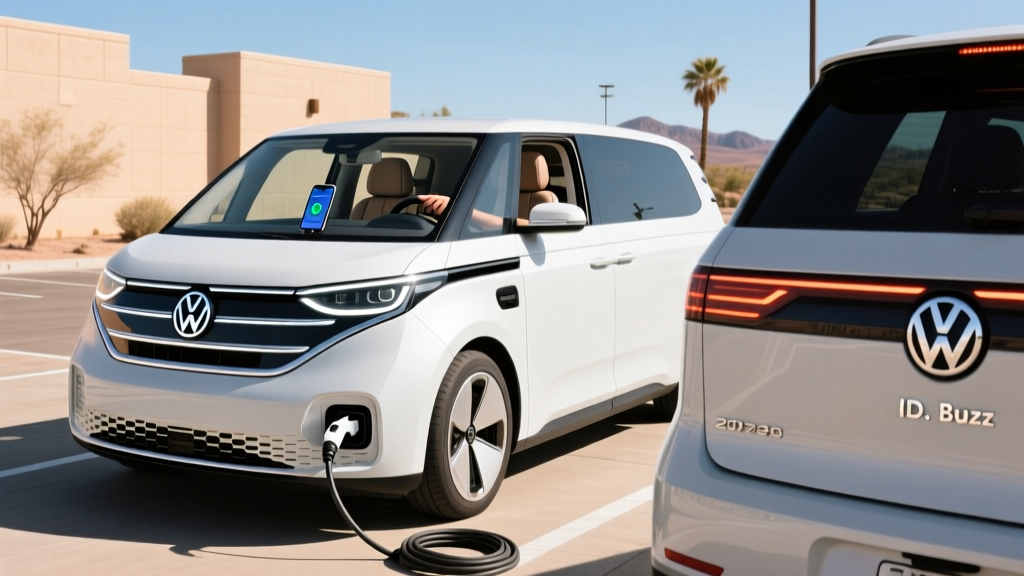
The 2026 Volkswagen ID. Buzz arrives in the U.S. as a retro-styled, three-row electric van that trades on nostalgia while delivering a genuinely usable 234 miles of EPA-estimated range. For Tolleson-area shoppers considering a lease, the ID. Buzz occupies a narrow but compelling lane: it's the only electric minivan alternative that seats seven, offers standard AWD on higher trims, and turns heads in every grocery store parking lot. But with a starting MSRP near $60,000 and real-world highway range that dips below 210 miles, buyers need to weigh emotional appeal against hard EV economics.
This review covers every spec that matters — battery chemistry, charging curves, real-world range in Arizona heat, federal tax-credit eligibility under current IRS §30D rules, and whether leasing through a Tolleson-area VW dealer makes financial sense versus the Chrysler Pacifica Hybrid or the Kia EV9.
Range, Battery, and Efficiency: What the Numbers Actually Mean
The 2026 ID. Buzz is built on Volkswagen's MEB platform and packs a 91 kWh usable battery (gross capacity approximately 100 kWh). Volkswagen uses an NMC (nickel manganese cobalt) lithium-ion chemistry in the U.S.-spec ID. Buzz, prioritizing energy density for acceptable range in a vehicle with the aerodynamic profile of a bread loaf.
| Spec | Proximity Plus (RWD) | Pro S (RWD) | Pro S Plus (AWD) |
|---|---|---|---|
| EPA Range | 234 mi | 232 mi | 219 mi |
| Battery (Usable) | 91 kWh NMC | 91 kWh NMC | 91 kWh NMC |
| Horsepower | 282 hp | 282 hp | 335 hp |
| 0-60 mph | 7.9 sec (est.) | 7.9 sec (est.) | 6.5 sec (est.) |
| Drivetrain | Rear-Wheel Drive | Rear-Wheel Drive | Dual-Motor AWD |
| MPGe (Combined) | 87 MPGe | 86 MPGe | 82 MPGe |
| Efficiency | 39 kWh/100 mi | 39 kWh/100 mi | 41 kWh/100 mi |
| Base MSRP | $59,995 | $64,995 | $69,995 |
EPA estimates are 234 miles (RWD) and 219 miles (AWD). In practice, expect the following based on testing and owner data:
- City/suburban driving (Tolleson, Phoenix metro): ~220–240 miles achievable with regen-heavy stop-and-go routes.
- Highway (I-10 at 75 mph): ~190–210 miles. The Buzz's tall, flat front end creates significant aero drag above 65 mph.
- Arizona summer heat (110°F+): Battery thermal management keeps degradation in check, but cabin cooling loads can reduce range by 5–10%. Expect ~200–215 miles mixed driving in peak summer.
- Cold weather (not typical for Tolleson, but relevant for Flagstaff trips): Range can drop 20–30% below freezing, to roughly 160–180 miles.
Source: EPA fueleconomy.gov
At 39–41 kWh per 100 miles, the ID. Buzz is not an efficiency leader. For comparison, the Tesla Model Y uses roughly 28 kWh/100 mi. But efficiency is the trade-off for a vehicle that offers minivan-level interior volume.
Charging Speed: DC Fast Charging and Home Level 2
The ID. Buzz supports a peak DC fast-charge rate of 170 kW on CCS-equipped public chargers (Volkswagen has confirmed NACS adapter compatibility for Tesla Supercharger access). The onboard AC charger handles up to 11 kW for Level 2 home charging.
| Charging Level | Power | Speed / Time | Notes |
|---|---|---|---|
| Level 1 (120V outlet) | ~1.4 kW | ~4 miles per hour | Emergency/top-up only; full charge in ~65 hours |
| Level 2 (240V home) | 11 kW (max) | ~30 miles per hour; full charge in ~9 hours | Requires 48-amp dedicated circuit recommended |
| DC Fast Charge | 170 kW peak | 10–80% in ~26 minutes | Peak rate sustained to ~40% SoC, then tapers; expect ~120 kW average through 80% |
The 170 kW peak is respectable but not class-leading. The Hyundai Ioniq 9 peaks around 200+ kW, and the Kia EV9 manages 239 kW. In practice, the ID. Buzz's charging curve holds strong through the mid-state-of-charge range but tapers noticeably above 70%. On a road trip from Tolleson to San Diego (~350 miles), plan on two DC fast-charge stops of roughly 25–30 minutes each.
For home charging in the Tolleson/Phoenix area, a Level 2 install on a 240V/48-amp circuit will replenish the battery overnight. Most owners will plug in at night and wake up fully charged — the 9-hour full-charge time is a non-issue for daily use.
Interior Space, Cargo, and Tech Features
The ID. Buzz's strongest selling point is interior volume. With three rows of seating for up to seven passengers, it delivers:
- Behind third row: 18.8 cu ft of cargo space
- Third row folded: 75.5 cu ft
- Second and third rows folded: 131.5 cu ft
- Front legroom: 42.1 inches
- Second-row legroom: 39.6 inches
- Third-row legroom: 33.5 inches (best suited for children or short trips)
The third row is tighter than a Chrysler Pacifica or Toyota Sienna, and the sloping roofline cuts into maximum cargo height. But for families who need occasional seven-seat capacity with electric running costs, the Buzz delivers.
Tech highlights include a 12.9-inch infotainment touchscreen (an upgrade over the ID.4's earlier screen), wireless Apple CarPlay and Android Auto, a configurable digital cockpit, and Volkswagen's IQ.DRIVE suite of driver-assistance features (adaptive cruise, lane-keeping, automatic emergency braking). IQ.DRIVE is an SAE Level 2 system — it assists with steering and speed but requires full driver attention at all times. It is not autonomous driving.
Volkswagen's IQ.DRIVE is a Level 2 driver-assistance system per SAE classification. It requires the driver to keep hands on the wheel and eyes on the road at all times. It does not navigate intersections, handle construction zones autonomously, or replace an attentive driver. For hands-free Level 2+ highway driving, GM's Super Cruise and Ford's BlueCruise offer more advanced (but still supervised) experiences.
Notable drawbacks include a lack of a front trunk (frunk) — the MEB platform's front end houses HVAC and power electronics — and capacitive touch sliders for climate and volume controls that frustrate many drivers. The panoramic glass roof (standard on Pro S and above) looks stunning but adds solar heat load, which matters in Arizona summers.
Pricing, Lease Deals, and Federal Tax-Credit Eligibility
The 2026 ID. Buzz starts at $59,995 for the Proximity Plus (RWD, five-seat configuration in some markets, seven-seat in the U.S.) and climbs to $69,995 for the Pro S Plus with AWD. Destination charges add approximately $1,395.
| Trim | Base MSRP | Est. As-Tested | §30D Credit Eligibility | Effective Price (if eligible) |
|---|---|---|---|---|
| Proximity Plus (RWD) | $59,995 | $61,390 | Partial — see below | ~$53,890–$61,390 |
| Pro S (RWD) | $64,995 | $67,500 | Partial — see below | ~$59,500–$67,500 |
| Pro S Plus (AWD) | $69,995 | $73,000+ | Partial — see below | ~$65,500–$73,000+ |
The ID. Buzz faces a complex tax-credit picture under current IRS guidelines:
- MSRP cap: Vans must be under $80,000 MSRP. All ID. Buzz trims qualify on price.
- Buyer income cap: AGI must not exceed $150,000 (single), $225,000 (head of household), or $300,000 (joint filers).
- Battery sourcing requirements: Critical minerals and battery component sourcing rules tighten each year. As of 2026, vehicles with battery components from a "foreign entity of concern" (FEOC) are disqualified. Volkswagen sources cells from suppliers that may partially trigger FEOC restrictions, meaning the ID. Buzz may qualify for only $3,750 (half credit) or potentially $0 depending on the specific model year's supply-chain compliance.
- Point-of-sale transfer: If eligible, the credit can be transferred to the dealer at purchase, reducing the sale price directly.
- Lease loophole: Under §45W, the commercial clean vehicle credit may apply to leased vehicles regardless of sourcing rules — the leasing company claims the credit and may pass savings to the lessee as a reduced monthly payment. This is why many Tolleson-area shoppers search specifically for lease deals.
Always confirm current eligibility with your tax professional and the dealer before signing. Rules are subject to legislative changes.
For Tolleson buyers, leasing the ID. Buzz may be the most financially rational approach. A 36-month lease with the §45W commercial credit applied could bring monthly payments into the $650–$850 range depending on money-down, mileage allowance, and dealer markups. Check with local Phoenix-metro VW dealers for current lease specials.
How the ID. Buzz Stacks Up Against Competitors
| Spec | VW ID. Buzz (Pro S, RWD) | Kia EV9 (Land AWD) | Chrysler Pacifica Hybrid |
|---|---|---|---|
| Powertrain | BEV | BEV | PHEV |
| EPA Range / Electric Miles | 232 mi | 280 mi | 32 mi electric + 490 mi gas |
| Seats | 7 | 6–7 | 7 |
| Starting MSRP | $64,995 | $59,900 | $47,095 |
| Max DC Charge | 170 kW | 239 kW | N/A (PHEV) |
| 10–80% Charge Time | ~26 min | ~20 min | ~2 hr (Level 2) |
| Cargo (behind 3rd row) | 18.8 cu ft | 20.2 cu ft | 32.3 cu ft |
| Towing | Not rated | 5,000 lb | 3,600 lb |
Choose the VW ID. Buzz if: You want a distinctive, retro-styled electric family hauler; you prioritize a car-like driving experience over SUV boxiness; your daily commute is under 150 miles round-trip; you value the three-row EV experience and don't need frequent long road trips.
Choose the Kia EV9 if: You need more range, faster charging, towing capability, and a more conventional SUV layout. The EV9 is the more practical all-around three-row EV.
Choose the Chrysler Pacifica Hybrid if: You lack reliable home charging, frequently drive 300+ miles in a day, or need maximum cargo space. The PHEV eliminates range anxiety entirely but still burns gas on longer trips.
Battery Warranty, Degradation, and Long-Term Ownership
Volkswagen provides an 8-year/100,000-mile battery warranty on the ID. Buzz, guaranteeing a minimum of 70% state-of-health (SoH) capacity retention over that period. The general vehicle warranty covers 4 years/50,000 miles.
NMC chemistry in the ID. Buzz is proven across the ID.4 fleet, which has shown moderate degradation of roughly 5–8% over the first 60,000 miles in real-world owner reports. Arizona heat can accelerate degradation if the vehicle is regularly fast-charged to 100% and left sitting in direct sun at full state-of-charge. Best practices for Tolleson owners:
- Set daily charge limit to 80% for routine use.
- Use DC fast charging sparingly (road trips, not daily routine).
- Park in shade or a garage when possible — battery thermal management helps but doesn't eliminate heat soak.
- Precondition the battery before fast-charging sessions (the ID. Buzz navigation-routed preconditioning activates this automatically when a DC charger is set as your destination).
Pros, Cons, and Who Should Lease the ID. Buzz
- Unique retro design — nothing else on the road looks like it
- Standard 7-seat configuration in a fully electric vehicle
- Comfortable, car-like ride quality with a tight turning radius
- Generous standard safety tech (IQ.DRIVE suite)
- Spacious second row with sliding/reclining seats
- Lease structure may unlock §45W commercial credit regardless of battery sourcing
- Real-world highway range falls well below 234-mile EPA estimate
- 170 kW peak charge rate is slower than Kia EV9 and Hyundai Ioniq 9
- No front trunk (frunk)
- Third-row legroom (33.5 in.) is tight for adults
- Capacitive-touch controls are frustrating while driving
- Panoramic roof adds heat load in desert climates
- Towing not rated — no utility beyond passenger/cargo hauling
Who this EV suits best: The ID. Buzz is ideal for families in the Phoenix/Tolleson metro area who want a distinctive daily driver for school runs, grocery trips, and weekend outings within a 100-mile radius. It works best for households with reliable Level 2 home charging and a second gas vehicle for longer road trips. It is not the right choice for frequent I-40 cross-state travelers or those who need to tow.
Frequently Asked Questions
What is the real-world range of the 2026 VW ID. Buzz?
The EPA rates the RWD model at 234 miles and the AWD at 219 miles. In real-world mixed driving around Tolleson and the Phoenix metro, expect 210–225 miles. Highway driving at 75+ mph drops that to 190–210 miles. Summer heat reduces range by an additional 5–10% due to cabin cooling demands.
How fast does the ID. Buzz charge at home and on the road?
At home on a Level 2 (240V) charger, the ID. Buzz accepts up to 11 kW, adding about 30 miles of range per hour and fully charging in roughly 9 hours. On DC fast chargers, it peaks at 170 kW and charges from 10–80% in approximately 26 minutes — adequate for road-trip stops but slower than the Kia EV9's ~20-minute 10–80% time.
Does the 2026 ID. Buzz qualify for the federal EV tax credit?
It depends. The ID. Buzz meets the MSRP cap (under $80,000 for vans) and buyer income caps apply. However, battery-sourcing and FEOC (foreign entity of concern) rules under IRS §30D may limit the credit to $3,750 or eliminate it entirely for outright purchases. Leasing may unlock the §45W commercial credit, which has no sourcing restrictions — consult your dealer and tax professional.
How much does it cost to lease the ID. Buzz in Tolleson?
Lease pricing varies by dealer, credit tier, and current incentives. Expect monthly payments in the $650–$900 range on a 36-month lease with $3,000–$5,000 down, assuming the dealer passes through any applicable lease credit. Contact Phoenix-area VW dealerships for current offers, as manufacturer incentives change monthly.
Is the ID. Buzz worth it versus the Kia EV9 or a hybrid minivan?
If you prioritize style, a car-like driving experience, and electric running costs for local driving, the ID. Buzz delivers a unique ownership experience. If range, charging speed, cargo flexibility, and towing matter more, the Kia EV9 is the more capable three-row EV. If you can't charge at home or drive long distances regularly, the Chrysler Pacifica Hybrid remains a pragmatic choice. The ID. Buzz wins on character; it compromises on practicality.
Can I use Tesla Superchargers with the ID. Buzz?
Volkswagen has confirmed NACS adapter support for the ID. Buzz, enabling access to Tesla's Supercharger network. The adapter may be included or available as an accessory — confirm with your dealer at delivery. Non-Tesla DC chargers (Electrify America, EVgo) use the native CCS port.