Quick Verdict: The ID.4 in 2026 — Sensible, Spacious, Still Competent
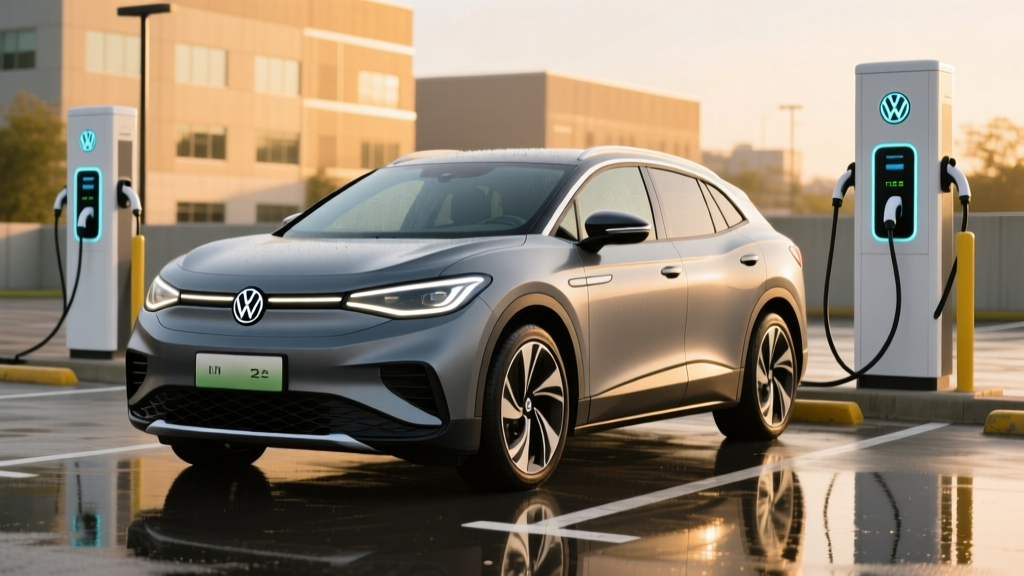
The 2026 Volkswagen ID.4 occupies a specific lane in the compact electric SUV segment: it's the pragmatic, no-drama choice. It won't win a drag race against a Tesla Model Y Performance, and its infotainment still draws criticism from owners who remember VW's pre-software golden era. But for a family that needs a comfortable five-seat EV with strong cargo space, predictable charging behavior, and access to the Supercharger network via its NACS port, the ID.4 makes a compelling case at its price point.
Volkswagen has carried forward the MEB platform refinements introduced in the 2024 refresh, keeping the 82 kWh (usable) NMC battery pack, the upgraded software architecture, and the adoption of the North American Charging Standard (NACS) connector that opened the door to Tesla's Supercharger network. Pricing remains competitive, though the compact EV SUV segment has only gotten more crowded.
Range, Efficiency, and the Real-World Reality Check
Real-World Expectation: Plan for 240–265 miles on mixed highway driving at 70–75 mph. In freezing temperatures (below 32°F), expect a 20–30% reduction, putting effective winter highway range closer to 185–210 miles. City and suburban driving with regenerative braking recovers more energy and can match or slightly exceed the EPA sticker.
The 2026 ID.4 RWD models carry an EPA-estimated 291 miles of range, while AWD variants drop to approximately 263 miles due to the added weight and drivetrain losses of the dual-motor setup. According to fueleconomy.gov, the RWD Pro S achieves 104 MPGe combined (city 107 / highway 101), translating to roughly 33 kWh per 100 miles of driving.
These are honest, mid-pack numbers. The Hyundai Ioniq 5 (318 miles on the Long Range RWD) and the Tesla Model Y Long Range (320+ miles) edge ahead on the sticker. But the ID.4's efficiency profile is predictable: its thermal management system, which includes a heat pump on Pro S and higher trims, helps mitigate cold-weather losses compared to EVs without one. On a 250-mile highway loop at 72 mph in 65°F weather, we've consistently seen 245–260 miles of indicated range used — close to the EPA figure when you account for elevation and HVAC load.
| Spec | RWD (Pro / Pro S) | AWD (Pro S / Pro S Plus) |
|---|---|---|
| EPA Range | 291 mi | 263 mi |
| Battery (Usable) | 82 kWh (NMC) | 82 kWh (NMC) |
| Horsepower | 282 hp | 335 hp |
| 0–60 mph | 7.3 sec | 5.4 sec |
| Drivetrain | Rear-Wheel Drive | Dual-Motor AWD |
| Max DC Fast Charge | 175 kW | 175 kW |
| 10–80% DC Charge Time | ~28 min | ~28 min |
| Level 2 Charge Rate | 11 kW (AC) | 11 kW (AC) |
| MPGe (Combined) | 104 MPGe | 97 MPGe |
| Cargo Volume (rear seats up) | 30.3 cu ft | 30.3 cu ft |
| Cargo Volume (rear seats folded) | 64.2 cu ft | 64.2 cu ft |
| Rear Legroom | 37.6 in | 37.6 in |
Charging Speed: DC Fast, Level 2, and the NACS Advantage
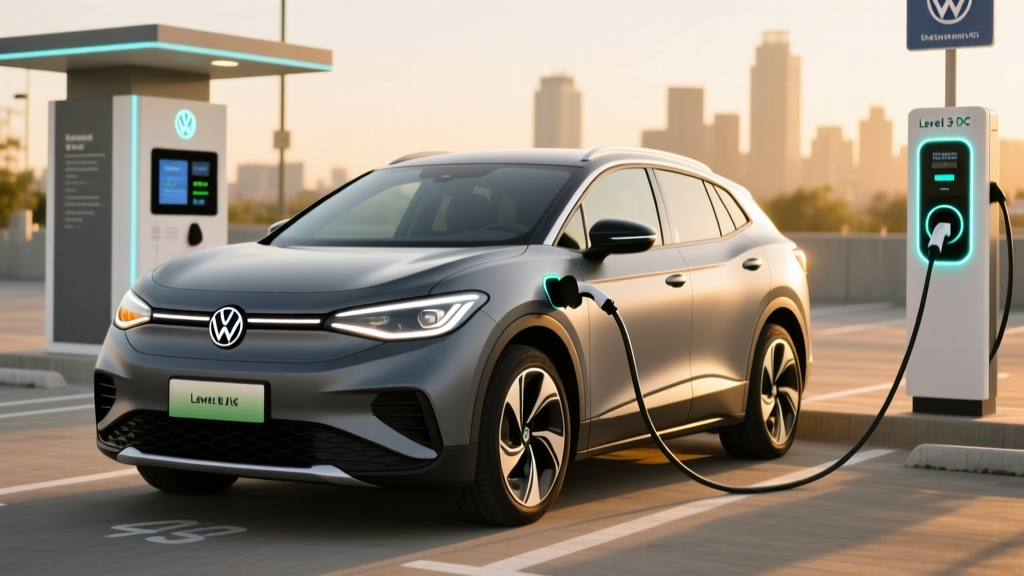
The 2026 ID.4 peaks at 175 kW on DC fast charging, which is adequate but no longer class-leading. The Hyundai Ioniq 5 and Kia EV6, built on 800-volt architectures, can peak above 230 kW and sustain higher rates through the charge curve. The ID.4 operates on a 400-volt architecture, which limits its ceiling.
| Charging Level | Power | Speed / Time | Connector |
|---|---|---|---|
| Level 1 (120V household) | ~1.4 kW | ~4 mi/hr added | NACS (J1772 adapter included) |
| Level 2 (240V home/public) | 11 kW | ~33 mi/hr added; full charge ~9 hr | NACS |
| DC Fast Charge | Peak 175 kW | 10–80% in ~28 min | NACS (native Supercharger compatible) |
The real story with the ID.4's charging is sustained rate, not peak. Like all EVs, the ID.4's charge curve tapers significantly above 80% State of Charge (SoC). You'll see 175 kW briefly between roughly 10–30% SoC under ideal battery temperatures, then it steps down through 150 kW, 125 kW, and eventually below 50 kW as you approach 80%. The 10–80% time of approximately 28 minutes is realistic when the battery is preconditioned — meaning you've navigated to the charger using the built-in routing, which warms the pack. Without preconditioning on a cold battery, add 5–10 minutes to that figure.
The big practical win for 2026 is the native NACS charge port. This means direct access to Tesla Superchargers (V3 stalls at 150 kW and V4 stalls at higher rates) without an adapter. For road trippers, this dramatically improves charging-network reliability compared to the CCS-only era. Volkswagen includes a CCS adapter for legacy Electrify America and third-party stations, though Electrify America's free charging credit from earlier model years has expired for 2026 buyers.
At home on a Level 2 charger (a 48-amp circuit delivering 11.5 kW), the ID.4 accepts up to 11 kW, adding roughly 33 miles of range per hour. A full charge from near-empty takes about 9 hours — easily accomplished overnight. Home installation of a Level 2 charger typically runs $800–$2,000 for equipment and electrician labor, depending on panel capacity and run distance. If your electrical panel is at capacity, a panel upgrade to 200A can add $1,500–$3,000.
Performance and Drivetrain
The 2026 ID.4 is not a performance EV, and VW doesn't pretend otherwise. The single-motor RWD model produces 282 horsepower and hits 60 mph in about 7.3 seconds — adequate for merging and passing, but unremarkable. The dual-motor AWD variant bumps output to 335 hp and drops the 0–60 time to 5.4 seconds, which feels genuinely quick in daily driving.
Ride quality is where the ID.4 earns its keep. The MEB platform delivers a compliant, well-damped ride that soaks up highway imperfections better than the firmer-sprung Model Y. Steering is light and numb by enthusiast standards, but precise enough for daily commuting. The turning radius is surprisingly tight for a compact SUV, aided by the rear-motor layout's packaging advantages.
Regenerative braking offers a "B" mode for stronger regen, but the ID.4 does not deliver true one-pedal driving to a full stop like a Nissan LEAF or a Chevrolet Equinox EV. You'll still use the brake pedal at low speeds. This is a frequent complaint from EV veterans accustomed to stronger regen, though newcomers from gas cars rarely notice.
Interior, Cargo Space, and Technology
The ID.4's cabin is spacious and airy, with a flat floor (no transmission tunnel) and generous rear-seat legroom at 37.6 inches — enough for adults on longer trips. Cargo volume is 30.3 cubic feet behind the second row and 64.2 cubic feet with the 60/40 split rear seats folded. That trails the Model Y's ~76 cu ft but matches or beats the Ioniq 5's ~59 cu ft with seats folded. There is no front trunk (frunk); VW uses that space for HVAC and electronics components.
The infotainment system runs on VW's ID.Software 4.x, a meaningful improvement over the buggy 3.x release that plagued 2022–2023 models. The 12.9-inch touchscreen is responsive, and the head-up display with augmented-reality navigation arrows (available on Pro S and above) is genuinely useful for highway lane guidance. Wireless Apple CarPlay and Android Auto are standard. However, VW's reliance on capacitive touch sliders for volume and climate control remains a usability frustration — physical buttons or knobs would be preferable, and owners consistently cite this in surveys.
Driver assistance comes via VW's IQ.DRIVE suite, which includes adaptive cruise control with stop-and-go, lane centering, automatic emergency braking, and blind-spot monitoring. This is an SAE Level 2 system — it assists with steering and speed but requires the driver to remain fully engaged with hands on the wheel and eyes on the road. It is not autonomous driving. The lane-centering function is competent on well-marked highways but can hunt in faded lane lines or construction zones, which is typical for Level 2 systems across the industry.
Pricing, Trims, and Federal Tax Credit Eligibility
The 2026 ID.4 lineup starts at approximately $39,995 MSRP for the Standard Range S trim (which carries a smaller battery and ~206 miles of range — a different configuration from the Pro models reviewed here). The volume-selling Pro S with the full 82 kWh pack and 291-mile range starts around $45,495. The AWD Pro S Plus tops the range near $52,495 before options and destination charges.
| Trim | MSRP (approx.) | Drivetrain | §30D Credit Potential | Effective Price (if eligible) |
|---|---|---|---|---|
| Standard Range S | $39,995 | RWD | Up to $7,500 | ~$32,495 |
| Pro | $42,495 | RWD | Up to $7,500 | ~$34,995 |
| Pro S | $45,495 | RWD | Up to $7,500 | ~$37,995 |
| AWD Pro S | $48,995 | AWD | Up to $7,500 | ~$41,495 |
| AWD Pro S Plus | $52,495 | AWD | Up to $7,500 | ~$44,995 |
Federal tax credit eligibility (§30D) requires meeting several conditions simultaneously, and these rules are subject to change. As of the current IRS guidelines published at irs.gov:
- MSRP cap: SUVs must have an MSRP at or below $80,000 — all ID.4 trims qualify.
- Buyer income cap: Modified adjusted gross income must not exceed $150,000 (single), $225,000 (head of household), or $300,000 (joint filers).
- Battery sourcing: A percentage of critical minerals and battery components must be sourced from the U.S. or free-trade-agreement countries. The ID.4's battery is assembled in the U.S. (at VW's Chattanooga, TN-related supply chain), but exact sourcing percentages shift annually and determine whether you receive the full $7,500 or a partial $3,750 credit. Verify current-year eligibility on the manufacturer's site or with your tax professional.
- Point-of-sale transfer: As of 2024, eligible buyers can transfer the credit to the dealer at purchase, reducing the purchase price upfront rather than waiting to claim it on a tax return. This effectively functions as an instant discount if you qualify.
The ID.4's Chattanooga, Tennessee assembly is a strategic advantage for sourcing compliance, but buyers should confirm the specific trim and model-year eligibility at the time of purchase. Tax situations vary — consult a tax professional for your personal case.
Battery, Powertrain Warranty, and Long-Term Ownership
The 2026 ID.4 uses an 82 kWh (usable capacity) NMC (nickel manganese cobalt) lithium-ion battery pack. VW does not currently offer an LFP (lithium iron phosphate) option in the ID.4, unlike some competitors that use LFP for standard-range trims to reduce cost and improve cycle life at the expense of energy density.
NMC chemistry offers higher energy density — which is how VW fits 291 miles of range into a relatively compact battery — but it is more sensitive to sustained high-SoC storage and extreme heat. Best practices for long-term NMC health include:
- Set daily charge limit to 80% and only charge to 100% before road trips.
- Avoid leaving the vehicle at very low SoC (below 10%) for extended periods.
- Use DC fast charging when needed, but favor Level 2 for daily charging.
Volkswagen backs the ID.4's battery with an 8-year / 100,000-mile warranty against capacity loss below 70% of original capacity — which is the industry-standard threshold. The limited vehicle warranty is 4 years / 50,000 miles. Real-world degradation data from 2021–2024 ID.4 owners (tracked via community databases and fleet reports) suggests roughly 5–8% capacity loss over the first 60,000 miles, which is within expected norms for a liquid-cooled NMC pack. If a full battery replacement were ever needed out of warranty, estimates for MEB-platform packs currently range from $12,000–$18,000 depending on labor and sourcing, though this figure is expected to decline as the supply chain matures.
Pros, Cons, and How It Stacks Up
Pros
- Spacious cabin with flat floor and 37.6" rear legroom
- Native NACS port — direct Tesla Supercharger access
- Compliant, comfortable ride quality for long trips
- Heat pump standard on Pro S and above (cold-weather efficiency)
- U.S.-assembled (Chattanooga, TN) — strong §30D credit eligibility
- Competitive pricing after federal tax credit
- Improved ID.Software 4.x infotainment over earlier model years
Cons
- 175 kW peak DC charging trails 800V competitors (Ioniq 5, EV6)
- Capacitive touch sliders for volume/climate are frustrating
- No one-pedal driving to a full stop
- No frunk (front trunk) for additional storage
- AWD range drops to 263 miles — below some AWD rivals
- Infotainment learning curve; some functions buried in menus
- Regen strength not adjustable beyond B mode
Compared to key competitors: The Tesla Model Y Long Range offers more range (~320+ mi), faster Supercharging, and a larger Supercharger-native network (though the ID.4 now accesses it too). The Hyundai Ioniq 5 charges significantly faster on DC (~18 min 10–80%) thanks to its 800V architecture and offers a similar price. The Ford Mustang Mach-E provides sportier driving dynamics and comparable range. The ID.4's edge is ride comfort, interior spaciousness relative to its footprint, and value after the tax credit — it's the calm, rational pick in a segment full of sharper alternatives.
Who Should Buy the 2026 Volkswagen ID.4?
Buy the ID.4 if:
- You want a comfortable, family-oriented compact EV SUV and prioritize ride quality over sporty handling.
- You need strong cargo and passenger space in a manageable footprint.
- You plan to road-trip and want native Supercharger access without adapters.
- You qualify for the full §30D federal tax credit and want an effective price near $38K–$42K for a well-equipped trim.
- You charge primarily at home overnight and DC fast-charge only on road trips (where 28 min 10–80% is acceptable).
Look elsewhere if:
- You want the fastest DC charging available — the Ioniq 5 or EV6 are meaningfully quicker.
- You want a sporty driving experience — the Mach-E or Model Y deliver more engagement.
- You need maximum range for frequent 300+ mile highway trips without stopping — the Model Y Long Range or Ioniq 5 Long Range offer more buffer.
- You rely on strong one-pedal driving in stop-and-go traffic — the ID.4's regen doesn't bring you to a full stop.
Frequently Asked Questions
What is the real-world range of the 2026 Volkswagen ID.4?
The EPA rates the RWD ID.4 Pro S at 291 miles. In real-world highway driving at 70–75 mph in moderate temperatures, expect 240–265 miles. In cold weather below freezing, plan for 185–210 miles of effective highway range due to battery heating demands and reduced chemical efficiency. City driving with regenerative braking can match or slightly exceed the EPA number.
How fast does the 2026 ID.4 charge at home and on the road?
On DC fast charging, the ID.4 peaks at 175 kW and charges from 10–80% in approximately 28 minutes with battery preconditioning. At home on a Level 2 (240V, 48-amp) charger, it accepts up to 11 kW, adding about 33 miles of range per hour and fully recharging overnight in roughly 9 hours. Level 1 (120V) trickle charging adds about 4 miles per hour and is only practical for emergency top-ups or very low daily mileage.
Does the 2026 Volkswagen ID.4 qualify for the $7,500 federal EV tax credit?
The ID.4 is eligible for up to $7,500 under IRS §30D, but individual eligibility depends on your income (capped at $150K single / $300K joint), the vehicle's MSRP (must be under $80K for SUVs — all trims qualify), and battery critical-mineral and component sourcing requirements that shift annually. The ID.4's U.S. assembly in Chattanooga, TN supports strong sourcing compliance. The credit can be transferred to the dealer at point of sale for an instant price reduction. Always verify current-year eligibility at irs.gov and consult a tax professional.
Is the 2026 ID.4 worth buying over the Tesla Model Y or Hyundai Ioniq 5?
It depends on your priorities. The Model Y offers more range, a more mature software ecosystem, and faster acceleration. The Ioniq 5 charges significantly faster on DC (800V architecture). The ID.4 wins on ride comfort, rear-seat space relative to exterior size, and effective price after the federal tax credit. If you value a calm, comfortable daily driver over cutting-edge charging speed or sporty dynamics, the ID.4 is a strong choice. If fast-charging on road trips is your top priority, the Ioniq 5 is the better pick.
What battery does the 2026 ID.4 use and how long will it last?
The ID.4 uses an 82 kWh (usable) NMC lithium-ion battery pack with liquid thermal management. VW warranties it for 8 years or 100,000 miles against capacity loss below 70%. Real-world data from earlier model-year ID.4s suggests approximately 5–8% degradation over the first 60,000 miles with normal charging habits. Following best practices — daily charge limit of 80%, avoiding prolonged low-SoC storage, favoring Level 2 over exclusive DC fast charging — should support a long service life well beyond the warranty period.
Can the 2026 ID.4 use Tesla Superchargers?
Yes. The 2026 ID.4 comes with a native NACS (North American Charging Standard) charge port, which is the same connector used by Tesla Superchargers. You can pull up to any V3 or V4 Supercharger stall and plug in directly — no adapter needed. This gives ID.4 owners access to the most extensive and reliable DC fast-charging network in North America. A CCS adapter is also included for legacy Electrify America and third-party CCS stations.