The Short Answer: Does a 2026 Toyota Highlander EV Exist?
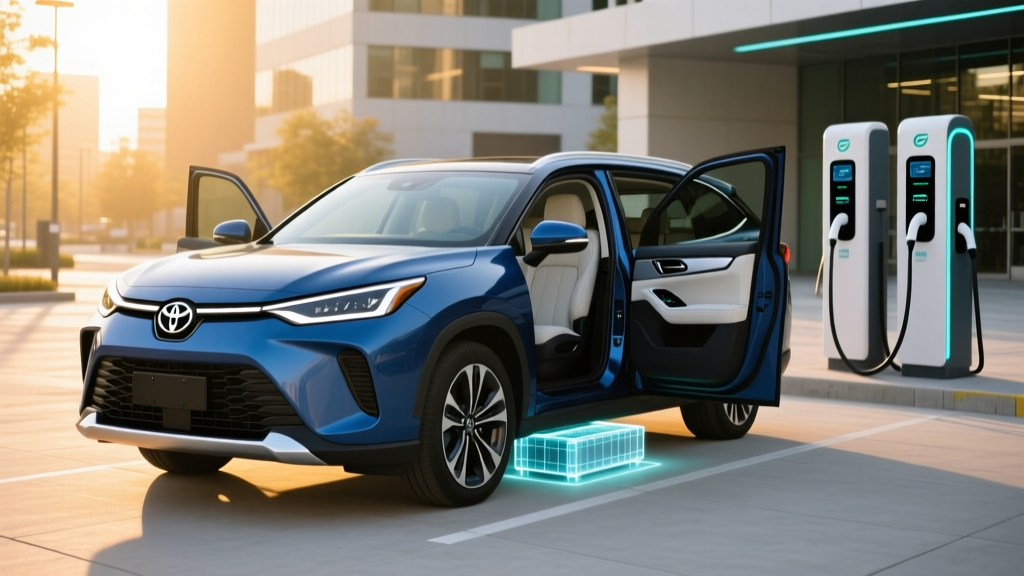
As of early 2026, Toyota has not released or officially detailed a battery-electric Highlander. The current Toyota Highlander is sold exclusively as a 2.4-liter turbocharged hybrid (HEV) producing up to 36 MPG combined. Toyota has confirmed it is developing a three-row electric SUV for the North American market, likely riding on an expanded version of its bZ dedicated EV architecture, but no official name, EPA range, pricing, or on-sale date has been published.
If you're searching for a 2026 Toyota Highlander EV to buy today, it doesn't exist yet. Below, we break down what Toyota has signaled, what the specs will likely look like based on the bZ platform and competitive benchmarks, and whether you should wait — or consider a three-row EV that's already on dealer lots.
Toyota's Three-Row EV Plans: What's Been Confirmed
Toyota has been historically cautious about full battery-electric vehicles, leaning heavily on its hybrid lineup. But the company's trajectory has shifted. In 2023, Toyota announced plans to launch a next-generation EV architecture with improved battery technology, and by late 2024, executives confirmed a three-row electric SUV was in development for North America — a market where three-row utility is non-negotiable for family buyers.
What we know from Toyota's public statements and regulatory filings:
- Platform: The vehicle will likely use an extended version of the e-TNGA platform (the same architecture underpinning the bZ4X), though Toyota has also referenced a next-generation "BEV Factory" platform with improved structural battery integration.
- Battery chemistry: Toyota has committed to both NMC (nickel-manganese-cobalt) and LFP (lithium iron phosphate) chemistries across its EV lineup. A three-row family hauler will likely use NMC for higher energy density, though a base LFP variant is possible for cost reduction.
- Target segment: Mid-to-large three-row crossover, competing directly with the Kia EV9, Hyundai Ioniq 9, and potentially the Tesla Model X refresh.
- Production: Toyota has invested in EV battery production at its North Carolina battery plant, suggesting US-market vehicles will use domestically sourced battery components — a factor for §30D federal tax credit eligibility.
What hasn't been confirmed: Whether the vehicle will carry the "Highlander" nameplate, what the MSRP will be, exact battery capacity, or a firm model year. Industry analysts have placed a potential reveal in late 2026 or early 2027, with deliveries possibly starting for the 2027 model year.
Estimated Specs: What a Toyota 3-Row EV Should Deliver
While official numbers don't exist, we can project reasonable estimates based on the current bZ4X, the competitive landscape, and Toyota's stated battery technology roadmap. Here's how a Toyota three-row EV would likely need to spec out to be competitive in 2026–2027:
| Specification | Projected (Toyota 3-Row EV) | Kia EV9 (Benchmark) |
|---|---|---|
| Battery Capacity (usable) | ~95–110 kWh (NMC) | 99.8 kWh (NMC) |
| EPA Range (est.) | 280–320 miles | 270–304 miles |
| Peak DC Fast Charge Rate | ~200–250 kW | 236 kW (800V) |
| 10–80% DC Charge Time | ~22–28 minutes | ~24 minutes |
| Level 2 AC Charging | ~11 kW (est.) | 10.9 kW |
| Horsepower (AWD est.) | ~350–400 hp | 379 hp (GT AWD) |
| 0–60 mph | ~5.0–6.0 sec (est.) | 4.5 sec (GT) / 7.7 sec (LR RWD) |
| Seating | 6 or 7 passengers | 6 or 7 passengers |
| Towing Capacity (est.) | ~3,500–5,000 lbs | 5,000 lbs (AWD) |
| Estimated Base MSRP | $55,000–$62,000 | $54,900 (2025 base) |
| Battery/Powertrain Warranty | 8 yr / 100,000 mi (Toyota std.) | 10 yr / 100,000 mi |
Highlander Hybrid vs. a Future Highlander EV: The Cost and Capability Gap
For many Toyota loyalists, the question isn't "should I go electric?" — it's "should I buy the Highlander Hybrid now, or wait for an EV that may be years away?" Here's a concrete comparison using the current 2026 Highlander Hybrid against projected EV ownership costs.
| Factor | 2026 Highlander Hybrid (XLE AWD) | Projected Toyota 3-Row EV |
|---|---|---|
| MSRP | ~$46,000 | ~$57,000 (est.) |
| EPA Fuel Economy / Efficiency | 35 MPG combined | ~90–100 MPGe (est.) |
| Annual Fuel/Energy Cost (15,000 mi) | ~$1,650 (gas at $3.40/gal) | ~$600–$900 (home L2 at $0.14/kWh) |
| Federal Tax Credit (§30D) | Not eligible | Up to $7,500 (if sourcing/income rules met) |
| Maintenance (5-year est.) | ~$2,500 (oil, filters, brakes) | ~$800 (cabin filter, wipers, tires) |
| Total Range | ~600+ miles (17.9 gal tank) | ~280–320 miles per charge |
| Home Energy Infrastructure | None needed | Level 2 install: $800–$2,500+ |
The math is clear: a future Toyota three-row EV would cost roughly $11,000 more upfront than the current Highlander Hybrid, but could save $750–$1,050 annually on fuel and $300–$400 per year on maintenance. The break-even point — even after a potential $7,500 tax credit — lands around 4 to 6 years of average driving, depending on your local electricity rates and gas prices.
That said, the Highlander Hybrid offers something the EV can't match: 600+ miles of total range with a five-minute refuel at any gas station. For families who road-trip frequently, tow boats or campers, or live in rural areas with sparse DC fast-charging infrastructure, the hybrid remains the pragmatic choice in 2026.
Ownership Realities: What First-Time EV Buyers Must Know
If you're considering waiting for Toyota's three-row EV — or pivoting to an existing competitor like the Kia EV9 — here are the practical ownership factors that spec sheets don't capture:
Home Charging Is Non-Negotiable for Most Owners
Public DC fast charging costs $0.30–$0.50+ per kWh in most US markets, which can make EV fuel costs comparable to a hybrid. The economic advantage of an EV depends heavily on Level 2 home charging at residential electricity rates ($0.10–$0.20/kWh depending on your state). If you live in an apartment without charging access, or your home has an older 100-amp electrical panel that can't support a 40-amp/9.6 kW charger without a $2,000–$4,000 panel upgrade, the ownership calculus changes significantly.
Charging Speed Matters More Than Peak kW
Manufacturers advertise peak DC charge rates (e.g., "250 kW"), but batteries can't sustain peak speed across the entire charging session. The charge curve tapers significantly above 80% state of charge to protect battery health. A vehicle with a 250 kW peak might only average 150 kW across a 10–80% session. Look for 10–80% charge times, not peak kW numbers, when comparing vehicles.
Cold Weather Cuts Range — Plan for It
Lithium-ion batteries lose efficiency in cold temperatures, and cabin heating draws substantial energy. In sustained sub-30°F conditions, expect 20–35% range reduction compared to the EPA sticker. A heat pump (which Toyota has used on the bZ4X) helps mitigate this but doesn't eliminate it. If you live in Minnesota, Montana, or New England, a 310-mile EPA rating may deliver only 210–240 miles in January.
Insurance Costs Are Higher for EVs
EV insurance premiums run 15–25% higher than comparable gas vehicles on average, driven by higher repair costs (specialized body shops, battery replacement risk, and aluminum-intensive structures). Get quotes before purchasing — a $200/month premium difference adds $12,000 over five years.
Competing 3-Row EVs You Can Actually Buy in 2026
Waiting for an unannounced vehicle carries opportunity cost. If you need a three-row electric SUV now, these are the established options with real EPA data and dealer availability:
| Vehicle | EPA Range | Battery (kWh) | DC Fast Charge | Base MSRP |
|---|---|---|---|---|
| Kia EV9 (LR RWD) | 304 mi | 99.8 (NMC) | 236 kW / 24 min (10–80%) | $54,900 |
| Hyundai Ioniq 9 (est.) | ~300 mi | 110.3 (NMC) | ~240 kW (800V) | ~$55,000 |
| Tesla Model X (LR AWD) | 335 mi | ~100 (NMC) | 250 kW / ~30 min (10–80%) | $79,990 |
| Rivian R1S (Dual Motor) | 321 mi (Max Pack) | ~141 (NMC, Max) | ~200 kW / ~30 min | $75,900 |
Data sourced from fueleconomy.gov and manufacturer specifications. The Kia EV9 remains the value benchmark in this segment, offering 800V fast-charging architecture and competitive range at the lowest entry price.
Tax Credit Eligibility: What to Expect
The IRS §30D Clean Vehicle Credit offers up to $7,500 for qualifying new EVs, but eligibility depends on multiple factors that change annually. For any future Toyota three-row EV to qualify, it must meet:
- MSRP cap: SUVs/vans/pickups must have an MSRP at or below $80,000
- Buyer income cap: Modified AGI ≤ $300,000 (joint), $225,000 (head of household), $150,000 (single)
- Battery component sourcing: A percentage of battery components must be manufactured or assembled in North America (threshold increases annually)
- Critical minerals: A percentage of critical minerals must be sourced from the US or free-trade-agreement countries
- Final assembly: Vehicle must be assembled in North America
Toyota's North Carolina battery plant and US assembly operations position a future three-row EV well for partial or full credit eligibility, but the specific battery-sourcing percentages will depend on supply chain details Toyota hasn't published yet. Always verify credit eligibility on the official IRS website or with a tax professional before making a purchase decision — rules can change between announcement and delivery.
Decision Framework: Should You Wait or Buy Now?
Choose the Current Highlander Hybrid If:
- You need a three-row family vehicle within the next 6 months
- You regularly drive 400+ miles between stops (road trips, rural living)
- You tow more than 3,500 lbs frequently
- You lack reliable home charging access
- Your budget tops out around $45,000–$50,000
- You want proven Toyota reliability with 20+ years of hybrid powertrain refinement
Choose an Existing 3-Row EV (Kia EV9, Ioniq 9) If:
- You have Level 2 home charging installed or can install it
- Your daily driving is under 80 miles round-trip with occasional longer trips
- You want the lowest per-mile fuel cost and minimal maintenance
- You qualify for the §30D tax credit on a current model
- You're comfortable with 250–300 miles of real-world range and planning DC fast-charge stops on road trips
Wait for Toyota's 3-Row EV If:
- You're loyal to the Toyota brand and want a Toyota-specific EV ecosystem
- You don't need a new vehicle for 18–24+ months
- You want Toyota's reputation for long-term durability applied to an EV battery and powertrain
- You're willing to accept the risk that specs, pricing, and tax credit eligibility remain unconfirmed
Common Misconceptions About Toyota and EVs
| Myth | Fact |
|---|---|
| "Toyota doesn't make EVs" | Toyota sells the bZ4X (a compact EV crossover) in the US and has committed to 30 BEV models globally by 2030. The company is late to the EV market but not absent from it. |
| "A Highlander EV will have 400+ miles of range" | No three-row EV currently on sale exceeds 335 miles EPA. Physics limits a heavy, boxy vehicle's efficiency. Expect 280–320 miles realistically. |
| "The EV will cost the same as the hybrid" | Large battery packs (95–110 kWh) add $12,000–$18,000 in cell costs alone. A three-row EV will carry a significant premium over the $46,000 hybrid, even with economies of scale. |
| "I'll automatically get the $7,500 tax credit" | The §30D credit has income caps, MSRP caps, and battery-sourcing requirements that disqualify many buyers and vehicles. Eligibility is never guaranteed until verified at point of sale. |
| "EV batteries need replacement every 5 years" | Modern NMC and LFP batteries are warrantied for 8 years/100,000 miles minimum. Industry data shows typical degradation of 10–15% over 8 years — not the 50%+ loss that would necessitate replacement. Full battery replacement is rare and typically costs $12,000–$20,000 if needed out of warranty. |
Frequently Asked Questions
When will the Toyota Highlander EV be available to buy?
Toyota has not announced a specific on-sale date. Industry projections suggest a reveal in late 2026 or 2027, with deliveries potentially starting as a 2027 or 2028 model year. Until Toyota publishes official specs and pricing on its US website, all dates are speculative.
Will the Toyota 3-row EV use the Highlander name?
Not necessarily. Toyota has used the "bZ" branding for its dedicated EVs (bZ4X). The three-row EV could launch under the bZ series (e.g., "bZ Large" or a new designation) or could inherit the Highlander nameplate for brand recognition. Toyota has not confirmed the production name.
Can I reserve a Toyota Highlander EV now?
No. Toyota has not opened reservations for any three-row EV. Any website claiming to accept deposits for a "Highlander EV" is not affiliated with Toyota. Check toyota.com for official announcements.
How will a Toyota 3-row EV charge compared to competitors?
The bZ4X currently charges at a peak of ~150 kW on DC fast chargers, which is slower than the Kia EV9's 236 kW (800V architecture). Toyota's next-generation platform is expected to improve charge rates to the 200–250 kW range, but the company has not published confirmed figures. If fast-charging speed is your top priority, the Hyundai/Kia 800V platform currently leads the segment.
Is the Highlander Hybrid a better buy than a 3-row EV in 2026?
For most families who take long road trips, lack home charging, or need maximum range flexibility, the Highlander Hybrid (35 MPG combined, 600+ mile range, ~$46,000 MSRP) remains the more practical choice today. A three-row EV makes financial sense if you have home charging, drive under 80 miles daily, qualify for the federal tax credit, and plan to own the vehicle 5+ years to recoup the higher purchase price through fuel and maintenance savings.
What should I do while waiting for Toyota's 3-row EV?
Prepare your home for EV ownership: get a quote from a licensed electrician for a 240V/40-amp or 50-amp Level 2 charger installation (typically $800–$2,500 depending on panel capacity and run length). If your panel is maxed out at 100 amps, budget $2,000–$4,000 for a 200-amp upgrade. Having the infrastructure ready means you can plug in on day one when your EV arrives.