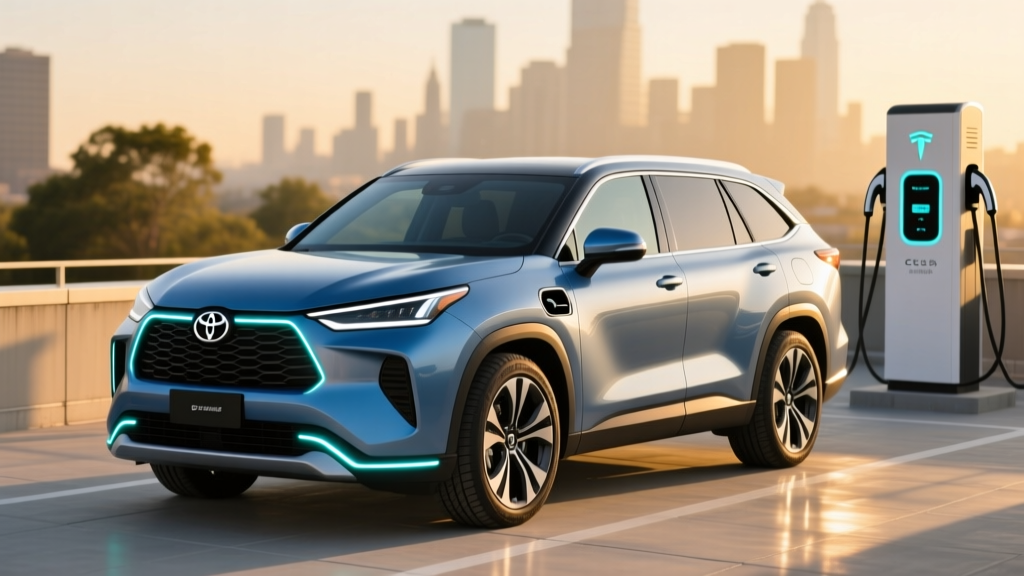
The Short Answer on the 2026 Highlander EV
As of early 2026, Toyota has not yet officially released a battery-electric Highlander. The current Highlander lineup remains a conventional V6 hybrid (HEV) and the Grand Highlander Hybrid. However, Toyota's accelerated EV roadmap — including the bZ Large SUV concept and a confirmed three-row electric SUV for the U.S. market — strongly suggests an electric three-row SUV wearing the Highlander nameplate (or a closely related bZ badge) is arriving for the 2027 model year, with a late-2026 reveal likely.
Based on Toyota's announced platform specs, the bZ Large SUV prototype, and competitive positioning against the Kia EV9 and Hyundai Ioniq 9, we can project a usable battery around 100–110 kWh, an EPA-estimated range of 280–320 miles, DC fast charging up to ~250 kW, and a starting MSRP in the $52,000–$58,000 range before incentives. Below, we break down what's confirmed, what's projected, and how to decide whether to wait or buy now.
What Toyota Has Actually Confirmed
Toyota has committed to launching 30 battery-electric models globally by 2030, with a specific emphasis on large SUVs for the North American market. The bZ Large SUV concept, shown in 2023, previewed a three-row electric crossover sized between the current bZ4X and the Sequoia. Toyota's U.S. press materials have referenced a production three-row EV arriving at U.S. dealers, though the company has not officially confirmed the "Highlander EV" badge as of this writing.
What we know from Toyota's public statements and the concept vehicle:
- Platform: A dedicated EV architecture (evolved e-TNGA or a next-generation platform), not a converted ICE chassis
- Seating: Three rows, targeting 6- or 7-passenger configurations
- Manufacturing: Toyota's Georgetown, Kentucky plant is being retooled for EV production, with battery packs sourced from Toyota Battery Manufacturing in North Carolina
- Timeline: Production start targeted for late 2026 or early 2027, meaning first deliveries would likely be the 2027 model year
If you're searching for a "2026 Highlander EV" available to buy today at a dealership, it doesn't exist yet. The current 2026 Highlander is a hybrid-only model line. But if you're planning ahead and weighing whether to wait, the projected specs below will help you decide.
Projected Specs: Range, Battery, and Charging
Based on the bZ Large SUV concept dimensions, Toyota's published battery technology roadmap, and competitive benchmarking against the Kia EV9 (which offers up to 304 miles EPA on a 100 kWh pack), here are our informed projections for a production Highlander EV:
| Attribute | Projected Figure | Notes |
|---|---|---|
| Battery Capacity | ~100–110 kWh usable | Likely NMC chemistry for energy density in a large pack |
| EPA Range (est.) | 280–320 miles | AWD models will be on the lower end |
| Real-World Highway Range | ~240–275 miles | 70+ mph sustained, moderate temps |
| DC Fast Charge Peak | ~200–250 kW | Toyota's newer platforms support faster charging than the bZ4X's 150 kW peak |
| 10–80% DC Charge Time | ~25–30 minutes (projected) | Charge curve taper above 80% will add significant time |
| Level 2 AC Charge Rate | ~11 kW | ~9–10 hours for a full charge from empty |
| Powertrain | Dual-motor AWD (likely) | ~350–400 HP projected |
| 0–60 mph | ~5.5–6.5 seconds | Estimate based on mass and competitor benchmarks |
| Towing Capacity | ~3,500–5,000 lbs (projected) | Towing cuts range roughly 40–50% |
Highlander EV vs. Gas Highlander vs. Kia EV9: The Numbers
The most practical comparison for shoppers is three-way: the projected Highlander EV, the current gas/hybrid Highlander, and the closest existing electric competitor — the Kia EV9. Here's how they stack up on the metrics that matter:
| Metric | Highlander EV (Projected) | 2026 Highlander Hybrid AWD | 2026 Kia EV9 AWD LR |
|---|---|---|---|
| Starting MSRP | ~$52,000–$58,000 | ~$42,000 | $59,900 |
| EPA Range / Fuel Economy | ~280–320 mi / ~85–95 MPGe | 35 MPG combined (~490 mi range) | 280 mi / 85 MPGe |
| Energy/Fuel Cost per Mile | ~$0.04–$0.06 (home charging) | ~$0.10–$0.13 (gas at $3.50/gal) | ~$0.04–$0.06 (home charging) |
| Annual Fuel/Energy (15k mi) | ~$600–$900 | ~$1,500–$1,950 | ~$600–$900 |
| DC Fast Charge (10–80%) | ~25–30 min | 5 min at a gas station | ~24 min (at 210 kW peak) |
| Federal Tax Credit (§30D) | Likely eligible (U.S.-built) | Not eligible (HEV, not plug-in) | Eligible up to $7,500 (GA-built) |
| Third Row Usability | Expected: adequate for kids | Tight, best for small children | Genuinely usable for adults |
| Battery/Powertrain Warranty | 10 yr / 150,000 mi (expected) | 10 yr / 150,000 mi (hybrid system) | 10 yr / 100,000 mi |
Sources: fueleconomy.gov for Highlander Hybrid data; Kia EV9 specs from Kia's official U.S. site. Highlander EV figures are projections based on Toyota's published platform data and competitive analysis.
The Real Cost of Ownership: 5-Year Breakdown
Upfront price is only part of the equation. Here's a realistic 5-year / 75,000-mile ownership cost comparison, assuming home Level 2 charging for the EVs, national-average electricity rates of $0.16/kWh, and gas at $3.50/gallon:
| Cost Category | Highlander EV (Proj.) | Highlander Hybrid | Kia EV9 AWD LR |
|---|---|---|---|
| Purchase Price (base MSRP) | $55,000 | $42,000 | $59,900 |
| Federal Tax Credit (§30D) | −$7,500* | $0 | −$7,500* |
| Net Purchase Cost | $47,500 | $42,000 | $52,400 |
| Home Charger Install (Level 2) | $1,200 | $0 | $1,200 |
| Energy/Fuel (75k miles) | $3,375 | $8,250 | $3,375 |
| Maintenance (5 years) | $1,500 | $3,000 | $1,500 |
| Insurance (5-yr est.) | $9,500 | $7,500 | $9,800 |
| 5-Year Total Cost | $63,075 | $60,750 | $68,275 |
*Tax credit caveat: The §30D federal tax credit of up to $7,500 is subject to buyer income caps ($150k single / $300k joint MAGI), MSRP caps ($80k for SUVs), and critical-mineral/battery-component sourcing requirements that tighten annually. As of 2026, vehicles assembled in the U.S. with qualifying battery sourcing are eligible. Always verify current eligibility on IRS.gov or consult a tax professional. The credit can now be transferred to the dealer at point of sale, reducing your out-of-pocket cost immediately.
The key insight: over five years, the EV's fuel savings (~$4,875 less than gas) nearly close the gap with the hybrid's lower purchase price. If you keep the vehicle 8–10 years, the EV pulls ahead meaningfully — and you're insulated from gas price volatility.
What First-Time EV Buyers Must Know Before Waiting
If you've never owned an EV and you're considering waiting for the Highlander EV, here are the practical realities that spec sheets don't convey:
Home Charging Is Non-Negotiable for Most Owners
Over 80% of EV charging happens at home. If you have a garage or driveway where you can install a 240V Level 2 charger (typically a 48-amp circuit on a 60-amp breaker), an EV integrates seamlessly into daily life — you wake up every morning with a full "tank." If you rely exclusively on street parking or apartment living with no charging access, the ownership experience becomes significantly more burdensome. Budget $800–$2,000 for a Level 2 home charger installation (equipment plus licensed electrician), and potentially $1,500–$3,000 more if your electrical panel needs an upgrade to 200 amps.
Charging Speed Isn't Just About Peak kW
When Toyota quotes a peak DC fast-charge rate (say, 250 kW), that number is sustained only during a narrow window of the charge curve — typically between 10% and 40% state of charge. Above 60%, the rate tapers significantly to protect battery health, and above 80%, it slows to a trickle. A "25-minute 10–80% charge" can easily become a 50-minute session if you charge from 5% to 95%. For road trips, plan your stops around 10–80% increments for the fastest experience.
Cold Weather Cuts Range — Permanently During Winter
This isn't a defect; it's electrochemistry. Lithium-ion batteries operate less efficiently in cold temperatures, and cabin heating draws substantial energy (unlike a gas car, which uses waste heat from the engine). Expect 20–30% range reduction in sustained sub-freezing conditions. A heat pump — which Toyota's newer EV platforms include — mitigates this but doesn't eliminate it. If you live in Minnesota or Maine and regularly drive 200+ miles in winter, plan accordingly.
Common Misconceptions, Corrected with Data
| Myth | Fact |
|---|---|
| "The battery will need replacing in 5 years and cost $20,000." | Modern EV batteries are warrantied for 10 years/100,000–150,000 miles at 70%+ capacity retention. Real-world degradation data from Geotab shows average annual loss of ~1.8%. A 100 kWh pack will likely still hold 85–90 kWh after 8 years. Full replacement is rare and typically covered under warranty within the coverage period. |
| "EVs are worse in cold weather, so they don't work where I live." | Norway — where winters are harsher than most of the U.S. — has the highest EV adoption rate in the world (>80% of new sales). With preconditioning, a heat pump, and realistic range planning, EVs function well in cold climates. You just need more buffer. |
| "Charging infrastructure isn't ready." | As of 2026, the U.S. has over 190,000 public charging ports, with Tesla's Supercharger network (now open to NACS-equipped non-Teslas) adding reliability. Electrify America, EVgo, and ChargePoint have expanded DC fast-charging corridors along major interstates. Rural gaps remain real — but for 90%+ of daily driving, home charging makes public infrastructure irrelevant. |
| "A hybrid is always the smarter financial choice." | It depends on your driving pattern. If you drive 8,000 miles/year with home charging, the hybrid's lower purchase price wins. If you drive 15,000+ miles/year, the EV's fuel savings (~$1,000–$1,300/year) plus lower maintenance (no oil changes, less brake wear from regen) and the $7,500 tax credit can make it cheaper over 5–7 years. |
| "The Highlander EV will just be a converted gas car." | Toyota has confirmed a dedicated EV platform for its large SUVs, not a converted ICE chassis. This means a flat floor, better interior packaging, optimized weight distribution, and more efficient thermal management — all advantages of purpose-built EV architecture. |
Decision Framework: Should You Wait for the Highlander EV?
Choose to WAIT for the Highlander EV if:
- You have home Level 2 charging access (garage/driveway with 240V circuit capacity)
- Your daily commute is under 80 miles round-trip, and you take road trips fewer than 6 times per year
- You want a Toyota-badged three-row SUV and are willing to wait until late 2026 or 2027 for availability
- You qualify for the §30D tax credit (income under $300k joint / $150k single) and the vehicle meets sourcing requirements
- You value lower per-mile operating costs and plan to keep the vehicle 7+ years
Choose the GAS/HYBRID HIGHLANDER NOW if:
- You cannot install a home charger (apartment, street parking, HOA restrictions)
- You regularly tow heavy loads (3,500+ lbs) over long distances — towing crushes EV range by 40–50%
- You frequently drive 300+ mile routes in rural areas with sparse DC fast-charging coverage
- You need a vehicle now and can't wait 12–18 months for production and dealer allocation
- Your budget is firmly under $45,000 and you need three rows
Choose the KIA EV9 NOW if:
- You want an electric three-row SUV available today with proven specs (280 miles EPA, 210 kW DC charging, usable third row)
- You're open to a Kia badge and want to start saving on fuel costs immediately
- You value the EV9's genuinely adult-friendly third row and class-leading interior space
Frequently Asked Questions
Is Toyota making an all-electric Highlander?
Toyota has confirmed a three-row electric SUV for the U.S. market based on the bZ Large SUV concept, but has not officially confirmed the "Highlander EV" badge as of early 2026. The vehicle is expected to be revealed in late 2026 with production beginning in 2027. It will be built at Toyota's Georgetown, Kentucky plant.
Will the Highlander EV qualify for the $7,500 federal tax credit?
Based on U.S. manufacturing (Kentucky assembly, North Carolina battery production) and Toyota's stated commitment to meeting §30D sourcing requirements, it is likely to qualify. However, eligibility depends on your personal income (MAGI caps of $150k single / $300k joint), the vehicle's MSRP staying under $80,000, and the final battery-component and critical-mineral sourcing meeting 2026 thresholds. Always verify on IRS.gov before purchasing.
How will the Highlander EV compare to the Kia EV9?
On paper, they'll be close competitors. The EV9 offers 280 miles EPA, 210 kW DC fast charging, and starts at $59,900. Toyota will likely target similar or slightly better range (300+ miles EPA) and potentially faster charging (250 kW peak) at a competitive price point ($52,000–$58,000 projected). The EV9's advantage is current availability and a proven, genuinely spacious third row. The Highlander EV's advantage will be the Toyota brand, U.S. manufacturing, and potentially better long-term resale value.
What will it cost to charge a Highlander EV at home?
Assuming a ~100 kWh battery and a national average electricity rate of $0.16/kWh, a full charge from empty would cost roughly $16. For typical daily driving of 30–40 miles (consuming ~10–13 kWh), expect to spend about $1.60–$2.10 per day, or $50–$65 per month. This compares to roughly $130–$165 per month in gasoline for a hybrid Highlander driven the same distance. Rates vary significantly by state and time-of-use plan — check with your utility for EV-specific rates.
Should I buy a used EV instead of waiting?
A used EV can be an excellent bridge strategy. The §25E used EV tax credit offers up to $4,000 (30% of sale price, capped) on vehicles priced under $25,000 from a dealer. A used Tesla Model X, Ford Explorer EV, or even a slightly used Kia EV9 could serve well while you wait for the Highlander EV. Check battery state of health (SoH) via the vehicle's diagnostics or a third-party scan before purchasing.