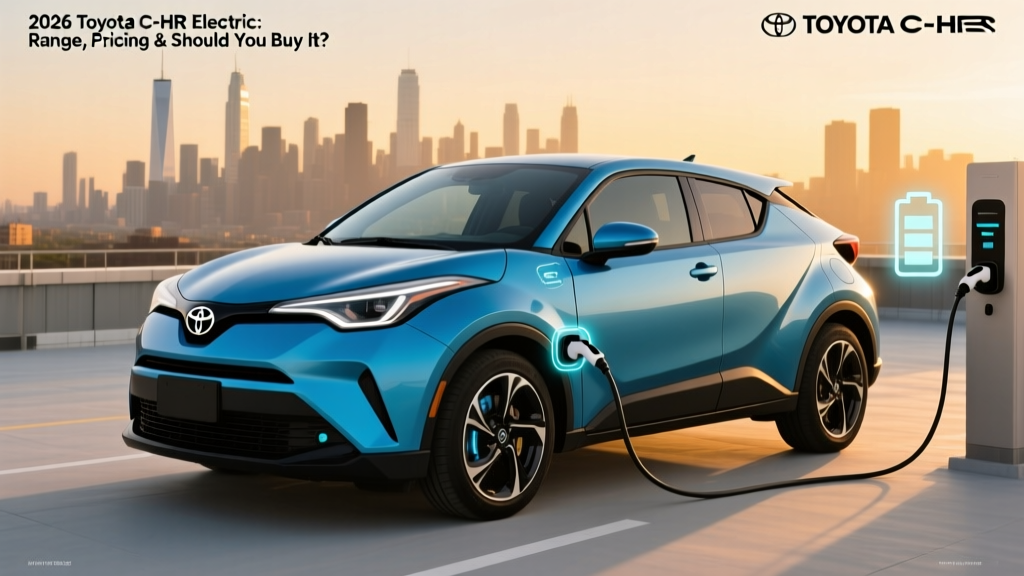
Quick Answer: Is the 2026 Toyota C-HR Electric Worth Waiting For?
The 2026 Toyota C-HR Electric is an announced compact crossover BEV built on Toyota's e-TNGA platform, targeting European and global markets with an estimated 250-mile WLTP range (~220 miles EPA equivalent), a ~58 kWh usable NMC battery, and a starting price expected around $32,000–$35,000 USD. US availability remains unconfirmed for 2026 — Toyota has not announced North American pricing or a launch date. If it does arrive stateside, expect EPA range closer to 200–220 miles and eligibility uncertainty for the §30D federal tax credit due to battery-sourcing requirements. Buyers who need a compact electric crossover now in the US should cross-shop the Hyundai Kona Electric (261 mi EPA), Chevrolet Equinox EV (315 mi EPA), or Volvo EX30 (275 mi EPA).
What We Know About the 2026 Toyota C-HR Electric So Far
Toyota officially unveiled the C-HR Electric concept in late 2024, with production specifications rolling out through 2025. The production model rides on a dedicated version of the e-TNGA architecture — the same platform underpinning the bZ4X — but tuned for a smaller, more affordable footprint. Here's a summary of confirmed and estimated specifications based on Toyota's European press materials and industry reporting:
| Specification | 2026 Toyota C-HR Electric (Estimated) |
|---|---|
| Battery (usable) | ~58 kWh, NMC chemistry |
| WLTP Range | ~250 miles (400 km) |
| Estimated EPA Range | ~200–220 miles |
| Motor / Drivetrain | Single front motor, FWD (~201 hp) |
| 0–62 mph (0–100 km/h) | ~8.6 seconds |
| Peak DC Fast Charge | ~150 kW |
| 10–80% DC Charge Time | ~30 minutes (est.) |
| Level 2 (AC) Charge Rate | 11 kW (onboard charger) |
| Estimated Base MSRP (USD) | $32,000–$35,000 |
| Battery Warranty | 8 years / 100,000 miles (typical Toyota) |
Important context: These figures are preliminary. Toyota's US-market specifications, if the C-HR Electric launches stateside, will likely differ — particularly on EPA range testing, which tends to yield 10–15% lower numbers than WLTP. We'll update this guide as confirmed data becomes available.
Real-World Range: What the Sticker Won't Tell You
Toyota's claimed 250-mile WLTP range translates to roughly 200–220 miles under EPA testing methodology, which more closely mirrors American driving patterns. But real-world results depend heavily on conditions:
2026 Toyota C-HR Electric — Real-World Range Expectations
- EPA Estimated: ~210 miles (projected)
- Highway (70 mph, 75°F): ~185–200 miles — smaller batteries suffer more at sustained highway speeds due to aerodynamic drag
- City / Suburban Mixed: ~215–230 miles — regenerative braking recovers energy in stop-and-go driving
- Cold Weather (30°F, highway): ~145–165 miles — expect 25–35% range loss without preconditioning; the C-HR Electric's heat pump (if equipped) can mitigate this by ~10%
With a ~58 kWh battery, efficiency would need to land around 3.6–3.8 miles/kWh to hit 210+ miles EPA. That's achievable but tight for a crossover form factor. For comparison, the Hyundai Kona Electric achieves 3.7 mi/kWh with its 65 kWh pack, and the Chevy Equinox EV hits roughly 3.4 mi/kWh with a much larger 85 kWh battery. The C-HR Electric's smaller battery keeps costs down but means less margin for cold-weather or highway range loss.
Charging Speed and Infrastructure Reality
The estimated 150 kW peak DC fast-charge rate puts the C-HR Electric in the mid-tier of compact EVs — adequate for road trips but not class-leading. Here's how charging breaks down across levels:
| Charge Level | Power (kW) | Miles Added per Hour | Use Case |
|---|---|---|---|
| Level 1 (120V outlet) | ~1.4 kW | ~4–5 mi/hr | Overnight top-up only |
| Level 2 (240V home) | ~11 kW | ~35–40 mi/hr | Daily home charging; full charge in ~6 hrs |
| DC Fast Charge | Up to 150 kW (peak) | ~400+ mi/hr (at peak) | Road trips; 10–80% in ~30 min |
Charging curve reality: The 150 kW peak only applies between roughly 10–50% State of Charge. Expect the rate to taper to ~80–100 kW from 50–70%, then drop sharply above 80%. A realistic 10–80% session at a 150+ kW charger (like an Electrify America or Tesla Supercharger with a Magic Dock adapter) will take about 30 minutes. Charging from 80–100% can add another 20+ minutes — so plan to unplug at 80% on road trips to maximize time efficiency.
At home on a Level 2 charger, the 11 kW onboard charger fills the 58 kWh battery from empty in roughly 5.5–6 hours. This is competitive — the Kona Electric charges at 10.5 kW, while the Equinox EV accepts up to 11.5 kW.
Cost Breakdown: Purchase, Fueling, and Ownership
The C-HR Electric's sub-$35,000 target price positions it as one of the more affordable electric crossovers — but total cost of ownership involves more than the sticker. Here's a realistic 5-year projection assuming 15,000 miles/year and national-average electricity/gas prices:
| Cost Category | C-HR Electric (Est.) | Gas C-HR (Previous Gen, 30 MPG) | Toyota Prius HEV (57 MPG) |
|---|---|---|---|
| Purchase Price (MSRP) | $33,500 | $26,000 | $29,000 |
| Federal Tax Credit (§30D) | $0–$7,500* | $0 | $0 |
| Fuel/Energy (5 yrs) | $3,750 (home charging at $0.15/kWh) | $8,750 (gas at $3.50/gal) | $4,605 (gas at $3.50/gal) |
| Maintenance (5 yrs) | $1,500 | $3,500 | $3,000 |
| Insurance (5 yrs, avg) | $7,500 | $6,000 | $6,200 |
| 5-Year Total (before credit) | $46,250 | $44,250 | $42,805 |
| 5-Year Total (after max credit) | $38,750 | $44,250 | $42,805 |
*Tax credit caveat: The §30D federal EV credit offers up to $7,500, but eligibility depends on battery-component sourcing (North American assembly requirement), critical-mineral sourcing thresholds, buyer income caps ($150K single / $300K joint AGI), and vehicle MSRP caps ($55,000 for SUVs/crossovers). As of early 2026, IRS rules have tightened sourcing requirements significantly. Toyota's battery supply chain for a European-built C-HR Electric may not meet US domestic-content rules — meaning the credit could be $0 or partial. Check the fueleconomy.gov tax credit tracker before assuming eligibility.
Energy cost detail: At 3.6 mi/kWh efficiency and $0.15/kWh (national residential average), the C-HR Electric costs about $0.042/mile to fuel at home. Public DC fast charging at $0.40–$0.50/kWh pushes that to $0.11–$0.14/mile — comparable to or slightly above a 57 MPG Prius at $3.50/gallon ($0.061/mile). Home charging access is the single biggest cost variable.
How It Compares: C-HR Electric vs. the Compact EV Field
The subcompact electric crossover segment is crowded in 2026. Here's how the C-HR Electric stacks up against confirmed US-market competitors:
| Spec | Toyota C-HR Electric (Est.) | Hyundai Kona Electric | Chevrolet Equinox EV | Volvo EX30 |
|---|---|---|---|---|
| EPA Range | ~210 mi | 261 mi | 315 mi | 275 mi |
| Battery (usable) | 58 kWh | 65 kWh | 85 kWh | 69 kWh |
| Peak DC Charge | 150 kW | 100 kW | 150 kW | 153 kW |
| 10–80% Time | ~30 min | ~43 min | ~30 min | ~27 min |
| Starting MSRP | ~$33,500 | $32,975 | $33,600 | $36,345 |
| Horsepower | 201 hp | 201 hp | 213 hp | 272 hp |
| §30D Credit Eligible | Uncertain | No (Korea-built) | Yes (up to $7,500) | No (China-built) |
Key takeaway: The C-HR Electric's ~210-mile projected EPA range would put it at a disadvantage against the Equinox EV's 315 miles and Kona's 261 miles. Toyota's brand reliability and expected competitive pricing are the main draws — but range-sensitive buyers or those in cold climates should note the smaller battery means less buffer.
Common Misconceptions — Fact-Checked
| Myth | Fact |
|---|---|
| "The C-HR Electric has 250 miles of range." | That's the WLTP figure. US EPA testing is stricter — expect ~200–220 miles EPA if it launches in the US. |
| "It qualifies for the full $7,500 tax credit." | Unlikely. European-built Toyotas face strict battery-component sourcing rules under §30D. The credit may be partial or $0. |
| "I can charge it at any Tesla Supercharger." | Only if equipped with a NACS port or using a J1772/CCS-to-NACS adapter. Toyota has committed to NACS adoption, but 2026 model-year connector specifics vary by market. |
| "EV batteries need replacing every 5 years." | Modern NMC packs retain 85–90% capacity after 100,000 miles. Toyota typically warranties the battery for 8 years/100,000 miles against dropping below 70% capacity. |
| "It's cheaper to own than any gas car." | Only if you charge at home. Public DC fast charging at $0.45+/kWh can make per-mile energy costs comparable to a 40+ MPG hybrid like the Prius. |
Decision Framework: Should You Wait, Buy Now, or Choose a Hybrid?
Choose the 2026 Toyota C-HR Electric if:
- You have reliable home Level 2 charging access (garage or driveway with 240V)
- Your daily commute is under 60 miles round-trip, with occasional 150-mile trips
- You want a Toyota-badge compact EV and are willing to accept ~210 miles of real-world range
- You live in a moderate climate where cold-weather range loss is manageable
Buy an existing competitor now if:
- You need 300+ miles of range: Chevrolet Equinox EV (315 mi EPA, §30D eligible)
- You want a proven platform available today: Hyundai Kona Electric (261 mi EPA)
- You want premium compact EV performance: Volvo EX30 (275 mi, 272 hp)
Choose a hybrid (Prius / Corolla Cross Hybrid) instead if:
- You lack home charging and rely on street parking or apartment living
- You regularly drive 300+ miles between stops in rural areas with sparse DC charging
- You want the lowest total cost of ownership without range compromises — the Prius at 57 MPG combined costs roughly $0.06/mile to fuel and has zero range anxiety
- You live in extreme cold climates (below 10°F) where EV range loss exceeds 30%
What First-Time EV Buyers Should Know Before Committing
If the C-HR Electric would be your first EV, here are the non-obvious ownership realities that spec sheets don't highlight:
1. Home charging is the economic linchpin. A Level 2 home charger installation typically costs $800–$2,000 (equipment + licensed electrician + permit), assuming your electrical panel has capacity. A 200-amp panel upgrade adds $1,500–$3,000. Without home charging, public DC fast charging costs 2–3× more per mile and adds time friction to daily life.
2. Plan for the 80% rule on road trips. Charging from 80–100% on DC fast chargers can take as long as 10–80%. Efficient road-tripping means charging to 80% and driving on — which, with a 210-mile EPA range, means stopping every ~150 miles in real-world conditions.
3. Insurance costs more. EV insurance premiums run 15–25% higher than equivalent gas cars due to battery replacement costs and specialized repair requirements. Budget an extra $200–$400/year over a gas C-HR equivalent.
4. Tire wear accelerates. EVs are heavier and deliver instant torque, wearing tires 15–25% faster than comparable gas vehicles. Budget for tire replacement every 30,000–40,000 miles instead of the 50,000+ you might expect from a gas crossover.
5. Resale value is uncertain. Early depreciation on non-Tesla EVs has been steep — some models lose 40–50% of value in 3 years. Toyota's brand reputation may help, but the compact EV segment is volatile. Lease if you're risk-averse.
Frequently Asked Questions
Will the 2026 Toyota C-HR Electric be sold in the United States?
As of early 2026, Toyota has not confirmed US availability. The C-HR Electric was designed primarily for European and Asian markets. Toyota's US EV lineup currently centers on the bZ4X and the upcoming bZ compact SUV. We'll update this guide if a US launch is announced.
What is the real-world range of the C-HR Electric?
The WLTP-rated range is approximately 250 miles (400 km). Under EPA testing, expect roughly 200–220 miles. Real-world highway driving at 70 mph in moderate temperatures will yield approximately 185–200 miles. In cold weather (below 30°F), plan for 145–165 miles unless you precondition the battery.
Does the C-HR Electric qualify for the $7,500 federal tax credit?
Very likely not the full amount, and possibly not at all. The §30D credit requires battery components and critical minerals to meet North American sourcing thresholds that tighten annually. A European-built Toyota with a likely Asian-sourced battery pack faces significant eligibility hurdles. Always verify on fueleconomy.gov before purchasing.
How long does it take to charge the C-HR Electric at home?
On a Level 2 (240V) home charger at 11 kW, a full charge from empty takes approximately 5.5–6 hours. On a standard 120V outlet (Level 1), a full charge takes over 40 hours — only practical for overnight top-ups of 20–30 miles.
Is the C-HR Electric better than a Prius hybrid?
It depends entirely on your charging access and driving patterns. With home charging and mostly local driving, the C-HR Electric offers lower per-mile energy costs (~$0.04/mi vs ~$0.06/mi) and zero tailpipe emissions. Without home charging, or for frequent 300+ mile trips, the Prius hybrid's 57 MPG combined and zero range compromise make it the more practical and often cheaper-to-own choice.
What connector does the C-HR Electric use?
European models use CCS2. If a US version launches, it will likely use either CCS1 or NACS (Tesla's connector), as Toyota has committed to NACS adoption for future US models. Check the specific model-year spec sheet for confirmation.