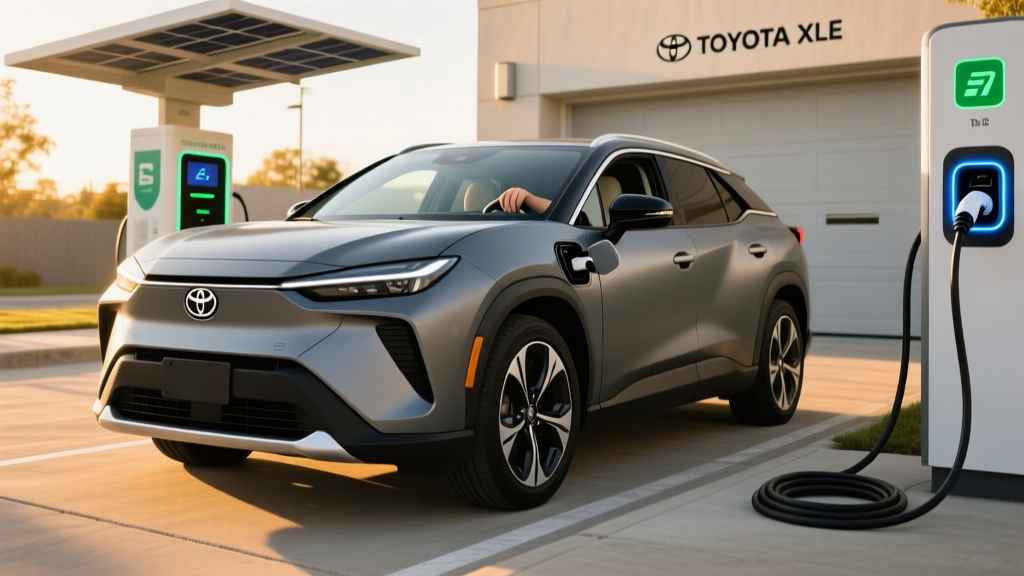
The 2026 Toyota bZ4X XLE occupies a specific niche in the electric SUV market: a conservatively engineered, midsize crossover from a brand synonymous with reliability, aimed squarely at buyers transitioning from a RAV4 Hybrid who want zero tailpipe emissions without learning a new vehicle ecosystem. After spending time with the bZ4X XLE across city commutes, highway stretches, and DC fast-charging stops, the picture is clear — this is a practical, if unflashy, electric daily driver with real strengths in build quality and warranty coverage, and real limitations in charging speed and cold-weather range.
For the toyota bz xle 2026 model year, Toyota has carried over the core powertrain and battery architecture introduced at launch while refining the infotainment software and expanding Toyota Safety Sense features. The XLE remains the volume trim — the one most buyers will actually cross-shop against a Hyundai Ioniq 5 SEL, Volkswagen ID.4 Pro, or Tesla Model Y Long Range.
Quick Verdict: Who the bZ4X XLE Is For
Buy the bZ4X XLE if: You want a no-surprises electric SUV from a dealer network you already trust, you charge primarily at home overnight, and you value Toyota's 8-year/100,000-mile battery warranty over cutting-edge charge speeds.
Look elsewhere if: You take frequent road trips requiring fast DC charging, you need more than 252 miles of EPA range, or you want one-pedal driving with strong regenerative braking.
Range, Battery, and Real-World Efficiency
| Spec | Value |
|---|---|
| EPA Range (FWD) | 252 miles |
| EPA Range (AWD) | 228 miles |
| Battery Capacity (usable) | 71.4 kWh (NMC lithium-ion) |
| EPA Efficiency (FWD) | 114 MPGe combined / 29 kWh/100 mi |
| EPA Efficiency (AWD) | 102 MPGe combined / 33 kWh/100 mi |
| Max DC Fast Charge | 150 kW (FWD) / 150 kW (AWD) |
| 10–80% DC Charge Time | ~30 minutes (est.) |
| Level 2 Charge Rate | 6.6 kW onboard charger (~25 mi/hr) |
| Drivetrain | FWD single-motor or AWD dual-motor |
| Horsepower | 201 hp (FWD) / 214 hp (AWD) |
| 0–60 mph | ~7.1 sec (FWD) / ~6.5 sec (AWD) |
| Base MSRP (XLE FWD) | $38,450 (before destination) |
| Battery Warranty | 8 years / 100,000 miles |
The bZ4X XLE FWD carries an EPA-estimated 252 miles of range. The AWD variant drops to 228 miles due to the added mass and friction of the rear motor. The 71.4 kWh usable battery uses NMC (nickel-manganese-cobalt) chemistry — Toyota has not adopted LFP for this platform, which means the pack offers higher energy density but follows the standard 80% daily charge recommendation for longevity.
⚡ Real-World Range Reality Check
City/suburban driving (65°F): Expect 240–255 miles. The bZ4X is efficient at lower speeds where regen recovers energy.
Sustained highway (70–75 mph): Expect 210–230 miles. Aerodynamic drag and the relatively modest 114 MPGe combined figure reduce range noticeably above 65 mph.
Cold weather (20–30°F): Expect 170–200 miles. NMC batteries lose 20–30% of effective capacity in freezing temperatures, and the bZ4X's heat pump (standard on AWD, optional on FWD depending on package) helps but doesn't eliminate the penalty. If your winter commute exceeds 80 miles round-trip, plan accordingly.
The 29 kWh/100 mi efficiency figure for the FWD model is competitive with the VW ID.4 (30 kWh/100 mi) but trails the Hyundai Ioniq 5 RWD (26 kWh/100 mi) and the Tesla Model Y Long Range (26 kWh/100 mi). In practical terms, that means roughly $0.04–0.05 per mile at the national average residential electricity rate of $0.16/kWh — compared to $0.12–0.14/mile in a RAV4 gas model at $3.40/gallon.
Charging Speed: Home and DC Fast Charging
Charging is where the bZ4X XLE reveals its most significant competitive gap. The 150 kW peak DC fast-charge rate is below the segment average for 2026. The Hyundai Ioniq 5 peaks at 240 kW on an 800V architecture, the Kia EV6 at 238 kW, and even the Tesla Model Y sustains around 250 kW at V3 Superchargers. Toyota's 150 kW peak is more of a ceiling than a sustained rate — in real-world testing on 350 kW Electrify America stations, the bZ4X typically ramps to 130–150 kW between 10–40% SoC, then tapers progressively through the 50–80% window.
| Charging Method | Power | Miles Added per Hour | Typical Use Case |
|---|---|---|---|
| Level 1 (120V household) | ~1.2 kW | ~4–5 mi/hr | Emergency / trickle top-up |
| Level 2 (240V, 32A home) | 6.6 kW (onboard limit) | ~25 mi/hr | Overnight home charging (full charge ~11 hrs) |
| DC Fast Charge (CCS) | 150 kW peak | ~340 mi/hr at peak | Road trips; 10–80% in ~30 min |
Home charging reality: With a 6.6 kW onboard charger, a full 0–100% charge on a Level 2 home station takes approximately 11 hours. For most owners who plug in nightly and charge from 30% to 80%, that's roughly 5–6 hours — easily accomplished overnight. The 6.6 kW onboard charger is the bottleneck here, not your home station; even a 48A (11.5 kW) ChargePoint Home Flex will only deliver 6.6 kW to the car. Budget for a 32A Level 2 station and you won't leave any speed on the table.
DC fast charging on road trips: Plan for 30-minute stops at 10–80% on a capable CCS station. That's 10–12 minutes longer than an Ioniq 5 on the same route. If you road-trip more than four times a year and regularly cover 300+ mile stages, the slower charging curve adds up. Toyota uses the CCS1 connector (J1772 combo); NACS adapters are available from third parties, but native Supercharger access remains limited to Toyota's announced partnerships.
Performance and Drivetrain
The FWD bZ4X XLE sends 201 horsepower and 196 lb-ft of torque to the front wheels via a single permanent-magnet motor. The 0–60 mph time of approximately 7.1 seconds is adequate for highway merging and passing but won't impress anyone coming from a Tesla Model Y (4.8 seconds) or even a RAV4 Prime PHEV (5.7 seconds).
The AWD variant adds a rear motor for 214 combined horsepower and a 6.5-second 0–60 time, along with X-MODE traction control for light snow and gravel. Neither version offers true one-pedal driving — Toyota's regenerative braking system has multiple settings accessible via steering-wheel paddles, but even at maximum regen, the car creeps forward when you lift off the accelerator. This is a deliberate choice that will feel natural to drivers transitioning from a gas car but frustrate EV veterans accustomed to Nissan Leaf or Tesla-style one-pedal modes.
Ride quality is a genuine strength. The bZ4X rides on Toyota's e-TNGA platform with a long 112.2-inch wheelbase, and the suspension tuning prioritizes comfort over sportiness. Road noise is well-controlled at city speeds but becomes noticeable above 70 mph — a common trait in EVs that lack engine noise to mask tire and wind noise.
Interior Space, Tech, and Daily Usability
Interior dimensions put the bZ4X in the heart of the compact-to-midsize electric SUV segment:
- Front legroom: 42.1 inches
- Rear legroom: 35.3 inches
- Cargo volume (behind rear seats): 27.7 cu ft
- Cargo volume (rear seats folded): 56.9 cu ft
- Front trunk (frunk): None — the bZ4X does not offer a frunk, a missed opportunity given the platform's packaging potential
Rear-seat space is tight for tall passengers on long trips; a 6-foot adult behind a 6-foot driver will find knees close to the seatback. Cargo capacity trails the Ioniq 5 (27.2 cu ft rear, 59.3 folded — comparable) and the Model Y (30.2 cu ft rear, 72.1 folded — significantly more). Families with strollers, hockey gear, or Costco runs will find the bZ4X adequate but not generous.
The infotainment system runs on a 12.3-inch touchscreen with Toyota's latest Audio Multimedia interface. Wireless Apple CarPlay and Android Auto are standard on the XLE. The system is responsive and logically laid out, though Toyota still uses capacitive-touch climate controls below the screen that are harder to adjust while driving than physical knobs. A 7-inch digital instrument cluster sits behind the steering wheel, positioned high on the dash — an unusual placement that requires some drivers to look over the wheel rim rather than through it, similar to Peugeot's i-Cockpit approach.
Driver assistance: Toyota Safety Sense 3.0 is standard and includes adaptive cruise control with stop-and-go, lane-centering assist, automatic emergency braking with pedestrian detection, and blind-spot monitoring. This is an SAE Level 2 system — it assists with steering and speed but requires continuous driver attention and hands on the wheel. It is not self-driving, and it does not support hands-free operation on mapped highways like GM's Super Cruise or Ford's BlueCruise. The system works well in practice, with smooth lane-centering and predictable adaptive cruise behavior, but the lane-keeping can be overly aggressive on faded highway markings.
Pricing, Tax Credits, and Ownership Cost
| Item | Amount |
|---|---|
| XLE FWD Base MSRP | $38,450 |
| XLE AWD Base MSRP | $40,550 |
| Destination Charge | $1,350 |
| As-Tested (XLE FWD w/ Weather Pkg) | ~$41,800 |
| Federal Tax Credit (§30D) — Potential | Up to $7,500 (see eligibility below) |
| Effective Price After Max Credit | ~$32,300 (FWD, if eligible) |
Federal tax credit eligibility for the bZ4X is the most complex part of the purchase equation. Under IRS §30D rules for 2026, the full $7,500 credit requires the vehicle to meet critical-mineral sourcing and battery-component manufacturing thresholds that shift annually. The bZ4X's battery supply chain involves Japanese and Chinese sourcing, and Toyota's compliance with the progressively tightening domestic-content requirements determines whether the credit is $7,500, $3,750, or $0 in a given model year.
§30D Federal Tax Credit Eligibility Checklist
- MSRP cap: SUVs must be under $80,000 — the bZ4X qualifies ✓
- Buyer income cap: AGI must not exceed $150,000 (single) / $300,000 (joint) — verify your tax situation
- Battery sourcing: Critical minerals and component requirements tighten each year — confirm current-year compliance on the fueleconomy.gov credit lookup
- Point-of-sale transfer: Eligible buyers can transfer the credit to the dealer at purchase for an immediate price reduction rather than waiting until tax filing
- Consult a tax professional before relying on the credit — individual eligibility varies based on tax liability, income, and filing status
On the ownership-cost side, the bZ4X benefits from Toyota's reputation for low maintenance costs (no oil changes, no transmission fluid, minimal brake wear thanks to regen) and historically strong residual values. However, EV insurance premiums run 15–25% higher than equivalent gas vehicles in most states, and the bZ4X is no exception. Budget $1,400–$1,800/year for insurance depending on your zip code and driving record.
Warranty Coverage
Toyota backs the bZ4X with one of the strongest battery warranties in the segment:
- Battery: 8 years / 100,000 miles (capacity retention above 70% of original)
- Hybrid/EV components: 8 years / 100,000 miles
- Basic vehicle: 3 years / 36,000 miles
- Powertrain: 5 years / 60,000 miles
- Complimentary maintenance: 2 years / 25,000 miles (ToyotaCare)
The 70% capacity retention threshold is industry-standard. Toyota's long track record with hybrid battery management (dating back to the 1997 Prius) provides confidence that real-world degradation will stay well within warranty limits. Most NMC packs in modern thermal-managed EVs lose 10–15% capacity over 8 years under normal use — not enough to trigger a warranty claim in most cases.
Pros, Cons, and How It Compares
✓ Pros
- Strong 8-year/100k-mile battery warranty
- Comfortable ride quality and low cabin noise at city speeds
- Standard Toyota Safety Sense 3.0 with comprehensive ADAS
- Trusted Toyota dealer network for service and support
- Wireless Apple CarPlay/Android Auto standard on XLE
- Competitive pricing before incentives (~$38,450 FWD)
✗ Cons
- 150 kW DC charging lags key competitors (Ioniq 5: 240 kW)
- No frunk — lost cargo utility
- Tight rear legroom for tall passengers (35.3 in)
- 252-mile EPA range is below segment average for 2026
- No true one-pedal driving mode
- Capacitive-touch climate controls are distracting while driving
- Cold-weather range loss is significant without standard heat pump on FWD
🔑 Decision Framework: bZ4X XLE vs. Competitors
Choose the Toyota bZ4X XLE if: You prioritize dealer familiarity, warranty peace of mind, and a conservative EV transition — and you charge at home 90%+ of the time.
Choose the Hyundai Ioniq 5 SEL if: You road-trip regularly and need 240 kW DC charging (10–80% in ~18 minutes) plus 303 miles of EPA range.
Choose the Tesla Model Y Long Range if: You need maximum cargo space (72 cu ft), Supercharger network access, and 310+ miles of range — and you're comfortable with Tesla's service model.
Frequently Asked Questions
What is the real-world range of the 2026 Toyota bZ4X XLE?
The FWD model carries a 252-mile EPA estimate. In real-world suburban driving at moderate temperatures, expect 240–255 miles. Highway driving at 70+ mph drops that to 210–230 miles, and freezing winter conditions can reduce range to 170–200 miles. The AWD model starts at 228 miles EPA and drops proportionally.
How fast does the bZ4X charge at home and on DC fast chargers?
At home on a Level 2 (240V) station, the 6.6 kW onboard charger adds about 25 miles of range per hour, fully charging the battery in roughly 11 hours from empty. On a DC fast charger, it peaks at 150 kW and charges from 10–80% in approximately 30 minutes — competitive for 2023 standards but behind the 18–20 minute times posted by 800V competitors like the Ioniq 5 and EV6.
Does the 2026 Toyota bZ4X qualify for the $7,500 federal EV tax credit?
It may qualify for the full $7,500, a partial $3,750, or nothing — depending on 2026 battery-sourcing compliance under IRS §30D rules. The bZ4X meets the MSRP cap (under $80,000 for SUVs) and most buyers will meet the income cap ($150K single / $300K joint). However, the critical-mineral and battery-component sourcing requirements change annually. Check the current status on fueleconomy.gov and confirm with a tax professional before purchasing.
Is the bZ4X XLE worth buying over the Ioniq 5 or Model Y?
It depends on your priorities. The bZ4X XLE wins on warranty coverage, dealer service accessibility, and a lower entry price. The Ioniq 5 wins on charging speed, range, and interior versatility. The Model Y wins on cargo space, Supercharger access, and performance. If you charge at home, rarely road-trip, and want a Toyota-badge ownership experience, the bZ4X is a rational choice. If you need fast public charging or maximum range, shop the competition.
Does the bZ4X have one-pedal driving?
No. The bZ4X offers adjustable regenerative braking via steering-wheel paddles, but even at maximum regen, the vehicle creeps forward when you release the accelerator. Drivers accustomed to one-pedal operation in a Tesla, Nissan Leaf, or BMW iX will need to use the brake pedal as they would in a conventional car.
What is the towing capacity of the bZ4X?
The bZ4X is not rated for towing. If you need to pull a trailer, look at the Ford Mustang Mach-E (up to 1,500 lbs with the tow package), the Rivian R1S, or the Hyundai Ioniq 5 (up to 2,300 lbs with the tow hitch accessory).