Quick Verdict: The 2026 Toyota bZ4X at a Glance
The 2026 Toyota bZ4X enters its fourth model year with incremental but meaningful updates: a slightly larger battery pack, revised thermal management for faster DC charging, and Toyota's latest Safety Sense 3.0 suite. It remains one of the most accessible electric crossovers from a legacy automaker, with a starting MSRP of $37,070 and standard front-wheel drive. However, in a segment where rivals now push past 300 miles of EPA range and 200+ kW charging, the bZ4X occupies a specific lane — practical, warranty-backed, and dealership-accessible — rather than leading on raw specs.
If you prioritize Toyota's reliability reputation, a robust battery warranty, and straightforward daily driving over maximum range or blistering charge speeds, the 2026 bZ4X deserves a serious look. If you road-trip frequently or live in extreme cold climates, competitors with larger batteries and heat pumps may serve you better.
| Spec | bZ4X XLE FWD | bZ4X Limited AWD |
|---|---|---|
| EPA Range | 252 mi | 228 mi |
| Battery (usable) | 71.4 kWh (NMC) | 71.4 kWh (NMC) |
| Max DC Charge Rate | 150 kW | 150 kW |
| 10–80% DC Time | ~30 min | ~30 min |
| Level 2 Charge Rate | 7.2 kW (~25 mi/hr) | 7.2 kW (~25 mi/hr) |
| 0–60 mph | 7.1 sec | 5.8 sec |
| Horsepower | 201 hp | 214 hp |
| Drivetrain | FWD (single motor) | AWD (dual motor) |
| MPGe (combined) | 119 MPGe | 107 MPGe |
| Base MSRP | $37,070 | $43,870 |
| Battery Warranty | 8 yr / 100,000 mi | 8 yr / 100,000 mi |
Range and Efficiency: EPA Numbers vs. Real-World Driving
The 2026 bZ4X XLE FWD carries an EPA-estimated 252 miles of range, while the dual-motor AWD Limited drops to 228 miles. These figures come from a 71.4 kWh usable lithium-ion pack using NMC (nickel manganese cobalt) chemistry — the same cell supplier ecosystem Toyota has used since the bZ4X's 2023 launch, though with revised module-level thermal controls for 2026.
The EPA 252-mile sticker applies to mixed city/highway driving at moderate temperatures. Expect approximately 215–230 miles on sustained highway runs at 70–75 mph, where aerodynamic drag reduces efficiency. In freezing conditions (below 32°F), range can drop 20–30% due to cabin heating demand and reduced battery chemistry performance — putting real winter range closer to 175–195 miles for the FWD model. The bZ4X does not offer a standard heat pump in all trims (it's optional on XLE, standard on Limited), which significantly affects cold-weather efficiency.
Efficiency ratings land at 119 MPGe combined (28 kWh/100 mi) for the FWD and 107 MPGe combined (31 kWh/100 mi) for the AWD. These are respectable but trail the segment's most efficient entries — the Hyundai Ioniq 5 RWD achieves 132 MPGe combined, for example. The bZ4X's curb weight of roughly 4,200 lbs (FWD) and conservative regen tuning contribute to its mid-pack efficiency showing.
For context on EPA testing methodology and how to interpret these figures, see the EPA's guide to electric vehicle fuel economy.
Charging Speed: DC Fast Charging and Home Level 2
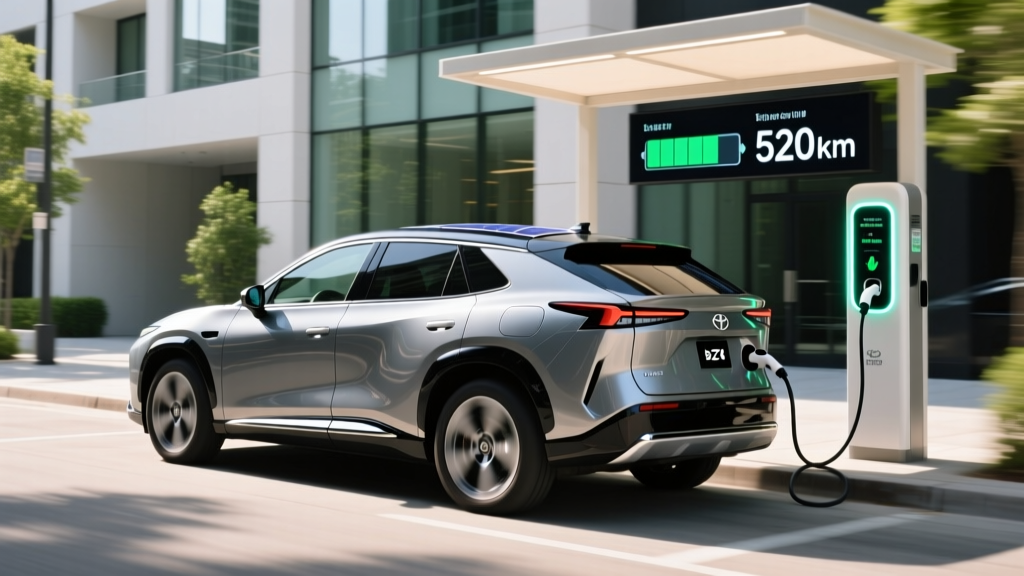
Charging capability is where the 2026 bZ4X shows its most pragmatic — and most debated — character. The peak DC fast-charge rate is 150 kW via its CCS1 connector (NACS adapter availability varies by region and dealer package). Toyota claims a 10–80% charge time of approximately 30 minutes under ideal conditions, which means a pre-conditioned battery at moderate ambient temperature connected to a capable 150+ kW charger.
Here's where real-world nuance matters: the bZ4X's charge curve is notably conservative above 80%. Like most NMC-based EVs, the vehicle aggressively tapers charge speed past 80% SoC to protect long-term battery health. If you're road-tripping and charging from 10–80%, expect roughly 30 minutes. If you need to push from 80–100%, plan on an additional 25–35 minutes. For highway travel, the practical strategy is to charge in the 10–80% window and skip the top-off unless overnight.
| Charging Level | Power | Speed (approx.) | Use Case |
|---|---|---|---|
| Level 1 (120V household) | 1.2 kW | ~4 mi/hr | Emergency top-off only |
| Level 2 (240V home/public) | 7.2 kW | ~25 mi/hr | Overnight home charging; full charge in ~10 hrs |
| DC Fast Charge | 150 kW peak | ~180 mi in 30 min (10–80%) | Road trips; requires 150+ kW station |
For home Level 2 charging, the bZ4X accepts 7.2 kW on a 240-volt circuit, adding roughly 25 miles of range per hour. A full 0–100% charge takes approximately 10 hours, which is fine for overnight charging but slower than rivals accepting 11.5 kW on Level 2 (like the Ioniq 5 or Tesla Model Y). If your daily commute is under 60 miles round-trip, a Level 2 home charger easily replenishes overnight. Home Level 2 installation typically costs $800–$2,000 depending on panel capacity and run length — consult a licensed electrician for your specific setup.
Performance and Driving Dynamics
The FWD bZ4X uses a single front-mounted motor producing 201 horsepower and 196 lb-ft of torque, delivering a 0–60 mph time of 7.1 seconds. That's adequate for highway merging and city driving, though it won't win any stoplight sprints against the segment's quicker offerings.
The AWD variant pairs front and rear motors for a combined 214 hp and 248 lb-ft, cutting the 0–60 time to 5.8 seconds. Toyota's X-MODE traction system on AWD trims provides basic snow/mud/rock settings, making the bZ4X a credible light-duty all-weather vehicle — though it's not designed for serious off-roading.
Driving dynamics are comfort-oriented rather than sporty. The steering is light and numb by enthusiast standards, the suspension soaks up bumps effectively, and cabin noise levels are well-controlled at highway speeds. Regenerative braking offers multiple levels selectable via paddle shifters, but the bZ4X does not provide true one-pedal driving that brings the car to a complete stop — you'll still need the brake pedal at low speeds, which some EV converts find annoying.
Interior, Cargo, and Technology
Inside, the 2026 bZ4X features Toyota's 12.3-inch touchscreen running the latest Toyota Audio Multimedia system with wireless Apple CarPlay and Android Auto, a 7-inch digital gauge cluster, and available panoramic fixed-glass roof (which does not open — a common complaint from buyers expecting a sunroof). The cabin materials are decent for the price point: soft-touch dash surfaces with some harder plastics on lower door panels.
Passenger space is generous for a compact crossover:
- Front legroom: 42.1 inches
- Rear legroom: 38.1 inches
- Front headroom: 39.9 inches (without glass roof)
- Rear headroom: 38.1 inches
Cargo volume measures 27.7 cubic feet behind the rear seats and 56.9 cubic feet with the 60/40 rear seats folded. There is no front trunk (frunk) — the space under the hood houses electronics and the HVAC system. Compared to the Hyundai Ioniq 5 (27.2 cu ft rear / 59.3 cu ft total) or the Ford Mustang Mach-E (29.7 / 59.7), the bZ4X is in the same ballpark but doesn't lead.
Toyota Safety Sense 3.0 comes standard across all trims and includes:
- Pre-Collision System with pedestrian detection
- Lane Departure Alert with Steering Assist
- Full-Speed Range Dynamic Radar Cruise Control
- Lane Tracing Assist (lane centering)
- Road Sign Assist
- Proactive Driving Assist (gentle deceleration/steering support)
Toyota Safety Sense 3.0, including Lane Tracing Assist, is an SAE Level 2 driver-assistance system. This means the vehicle can control steering and acceleration/braking simultaneously under certain conditions, but the driver must remain fully engaged, hands on or near the wheel, and eyes on the road at all times. This is not autonomous or self-driving capability. For a full breakdown of SAE automation levels, see SAE International's J3016 standard.
Pricing, Trims, and Federal Tax Credit Eligibility
The 2026 Toyota bZ4X is offered in two primary trims:
| Trim | Base MSRP | Destination | Total Before Credit | Est. After §30D Credit* |
|---|---|---|---|---|
| XLE FWD | $37,070 | $1,350 | $38,420 | ~$30,920 |
| XLE AWD | $39,470 | $1,350 | $40,820 | ~$33,320 |
| Limited FWD | $42,470 | $1,350 | $43,820 | ~$36,320 |
| Limited AWD | $43,870 | $1,350 | $45,220 | ~$37,720 |
*Federal tax credit estimates assume full eligibility under IRS §30D rules. Actual credit may range from $0 to $7,500 depending on battery component and critical mineral sourcing requirements, which shift annually. See IRS.gov clean vehicle credit page for current-year sourcing tables and eligibility details.
Critical eligibility factors for the §30D credit on the 2026 bZ4X:
- MSRP cap: The bZ4X is classified as an SUV/crossover, subject to the $80,000 MSRP cap — all trims clear this easily.
- Buyer income cap: Modified AGI must not exceed $150,000 (single), $225,000 (head of household), or $300,000 (joint). These thresholds have remained stable since 2023.
- Battery sourcing: For 2026, the credit splits into two halves — $3,750 for battery component manufacturing (North America) and $3,750 for critical minerals (US or FTA-partner sourcing). Toyota has worked to localize battery supply, but full $7,500 eligibility varies by build date and cell batch. Confirm with your dealer and a tax professional before relying on the full amount.
- Point-of-sale transfer: As of 2024, buyers can transfer the credit to the dealer at purchase, reducing the purchase price upfront rather than waiting for a tax refund. This is available for the bZ4X if the dealer is registered with the IRS energy credits portal.
Warranty and Long-Term Ownership
Toyota backs the bZ4X with its standard EV warranty package:
- Battery: 8 years / 100,000 miles (whichever comes first), covering capacity loss below 70% of original
- Hybrid/EV powertrain components: 8 years / 100,000 miles
- Basic bumper-to-bumper: 3 years / 36,000 miles
- Corrosion perforation: 5 years / unlimited miles
The 70% capacity retention threshold is standard for the industry — Tesla, Hyundai, and Ford use similar benchmarks. In practice, NMC batteries in liquid-cooled packs like the bZ4X's typically retain 85–92% capacity after 100,000 miles based on fleet data from earlier Toyota and Subaru EV deployments (the Subaru Solterra shares this platform). Catastrophic battery failure is rare; gradual degradation is the norm.
If you do need an out-of-warranty battery replacement down the road, expect pricing in the $12,000–$18,000 range for the pack plus labor, though module-level repairs (replacing individual cell groups rather than the full pack) can reduce costs significantly. Toyota's dealership network is a genuine advantage here — EV service infrastructure is broader than most startup brands can offer.
How the bZ4X Compares to Key Rivals
The bZ4X competes in the compact electric crossover segment against several well-established alternatives. Here's how the key numbers stack up:
| Attribute | 2026 Toyota bZ4X XLE FWD | 2026 Hyundai Ioniq 5 SEL RWD | 2026 Tesla Model Y LR RWD | 2026 Ford Mach-E Select RWD |
|---|---|---|---|---|
| EPA Range | 252 mi | 303 mi | 320 mi | 250 mi |
| Battery | 71.4 kWh NMC | 77.4 kWh NMC | 75 kWh (est.) NMC | 70 kWh NMC |
| DC Fast Charge | 150 kW | 235 kW | 250 kW | 150 kW |
| 10–80% Time | ~30 min | ~18 min | ~20 min | ~33 min |
| 0–60 mph | 7.1 sec | 7.2 sec | 5.8 sec | 6.1 sec |
| Base MSRP | $37,070 | $42,400 | $44,990 | $39,995 |
The bZ4X's range and charging speed are its weakest competitive metrics. The Ioniq 5 and Model Y both charge significantly faster and offer 50+ more miles of EPA range. However, the bZ4X undercuts both on price — by $5,300 versus the Ioniq 5 and nearly $8,000 versus the Model Y. For buyers who don't road-trip often and can charge at home, the price gap may outweigh the spec-sheet deficit.
The Mach-E Select is the closest rival in both price and range, though Ford's charging speed is similarly conservative. The Mach-E offers slightly more cargo space and a more engaging driving experience, but Toyota's warranty reputation and dealer density are differentiators for risk-averse buyers.
- Competitive starting price with standard equipment
- Toyota Safety Sense 3.0 standard on all trims
- Strong battery warranty (8 yr / 100k mi)
- Comfortable ride quality and low cabin noise
- Wide Toyota dealership network for service
- Eligible for up to $7,500 federal tax credit (sourcing dependent)
- EPA range (252 mi max) trails segment leaders by 50+ miles
- 150 kW DC fast charging is slow vs. 200+ kW rivals
- Level 2 acceptance capped at 7.2 kW (competitors offer 11.5 kW)
- No front trunk (frunk)
- No true one-pedal driving mode
- Heat pump not standard on base XLE trim
Who Should Buy the 2026 Toyota bZ4X?
Choose the bZ4X if: You want a no-drama, warranty-backed EV from a brand you trust, your daily commute is under 80 miles round-trip, you have access to home Level 2 charging, and you want to stay under $40,000 before incentives. It's ideal as a commuter and family runabout where overnight home charging covers 95% of your driving.
Look elsewhere if: You regularly drive 200+ miles between charging stops, you live in a region with harsh winters and limited charging infrastructure, you want the fastest possible road-trip charging, or you need maximum cargo space for gear-heavy lifestyles. The Ioniq 5 or Model Y better serve road-trip-heavy or cold-climate use cases.
Frequently Asked Questions
What is the real-world range of the 2026 Toyota bZ4X?
The EPA rates the bZ4X XLE FWD at 252 miles and the AWD Limited at 228 miles. In real-world highway driving at 70–75 mph, expect approximately 215–230 miles from the FWD model. In cold weather (below freezing), range can drop 20–30%, yielding roughly 175–195 miles. City driving with regenerative braking tends to be closer to or slightly above the EPA estimate.
How fast does the bZ4X charge at home and on the road?
On DC fast charging, the bZ4X peaks at 150 kW and charges from 10–80% in approximately 30 minutes on a capable station. At home on a 240V Level 2 charger, it accepts 7.2 kW, adding about 25 miles per hour and fully charging in roughly 10 hours. It uses the CCS1 connector; a NACS adapter may be available depending on your region and dealer.
How much does the 2026 bZ4X cost after federal tax credits?
The XLE FWD starts at $38,420 including destination. If you qualify for the full $7,500 §30D credit (subject to income, MSRP, and battery sourcing rules), the effective price drops to approximately $30,920. The top Limited AWD at $45,220 would come to roughly $37,720 after the maximum credit. Eligibility depends on your tax filing status, modified AGI, and the specific vehicle's battery component sourcing — confirm with your dealer and a tax professional.
Does the 2026 bZ4X qualify for the $7,500 federal EV tax credit?
The bZ4X is eligible for up to $7,500 under IRS §30D, split into $3,750 for battery component manufacturing and $3,750 for critical mineral sourcing. All trims fall well under the $80,000 MSRP cap for SUVs. Buyer income must not exceed $150K (single), $225K (head of household), or $300K (joint). The actual credit amount depends on battery sourcing compliance, which can vary by production batch. Check the fueleconomy.gov tax credit database for VIN-specific eligibility once available.
Is the Toyota bZ4X worth buying versus the Hyundai Ioniq 5 or Tesla Model Y?
It depends on your priorities. The Ioniq 5 and Model Y offer significantly more range (300+ miles) and much faster DC charging (200+ kW), making them better for road trips and cold climates. However, the bZ4X starts $5,000–$8,000 lower, comes with Toyota's warranty and dealer network, and is perfectly adequate for daily commuting with home charging. If range and charge speed are non-negotiable, choose the Ioniq 5 or Model Y. If price and brand trust matter more, the bZ4X is a solid, rational choice.
Does the bZ4X have a heat pump for cold weather?
A heat pump is optional on the XLE trim and standard on the Limited. The heat pump significantly improves cold-weather efficiency by using ambient and waste heat for cabin warming instead of relying solely on resistive heating, which draws heavily from the battery. If you live in a climate with regular sub-40°F winters, prioritize a bZ4X equipped with the heat pump option.