The 2026 Toyota bZ XLE Plus sits in the middle of Toyota's expanding battery-electric lineup, bridging the gap between the base XLE and the range-topping Limited. It's the trim most buyers will actually cross-shop against the Hyundai Ioniq 5, Ford Mustang Mach-E, and Tesla Model Y — and for 2026, Toyota has sharpened its pitch with revised thermal management, a slightly larger usable battery, and updated infotainment. But does the bZ XLE Plus deliver where it counts: real-world range, charging speed, and ownership economics? Here's every number you need.
2026 Toyota bZ XLE Plus: Quick Verdict
The bZ XLE Plus is a competent, comfort-oriented electric crossover that prioritizes everyday usability over headline performance. It won't win drag races or set charging-speed records, but its ride quality, cabin materials, and Toyota's dealer network make it a strong pick for buyers who want a mainstream EV from a brand they already trust. The 2026 model year brings meaningful improvements in cold-weather efficiency and software responsiveness, narrowing the gap with Korean and American rivals.
| Spec | Value |
|---|---|
| EPA Range (AWD) | 252 miles |
| Battery (Usable) | 72.8 kWh, NMC (Nickel Manganese Cobalt) |
| Peak DC Fast Charge | 150 kW |
| 10–80% DC Charge Time | ~30 minutes |
| Level 2 Home Charging | 11 kW (~37 mi/hr) |
| Drivetrain | Dual-motor AWD |
| Horsepower | 338 hp (combined) |
| 0–60 mph | 4.8 seconds |
| Efficiency | 112 MPGe combined / 30 kWh/100 mi |
| Cargo (rear seats up / folded) | 27.7 / 56.9 cu ft |
| Rear Legroom | 38.0 inches |
| Base MSRP (XLE Plus AWD) | $44,500 |
| Battery Warranty | 8 years / 100,000 miles |
Real-World Range: Beyond the EPA Sticker
Real-World Expectation: ~215–230 miles at sustained highway speeds (70–75 mph); ~185–200 miles in sub-30°F winter conditions with cabin heat; up to ~255 miles in moderate-temperature city driving with regen braking.
The EPA's 252-mile figure for the AWD XLE Plus reflects a mixed driving cycle, but fueleconomy.gov data and independent testing show that highway-heavy driving shaves 10–15% off that number. At 75 mph on a flat interstate in 65°F weather, expect roughly 220 miles before the low-battery warning. In winter conditions — particularly below freezing where battery internal resistance increases and cabin heating draws significant energy — range can drop to 185–200 miles.
Toyota's 2026 heat pump upgrade (now standard on XLE Plus and above) partially mitigates cold-weather losses compared to the 2024–2025 models. Owners in northern climates should still plan for a 20–25% range reduction in deep winter, which means a 200-mile round-trip commute in January could require a mid-route top-up. City drivers in mild climates will see numbers at or slightly above the EPA sticker, thanks to regenerative braking recapturing energy at lower speeds.
Charging Speed: DC Fast and Home Level 2
| Charging Level | Power / Rate | Speed |
|---|---|---|
| Level 1 (120V household) | ~1.4 kW | ~4 miles per hour |
| Level 2 (240V home / public) | 11 kW (max onboard) | ~37 miles per hour; full charge in ~7 hours |
| DC Fast Charge (CCS) | 150 kW peak | 10–80% in ~30 min; 30–70% in ~15 min |
The bZ XLE Plus peaks at 150 kW on a DC fast charger, which is adequate but trails the Hyundai Ioniq 5's 240 kW (on its 800V architecture) and the Tesla Model Y's ~250 kW capability. The critical nuance here is the charge curve: the bZ holds close to 150 kW from roughly 10% to 45% State of Charge (SoC), then tapers progressively. From 70% to 80%, you're looking at roughly 50–70 kW, which is why the final 10% takes nearly as long as the first 30%. On a road trip, the practical strategy is to charge from 10–70% (about 15 minutes at a 150+ kW station) and move on, rather than waiting for 80%.
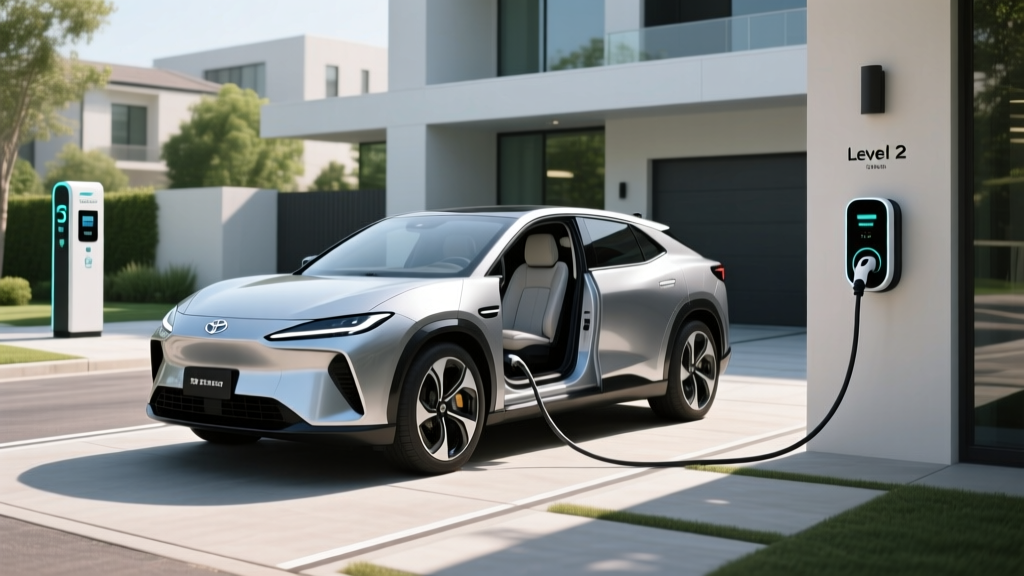
For home charging, the 11 kW onboard charger is a strong point. A Level 2 wallbox (48-amp circuit) will fully replenish the 72.8 kWh battery in roughly 7 hours — easily overnight. Toyota includes a dual-voltage mobile charger with the vehicle that handles both 120V (Level 1) and 240V (Level 2 at reduced amperage), though most buyers will want a dedicated Level 2 home installation for daily convenience.
The bZ XLE Plus uses the CCS1 connector for DC fast charging. Toyota has announced NACS adoption for future models, but the 2026 bZ retains CCS — meaning access to Electrify America, EVgo, and ChargePoint DC networks natively, with Tesla Supercharger access via the included adapter.
Performance and Driving Dynamics
The dual-motor AWD powertrain delivers 338 combined horsepower, launching the bZ XLE Plus to 60 mph in 4.8 seconds. That's brisk for daily driving and confident for highway merging, though it trails the Mach-E GT (3.5 sec) and Model Y Long Range AWD (4.8 sec — essentially a tie). The single-speed reduction gear provides smooth, linear acceleration without the shift-shock of a traditional transmission.
Where the bZ distinguishes itself is ride comfort. Toyota tuned the suspension for compliance over sportiness, and the result is a crossover that absorbs expansion joints and potholes better than the firmer-riding Ioniq 5 or Model Y. Steering is light and precise, if not particularly communicative. The regenerative braking system offers multiple levels selectable via paddle shifters, though it doesn't quite achieve true one-pedal driving at its strongest setting — you'll still need the friction brakes for a complete stop.
Towing capacity is rated at 1,500 pounds (with the factory tow package), sufficient for a small utility trailer or a pair of dirt bikes but not a camper. This is typical for the compact electric crossover segment.
Interior, Tech, and Driver Assistance
The XLE Plus cabin uses SofTex synthetic leather upholstery with heated and ventilated front seats — a notable upgrade from the base XLE. The 12.3-inch touchscreen runs Toyota's latest Audio Multimedia system with wireless Apple CarPlay and Android Auto, native navigation with real-time charger availability, and over-the-air update capability. The 2026 model year adds faster boot times and improved voice recognition, addressing one of the most common complaints from early bZ owners.
The instrument cluster remains a 7-inch digital display positioned above the steering wheel rather than a full digital cockpit, which feels dated next to the Ioniq 5's dual 12.3-inch screens or the Model Y's minimalist single-screen approach. Physical climate controls are retained — a practical choice that many EV buyers prefer over touchscreen-only HVAC.
Toyota Safety Sense 3.0 is standard and includes:
- Pre-Collision System with Pedestrian Detection
- Full-Speed Range Dynamic Radar Cruise Control
- Lane Departure Alert with Steering Assist
- Lane Tracing Assist (centering)
- Automatic High Beams
- Road Sign Assist
- Proactive Driving Assist (gentle deceleration when approaching slower traffic or curves)
Cargo volume measures 27.7 cubic feet behind the rear seats and 56.9 cubic feet with the 60/40 split rear seats folded. The front trunk (frunk) adds a small 0.8 cubic feet — enough for a charging cable bag but not much more. Rear-seat legroom of 38.0 inches is competitive with the segment, and the flat floor (no transmission tunnel) makes the middle seat usable for short trips.
Pricing, Tax Credit, and Ownership Costs
| Item | Amount |
|---|---|
| Base MSRP (XLE Plus AWD) | $44,500 |
| Destination & Delivery | $1,395 |
| As-Tested (Premium Paint + Cargo Package) | $47,200 |
| Federal Tax Credit (§30D) — Potential Max | Up to $7,500* |
| Effective Price After Max Credit | ~$37,000–$38,400 |
*Credit eligibility depends on buyer income, battery component sourcing, and critical mineral requirements. See IRS rules below.
Federal EV Tax Credit Eligibility (§30D)
- MSRP Cap: SUVs/crossovers must be under $80,000 MSRP. The bZ XLE Plus at $44,500 clears this easily.
- Buyer Income Cap: Modified AGI must not exceed $150,000 (single), $225,000 (head of household), or $300,000 (married filing jointly).
- Battery Sourcing: The $7,500 credit splits into two halves — $3,750 for critical minerals and $3,750 for battery component manufacturing. Toyota's bZ battery supply chain (primarily Panasonic cells with Japanese-sourced components) may qualify for one or both halves depending on current-year sourcing percentages. Verify the latest status on fueleconomy.gov before purchasing.
- Point-of-Sale Transfer: Eligible buyers can transfer the credit to the dealer at purchase, reducing the upfront cost rather than waiting for a tax refund.
- Foreign Entity of Concern (FEOC) Restriction: Battery components or critical minerals from a FEOC (certain Chinese, Russian, North Korean, or Iranian entities) can disqualify the vehicle. Toyota's supply chain has historically been less exposed to FEOC risk than some competitors, but verify current-year status.
Five-Year Ownership Cost Estimate
Beyond the purchase price, the bZ XLE Plus benefits from lower fueling costs (electricity at $0.14/kWh national average translates to roughly $0.042/mile vs. $0.12–$0.15/mile for a comparable gas crossover at 25 MPG). Insurance premiums run 10–20% higher than a gas RAV4, according to industry averages. Maintenance is minimal — no oil changes, fewer brake replacements thanks to regen, and cabin air filter swaps every 15,000–20,000 miles. Toyota's 2-year/25,000-mile complimentary maintenance plan covers the basics early on.
Pros, Cons, and Who Should Buy
- Comfortable, compliant ride quality — best in segment for daily commuting
- 11 kW Level 2 onboard charger — faster overnight charging than many rivals
- Toyota's dealer network and resale reputation
- Physical climate controls and intuitive infotainment layout
- Comprehensive Toyota Safety Sense 3.0 standard
- Heat pump standard on XLE Plus (improved cold-weather efficiency)
- 150 kW peak DC charging is slower than Ioniq 5 (240 kW) and Model Y (~250 kW)
- 252-mile EPA range is below segment leaders (Ioniq 5: 303 mi; Model Y: 320 mi)
- Small frunk (0.8 cu ft) limits front storage utility
- 7-inch instrument cluster feels dated
- No true one-pedal driving mode
- CCS connector only (NACS adapter required for Supercharger access)
- Choose the bZ XLE Plus if: You prioritize ride comfort and build quality over maximum range, you have reliable home Level 2 charging, you value Toyota's dealer network and warranty support, and your daily driving stays under 150 miles with occasional road trips under 250 miles between stops.
- Look elsewhere if: You frequently road-trip 400+ miles and need the fastest possible DC charging (Ioniq 5 or Model Y), you need 300+ miles of EPA range for a long commute, or you want NACS native compatibility for seamless Supercharger access without an adapter.
How It Stacks Up Against Key Competitors
| Spec | Toyota bZ XLE Plus AWD | Hyundai Ioniq 5 SEL AWD | Tesla Model Y LR AWD | Ford Mach-E Premium AWD |
|---|---|---|---|---|
| EPA Range | 252 mi | 290 mi | 320 mi | 275 mi |
| Battery (Usable) | 72.8 kWh | 77.4 kWh | ~78 kWh | 75.7 kWh |
| Peak DC Charge | 150 kW | 240 kW | ~250 kW | 150 kW |
| 10–80% Time | ~30 min | ~18 min | ~25 min | ~32 min |
| 0–60 mph | 4.8 sec | 5.1 sec | 4.8 sec | 5.1 sec |
| Horsepower | 338 hp | 320 hp | 384 hp | 312 hp |
| Base MSRP | $44,500 | $47,400 | $48,990 | $45,995 |
| Cargo (seats up) | 27.7 cu ft | 27.2 cu ft | 30.2 cu ft | 29.7 cu ft |
The bZ XLE Plus undercuts the Ioniq 5 and Model Y on price but concedes range and charging speed. It matches or beats most competitors on 0–60 performance and offers the most comfortable ride in the group. For buyers who charge primarily at home and rarely road-trip beyond 200 miles, the range deficit is academic. For frequent highway travelers, the Ioniq 5's 18-minute 10–80% charge time is a meaningful advantage at DC fast chargers.
Battery Warranty and Longevity
Toyota covers the bZ XLE Plus battery with an 8-year / 100,000-mile warranty (10 years / 150,000 miles in CARB states including California, New York, Massachusetts, and others that follow California emissions standards). The warranty guarantees the battery will retain at least 70% of its original capacity during the coverage period.
The NMC (Nickel Manganese Cobalt) chemistry in the bZ offers higher energy density than LFP (Lithium Iron Phosphate), giving more range per kilogram but with slightly faster long-term degradation. In practice, Toyota's conservative buffer management — locking off roughly 8% of the battery at the top and bottom — protects the cells from the high-SoC and low-SoC stress that accelerates degradation. Owners who primarily charge to 80% at home and avoid frequent DC fast charging can expect 90%+ capacity retention at 100,000 miles based on data from similar Panasonic-supplied NMC packs.
Battery replacement cost, should it be needed outside warranty, is estimated at $12,000–$18,000 including labor — comparable to other mainstream EVs in this segment. Most owners will never face this expense, as modern NMC packs are designed for 200,000+ mile service life with gradual capacity loss rather than sudden failure.
Frequently Asked Questions
What is the real-world range of the 2026 Toyota bZ XLE Plus?
The EPA rates it at 252 miles (AWD), but real-world highway driving at 70–75 mph yields approximately 215–230 miles. In sub-freezing winter conditions with cabin heat, expect 185–200 miles. City driving in moderate temperatures can match or slightly exceed the EPA figure.
How fast does the bZ XLE Plus charge?
On a DC fast charger, it peaks at 150 kW and charges from 10–80% in approximately 30 minutes. At home on a Level 2 (240V, 48A) charger, the 11 kW onboard charger delivers roughly 37 miles of range per hour, fully recharging the battery in about 7 hours.
Does the 2026 bZ XLE Plus qualify for the federal EV tax credit?
Potentially. The MSRP of $44,500 is well under the $80,000 SUV cap. Eligibility for the full $7,500 depends on the buyer's income (AGI limits apply) and whether Toyota's battery supply chain meets the current-year critical minerals and battery component sourcing requirements under IRS §30D. Check fueleconomy.gov for the latest qualifying status before purchase. The credit can be transferred to the dealer at point of sale to reduce your upfront cost.
Is the bZ XLE Plus worth buying over the Ioniq 5 or Model Y?
It depends on your priorities. If ride comfort, Toyota's dealer network, and a lower entry price matter most, the bZ XLE Plus is a strong choice. If maximum range (320 mi) and the fastest DC charging are your top concerns, the Model Y or Ioniq 5 respectively are better fits. For buyers who charge at home nightly and commute under 100 miles daily, the bZ's range deficit rarely surfaces in practice.
What connector does the bZ XLE Plus use?
It uses CCS1 for DC fast charging and J1772 for Level 2 AC charging. A Tesla Supercharger adapter (NACS) is included, enabling access to Tesla's V3 and V4 Supercharger network. Toyota has not adopted native NACS for the 2026 model year.
Does it have one-pedal driving?
Not fully. The bZ offers adjustable regenerative braking via steering-wheel paddle shifters, with the strongest setting providing significant deceleration. However, the vehicle will creep at very low speeds rather than holding completely still, so you'll need the brake pedal for full stops.
What is the battery warranty?
8 years / 100,000 miles nationwide, extended to 10 years / 150,000 miles in CARB states. The warranty guarantees at least 70% capacity retention during the coverage period.