Quick Verdict: The 2026 Toyota bZ Finally Fixes the Cabin
Toyota's second-generation bZ electric crossover arrives for the 2026 model year with a substantially redesigned interior, a larger battery, and the kind of pragmatic EV engineering that Toyota does best. Where the outgoing bZ4X drew criticism for a sparse cabin, awkward ergonomics, and mediocre range, the 2026 Toyota bZ addresses each shortcoming directly. The result is a compact electric SUV that finally competes on the merits that matter to daily drivers: a well-built 2026 Toyota bZ interior, competitive EPA range, and a price that undercuts most rivals before incentives.
But does the bZ stack up against the Hyundai Ioniq 5, Tesla Model Y, and Ford Mustang Mach-E when you look past the brochure? We break down every spec, charging curve reality, and ownership cost so you can decide.
2026 Toyota bZ Interior: Materials, Space, and Technology
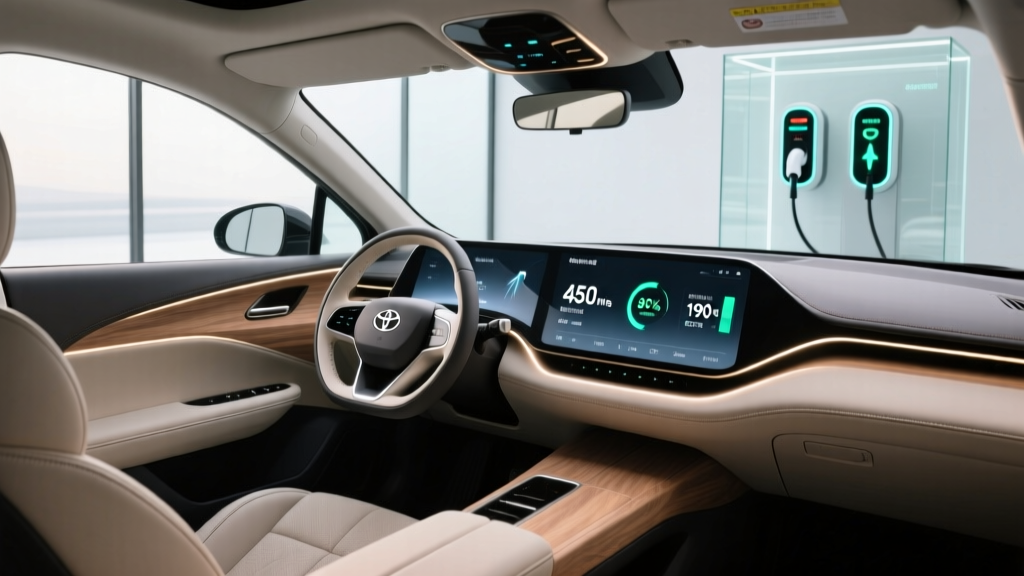
The headline upgrade for 2026 is the cabin. Toyota has replaced the hard plastics and confusing touch-capacitive buttons of the bZ4X with a layered, soft-touch dashboard, physical climate controls, and a 14-inch infotainment touchscreen running Toyota's latest Audio Multimedia system. The 2026 Toyota bZ interior now features a standard 12.3-inch digital driver display, a redesigned center console with usable storage, and available synthetic leather upholstery that holds up well against family duty.
Front-seat comfort is excellent, with 42.1 inches of legroom — more than the Ioniq 5 and competitive with the Model Y. The rear seat offers 38.3 inches of legroom, adequate for adults on shorter trips but tighter than the class-leading Ioniq 5 (41.7 inches rear). Cargo volume behind the second row measures 27.8 cubic feet, expanding to approximately 56.9 cubic feet with the 60/40 split rear seats folded. That's enough for a week's groceries or two carry-ons and a stroller, though the Model Y's 76-cubic-foot maximum still leads the segment.
Standard tech includes wireless Apple CarPlay and Android Auto, six USB-C ports (two front, four rear), a Qi wireless charging pad, and Toyota Safety Sense 3.0 — the brand's Level 2 driver-assistance suite featuring adaptive cruise control, lane-centering assist, automatic emergency braking with pedestrian detection, and blind-spot monitoring. An available 360-degree camera and digital rearview mirror round out the package.
| Spec | XLE (FWD) | Limited (AWD) |
|---|---|---|
| EPA Range | 252 miles | 236 miles |
| Battery (usable) | 74.8 kWh | 74.8 kWh |
| Chemistry | NMC (Nickel Manganese Cobalt) | NMC |
| Horsepower | 201 hp | 338 hp (dual-motor) |
| 0–60 mph | 7.1 seconds | 4.6 seconds |
| Drivetrain | FWD, single motor | AWD, dual motor |
| Max DC Charge Rate | 150 kW | 150 kW |
| 10–80% DC Fast Charge | ~30 minutes | ~30 minutes |
| Level 2 Home Charge (kW) | 7.7 kW | 7.7 kW |
| MPGe (combined) | 114 MPGe | 102 MPGe |
| Efficiency | 29 kWh/100 mi | 33 kWh/100 mi |
| Base MSRP | $38,450 | $44,950 |
| Cargo (rear seats up) | 27.8 cu ft | 27.8 cu ft |
| Front Legroom | 42.1 in | 42.1 in |
| Rear Legroom | 38.3 in | 38.3 in |
| Battery Warranty | 8 yr / 100,000 mi | 8 yr / 100,000 mi |
Range, Efficiency, and Real-World Expectations
The 2026 Toyota bZ FWD earns an EPA-estimated 252 miles of range on a full charge, while the dual-motor AWD Limited drops to 236 miles. Those figures represent a meaningful improvement over the outgoing bZ4X's 222–252 mile spread, thanks to a larger 74.8 kWh usable battery (up from 64.8 kWh) and improved thermal management.
EPA estimate: 252 miles (FWD) / 236 miles (AWD). In mixed highway driving at 70–75 mph, expect approximately 215–230 miles from the FWD model and 200–215 miles from the AWD. In freezing temperatures (below 32°F), range can drop 20–30%, bringing real-world highway range down to roughly 175–195 miles (FWD). The bZ does include a standard heat pump, which mitigates cold-weather cabin heating losses compared to resistive heaters, but battery chemistry still suffers in deep cold. Plan charging stops accordingly on winter road trips.
Efficiency for the FWD model is rated at 114 MPGe combined (29 kWh per 100 miles), which is respectable but trails the Ioniq 5 Long Range (114 MPGe, similar) and the Model Y Long Range (123 MPGe, 27 kWh/100 mi). The AWD model's 102 MPGe reflects the energy cost of the second motor.
Charging Speed: DC Fast Charging and Home Level 2
Toyota equips the 2026 bZ with a 150 kW peak DC fast-charging rate via the NACS connector — a welcome shift from the CCS1 port on the bZ4X, now that Toyota has adopted the Tesla North American Charging Standard across its EV lineup. This grants access to Tesla Supercharger stations (now open to non-Tesla EVs) in addition to networks like Electrify America and EVgo.
| Charging Level | Power | Speed / Time | Notes |
|---|---|---|---|
| Level 1 (120V household) | 1.4 kW | ~4 miles per hour | Emergency/trickle only; full charge in 50+ hours |
| Level 2 (240V home) | 7.7 kW | ~23 miles per hour; full charge in ~10 hours | Requires 40A circuit; standard J1772/NACS adapter |
| DC Fast Charge | 150 kW peak | 10–80% in ~30 minutes | Peak rate sustained to ~55% SoC; tapers significantly above 80% |
A critical note on the charging curve: the bZ hits its 150 kW peak at low states of charge (roughly 10–20% SoC) and sustains strong rates to about 55%. Above 80%, the charge rate drops sharply to protect battery health — a common pattern with NMC chemistry. If you're road-tripping, plan to charge from 10% to 80% and move on rather than waiting for a full top-off. That 10–80% session takes approximately 30 minutes at a capable 150+ kW station.
For home charging, the onboard 7.7 kW charger means an overnight session on a Level 2 wallbox (like a ChargePoint Home Flex or Tesla Wall Connector) replenishes the full battery in roughly 10 hours. If your electrical panel supports a 48A circuit, you can push slightly faster, but the bZ's onboard charger caps at 7.7 kW regardless.
Performance and Drivetrain
The FWD XLE uses a single front-mounted motor producing 201 horsepower and a 0–60 mph time of 7.1 seconds — adequate for highway merging and daily commuting but unremarkable. The AWD Limited pairs front and rear motors for a combined 338 horsepower and a genuinely quick 4.6-second 0–60 time. Dual-motor AWD also provides torque-vectoring traction in rain and light snow, a practical advantage over FWD for buyers in northern climates.
Ride quality is tuned for comfort over sportiness. The bZ absorbs road imperfections well, and cabin noise isolation is a clear step up from the bZ4X. Regenerative braking offers multiple levels selectable via steering-wheel paddles, though the bZ does not offer true one-pedal driving to a complete stop — you'll still use the friction brake at low speeds. Toyota's approach prioritizes a familiar driving feel for buyers transitioning from gas vehicles.
Pricing, Trims, and Federal Tax Credit Eligibility
The 2026 Toyota bZ is offered in three trims: the base XLE (FWD), the XLE AWD, and the Limited AWD.
| Trim | Base MSRP | Est. Federal Credit* | Effective Price |
|---|---|---|---|
| XLE (FWD) | $38,450 | Up to $7,500 | ~$30,950 |
| XLE (AWD) | $41,450 | Up to $7,500 | ~$33,950 |
| Limited (AWD) | $44,950 | Up to $7,500 | ~$37,450 |
*Federal tax credit under IRS §30D is subject to buyer income caps ($150K single / $300K joint MAGI), vehicle MSRP caps ($80K for SUVs), and critical-mineral/battery-component sourcing requirements that change annually. The credit can now be transferred to the dealer at point of sale as an instant discount. Verify current-year eligibility at IRS.gov before purchasing. State and local incentives vary by jurisdiction — consult your state energy office for details.
At $38,450 before incentives, the bZ XLE FWD undercuts the Hyundai Ioniq 5 SE ($42,600) and the Tesla Model Y Long Range ($44,990) by a wide margin. With the full $7,500 federal credit applied, the effective price drops to approximately $30,950 — a compelling entry point for a well-equipped compact electric SUV. However, credit eligibility is not guaranteed. Toyota sources battery cells from Panasonic, and the critical-mineral and battery-component requirements under §30D are stringent and evolving. Confirm the bZ's eligibility status for the specific month of your purchase, as supply-chain shifts can affect qualification mid-year.
Warranty and Long-Term Battery Outlook
Toyota covers the bZ's battery pack and electric powertrain with an 8-year/100,000-mile warranty, with a capacity retention threshold of 70% — meaning Toyota will repair or replace the battery if it degrades below 70% of original capacity within that period. The limited vehicle warranty runs 3 years/36,000 miles, with 5 years/60,000 miles for powertrain components beyond the EV system.
Toyota's NMC battery chemistry has a proven track record in the brand's hybrid lineup, and the bZ's active thermal management system (liquid cooling and heating) should keep degradation moderate. Independent long-term data on the bZ platform specifically is still limited given its relative newness, but Toyota's conservative approach to battery management — including a sizable buffer above and below the usable capacity — suggests longevity in line with industry norms of 85–90% capacity retention at 100,000 miles.
Pros, Cons, and Who Should Buy the 2026 Toyota bZ
- Significantly improved 2026 Toyota bZ interior with quality materials and physical controls
- Competitive base price ($38,450) before incentives — one of the most affordable compact EV SUVs
- NACS connector provides access to Tesla Supercharger network
- Standard heat pump for better cold-weather efficiency
- Strong AWD performance on Limited trim (4.6 sec 0–60)
- Toyota Safety Sense 3.0 standard on all trims
- 8-year/100,000-mile battery warranty
- DC fast-charging at 150 kW is slower than Ioniq 5 (240 kW) and Model Y (250 kW)
- Real-world highway range falls noticeably below EPA sticker
- No one-pedal driving to a full stop
- Rear legroom is tighter than Ioniq 5 and Model Y
- No front trunk (frunk) — space is consumed by HVAC components
- Federal tax credit eligibility depends on evolving sourcing rules
Best for: Daily commuters and small families who prioritize cabin quality, a comfortable ride, and a strong dealer network over maximum range or fastest charging. The bZ is ideal for buyers who charge primarily at home and take road trips only a few times per year. The AWD Limited suits those in snowy climates who want dual-motor traction without paying luxury-EV prices.
Look elsewhere if: You regularly drive 300+ miles between charging stops, need the fastest possible DC charging for frequent road trips, or require maximum rear-seat and cargo space. The Ioniq 5 or Model Y remain stronger picks for those use cases.
Frequently Asked Questions
What is the real-world range of the 2026 Toyota bZ?
The EPA rates the FWD bZ at 252 miles and the AWD at 236 miles. In real-world highway driving at 70–75 mph, expect roughly 215–230 miles (FWD) and 200–215 miles (AWD). In freezing weather, plan for 175–195 miles (FWD) due to battery chemistry limitations, even with the standard heat pump reducing cabin-heating losses.
How fast does the 2026 Toyota bZ charge?
On a DC fast charger, the bZ peaks at 150 kW and charges from 10% to 80% in approximately 30 minutes. The charge rate tapers above 80% SoC to protect the battery. At home on a Level 2 (240V, 7.7 kW) charger, a full charge takes about 10 hours — easily achievable overnight. Level 1 (120V) trickle charging adds roughly 4 miles per hour and is only practical for emergencies.
Does the 2026 Toyota bZ qualify for the federal EV tax credit?
The bZ is eligible for up to $7,500 under IRS §30D, provided the buyer meets income caps ($150,000 single / $300,000 joint modified AGI), the vehicle MSRP is under $80,000 (it is), and the battery meets critical-mineral and component sourcing requirements. These sourcing rules change annually and can shift mid-year. The credit can be transferred to the dealer at point of sale for an instant price reduction. Always verify current eligibility at IRS.gov and consult a tax professional for your specific situation.
Is the 2026 Toyota bZ worth buying vs. the Ioniq 5 or Model Y?
It depends on your priorities. The bZ wins on base price (thousands less than both rivals) and cabin quality for the money. The Ioniq 5 wins on charging speed (240 kW peak, 10–80% in ~18 min) and rear-seat space. The Model Y wins on range (320+ miles EPA), Supercharger-native integration, and cargo volume. If budget is your top concern and you mostly charge at home, the bZ is an excellent choice. If you road-trip frequently, the faster-charging Ioniq 5 or longer-range Model Y may serve you better.
What connector does the 2026 Toyota bZ use?
The 2026 bZ uses the NACS (North American Charging Standard) connector, the same plug used by Tesla vehicles. This provides native access to the Tesla Supercharger network (via Tesla's open-access stations) as well as NACS-equipped Electrify America, EVgo, and other networks. No adapter is needed for NACS stations. For legacy CCS1 stations, a NACS-to-CCS adapter may be required — check with your dealer.
Does the bZ have a frunk (front trunk)?
No. The 2026 Toyota bZ does not include a front trunk. The space under the hood is occupied by HVAC and power electronics. All cargo must go in the rear cargo area (27.8 cu ft behind the second row, ~56.9 cu ft with seats folded).