If you've ever typed "show me a picture of a Tesla" into a search bar, you're not alone — it remains one of the most common gateway queries for shoppers entering the EV space. But a photo only tells part of the story. Below, we pair a detailed visual walkthrough of the 2026 Tesla Model Y with the hard numbers that actually matter: EPA range, battery chemistry, DC fast-charging curves, real-world efficiency, and federal tax credit eligibility under current IRS §30D rules.
The Model Y remains Tesla's volume leader and the best-selling EV in the United States. For 2026, Tesla has streamlined the lineup into three core trims: Long Range RWD, Long Range AWD, and Performance AWD — all built on the refreshed "Juniper" platform introduced in early 2025 with revised styling, a ventilated-seat interior, ambient lighting, and a rear-seat touchscreen.
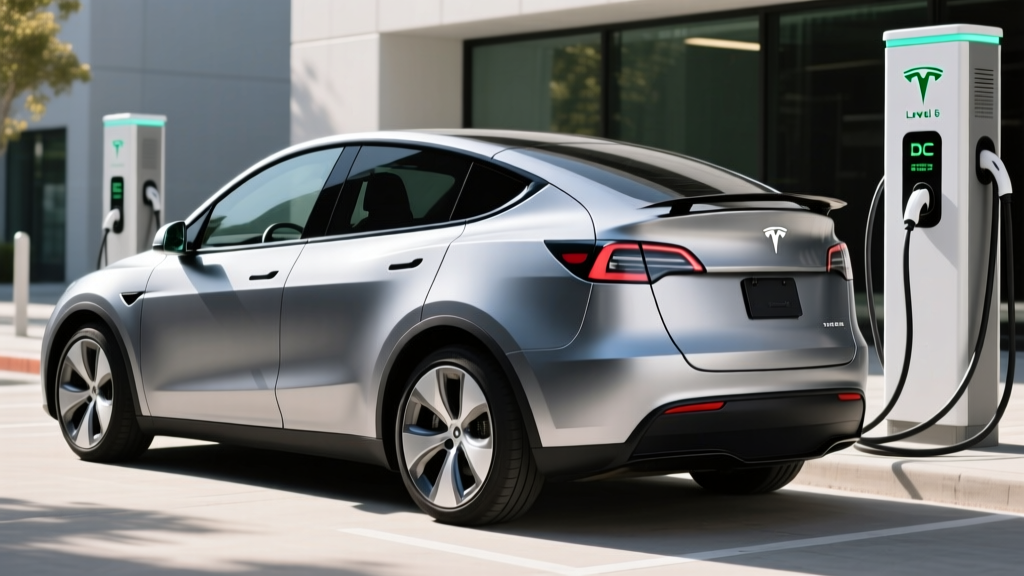
2026 Tesla Model Y: What It Looks Like
The 2026 Model Y carries the Juniper design language: a full-width light bar up front replaces the old split headlamps, while a slim reflector strip spans the rear hatch. The roofline is slightly more swept, the front bumper cleaner, and the new 19-inch Helix wheels (standard on Long Range) improve aero efficiency. The overall silhouette is unmistakably Tesla, but the details are noticeably sharper than the 2020–2024 pre-refresh cars.
Inside, the cabin borrows heavily from the Model 3 Highland: a 15.4-inch center touchscreen, an 8-inch rear passenger display, ventilated front seats, power-folding second row, ambient lighting strips along the dash and doors, and Tesla's latest acoustic glass for a noticeably quieter ride at highway speed. The minimalist steering wheel integrates turn signals and gear selection (no stalks).
Spec Table: 2026 Tesla Model Y at a Glance
| Spec | Long Range RWD | Long Range AWD | Performance AWD |
|---|---|---|---|
| EPA Range | 320 mi | 305 mi | 285 mi |
| Battery (usable) | ~75 kWh (NMC) | ~75 kWh (NMC) | ~75 kWh (NMC) |
| Drivetrain | Rear-Wheel Drive | Dual-Motor AWD | Dual-Motor AWD |
| Horsepower | 346 hp | 384 hp | 456 hp |
| 0–60 mph | 5.8 sec | 4.8 sec | 3.5 sec |
| Top Speed | 125 mph | 125 mph | 155 mph |
| Max DC Fast Charge | 250 kW | 250 kW | 250 kW |
| 10–80% DCFC Time | ~25 min | ~25 min | ~25 min |
| Level 2 Home Rate | 11.5 kW (~44 mi/hr) | 11.5 kW (~44 mi/hr) | 11.5 kW (~44 mi/hr) |
| MPGe (combined) | 122 MPGe | 117 MPGe | 111 MPGe |
| kWh/100 mi | 28 | 29 | 30 |
| Cargo (rear seats up) | 30.2 cu ft | 30.2 cu ft | 30.2 cu ft |
| Cargo (rear seats down) | 72.1 cu ft | 72.1 cu ft | 72.1 cu ft |
| Frunk | 4.1 cu ft | 4.1 cu ft | 4.1 cu ft |
| Rear Legroom | 41.6 in | 41.6 in | 41.6 in |
| Base MSRP | $44,990 | $47,990 | $52,490 |
| Battery Warranty | 8 yr / 120,000 mi | 8 yr / 120,000 mi | 8 yr / 120,000 mi |
| Basic Warranty | 4 yr / 50,000 mi | 4 yr / 50,000 mi | 4 yr / 50,000 mi |
Real-World Range: Beyond the EPA Sticker
EPA (Long Range AWD): 305 miles
Real-world highway (70 mph, 72°F): ~265–280 miles
Real-world highway (32°F, winter): ~215–240 miles
City / mixed driving (moderate climate): ~290–305 miles
Tesla's efficiency engineering is among the best in the industry, and the Model Y's heat pump (standard on all 2026 trims) significantly reduces cold-weather energy draw compared to resistive heaters. Still, EPA figures from fueleconomy.gov assume a mix of city and highway driving at moderate temperatures. On a sustained 70–80 mph interstate run, expect to use roughly 10–12% more energy than the sticker suggests. In sub-freezing conditions without preconditioning, range can drop 20–30%. Preconditioning the battery while plugged in — a feature Tesla handles automatically when you set a departure time or navigate to a Supercharger — mitigates much of this loss.
Charging Speed: DC Fast Charge and Home Level 2
The 2026 Model Y retains Tesla's proven 250 kW peak DC fast-charging capability on V3 and V4 Superchargers. Here's what that actually means in practice:
| Charging Method | Power | Miles Added per Hour | Notes |
|---|---|---|---|
| DC Fast Charge (Supercharger V3/V4) | Peak 250 kW | ~1,000 mi/hr (peak) | 10–80% in ~25 min; tapers sharply above 80% |
| DC Fast Charge (CCS adapter, third-party) | Up to 250 kW | ~1,000 mi/hr (peak) | Speeds vary by station; Electrify America, EVgo supported |
| Level 2 Home (Tesla Wall Connector) | 11.5 kW (48A) | ~44 mi/hr | Full charge in ~7 hours; requires 60A circuit |
| Level 2 Home (generic J1772 w/ adapter) | Up to 11.5 kW | ~44 mi/hr | Works with ChargePoint, Emporia, etc. |
| Level 1 (120V household outlet) | ~1.4 kW | ~3–5 mi/hr | Emergency/trickle only; not practical for daily use |
Charging curve reality: The 250 kW peak only holds between roughly 10–30% state of charge. From 30–60%, expect ~170–200 kW. From 60–80%, the rate drops to ~100–120 kW. Above 80%, charging slows dramatically to protect battery longevity — plan to unplug at 80% on road trips unless you need the extra miles. This is standard behavior for NMC lithium-ion packs and not unique to Tesla.
For home charging, the Tesla Wall Connector at $475 is one of the best value Level 2 units available, offering 48 amps on a NACS plug without needing an adapter. A licensed electrician will typically charge $500–$2,000 for installation depending on panel proximity and whether a 200-amp panel upgrade is needed.
Performance and Driving Dynamics
Even the base Long Range RWD hits 60 mph in 5.8 seconds — quicker than most gas-powered compact SUVs. The Performance AWD's 3.5-second sprint puts it in sports-car territory. All trims use Tesla's latest drive unit with improved NVH (noise, vibration, harshness), and the Juniper chassis tuning delivers a firmer but more controlled ride than the pre-2025 Model Y.
Regenerative braking remains single-mode (no adjustable regen levels), which means one-pedal driving is the default experience. Most Tesla owners adapt within a week, but if you prefer a coasting feel, this is worth test-driving before committing. The steering is quick and precise but offers minimal road feedback — a deliberate design choice Tesla has maintained across its lineup.
Tech, Autopilot, and Driver Assistance
Every 2026 Model Y comes with Basic Autopilot (Traffic-Aware Cruise Control and Autosteer) as standard. This is an SAE Level 2 driver-assistance system — the driver must remain fully engaged, hands on the wheel (or applying torque), and eyes on the road at all times.
Autopilot and FSD (Supervised) are Level 2 systems. They do NOT drive the car autonomously. You are the driver. You are liable. Keep your hands on the wheel and eyes on the road. Only Level 4 services like Waymo operate without a human driver in defined zones.
FSD (Supervised) remains an $8,000 add-on (or $99/month subscription) and adds city-street navigation, traffic-light recognition, and automatic turns. As of 2026, FSD is impressive but still requires active supervision — it occasionally misreads construction zones, struggles with unprotected left turns in heavy traffic, and can hesitate at complex multi-lane roundabouts. NHTSA continues to monitor Tesla's Autopilot/FSD through its Standing General Order crash-reporting mandate.
The infotainment system runs on Tesla's proprietary OS with Netflix, YouTube, and Spotify streaming (parked only), a built-in trip planner with automatic battery preconditioning for Supercharger stops, and over-the-air updates that periodically add features. The 8-inch rear screen allows passengers to control climate and media independently.
Pricing, Trims, and Federal Tax Credit (IRS §30D)
| Trim | Base MSRP | Est. After §30D Credit* | Destination |
|---|---|---|---|
| Long Range RWD | $44,990 | $37,490 | $1,390 |
| Long Range AWD | $47,990 | $40,490 | $1,390 |
| Performance AWD | $52,490 | $44,990 | $1,390 |
*Estimated after full $7,500 federal tax credit. Actual eligibility depends on income, battery sourcing, and MSRP cap compliance. See checklist below.
§30D Tax Credit Eligibility Checklist (2026 rules):
- MSRP cap: SUVs/vans must be ≤ $80,000 — all Model Y trims qualify ✅
- Buyer income cap: AGI ≤ $150,000 (single), $225,000 (head of household), $300,000 (joint) — verify your MAGI
- Battery sourcing: Critical minerals and battery components must meet phased-in percentages per the Inflation Reduction Act. Tesla's US-built Model Y has historically met these thresholds, but confirm at purchase via the dealer's IRS compliance report.
- Point-of-sale transfer: You can apply the $7,500 credit as a down-payment reduction at the time of purchase (effective Jan 2024 onward) — no need to wait for tax filing.
- Refer to IRS.gov §30D for the latest rules.
Who the 2026 Model Y Suits Best
Ideal for: Daily commuters with home charging access, small-to-medium families needing cargo flexibility (72 cu ft with seats folded), road-trippers who value the Supercharger network, and tech-forward buyers who want OTA updates and a mature software ecosystem.
Less ideal for: Buyers who need three-row seating (look at the Model X or Rivian R1S), those who prefer physical buttons and traditional interfaces, fleet/commercial buyers (the Tesla Semi or other platforms may be more purpose-built), and anyone in a region with sparse Supercharger coverage who also lacks home charging.
2026 Model Y vs. Key Competitors
| Attribute | Tesla Model Y LR AWD | Hyundai Ioniq 5 Limited AWD | Ford Mustang Mach-E Premium AWD |
|---|---|---|---|
| EPA Range | 305 mi | 290 mi | 290 mi |
| Max DCFC | 250 kW | 238 kW | 150 kW |
| 10–80% Time | ~25 min | ~18 min (800V) | ~38 min |
| 0–60 mph | 4.8 sec | 5.1 sec | 5.5 sec |
| Base MSRP (AWD) | $47,990 | $52,600 | $48,995 |
| Charging Network | Supercharger (native) | NACS (adapter req.) | NACS (adapter req.) |
| Rear Cargo | 72.1 cu ft | 59.3 cu ft | 59.7 cu ft |
The Ioniq 5's 800V architecture delivers a faster 10–80% charge, but Tesla's Supercharger network remains the most reliable and seamless long-distance charging experience in the US. The Model Y also leads in cargo volume and software maturity. The Mach-E offers a more traditional driving feel with physical controls but lags in charging speed.
Pros and Cons
- Class-leading cargo space (72 cu ft)
- Supercharger network: 20,000+ stalls, seamless plug-and-charge
- Top-tier efficiency (28–30 kWh/100 mi)
- Strong OTA update track record
- Standard heat pump for cold-weather range preservation
- Qualifies for full $7,500 §30D credit (verify at purchase)
- No physical buttons — all controls via touchscreen
- Turn signals on steering wheel take adjustment
- FSD (Supervised) still requires active driver attention at $8K
- No adjustable regen — one-pedal only
- Rear visibility limited; relies heavily on cameras
- Insurance premiums run 15–25% above segment average
Frequently Asked Questions
What is the real-world range of the 2026 Tesla Model Y?
The EPA rates the Long Range AWD at 305 miles. In real-world highway driving at 70 mph in mild weather, expect ~265–280 miles. In freezing temperatures without preconditioning, that can drop to ~215–240 miles. City driving with regen braking typically matches or slightly exceeds the EPA number.
How fast does the Model Y charge at home and on the road?
On a Tesla Supercharger (V3/V4), the Model Y peaks at 250 kW and charges from 10–80% in approximately 25 minutes. At home on a Level 2 Wall Connector (11.5 kW / 48A), it adds about 44 miles of range per hour, fully charging overnight in ~7 hours.
Does the 2026 Model Y qualify for the $7,500 federal EV tax credit?
All Model Y trims fall under the $80,000 SUV MSRP cap. However, you must also meet IRS income limits ($150K single / $300K joint) and the vehicle's battery must comply with critical-mineral and component sourcing requirements. Tesla's US-built Model Y has historically qualified, but confirm at point of sale. The credit can be applied as a point-of-sale rebate since 2024. See IRS.gov for current rules.
Is the Model Y worth buying over the Ioniq 5 or Mach-E?
If you prioritize cargo space, Supercharger access, and software integration, the Model Y is the strongest all-around choice. If you value faster peak DC charging (18 min 10–80% via 800V) and a more conventional interior with physical buttons, the Ioniq 5 is compelling. The Mach-E suits buyers who want a more traditional crossover feel. All three are strong — the right choice depends on your charging setup and interface preferences.
What does it cost to own a Model Y over 5 years?
Assuming 12,000 miles/year, home charging at $0.14/kWh, and no major repairs: electricity costs roughly $4,700 over 5 years (vs. ~$9,500 in gas for a comparable 25 MPG AWD SUV). Factor in higher insurance ($1,800–$2,400/year depending on state and driving record) and minimal maintenance (no oil changes, cabin filter replacement every 2 years, tire rotation). Total cost of ownership typically undercuts a similarly priced gas SUV by $3,000–$6,000 over 5 years, especially after the tax credit.
How long will the Model Y battery last?
Tesla warranties the battery for 8 years or 120,000 miles (whichever comes first), guaranteeing at least 70% capacity retention. Real-world data from Tesla's fleet suggests NMC packs retain ~85–90% capacity at 100,000 miles with typical charging habits (avoiding consistent 100% charges, using daily charge limits of 80–90%). Full battery replacement, if ever needed out of warranty, currently runs $12,000–$16,000 at a Tesla service center.