Buying a 2026 Tesla Model Y involves more than picking a color and wheel size. The 17-character Vehicle Identification Number (VIN) assigned to your car encodes critical details about its battery chemistry, drivetrain, manufacturing plant, and even whether it qualifies for the federal EV tax credit. For EV buyers navigating LFP versus NMC batteries, varying EPA ranges, and IRS §30D sourcing rules, understanding your Model Y VIN is a practical necessity — not a curiosity.
This guide walks you through the 2026 Tesla Model Y VIN structure, what each position reveals, and how to use that information to verify range, charging capability, and tax credit eligibility before you take delivery.
2026 Tesla Model Y: Quick Specs by Trim
Before decoding the VIN, here is what the 2026 Model Y lineup looks like across its current trims. These figures apply to US-market vehicles built at Giga Texas (Austin) and Giga Shanghai (for select markets).
| Spec | Long Range RWD | Long Range AWD | Performance |
|---|---|---|---|
| EPA Range | 320 mi | 308 mi | 277 mi |
| Battery (usable) | ~75 kWh (LFP) | ~75 kWh (NMC) | ~75 kWh (NMC) |
| Max DC Fast Charge | 250 kW | 250 kW | 250 kW |
| 10–80% DCFC Time | ~27 min | ~25 min | ~25 min |
| Level 2 Home Charge | 11.5 kW (~44 mi/hr) | 11.5 kW (~44 mi/hr) | 11.5 kW (~44 mi/hr) |
| 0–60 mph | 6.5 sec | 4.8 sec | 3.5 sec |
| Horsepower | 346 hp | 384 hp | 510 hp |
| Drivetrain | RWD (single motor) | AWD (dual motor) | AWD (dual motor) |
| Efficiency | 123 MPGe / 27 kWh/100mi | 117 MPGe / 29 kWh/100mi | 111 MPGe / 30 kWh/100mi |
| Base MSRP | $44,990 | $47,990 | $52,490 |
Source: fueleconomy.gov and Tesla specifications. Real-world results may vary.
How to Read a 2026 Tesla Model Y VIN
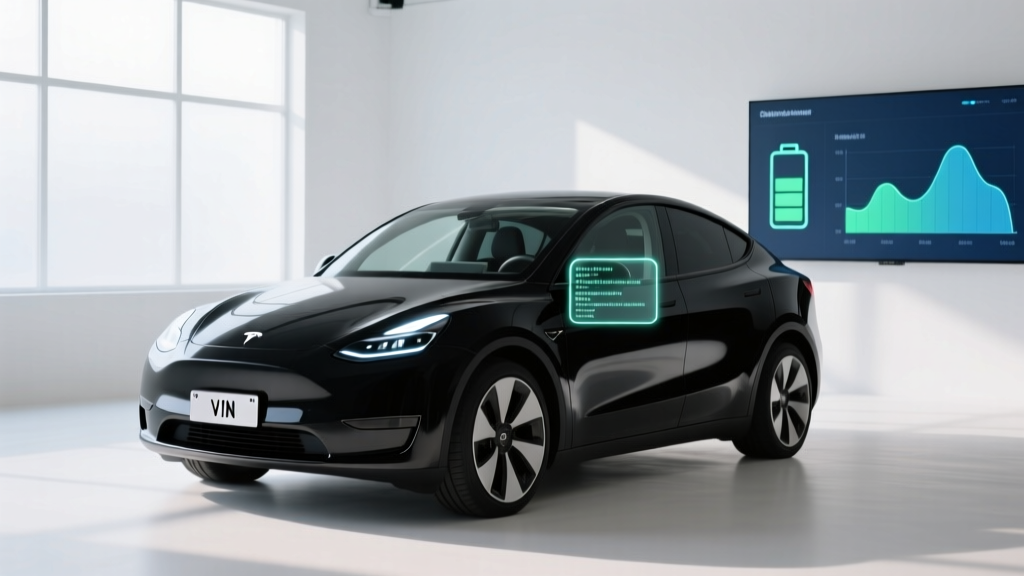
Every 2026 Model Y VIN follows the global 17-character standard defined by the NHTSA. Tesla-specific positions encode details that matter directly to EV ownership. Here is the position-by-position breakdown:
Positions 1–3: World Manufacturer Identifier (WMI)
- 5YJ — Tesla, Inc., manufactured in the United States (Giga Texas, Austin)
- 7SA — Tesla, Inc., manufactured in the United States (alternate WMI for newer production lines)
The first character confirms the country of origin. A "5" or "7" indicates US production. Vehicles built at Giga Shanghai for export markets carry a different WMI entirely, and those vehicles are not eligible for the US federal tax credit.
Position 4: Vehicle Type / Restraint System
For the Model Y, this position is typically "3" (multipurpose passenger vehicle with active and passive restraints). This classifies the Model Y as an SUV/crossover under NHTSA definitions, which matters for the §30D MSRP cap — SUVs have an $80,000 ceiling versus $55,000 for sedans.
Positions 5–7: Model, Body, and Trim
These positions encode the specific Model Y variant:
- Model designation — Confirms this is a Model Y (vs. Model 3, S, or X)
- Body type — Crossover/SUV
- Trim level — Differentiates Long Range RWD, Long Range AWD, and Performance
This is where you can verify whether the vehicle you are buying is truly a dual-motor AWD or a single-motor RWD — a distinction that affects range, performance, and winter capability.
Position 8: Battery / Motor Configuration
This is the most consequential position for EV buyers. Tesla uses this position to encode the battery chemistry and motor setup:
- LFP (Lithium Iron Phosphate) — Found in the Long Range RWD. LFP batteries can be charged to 100% daily without degradation concerns, have longer cycle life, but suffer greater cold-weather range loss (up to 30% below freezing) and slightly lower energy density.
- NMC (Nickel Manganese Cobalt) — Found in Long Range AWD and Performance trims. Higher energy density, better cold-weather retention (~20% loss), but Tesla recommends charging to 80% daily for longevity.
Knowing the chemistry from the VIN helps you set proper charging habits from day one and understand real-world range expectations in your climate.
Position 9: Check Digit
A calculated value used to verify VIN authenticity. You can validate this using the standard DOT check-digit algorithm to confirm the VIN has not been altered or fabricated.
Position 10: Model Year
For the 2026 model year, this position is "T". This confirms the vehicle is a 2026 model, which determines which IRS tax credit rules and battery-sourcing requirements apply.
Position 11: Manufacturing Plant
- "A" — Giga Texas, Austin (primary US-market production)
- "F" — Giga Berlin (European market)
- "C" — Giga Shanghai (Asia-Pacific and select export markets)
US-delivered Model Y vehicles are overwhelmingly built at Giga Texas. The plant code matters for tax credit purposes: the §30D credit requires final assembly in North America, which Giga Texas satisfies. You can verify assembly location independently via the NHTSA VIN decoder.
Positions 12–17: Production Sequence Number
A unique serial number assigned on the production line. Lower numbers generally indicate earlier production within the model year, which can be relevant for tracking service bulletins and early-build quality patterns.
Real-World Range: What the VIN-Confirmed Trim Actually Delivers
Long Range RWD (LFP): EPA 320 mi. Expect ~270–290 mi in mixed driving, ~250 mi sustained highway at 75 mph, and ~220–240 mi in sub-freezing conditions. LFP chemistry is more sensitive to cold.
Long Range AWD (NMC): EPA 308 mi. Expect ~260–280 mi mixed, ~245 mi highway, and ~240–260 mi in cold weather. NMC retains capacity better in the cold.
Performance (NMC): EPA 277 mi. Expect ~235–255 mi mixed, ~220 mi highway at speed, and ~210–230 mi in cold weather. The 21-inch wheels and stickier tires increase rolling resistance.
These numbers reflect real-world testing patterns across multiple owners and independent reviewers. The EPA cycle includes significant city/regenerative braking segments that boost range versus sustained highway driving, where aerodynamic drag dominates at speeds above 65 mph. If your commute is mostly stop-and-go city driving, you may meet or exceed EPA estimates. If you drive 75+ mph on interstates, plan for 15–20% below the sticker number.
Charging Speed: DC Fast, Level 2, and What the VIN Tells You
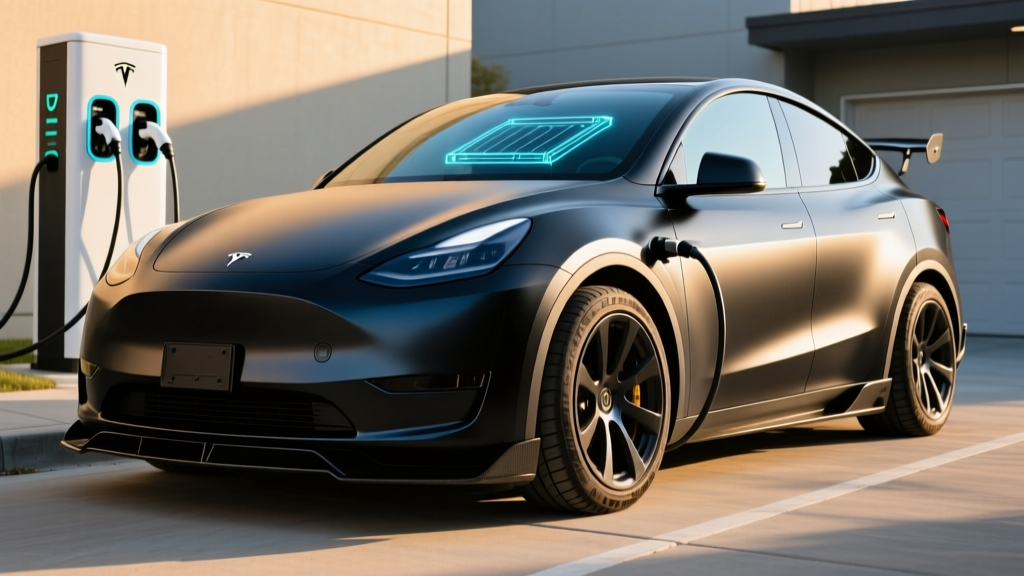
All 2026 Model Y trims share the same charging hardware: a 250 kW peak DC fast-charge capability via the NACS (North American Charging Standard) connector, and an 11.5 kW onboard charger for Level 2 home charging.
| Charging Level | Power (kW) | Speed | Typical Use Case |
|---|---|---|---|
| Level 1 (120V outlet) | ~1.4 kW | ~5 mi/hr | Emergency / trickle |
| Level 2 (240V, 48A) | 11.5 kW | ~44 mi/hr | Home overnight charging |
| DC Fast Charge (peak) | 250 kW | ~1,000 mi/hr (at peak) | Road trips / Supercharger |
| DC Fast Charge (10–80%) | — | ~25–27 minutes | Practical road-trip stop |
Charging curve reality: The 250 kW peak only holds between approximately 10–30% state of charge. From 30–60%, the rate tapers to roughly 150–170 kW. From 60–80%, it drops further to ~70–90 kW. Above 80%, charging slows dramatically to protect battery health — expect 40 kW or less. This is why the 10–80% time is the meaningful metric, not peak kW alone.
LFP vs NMC charging behavior: If your VIN confirms an LFP battery (Long Range RWD), Tesla recommends charging to 100% at least once per week to allow the battery management system to recalibrate. NMC owners should set their daily charge limit to 80% and only charge to 100% before long trips. This difference directly affects usable daily range: an LFP owner gets the full 320 EPA miles regularly, while an NMC owner's daily usable range is closer to ~246 miles (80% of 308).
Federal Tax Credit: Does the 2026 Model Y Qualify Under §30D?
The 2026 Tesla Model Y may qualify for up to $7,500 under the IRS §30D Clean Vehicle Credit, but eligibility depends on several factors that your VIN can help verify:
| Trim | Base MSRP | §30D Credit (max) | Effective Price |
|---|---|---|---|
| Long Range RWD | $44,990 | Up to $7,500 | ~$37,490 |
| Long Range AWD | $47,990 | Up to $7,500 | ~$40,490 |
| Performance | $52,490 | Up to $7,500 | ~$44,990 |
Eligibility requirements for 2026 (current IRS rules):
- MSRP cap: The Model Y is classified as an SUV/crossover, so the cap is $80,000. All current trims clear this threshold comfortably.
- Buyer income cap: Modified adjusted gross income must not exceed $300,000 (joint filers), $225,000 (head of household), or $150,000 (single). This is based on the tax year of delivery or the prior year, whichever is lower.
- Battery sourcing: At least 60% of critical minerals and 75% of battery components must be sourced from the US or free-trade-agreement countries for the full $7,500. Vehicles failing one requirement receive $3,750; failing both, $0. Tesla's LFP batteries (often using CATL cells) have historically faced sourcing challenges, while NMC packs assembled with US-sourced materials more consistently qualify.
- Final assembly: Must occur in North America. Giga Texas satisfies this requirement. Your VIN's plant code (position 11) confirms it.
- Point-of-sale transfer: As of 2024, buyers can transfer the credit to the dealer at purchase, receiving the discount immediately rather than waiting to claim it on their tax return.
VIN-critical insight: If your VIN shows a Giga Shanghai build (plant code "C"), the vehicle does NOT qualify for §30D regardless of other factors. Only North American-assembled vehicles are eligible. Always verify the plant code before assuming credit eligibility. Check current rules at IRS.gov §30D.
Interior, Cargo, and Practicality
The 2026 Model Y (post-refresh) retains the cabin architecture introduced in the "Juniper" update with incremental refinements:
- Cargo volume: 30.2 cu ft behind the second row, 72.1 cu ft with rear seats folded. The front trunk (frunk) adds approximately 4.1 cu ft.
- Front headroom: 41.0 inches
- Front legroom: 41.8 inches
- Rear headroom: 38.5 inches
- Rear legroom: 37.5 inches
- Towing capacity: 3,500 lbs (AWD trims, with tow package)
The refreshed interior includes ventilated front seats, ambient lighting, a rear-seat touchscreen for climate and media control, and power-folding second-row seats. The minimalist dashboard remains — there are no physical buttons for climate or media; everything routes through the 15.4-inch center touchscreen. This is a love-it-or-hate-it design choice. If you prefer tactile controls, spend time with the interface during a test drive before committing.
Technology, Driver Assistance, and Safety
Tesla Autopilot and Full Self-Driving (Supervised) are SAE Level 2 driver-assistance systems. The driver must remain fully attentive, hands on or near the wheel, and prepared to take over at any moment. These systems do NOT make the vehicle self-driving. Only Level 4 services like Waymo operate without a driver engaged.
Standard technology:
- 15.4-inch center touchscreen with navigation, media, and vehicle controls
- Tesla Autopilot (adaptive cruise control + lane centering)
- Tesla Vision camera suite (no radar or ultrasonic sensors)
- Over-the-air software updates
- Phone-as-key via Bluetooth
- Dashcam and Sentry Mode (surveillance recording while parked)
Optional: Full Self-Driving (Supervised) — $8,000
FSD (Supervised) adds automatic lane changes, traffic light and stop sign recognition, autosteer on city streets, and Smart Summon. In practice, FSD remains a Level 2 system requiring constant supervision. It handles many scenarios competently but makes unpredictable errors at construction zones, unprotected left turns, and complex intersections. Budget for it only if you value the convenience and accept the supervision requirement — it does not eliminate driving responsibility.
Safety ratings: The Model Y continues to earn top marks from NHTSA (5-star overall) and the IIHS (Top Safety Pick+ when equipped with acceptable headlights). The rigid battery pack structure contributes to excellent crash performance.
Warranty Coverage
| Component | Coverage |
|---|---|
| Basic Vehicle | 4 years / 50,000 miles |
| Battery & Drive Unit | 8 years / 120,000 miles (Long Range RWD) |
| Battery & Drive Unit | 8 years / 120,000 miles (Long Range AWD & Performance) |
| Battery Capacity Retention | Minimum 70% over warranty period |
Tesla's battery warranty guarantees that the pack will retain at least 70% of its original capacity over the warranty period. If degradation drops below that threshold, Tesla will repair or replace the battery to bring it back above 70%. In practice, Tesla battery degradation curves typically show a 5–8% loss in the first 30,000 miles, then a much slower linear decline. Most Model Y packs are projected to retain 85–90% capacity at 100,000 miles based on fleet data.
Who the 2026 Model Y Suits Best
- You live in a mild climate (LFP cold-weather loss is a non-issue)
- You want the longest EPA range and lowest price
- You can charge to 100% daily without worry (LFP advantage)
- You don't need AWD for snow or traction
- You drive in snow, rain, or mountainous terrain regularly
- You want better cold-weather range retention (NMC chemistry)
- You value the 4.8-second 0–60 time for highway merging confidence
- You plan to tow (3,500-lb capacity requires AWD)
- You prioritize acceleration (3.5 sec 0–60) and handling
- You accept ~40 fewer miles of range for the speed upgrade
- You want the track-mode software and upgraded brakes
- MSRP budget allows the $52,490 starting price
2026 Model Y vs. Key Competitors
The Model Y competes in the most crowded EV crossover segment. Here is how it stacks up against its closest rivals on the metrics that matter:
- Hyundai Ioniq 5: 310 mi range (Long Range AWD), 350 kW peak charging (10–80% in ~18 min), starts at ~$47,000. Faster charging, but slightly less range and no Supercharger network access (though Hyundai is adding NACS adapters).
- Ford Mustang Mach-E: 312 mi range (Extended Range RWD), 150 kW peak charging, starts at ~$42,000. Lower charge speed, but competitive pricing and more traditional interior controls.
- Chevrolet Equinox EV: 319 mi range, 150 kW peak, starts at ~$33,000. Significantly cheaper, but slower charging and less performance.
The Model Y's enduring advantages are the Supercharger network (over 6,000 US stations with near-flawless plug-and-charge reliability), over-the-air update cadence, and resale value. Its disadvantages include the touchscreen-only interface, Tesla Vision's occasional parking-sensor gaps (no ultrasonics), and FSD's unfulfilled autonomy promises.
- Class-leading Supercharger network access
- Strong real-world efficiency (27–30 kWh/100mi)
- Spacious cargo area (72.1 cu ft max)
- Excellent safety ratings (NHTSA 5-star, IIHS TSP+)
- Regular OTA updates add features post-purchase
- Strong resale value relative to EV competitors
- No physical buttons — all controls via touchscreen
- Tesla Vision lacks ultrasonic parking sensors
- FSD ($8,000) remains Level 2, not self-driving
- LFP battery loses more range in extreme cold
- Ride quality firm on 20/21-inch wheels
- Tax credit eligibility varies by battery sourcing
Frequently Asked Questions
What is the real-world range of the 2026 Tesla Model Y?
The Long Range RWD delivers an EPA-estimated 320 miles, but expect ~270–290 miles in mixed driving, ~250 miles at sustained highway speeds, and ~220–240 miles in sub-freezing temperatures. The LFP battery in the RWD model is more sensitive to cold than the NMC packs in AWD trims.
How fast does the 2026 Model Y charge at home and on the road?
At home on a 240V Level 2 charger (48A), the Model Y adds approximately 44 miles of range per hour at 11.5 kW — a full overnight charge from 20% to 80% takes about 5–6 hours. On a DC fast charger (Tesla Supercharger V3/V4), it peaks at 250 kW and charges from 10–80% in approximately 25–27 minutes, though the rate tapers significantly above 60%.
How much does the 2026 Model Y cost after the federal tax credit?
The Long Range RWD starts at $44,990 and can drop to approximately $37,490 with the full $7,500 §30D credit. The Long Range AWD drops from $47,990 to ~$40,490, and the Performance from $52,490 to ~$44,990. However, credit eligibility depends on your income, the vehicle's battery sourcing, and final assembly location — verify via your VIN's plant code and current IRS rules.
Does the 2026 Tesla Model Y qualify for the federal EV tax credit?
It can qualify for up to $7,500 under §30D, provided: (1) your income is within the caps ($150K single / $300K joint), (2) the vehicle's MSRP is under $80,000 (all trims qualify), (3) the battery meets critical-mineral and component-sourcing thresholds, and (4) final assembly occurred in North America (confirmed by VIN plant code "A" for Giga Texas). The LFP battery in the RWD trim may face sourcing challenges that reduce the credit to $3,750 or $0 depending on the current supply chain.
Is the 2026 Model Y worth buying versus competitors?
The Model Y remains the benchmark EV crossover for buyers who prioritize charging infrastructure reliability, efficiency, and over-the-air feature updates. If fast DC charging is your top priority, the Hyundai Ioniq 5 (350 kW peak) charges faster. If budget is paramount, the Chevrolet Equinox EV starts ~$12,000 lower. But for the combination of Supercharger access, cargo space, safety ratings, and resale value, the Model Y is difficult to beat.
What does the VIN tell me about battery chemistry?
Position 8 of the VIN encodes the battery and motor configuration. LFP batteries appear in the Long Range RWD trim; NMC batteries appear in Long Range AWD and Performance trims. This affects your daily charging habits (LFP: charge to 100% weekly; NMC: limit to 80% daily), cold-weather range retention, and potentially your tax credit eligibility.
Can I charge the Model Y at non-Tesla chargers?
Yes. The 2026 Model Y uses the NACS connector natively. Most public DC fast-charging networks (Electrify America, EVgo, ChargePoint) now offer NACS cables or CCS-to-NACS adapters. Tesla also provides a CCS adapter for backward compatibility. Level 2 public chargers with J1772 connectors require the J1772-to-NACS adapter included with the vehicle.