Quick Verdict: The 2026 Tesla Model Y in Stealth Grey
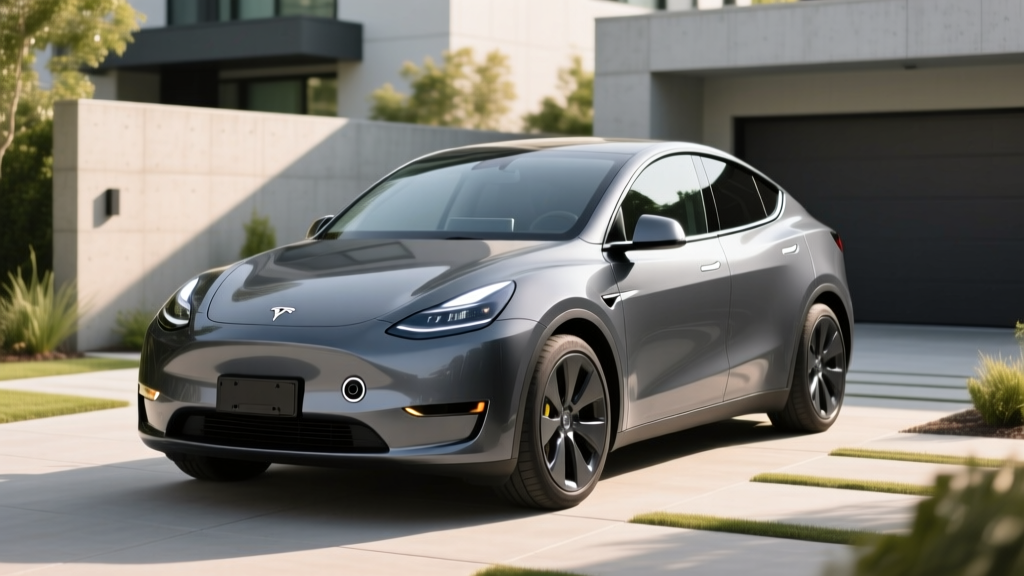
The 2026 Tesla Model Y remains the best-selling electric vehicle in the United States for good reason: it delivers a compelling mix of range, charging speed, cargo practicality, and access to Tesla's Supercharger network. The Stealth Grey paint option — a mid-tone metallic that replaced the earlier Steel Grey — gives the crossover a more understated, premium look that hides road grime better than solid black or white. But beyond aesthetics, the real question for buyers is whether the 2026 Model Y's specifications hold up against an increasingly crowded field of midsize electric crossovers. This review breaks down every number that matters.
| Spec | Value |
|---|---|
| EPA Range | 320 miles (Long Range AWD) |
| Battery Capacity | ~78 kWh usable (NMC chemistry) |
| Max DC Fast Charge | 250 kW peak |
| 10–80% DC Charge Time | ~25 minutes |
| Level 2 Home Charge Rate | 11.5 kW (~44 mi/hr) |
| 0–60 mph | 4.8 seconds (Long Range AWD) |
| Horsepower | 384 hp (dual motor combined) |
| Drivetrain | Dual-motor AWD |
| MPGe (combined) | 117 MPGe |
| Efficiency | 28 kWh/100 mi |
| Cargo Volume (rear seats up) | 30.2 cu ft |
| Cargo Volume (rear seats folded) | 72.0 cu ft |
| Rear Legroom | 37.8 inches |
| Battery Warranty | 8 years / 120,000 miles |
| Base MSRP (Long Range AWD) | $48,990 |
Range and Efficiency: EPA vs. Real-World Expectations
The 2026 Tesla Model Y Long Range AWD carries an EPA-estimated 320 miles of range. The rear-wheel-drive (RWD) variant, which uses an LFP (lithium iron phosphate) battery, is rated at approximately 260 miles. Efficiency for the Long Range AWD comes in at 117 MPGe combined, or roughly 28 kWh per 100 miles — competitive with the Hyundai Ioniq 5 and slightly better than the Ford Mustang Mach-E Extended Range.
EPA 320 miles is measured under mixed city/highway conditions at moderate temperatures. In our experience and consistent with independent testing:
- Highway-only (70–75 mph, 70°F): Expect ~270–285 miles. Aerodynamic drag at sustained speed reduces efficiency by roughly 10–15%.
- Cold weather (30°F, mixed driving): Expect ~230–260 miles. The Model Y uses a heat pump for cabin and battery thermal management, which mitigates some cold-weather loss compared to resistive heating, but LFP chemistry in the RWD variant is more cold-sensitive than NMC.
- City/regenerative-heavy driving (55°F): You may approach or slightly exceed the 320-mile EPA figure thanks to aggressive regen recapturing energy.
The Long Range AWD uses NMC (nickel manganese cobalt) cell chemistry, which offers higher energy density and better cold-weather performance than LFP. The RWD variant's LFP pack is heavier and holds less total energy, but LFP cells tolerate daily 100% charging without accelerated degradation — a practical advantage for commuters who need every mile every day. According to fueleconomy.gov, the Model Y Long Range AWD achieves 123 MPGe city and 111 MPGe highway.
Charging Speed: DC Fast, Level 2, and the Supercharger Advantage
Charging speed is where the Model Y continues to stand out, largely thanks to Tesla's vertically integrated Supercharger network and the vehicle's thermal preconditioning system. When you navigate to a Supercharger, the car automatically warms or cools the battery to optimal temperature before you arrive, enabling faster charge acceptance.
| Charge Level | Power / Rate | Miles Added per Hour | Typical Use Case |
|---|---|---|---|
| Level 1 (120V household) | ~1.4 kW | ~5 mi/hr | Emergency / trickle top-up |
| Level 2 (240V home Wall Connector) | 11.5 kW | ~44 mi/hr | Daily home charging (full overnight) |
| DC Fast Charge (Supercharger V3/V4) | 250 kW peak | ~1,000 mi/hr at peak | Road trips, 10–80% in ~25 min |
DC fast charging nuance: The 250 kW figure is a peak rate, not a sustained one. The Model Y's charge curve is aggressive in the 10–50% state-of-charge window, then tapers progressively. From 10% to 80%, expect roughly 25 minutes at a V3 Supercharger (250 kW). Above 80%, charging slows significantly to protect battery health — going from 80% to 100% can add another 20+ minutes. This is why Tesla and most EV experts recommend charging to 80% on road trips and topping off only when needed.
For home charging, Tesla's Gen 3 Wall Connector delivers up to 11.5 kW (48 amps) on a 60-amp circuit, adding approximately 44 miles of range per hour. A full overnight charge from 20% to 80% takes roughly 5–6 hours. The Model Y also ships with a NACS (North American Charging Standard) port natively — no adapter required at Superchargers. With the broader industry adopting NACS for 2025 and beyond, Tesla owners now share Supercharger stalls with Ford, Rivian, and other NACS-equipped vehicles, which may affect wait times at popular corridors.
Performance and Driving Dynamics
The 2026 Model Y Long Range AWD uses a dual-motor setup producing 384 combined horsepower, launching from 0 to 60 mph in 4.8 seconds. That's brisk for a family crossover and quicker than most competitors in this price bracket. The Performance trim shaves that to approximately 3.5 seconds with 456 hp, though it sacrifices roughly 15 miles of EPA range.
Ride quality has improved with the refreshed "Juniper" architecture introduced in the 2025 model year — revised suspension tuning, acoustic glass, and improved damping reduce road noise and harshness noticeably compared to pre-2025 Model Ys. Steering remains on the firm, direct side, which suits highway driving but can feel heavy in parking lots. Regenerative braking offers strong one-pedal driving capability, though Tesla removed the driver-adjustable regen setting several years ago — you get one strong regen profile, and it takes a few days to adapt if you're coming from a vehicle with adjustable levels.
Interior, Cargo, and Technology
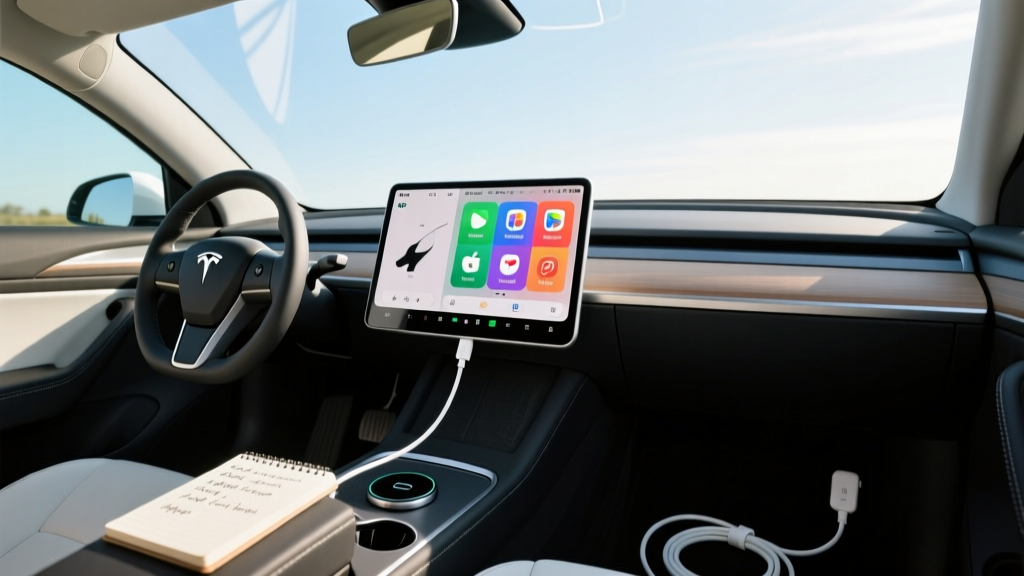
The Model Y's cabin follows Tesla's minimalist philosophy: a single 15.4-inch center touchscreen handles infotainment, climate, navigation, and vehicle settings. There is no traditional instrument cluster — speed and driving information appear in the upper-left corner of the main screen. The refreshed interior adds ventilated front seats, ambient lighting, a rear-seat touchscreen for passengers, and power-folding second-row seats.
Cargo capacity remains a strong point: 30.2 cubic feet behind the second row and 72.0 cubic feet with the rear seats folded flat. A small front trunk (frunk) adds roughly 2.1 cubic feet for charging cables or a soft bag. Rear legroom measures 37.8 inches — adequate for adults on longer trips, though the panoramic glass roof can create a greenhouse effect in hot climates; Tesla includes a tinted roof, but many owners add an aftermarket sunshade.
Driver assistance: Every Model Y ships with Tesla's Basic Autopilot (adaptive cruise control and lane-centering). Full Self-Driving (Supervised) remains a $8,000 add-on or $99/month subscription as of 2026.
Tesla Autopilot and FSD (Supervised) are SAE Level 2 driver-assistance systems. Despite the "Full Self-Driving" name, the driver must remain attentive, keep hands on the wheel, and be prepared to take over at any moment. These systems are not autonomous. True driverless (Level 4) operation is currently limited to geofenced robotaxi services like Waymo in select cities.
Pricing, Trims, and Federal Tax Credit Eligibility
The 2026 Tesla Model Y is offered in three configurations:
| Trim | Base MSRP | EPA Range | Est. §30D Credit | Effective Price (if eligible) |
|---|---|---|---|---|
| Long Range RWD (LFP) | $44,990 | 260 mi | Up to $7,500 | ~$37,490 |
| Long Range AWD (NMC) | $48,990 | 320 mi | Up to $7,500 | ~$41,490 |
| Performance AWD | $52,490 | 303 mi | Up to $7,500 | ~$44,990 |
Tax credit caveats — read carefully: The federal §30D Clean Vehicle Credit offers up to $7,500, but eligibility depends on multiple requirements that change periodically. As of 2026, per IRS guidelines:
- MSRP cap: The vehicle's MSRP must not exceed $80,000 for SUVs (the Model Y qualifies).
- Buyer income cap: Modified adjusted gross income must not exceed $150,000 (single), $225,000 (head of household), or $300,000 (married filing jointly).
- Battery sourcing: A percentage of critical minerals and battery components must be sourced from the U.S. or free-trade-agreement countries. Tesla's shifting supply chain means eligibility can change mid-year — always verify at the point of sale.
- Point-of-sale transfer: As of 2024, buyers can transfer the credit to the dealer for an immediate price reduction rather than waiting to claim it on their tax return.
The Stealth Grey paint is a $0 standard color option as of 2026 (Tesla periodically restructures paint pricing). Adding FSD, larger wheels, or premium interior packages can push the as-tested price above $55,000. Consult a tax professional to confirm your personal eligibility before relying on the credit in your budget.
Ownership Costs and Warranty
Tesla provides a 4-year/50,000-mile basic vehicle warranty and an 8-year/120,000-mile battery and drive unit warranty for the Long Range and Performance trims. The battery warranty guarantees at least 70% capacity retention over the warranty period — if degradation exceeds 30%, Tesla will repair or replace the pack. Real-world data from Tesla's fleet suggests most Model Y packs retain 88–92% capacity at 100,000 miles, well within the warranty threshold.
Insurance costs for the Model Y tend to run higher than average for the segment — expect $1,800–$2,800 annually depending on your location, driving record, and coverage level. Tesla offers its own insurance product in many states, priced dynamically based on real-time driving behavior (via the Tesla Safety Score), which can be cheaper for cautious drivers but significantly more expensive for aggressive ones.
Electricity costs vary widely by region, but charging at home at the U.S. average of ~$0.16/kWh, a full 78 kWh charge costs roughly $12.50 — translating to about $0.045 per mile. Compare that to a 25 MPG gas crossover at $3.40/gallon ($0.136/mile), and the per-mile fuel savings are substantial, particularly for high-mileage commuters.
- 320-mile EPA range (Long Range AWD) is among the best in class
- 250 kW Supercharger access with native NACS — no adapters needed
- 72 cu ft cargo volume with seats folded beats most competitors
- OTA updates continuously add features post-purchase
- Heat pump standard — better cold-weather range retention
- Strong resale value relative to EV segment average
- No Apple CarPlay or Android Auto — Tesla's proprietary system only
- Single regen profile — no driver-adjustable braking feel
- FSD (Supervised) costs $8,000 extra and remains SAE Level 2
- Insurance premiums run 15–30% above segment average
- Glass roof lacks a physical shade — heat soak in summer
- Increasing Supercharger congestion as non-Tesla EVs gain NACS access
Who Should Buy the 2026 Tesla Model Y in Stealth Grey?
Choose the Model Y Long Range AWD if: You need 300+ miles of real-world range for road trips, value the Supercharger network for cross-country travel, want strong cargo capacity for a family, and can charge at home most nights. The Stealth Grey finish suits buyers who want a premium look without the maintenance demands of darker paints.
Choose the Model Y RWD (LFP) if: Your daily commute is under 100 miles round-trip, you charge at home every night, you want the lowest purchase price, and you prefer the LFP battery's tolerance for daily 100% charging. You sacrifice 60 miles of range but save $4,000.
Look at competitors (Hyundai Ioniq 5, Ford Mustang Mach-E, Kia EV6) if: You want Apple CarPlay, prefer a more traditional interior layout, need CCS compatibility without adapters at non-Tesla chargers, or want to test-drive before buying (Tesla's direct-sales model limits in-person showroom availability in some states).
Frequently Asked Questions
What is the real-world range of the 2026 Tesla Model Y?
The EPA rates the Long Range AWD at 320 miles. In real-world highway driving at 70–75 mph in moderate temperatures, expect approximately 270–285 miles. In cold weather (below freezing), that drops to roughly 230–260 miles depending on cabin heating use and whether you precondition the battery. The RWD (LFP) variant is EPA-rated at 260 miles with similar proportional reductions.
How fast does the 2026 Model Y charge at home and on the road?
At a Tesla V3/V4 Supercharger, the Model Y peaks at 250 kW and charges from 10% to 80% in approximately 25 minutes. At home on a Level 2 Tesla Wall Connector (11.5 kW / 48 amps), you'll add about 44 miles of range per hour, meaning a 20–80% charge takes roughly 5–6 hours overnight. On a standard 120V outlet (Level 1), expect about 5 miles per hour — adequate only for emergency trickle charging.
Does the 2026 Tesla Model Y qualify for the $7,500 federal EV tax credit?
It can, but eligibility is not automatic. Under IRS §30D rules, the buyer must meet income caps ($150K single / $300K joint), the vehicle MSRP must be under $80,000 (it is), and a specified percentage of battery critical minerals and components must be U.S.- or FTA-sourced. Tesla's supply chain sourcing has shifted periodically, and the credit amount can be $3,750 or $7,500 depending on which sourcing thresholds are met at the time of delivery. Always confirm eligibility with your tax advisor and at the Tesla point of sale. See IRS.gov Clean Vehicle Credits for current rules.
Is the 2026 Model Y worth buying over the Hyundai Ioniq 5 or Ford Mach-E?
The Model Y wins on Supercharger network access, cargo volume (72 cu ft vs. ~53–60 cu ft for rivals), and efficiency (28 kWh/100 mi). The Ioniq 5 and EV6 charge faster on non-Tesla DC networks (up to 350 kW on 800V architecture, 10–80% in ~18 minutes), offer Apple CarPlay, and have more conventional interiors. The Mach-E provides a sportier driving feel and broader dealer service access. If Supercharger reliability and cargo space are your top priorities, the Model Y still leads. If you prefer CarPlay, faster peak charging on Electrify America, or a traditional dealership experience, the Korean and American alternatives deserve serious consideration.
What are the biggest drawbacks of the 2026 Model Y?
The most commonly cited issues are the lack of Apple CarPlay/Android Auto, the non-adjustable regenerative braking, higher-than-average insurance costs, and the glass roof's heat retention in summer. FSD (Supervised) remains a Level 2 system despite its $8,000 price tag, and some buyers find Tesla's minimal interior lacking the physical controls and material warmth of competitors. Additionally, as more non-Tesla EVs gain Supercharger access via NACS, popular corridor stations may see increased wait times during peak travel periods.
Is Stealth Grey a good color choice for the Model Y?
Stealth Grey is one of Tesla's more practical paint options. It hides dust, pollen, and light road film better than Solid Black or Deep Blue, reducing wash frequency. It carries no upcharge as of 2026 (pricing subject to Tesla's periodic restructuring). The metallic flake gives it depth under direct sunlight while reading as a conservative, professional tone in overcast conditions. If resale value is a concern, white and grey historically perform well in the used EV market.