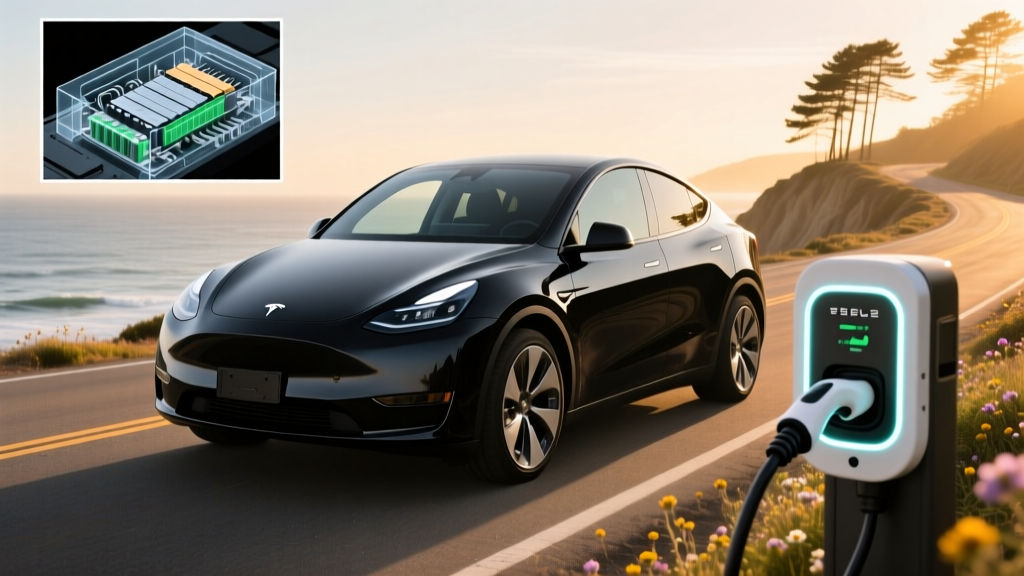
The Tesla Model Y remains the benchmark against which every other electric crossover is measured. For 2026, the refreshed Model Y (internally dubbed "Juniper") carries over the core formula — spacious cabin, access to the Supercharger network, and competitive efficiency — while adding subtle refinements to ride quality, interior materials, and thermal management. If you've been searching for something like a "power wheels Tesla" that handles real-world family duty, highway road trips, and daily commuting with equal competence, the Model Y is the closest thing to a do-it-all electric SUV on the market.
But benchmark status doesn't mean it's flawless. This review digs into the numbers that matter: real-world range versus the EPA sticker, actual DC fast-charging curves (not just peak kW), tax credit eligibility under current IRS §30D rules, and how the 2026 Model Y stacks up against the Hyundai Ioniq 5, Ford Mustang Mach-E, and Chevrolet Equinox EV.
2026 Tesla Model Y: Quick Verdict
Who it's for: Families and commuters who want a proven electric crossover with best-in-class charging infrastructure access, strong efficiency, and a usable 300+ mile range — and who are comfortable with Tesla's minimalist interior and panel-touchscreen interface.
Who should look elsewhere: Buyers who prioritize physical controls, luxury interior materials, or the lowest possible purchase price. The Chevrolet Equinox EV undercuts it by thousands, and the Hyundai Ioniq 5 offers a more conventional cockpit.
Range, Efficiency, and Real-World Expectations
The 2026 Tesla Model Y Long Range AWD carries an EPA-estimated range of 320 miles on a full charge, while the Rear-Wheel Drive (RWD) base model is rated at 303 miles. The Performance trim drops slightly to 285 miles due to stickier tires and more aggressive tuning. Efficiency across the lineup hovers around 28–29 kWh/100 mi (roughly 115–120 MPGe combined), which remains class-leading for a dual-motor AWD crossover of this size.
Real-World Range Reality Check
EPA Sticker: 320 mi (Long Range AWD)
Expect in practice:
- City/suburban mixed driving (65°F): ~305–315 mi — regenerative braking recovers energy in stop-and-go traffic.
- Sustained highway (75 mph, 70°F): ~265–280 mi — aerodynamic drag dominates at speed.
- Cold weather (30°F, highway): ~220–245 mi — battery resistance and cabin heating reduce range 25–30%. The 2026 Model Y's heat pump mitigates some loss versus resistive heating, but physics still applies.
Preconditioning the battery before a DC fast-charge stop (via the car's navigation routing) is essential for hitting peak charge speeds. Skip it and you'll see charge rates cut in half in cold conditions.
| Spec | RWD (Base) | Long Range AWD | Performance |
|---|---|---|---|
| EPA Range | 303 mi | 320 mi | 285 mi |
| Battery (usable) | ~60 kWh (LFP) | ~78 kWh (NMC) | ~78 kWh (NMC) |
| Horsepower | 295 hp | 384 hp | 456 hp |
| 0–60 mph | 6.6 sec | 4.8 sec | 3.5 sec |
| Drivetrain | RWD, single motor | AWD, dual motor | AWD, dual motor |
| Efficiency | 27 kWh/100 mi (122 MPGe) | 28 kWh/100 mi (120 MPGe) | 29 kWh/100 mi (115 MPGe) |
| Base MSRP | $44,990 | $48,990 | $53,990 |
Battery Chemistry: LFP vs. NMC in the Model Y Lineup
Tesla continues to segment its battery strategy by trim. The RWD base Model Y uses a lithium iron phosphate (LFP) pack — approximately 60 kWh usable. LFP cells are heavier and slightly less energy-dense than NMC, but they offer a longer cycle life, better thermal stability, and can be charged to 100% daily without accelerated degradation. Tesla recommends periodic 100% charges for LFP packs to keep the battery management system calibrated.
The Long Range and Performance trims use nickel manganese cobalt (NMC) chemistry with roughly 78 kWh usable. NMC delivers higher energy density (more range per pound) but Tesla recommends daily charging to 80–90% for longevity, reserving 100% for road trips. Over a 150,000-mile ownership cycle, NMC packs typically show 8–12% degradation based on fleet data, while LFP packs tend to degrade 5–8% over the same distance.
Charging Speed: DC Fast, Level 2, and the Supercharger Advantage
Charging infrastructure remains Tesla's strongest competitive moat. The 2026 Model Y retains the NACS (North American Charging Standard) connector natively, giving it plug-and-play access to over 20,000 Supercharger stalls across North America — no adapter needed. Competitors using CCS1 are gaining access to Superchargers via adapters, but the native NACS experience (automatic stall identification, billing through the car, preconditioning integration) is still more seamless.
| Charging Level | Power (kW) | Speed | Notes |
|---|---|---|---|
| Level 1 (120V household) | ~1.4 kW | ~3–4 mi/hr | Emergency/trickle only |
| Level 2 (240V, 48A home) | 11.5 kW | ~37 mi/hr | Full overnight charge in ~8–9 hr |
| DC Fast Charge (peak) | 250 kW | 10–80% in ~25 min | Long Range/Performance; RWD peaks ~170 kW |
| DC Fast Charge (sustained avg.) | ~150 kW | ~180 mi in 30 min | Charge curve tapers above 60% SoC |
A critical nuance that spec sheets gloss over: peak kW is not sustained kW. The Long Range Model Y can hit 250 kW at low state of charge (10–20%), but the charge curve tapers progressively. By 60% SoC you're typically seeing 100–120 kW, and above 80% it drops to under 50 kW. This is why the 10–80% time (~25 minutes) is the relevant metric — not the peak number. On a road trip, plan stops around 15–20 minute charges from 10–70%, which adds roughly 180–200 miles each time.
For home charging, a Tesla Wall Connector on a 60A circuit (48A continuous) delivers 11.5 kW, adding about 37 miles of range per hour. Most owners who plug in overnight will wake up to a full battery regardless of daily mileage. Installation costs typically run $500–$1,500 depending on panel proximity and local permitting, though older homes may need a $1,500–$3,000 panel upgrade to support a 60A circuit.
Performance and Driving Dynamics
The Model Y's performance envelope is broad. The base RWD delivers 295 hp and a 6.6-second 0–60 mph time — perfectly adequate for merging and daily driving. The Long Range AWD's dual-motor setup pushes 384 hp with a 4.8-second sprint, while the Performance variant drops the 0–60 to 3.5 seconds with 456 hp — sports-car territory in a five-passenger crossover.
The 2026 Juniper refresh improved ride quality with revised damper tuning and additional acoustic insulation. Road noise is noticeably reduced at highway speeds compared to the pre-2025 model. The steering remains quick and direct, though some drivers find it overly assisted in Comfort mode. Switching to Sport tightens the feel without being heavy.
Regenerative braking in the Model Y is aggressive by default (Tesla removed the user-adjustable regen setting several model years ago). Most owners adapt to one-pedal driving within a week, but if you're transitioning from a gas car or an EV with adjustable regen (like the Hyundai Ioniq 5), expect a brief adjustment period.
Interior, Cargo, and Technology
The 2026 Model Y interior received meaningful updates: ventilated front seats, ambient lighting, power-folding second-row seats, and a rear-seat touchscreen for climate and entertainment. The cabin remains minimalist — there are no physical buttons for climate, mirrors, or glovebox. Everything routes through the 15.4-inch center touchscreen.
Cargo capacity:
- Behind second row: 30.2 cu ft
- Second row folded: 72.1 cu ft
- Front trunk (frunk): 4.1 cu ft
- Rear legroom: 41.6 in
- Front headroom: 41.0 in
Those numbers put the Model Y ahead of the Ioniq 5 and Mach-E for cargo space, and competitive with midsize gas crossovers like the Honda CR-V. The flat load floor and wide hatch opening make it practical for bulky items, and the frunk is useful for charging cables or a small bag.
Tech highlights:
- Infotainment: 15.4" center display, Netflix/YouTube/Spotify, gaming capable, Bluetooth 5.0, no Apple CarPlay or Android Auto (Tesla's closed ecosystem)
- Driver assistance: Basic Autopilot standard (adaptive cruise + lane centering, SAE Level 2). Full Self-Driving (Supervised) available as an $8,000 add-on — still Level 2 with mandatory driver supervision despite the name
- Over-the-air updates: Regular software pushes that add features and refine existing ones
- Sentry Mode / Dashcam: Built-in camera recording with USB storage
- Dog Mode / Camp Mode: Climate control presets for leaving pets or sleeping in the vehicle
⚠️ Autopilot & FSD: SAE Level 2 — Not Self-Driving
Both Autopilot and Full Self-Driving (Supervised) are SAE Level 2 driver-assistance systems. The driver must remain attentive, keep hands on the wheel, and be prepared to take over instantly. FSD Supervised can navigate intersections, change lanes, and handle some highway-to-off-ramp transitions, but it makes errors — particularly in construction zones, unusual intersections, and poor weather. It does not replace an alert driver. Only Level 4 robotaxi services (Waymo, Zoox) operate without a human driver, and those are geofenced to specific cities.
Pricing, Tax Credits, and Ownership Cost
| Trim | Base MSRP | As-Tested (typical) | §30D Credit Eligible? | Effective Price (if eligible) |
|---|---|---|---|---|
| RWD | $44,990 | $45,990 | Yes (meets MSRP cap, sourcing rules) | ~$37,490* |
| Long Range AWD | $48,990 | $50,490 | Yes (meets MSRP cap, sourcing rules) | ~$41,490* |
| Performance | $53,990 | $55,990 | Yes (SUV MSRP cap is $80,000) | ~$46,490* |
*Effective price assumes full $7,500 IRS §30D federal tax credit, taken as a point-of-sale transfer. Eligibility requires:
- Buyer income caps: AGI ≤ $150,000 (single), $225,000 (head of household), $300,000 (joint)
- MSRP cap: ≤ $80,000 for SUVs/vans/pickups (Model Y qualifies as an SUV)
- Battery sourcing: Critical minerals and battery components must meet phased percentage thresholds from US/FTA countries — Tesla's US-built packs currently satisfy these requirements
- Point-of-sale transfer: As of 2024+, you can transfer the credit to the dealer at purchase for an immediate price reduction rather than claiming it on your tax return
Consult a tax professional to confirm your personal eligibility. State and local incentives vary — check AFDC's state incentive database for additional rebates in your area.
Five-year ownership cost estimate (Long Range AWD, 15,000 mi/yr, national average electricity at $0.16/kWh):
- Energy cost: ~$3,360/year ($0.08/mi) vs. ~$2,100/year for a 28 MPG gas crossover at $3.50/gal
- Maintenance: ~$300/year (cabin filter, wipers, tire rotation — no oil changes, no transmission fluid)
- Insurance: ~$1,800–$2,400/year (EV insurance premiums run 15–25% higher than comparable gas vehicles)
- Estimated 5-year total: ~$27,000–$31,000 in operating costs, depending on electricity rates and insurance market
Pros and Cons
✅ Pros
- Best-in-class Supercharger network access (native NACS)
- Class-leading cargo space and practical hatchback design
- Strong efficiency (28 kWh/100 mi) maximizes range per kWh
- LFP option on base trim allows daily 100% charging without degradation worry
- Over-the-air updates continue to add features post-purchase
- Competitive 0–60 performance across all trims
- Heat pump standard for better cold-weather efficiency
❌ Cons
- No Apple CarPlay or Android Auto — Tesla's closed ecosystem only
- All controls via touchscreen — no physical buttons for climate or mirrors
- FSD (Supervised) is expensive ($8,000) and still Level 2, not autonomous
- Ride quality improved in 2026 but still firmer than some competitors
- Insurance premiums run higher than gas equivalents
- DC fast charging peaks at 250 kW — some rivals now charge at 350 kW
How It Compares: Model Y vs. Key Rivals
The 2026 Model Y competes in the hottest segment of the EV market. Here's how the numbers stack up against the three closest alternatives:
| Spec | Tesla Model Y LR | Hyundai Ioniq 5 LR AWD | Ford Mustang Mach-E ER AWD | Chevy Equinox EV RS |
|---|---|---|---|---|
| EPA Range | 320 mi | 290 mi | 305 mi | 319 mi |
| Battery | 78 kWh (NMC) | 77.4 kWh (NMC) | 88 kWh (NMC) | 85 kWh (NMC) |
| Peak DC Charge | 250 kW | 350 kW | 150 kW | 190 kW |
| 10–80% Time | ~25 min | ~18 min | ~37 min | ~30 min |
| 0–60 mph | 4.8 sec | 5.1 sec | 5.5 sec | 6.2 sec |
| Cargo (rear seats up) | 30.2 cu ft | 27.2 cu ft | 29.7 cu ft | 26.4 cu ft |
| Base MSRP (AWD) | $48,990 | $50,250 | $48,995 | $43,900 |
| Native Connector | NACS | CCS1 (NACS adapter) | CCS1 (NACS adapter) | CCS1 (NACS adapter) |
The Ioniq 5 charges faster (350 kW peak, 18-minute 10–80%) but carries less range and less cargo. The Mach-E is a compelling alternative with Ford's dealer network behind it, but its 150 kW peak charge rate is a real road-trip penalty. The Equinox EV is the value play — $5,000 less than the Model Y RWD with comparable range — but it can't match Tesla's efficiency or charging network seamlessness.
Warranty Coverage
- Basic vehicle: 4 years / 50,000 miles
- Battery & drive unit (RWD): 8 years / 100,000 miles, ≥70% capacity retention
- Battery & drive unit (Long Range/Performance): 8 years / 120,000 miles, ≥70% capacity retention
Tesla's battery warranty is competitive but not class-leading — Hyundai backs the Ioniq 5 battery for 10 years / 100,000 miles. In practice, Tesla fleet data shows most Model Y packs retain 88–92% capacity at 100,000 miles, well above the warranty threshold. Out-of-warranty battery replacement costs $12,000–$16,000 depending on pack size, though full replacements remain rare under 150,000 miles.
Frequently Asked Questions
What is the real-world range of the 2026 Tesla Model Y?
The Long Range AWD is EPA-rated at 320 miles. In real-world driving, expect ~305–315 miles in city/suburban conditions, ~265–280 miles on sustained highway drives, and ~220–245 miles in cold weather (30°F) highway driving. The base RWD's 303-mile EPA rating translates to roughly 250–260 highway miles and 210–230 in cold weather.
How fast does the Model Y charge at home and on the road?
On a 240V Level 2 home charger (48A), the Model Y charges at 11.5 kW, adding ~37 miles per hour — a full overnight charge takes 8–9 hours. On a DC fast charger, the Long Range and Performance trims peak at 250 kW, achieving a 10–80% charge in approximately 25 minutes. The RWD base model peaks at ~170 kW with a 10–80% time closer to 30 minutes.
Does the 2026 Model Y qualify for the $7,500 federal EV tax credit?
Yes, all Model Y trims currently qualify for the full $7,500 §30D federal tax credit, assuming you meet the income requirements (≤$150K single / $300K joint AGI) and the vehicle meets battery-sourcing rules — which Tesla's US-built packs currently satisfy. The credit can be transferred at point of sale for an immediate price reduction. Always verify current eligibility on the IRS website, as sourcing rules evolve.
Is the Model Y worth buying versus the Ioniq 5 or Equinox EV?
Choose the Model Y if charging-network access, cargo space, and efficiency are your top priorities. Choose the Ioniq 5 if you want faster DC charging (18 min vs. 25 min, 10–80%) and physical controls. Choose the Equinox EV if you want to minimize purchase price and are willing to sacrifice some efficiency and charge speed. For road-trip-heavy owners, the Supercharger network remains a meaningful advantage.
What are the biggest drawbacks of the Model Y?
The absence of Apple CarPlay/Android Auto is a dealbreaker for some buyers. The all-touchscreen interface (no physical buttons) requires adaptation. FSD is expensive and still requires full driver attention. Insurance costs run 15–25% higher than equivalent gas vehicles. And while 250 kW peak charging is fast, rivals like the Ioniq 5 now charge meaningfully quicker at 350 kW.
Can I charge a Model Y at non-Tesla charging stations?
Yes. The Model Y's native NACS connector works at Tesla Superchargers and at the growing number of third-party networks that have adopted NACS. For CCS1 stations (Electrify America, some ChargePoint DC stalls), you'll need a NACS-to-CCS adapter — Tesla sells one, and third-party options are available. CHAdeMO stations are effectively obsolete in North America and not worth planning around.
Sources: EPA Fuel Economy — Tesla Model Y, IRS Clean Vehicle Credits (§30D), Tesla Model Y Specifications.