Quick Verdict: Still the Default Tesla Transport for a Reason
If you search for "Tesla transport" in any EV forum, you'll mostly find owners talking about the Model Y as their daily people-and-cargo hauler. For 2026, the refreshed Model Y (internally dubbed "Juniper") continues to anchor Tesla's lineup as the most practical vehicle they sell — more cargo room than the Model 3, cheaper than the Model X, and backed by the Supercharger network that still sets the standard for road-trip usability. It's not the most exciting EV on the market anymore, but as a do-everything electric family transport, it remains the baseline competitors measure themselves against.
| Spec | Long Range AWD | Performance |
|---|---|---|
| EPA Range | 320 miles | 295 miles |
| Battery (usable) | ~75 kWh, NMC | ~75 kWh, NMC |
| Drivetrain | Dual-Motor AWD | Dual-Motor AWD |
| Horsepower | 384 hp | 510 hp |
| 0–60 mph | 4.8 sec | 3.5 sec |
| Max DC Fast Charge | 250 kW | 250 kW |
| 10–80% DC Time | ~24 min | ~24 min |
| Level 2 Rate | 11.5 kW (~44 mi/hr) | 11.5 kW (~44 mi/hr) |
| MPGe (combined) | 122 MPGe | 111 MPGe |
| Efficiency | 28 kWh/100 mi | 30 kWh/100 mi |
| Cargo (rear seats up) | 30.2 cu ft | 30.2 cu ft |
| Cargo (rear seats folded) | 72.1 cu ft | 72.1 cu ft |
| Base MSRP | $44,990 | $51,490 |
| Warranty (battery) | 8 yr / 120,000 mi | 8 yr / 120,000 mi |
Range & Efficiency: EPA Sticker vs. Real-World Transport
Real-World Expectation: Plan on ~270–290 miles for mixed highway driving at 70–75 mph. In cold weather (below 32°F), expect a 15–25% reduction — roughly 240–260 usable miles before you'll want to stop. City driving with regenerative braking can push closer to, or slightly above, the EPA number.
The 2026 Model Y Long Range pairs its ~75 kWh usable NMC (nickel-manganese-cobalt) battery with Tesla's heat pump, which significantly reduces cold-weather range loss compared to earlier resistive-heating models. Efficiency of 28 kWh per 100 miles is excellent for a crossover of this size — better than the Ford Mustang Mach-E Extended Range (33 kWh/100 mi) and competitive with the Hyundai Ioniq 5 (30 kWh/100 mi AWD).
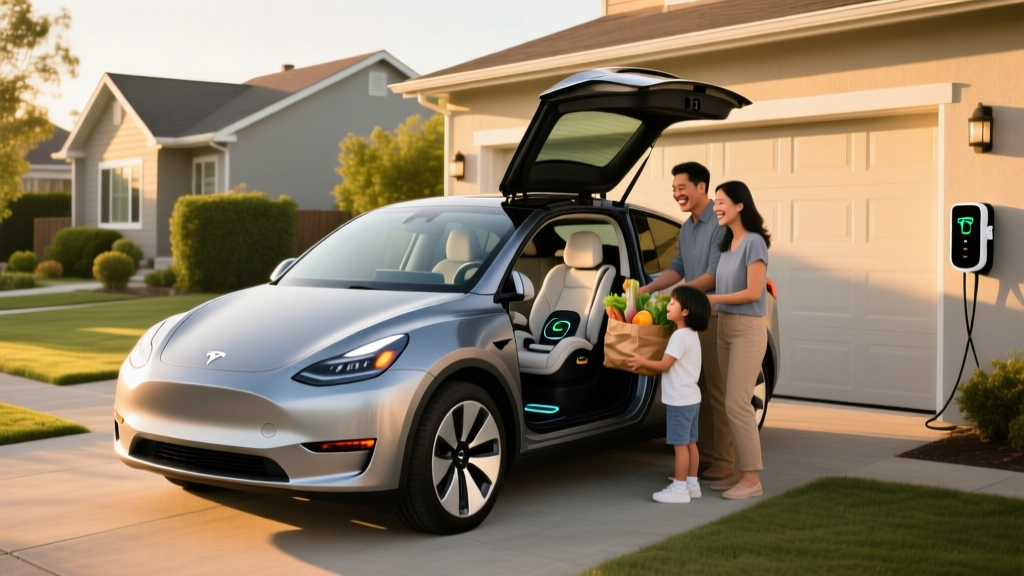
For family transport duty — school runs, grocery hauls, weekend road trips — the real-world 270-mile highway buffer is enough for most one-day round trips without charging. According to fueleconomy.gov, the Model Y Long Range achieves 122 MPGe combined, which translates to roughly 4 miles per kWh in everyday mixed driving.
Charging: Supercharger Strength and Home Setup
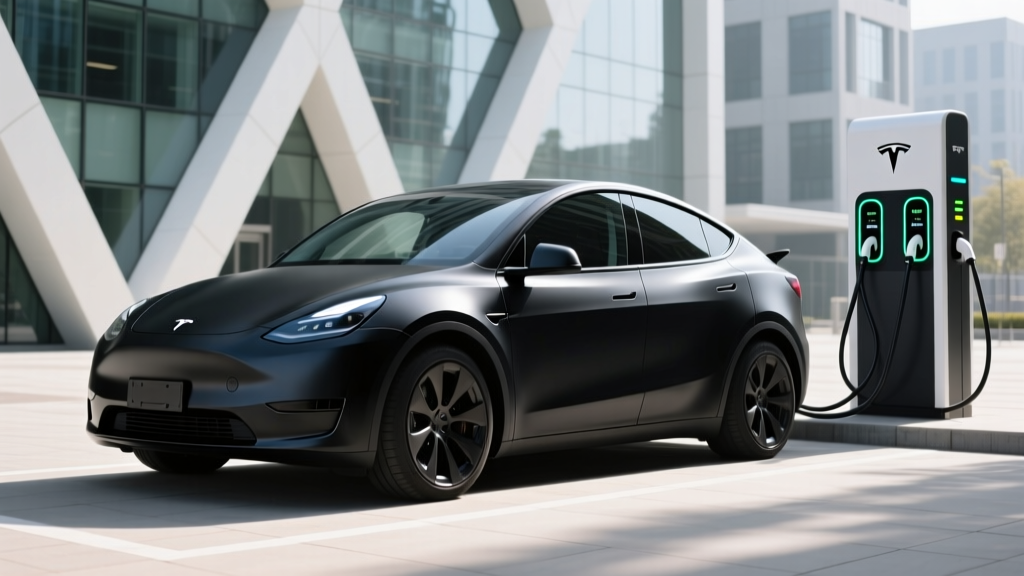
Charging speed is where Tesla ownership still pays dividends. The 2026 Model Y supports a peak 250 kW on V3/V4 Superchargers, and — critically — the charge curve is well-managed. You'll hold above 200 kW through roughly 40% SoC before tapering. A 10–80% session takes approximately 24 minutes at a V3 stall. Above 80%, charging slows sharply to protect the battery, adding the final 20% in another 20+ minutes (plan accordingly on road trips: leave at 80% unless you truly need the electrons).
| Charging Level | Power | Miles Added Per Hour | Typical Use Case |
|---|---|---|---|
| Level 1 (120V) | ~1.4 kW | ~5 mi/hr | Emergency/top-up only |
| Level 2 (240V, 48A) | 11.5 kW | ~44 mi/hr | Home overnight charging |
| DC Fast (V3 Supercharger) | Peak 250 kW | ~1,000 mi/hr (peak) | Road trips, 10–80% in ~24 min |
| DC Fast (CCS adapter) | Up to ~150 kW | Varies | Non-Tesla networks (Electrify America, EVgo) |
At home, the Model Y's onboard charger accepts up to 11.5 kW on a 240V/48A circuit (Hardwired Tesla Wall Connector). This adds roughly 44 miles of range per hour, meaning a full overnight session (8 hours) easily replenishes 300+ miles. If your home has a standard NEMA 14-50 outlet (240V/40A), expect ~30 mi/hr — still sufficient for daily commuting. Note: Tesla now ships vehicles with the NACS (North American Charging Standard) port natively, and the broader Supercharger network is opening to other brands, but Tesla owners retain the simplest plug-and-charge experience.
Performance & Driving Dynamics
The Long Range AWD model delivers 384 horsepower and a 4.8-second 0–60 mph time — brisk enough for confident highway merging and passing. The Performance trim bumps output to 510 hp and drops 0–60 to 3.5 seconds, which is genuinely sports-car quick in a family crossover.
Ride quality in the Juniper refresh is noticeably improved over pre-2025 models, with revised damping that soaks up highway expansion joints more gracefully. Steering remains precise but heavy — this is a car tuned for efficiency and composure, not playful corner-carving. Regenerative braking offers strong one-pedal driving in "Standard" mode, though Tesla removed the low-regen option in recent years, which some passengers find abrupt.
Towing capacity is rated at 3,500 pounds — sufficient for a small utility trailer or a pair of dirt bikes, but not a boat or camper. If heavy towing is part of your transport needs, look at the Rivian R1S or Ford F-150 Lightning instead.
Interior, Cargo, and Tech: Built for Family Transport
The 2026 Model Y's cabin is minimalist in the extreme — a single 15.4-inch center touchscreen handles climate, navigation, media, and vehicle settings. The Juniper refresh adds ambient lighting, ventilated front seats, and a rear-seat touchscreen for passengers, addressing longstanding complaints about rear-seat comfort. Build quality has also improved: panel gaps are tighter, and materials feel a tier above the 2022–2024 cars.
Cargo volume stands at 30.2 cubic feet behind the second row and 72.1 cu ft with the 60/40 split rear seats folded — competitive with a Toyota RAV4 and significantly more usable than the Model 3's trunk. The front trunk (frunk) adds another ~4.1 cu ft for charging cables or a gym bag. Rear legroom measures 41.6 inches, enough for two adults on longer trips, though the sloping roofline cuts into headroom for taller passengers.
On the tech front, Tesla's infotainment remains the segment benchmark: fast, responsive, with built-in trip planning that automatically routes through Superchargers and preconditions the battery for optimal charge speed. Over-the-air updates continue to add features post-purchase.
Driver Assistance: Autopilot and FSD Supervised
Standard Autopilot includes Traffic-Aware Cruise Control and Autosteer (lane centering) on highways. The optional FSD (Supervised) package ($8,000 or $99/month subscription in 2026) adds automatic lane changes, intersection handling, and navigation-guided driving. In practice, FSD handles 85–90% of highway miles competently, but urban and construction-zone scenarios still require frequent takeovers. For family transport, standard Autopilot is the better value — FSD remains a beta product best suited for enthusiasts willing to supervise closely.
Pricing, Tax Credits, and Ownership Cost
| Trim | Base MSRP | Est. As-Tested* | §30D Credit Eligibility |
|---|---|---|---|
| Long Range AWD | $44,990 | $46,500–$50,000 | Eligible for up to $7,500 (subject to sourcing + income rules) |
| Performance | $51,490 | $53,000–$57,000 | Eligible for up to $7,500 (subject to sourcing + income rules) |
*As-tested prices reflect typical options (FSD, paint, wheels). Destination fee included in MSRP.
The 2026 Model Y qualifies for the federal §30D EV tax credit — up to $7,500 — but eligibility is not automatic. Per IRS rules, the following apply:
- MSRP Cap: SUVs/crossovers must have an MSRP at or below $80,000 (Model Y qualifies).
- Buyer Income Cap: Modified AGI must not exceed $150,000 (single), $225,000 (head of household), or $300,000 (joint filers).
- Battery Sourcing: A percentage of critical minerals and battery components must be sourced from the U.S. or FTA-partner countries. The $7,500 credit splits into two halves ($3,750 + $3,750), and partial credit may apply depending on current sourcing compliance.
- Point-of-Sale Transfer: As of 2024+, eligible buyers can transfer the credit to the dealer at purchase, reducing the out-of-pocket price immediately rather than waiting for tax filing.
- FEOC Restriction: Vehicles with battery components from a "foreign entity of concern" (certain Chinese suppliers) may be disqualified. Verify current eligibility at fueleconomy.gov before purchasing.
Consult a tax professional for your specific situation — credit rules have tightened incrementally each year, and battery-sourcing compliance can shift model year to model year.
Pros, Cons, and Who Should Buy
Pros
- Class-leading Supercharger network access — still the most reliable DC fast-charging experience
- Excellent efficiency (28 kWh/100 mi) translates to low per-mile fuel cost
- Spacious cargo area (72.1 cu ft) suitable for family transport and gear
- Strong real-world range buffer (~270 mi highway)
- Best-in-class infotainment and OTA update ecosystem
- Improved ride quality and build in Juniper refresh
Cons
- Minimalist interior frustrates buyers who prefer physical buttons and traditional gauges
- FSD (Supervised) remains a Level 2 system requiring constant attention — expensive for what it delivers
- 250 kW peak charge rate now trails Hyundai/Kia's 350 kW E-GMP architecture (Ioniq 5, EV6)
- Service center wait times in high-population areas remain a common complaint
- No Apple CarPlay or Android Auto — Tesla's ecosystem is closed
Consider competitors if: You need faster peak charging (Hyundai Ioniq 5), want Apple CarPlay (nearly every other brand), prefer a more traditional interior layout (Ford Mach-E, VW ID.4), or need 3-row seating (Kia EV9).
As a daily Tesla transport for a family of four, the Model Y Long Range AWD is the sweet-spot trim. The Performance model's 3.5-second 0–60 time is thrilling but costs $6,500 more and sacrifices 25 miles of EPA range — a trade-off that rarely pays off for family duty.
Warranty and Long-Term Ownership
Tesla covers the Model Y's battery and drive units for 8 years or 120,000 miles (whichever comes first), with a guaranteed minimum 70% capacity retention over that period. The limited vehicle warranty is 4 years / 50,000 miles. In practice, Tesla's NMC packs have shown degradation curves that plateau around 8–10% loss after 100,000 miles, based on fleet data aggregated by independent EV analysts. Replacement battery costs, should you need one out of warranty, run approximately $12,000–$16,000 including labor — a figure worth factoring into 10+ year ownership plans.
Frequently Asked Questions
What is the real-world range of the 2026 Tesla Model Y?
Expect approximately 270–290 miles on the highway at 70–75 mph in moderate temperatures. In cold weather (below freezing), plan on 240–260 miles. City driving with regenerative braking can match or slightly exceed the 320-mile EPA estimate.
How fast does the Model Y charge at home and on the road?
On a Level 2 home charger (240V/48A), the Model Y adds about 44 miles of range per hour — a full overnight charge covers most weekly driving. On a V3 Supercharger, it peaks at 250 kW and charges from 10–80% in roughly 24 minutes.
Does the 2026 Model Y qualify for the $7,500 federal EV tax credit?
It can, but eligibility depends on your income (AGI caps apply), the vehicle's battery-sourcing compliance, and the MSRP cap (under $80,000 for SUVs — the Model Y qualifies). The credit can be transferred at point of sale. Always verify current eligibility on fueleconomy.gov and consult a tax professional.
Is the Model Y worth buying over the Ford Mach-E or Hyundai Ioniq 5?
If Supercharger access and cargo space are priorities, yes — Tesla's charging network remains the most reliable. If you want faster DC charging, Apple CarPlay, or a more traditional interior, the Ioniq 5 and Mach-E are strong alternatives. Cross-shop all three before deciding.
Is Tesla's Full Self-Driving actually self-driving?
No. FSD (Supervised) is an SAE Level 2 driver-assistance system that requires your full attention and readiness to take over at any moment. It handles many highway scenarios well but is not autonomous. Only Level 4 robotaxi services (Waymo, Zoox) operate without a human driver, and those are geofenced to specific cities.
How much cargo can the Model Y carry for family transport?
30.2 cubic feet behind the second row and 72.1 cu ft with rear seats folded — comparable to a Toyota RAV4. The frunk adds 4.1 cu ft. It comfortably fits two strollers, a week's groceries, or luggage for a family of four on a road trip.