The 2026 Tesla Model Y: Separating the Car from the Ticker Symbol
If you follow financial news, you've likely encountered the phrase "tesla meme stock" in headlines, Reddit threads, and YouTube thumbnails. The narrative often swings between "unstoppable EV juggernaut" and "overvalued tech darling." But for buyers actually shopping for an electric SUV, the stock price is irrelevant. What matters is whether the 2026 Tesla Model Y delivers as a daily driver, a road-trip companion, and a long-term ownership proposition.
This review strips away the Wall Street noise and evaluates the 2026 Model Y on the metrics that matter to EV buyers: real-world range, charging speed, interior practicality, total cost, and how it stacks up against rivals like the Hyundai Ioniq 5, Ford Mustang Mach-E, and Kia EV6.
Range, Efficiency, and Real-World Expectations
The 2026 Tesla Model Y Long Range AWD carries an EPA-estimated range of 320 miles from its 78.1 kWh usable battery pack (NMC chemistry). The Performance trim drops slightly to 293 miles due to larger 21-inch wheels and stickier tires.
EPA Estimate: 320 miles (Long Range AWD)
Real-World Highway (70-75 mph, moderate climate): ~265–285 miles
Real-World Cold Weather (below 32°F, highway): ~220–245 miles
City/Commuter Driving (regen-heavy): ~290–310 miles
Bottom line: Plan road trips around 250-mile legs for comfort. Preconditioning the battery via navigation routing to a Supercharger helps mitigate cold-weather losses.
Efficiency is a Tesla strong suit. The Long Range AWD achieves 122 MPGe combined (28 kWh/100 miles) per the EPA, which translates to roughly $0.04–$0.06 per mile on residential electricity at $0.14/kWh. That's among the most efficient vehicles in the midsize electric SUV class, edging out the Ioniq 5 AWD (110 MPGe) and Mach-E Extended Range AWD (101 MPGe).
Charging Speed: Supercharger Network Advantage
Tesla's charging ecosystem remains a primary differentiator, though the gap is narrowing as competitors gain access to the North American Charging Standard (NACS) and networks like Electrify America expand.
| Charging Level | Power / Rate | Time / Miles Added |
|---|---|---|
| Level 1 (120V household) | ~1.4 kW | ~3–4 miles per hour |
| Level 2 (240V, 48A Wall Connector) | 11.5 kW | ~44 miles per hour; full charge in ~8 hrs |
| DC Fast Charge (V3 Supercharger) | Peak 250 kW | 10–80% in ~27 minutes |
| DC Fast Charge (V4 Supercharger) | Peak 250+ kW | 10–80% in ~25 minutes (varies by stall) |
The Model Y's charge curve is well-managed. It sustains above 200 kW from roughly 10% to 35% SoC, then tapers progressively. By 60%, you're typically seeing 120–140 kW; above 80%, it drops below 50 kW. Tesla's navigation-based battery preconditioning is essential — arriving at a Supercharger without preconditioning can add 10+ minutes to your session, especially in cold weather.
For home charging, the Tesla Wall Connector ($475) on a 60-amp circuit delivers 48 amps / 11.5 kW, sufficient to replenish a full day's driving overnight. Most owners will need a 200-amp electrical panel; budget $800–$2,000 for professional installation depending on panel proximity and local permit requirements.
Performance and Drivetrain
| Spec | Long Range AWD | Performance AWD |
|---|---|---|
| 0–60 mph | 4.8 seconds | 3.5 seconds |
| Horsepower | ~384 hp (combined) | ~456 hp (combined) |
| Drivetrain | Dual-motor AWD | Dual-motor AWD |
| Top Speed | 135 mph | 155 mph |
| Towing Capacity | 3,500 lbs | 3,500 lbs |
Both trims use Tesla's dual-motor setup with an induction front motor and permanent-magnet rear motor. The Performance trim adds larger brakes, a lowered sport suspension, and 21-inch Überturbine wheels. Acceleration is immediate and linear in both — the Long Range's 4.8-second sprint is more than adequate for highway merging and passing.
Regenerative braking is aggressive and effectively enables one-pedal driving in most conditions. Tesla removed the user-adjustable regen setting in recent model years, so the behavior is fixed.
Interior, Cargo, and Practicality
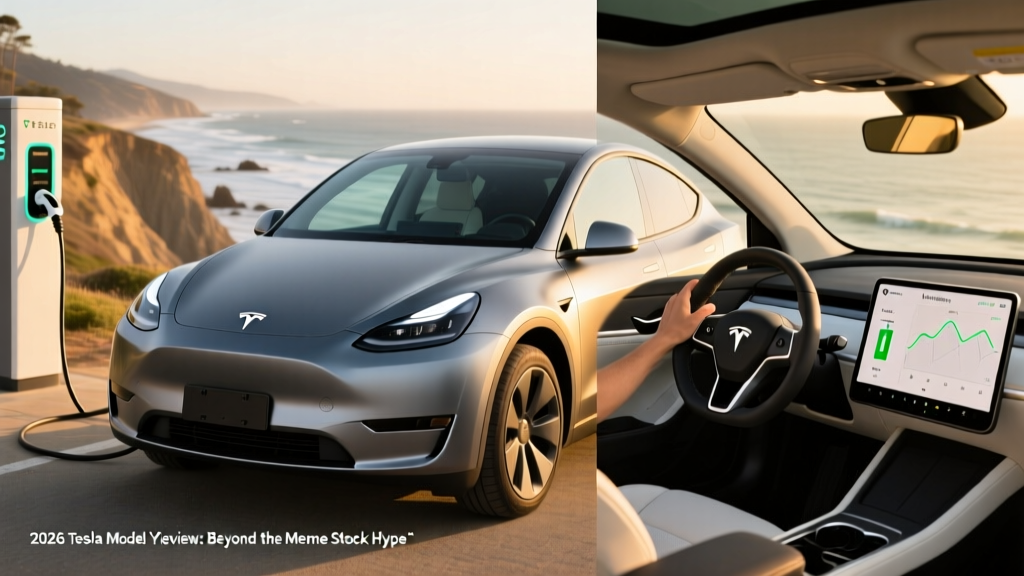
The 2026 Model Y's minimalist interior centers on a 15.4-inch touchscreen that handles nearly all vehicle functions — climate, mirrors, glovebox, and speedometer. There is no instrument cluster or head-up display. Love it or not, the interface is responsive and logically organized, though the lack of physical buttons for wipers and turn signals (now on the steering wheel as haptic-touch pads) draws consistent criticism.
Interior dimensions:
- Front headroom: 41.0 inches
- Rear legroom: 41.6 inches (generous for the class)
- Cargo behind rear seats: 30.2 cu ft
- Cargo with rear seats folded: 72.1 cu ft
- Front trunk (frunk): 4.1 cu ft
The Model Y offers class-leading cargo volume, outpacing the Ioniq 5 (27.2 cu ft rear / 59.3 cu ft folded) and rivaling the larger Ford Mustang Mach-E (29.7 / 59.7 cu ft). An optional third row is available, though it's best suited for children — adults will find it cramped.
Pricing, Tax Credits, and Ownership Cost
| Trim | Base MSRP | Est. Federal Credit (§30D) | Effective Price |
|---|---|---|---|
| Long Range AWD | $44,990 | Up to $7,500* | ~$37,490* |
| Performance AWD | $48,990 | Up to $7,500* | ~$41,490* |
*Federal §30D tax credit eligibility depends on buyer income (AGI caps: $150K single / $300K joint), vehicle MSRP (must be under $80,000 for SUVs), and battery component/critical mineral sourcing requirements that tighten annually. As of 2026, Tesla's battery sourcing compliance has qualified for the full $7,500, but this is subject to change. The credit can be transferred at point of sale as a purchase-price reduction per IRS rules. Consult a tax professional for your specific eligibility.
Beyond the purchase price, Model Y ownership benefits from:
- Insurance: Average $1,800–$2,400/year (varies significantly by state and driving record)
- Maintenance: Minimal — no oil changes, cabin air filter replacement every 2 years (~$150), tire rotation every 6,250 miles
- Electricity cost: ~$540–$720/year at 12,000 miles and $0.14/kWh home charging
- Depreciation: Model Y has held value well historically, though Tesla's frequent price adjustments can affect resale
Tech, Driver Assistance, and Safety
Every Model Y comes standard with Tesla's Basic Autopilot (SAE Level 2), which includes adaptive cruise control and lane-centering on highways. The optional Full Self-Driving (Supervised) package ($8,000 one-time or $99/month) adds automatic lane changes, traffic-light recognition, and city-street navigation — but requires continuous driver supervision at all times.
Tesla Autopilot and FSD (Supervised) are SAE Level 2 systems. The driver must keep hands on the wheel (or provide torque input), eyes on the road, and remain prepared to take over instantly. These systems do not make the vehicle autonomous. Only Level 4 services like Waymo operate without a human driver.
The infotainment system is robust: built-in navigation, streaming (Netflix, YouTube, Spotify while parked), a dashcam viewer, Sentry Mode surveillance, and over-the-air updates that periodically add features. There is no Apple CarPlay or Android Auto — a dealbreaker for some buyers accustomed to phone mirroring.
Safety ratings are strong. The Model Y earned a 5-star overall rating from NHTSA and Top Safety Pick+ recognition from IIHS in prior model years (2026 ratings pending at publication).
Warranty and Long-Term Reliability
- Basic vehicle warranty: 4 years / 50,000 miles
- Battery & drive unit: 8 years / 120,000 miles (Long Range & Performance)
- Battery degradation guarantee: Tesla warrants minimum 70% capacity retention over the warranty period
The NMC battery in the Long Range and Performance trims has shown typical degradation of 8–12% over the first 50,000 miles based on fleet data, after which the curve flattens. Tesla recommends daily charging to 80–90% for NMC chemistry and reserving 100% charges for road trips. (Note: Tesla's Standard Range RWD variant, when available, uses LFP chemistry, which can be charged to 100% daily without degradation concern — but offers less range.)
Pros, Cons, and Who Should Buy
- Best-in-class Supercharger network (17,000+ stalls in North America)
- Leading efficiency (122 MPGe) keeps charging costs low
- Spacious cargo area (72.1 cu ft) and generous rear legroom
- Rapid OTA updates continuously improve the vehicle
- Strong acceleration and low center of gravity
- No Apple CarPlay / Android Auto
- Minimalist interior feels sparse at this price point
- Touchscreen-only controls frustrate some drivers
- FSD package is expensive and still requires full supervision
- Ride quality can be firm, especially on Performance 21" wheels
Best for: Tech-forward commuters and small families who value charging infrastructure, efficiency, and cargo space. The Model Y excels as a daily driver with frequent road-trip capability thanks to the Supercharger network.
Consider alternatives if: You want a more traditional interior with physical controls, prefer Apple CarPlay, need a softer ride, or want a more distinctive design (the Ioniq 5 and EV6 stand out visually).
Frequently Asked Questions
What is the real-world range of the 2026 Tesla Model Y?
The EPA rates the Long Range AWD at 320 miles, but expect 265–285 miles on highway road trips at 70–75 mph and as low as 220–245 miles in freezing temperatures. City driving with regenerative braking gets closer to the EPA figure.
How fast does the Model Y charge at home and on the road?
On a Tesla V3 Supercharger (250 kW peak), the Model Y charges from 10–80% in approximately 27 minutes. At home on a 240V / 48A Wall Connector (11.5 kW), it adds about 44 miles per hour, fully recharging overnight.
Does the 2026 Model Y qualify for the federal EV tax credit?
As of early 2026, the Model Y qualifies for the full $7,500 §30D credit when purchased by eligible buyers (income under $150K single / $300K joint). The credit can be applied at point of sale. Battery sourcing requirements are subject to annual updates — verify current eligibility at fueleconomy.gov.
Is the Model Y worth buying vs. the Hyundai Ioniq 5 or Ford Mach-E?
The Model Y wins on charging infrastructure, efficiency, and cargo space. The Ioniq 5 offers 800V ultra-fast charging (10–80% in ~18 minutes on 350 kW chargers), a more distinctive design, and CarPlay. The Mach-E provides a more traditional interior layout and competitive pricing. Test-drive all three before deciding.
What are the biggest drawbacks of the 2026 Model Y?
The touchscreen-centric interface, lack of Apple CarPlay/Android Auto, firm ride on larger wheels, and the $8,000 FSD package (which still requires full driver attention) are the most common owner complaints. Build quality has improved but still shows occasional panel-gap inconsistency.