The 2026 Tesla Model Y Juniper: Does It Hold Value in a Crowded EV Market?
The Tesla Model Y has been the best-selling EV in America for years, but a wave of competitors — the Hyundai Ioniq 5, Ford Mustang Mach-E, Chevrolet Equinox EV, and refreshed Rivian R2 — have narrowed the gap significantly. For 2026, the Model Y arrives with the "Juniper" refresh: a restyled exterior, ventilated seats, an ambient lighting strip, a rear touchscreen, and a slightly revised battery pack. But the question buyers ask most isn't about the new light bar — it's about the resale value of Tesla vehicles in an era of aggressive price cuts and rapidly improving competition.
This review covers the 2026 Model Y Long Range AWD and Performance trims with exact specs, real-world range expectations, charging performance, and a hard look at what Tesla's resale trajectory means for your wallet over a 3-to-5-year ownership cycle.
2026 Tesla Model Y: Full Spec Sheet
| Specification | Long Range AWD | Performance |
|---|---|---|
| EPA Range | 320 miles | 295 miles |
| Battery (usable) | ~78 kWh, NMC | ~78 kWh, NMC |
| Drivetrain | Dual-Motor AWD | Dual-Motor AWD |
| Horsepower | 384 hp | 456 hp |
| 0–60 mph | 4.8 seconds | 3.5 seconds |
| MPGe (combined) | 122 MPGe | 111 MPGe |
| Efficiency | 28 kWh/100 mi | 30 kWh/100 mi |
| Max DC Fast Charge | 250 kW (peak) | 250 kW (peak) |
| 10–80% DC Charge | ~25 minutes | ~25 minutes |
| Level 2 Home Charge | 11.5 kW (~44 mi/hr) | 11.5 kW (~44 mi/hr) |
| Cargo Volume | 30.2 cu ft (rear up) / 72.1 cu ft (folded) | 30.2 cu ft / 72.1 cu ft |
| Frunk | 4.1 cu ft | 4.1 cu ft |
| Rear Legroom | 41.6 inches | 41.6 inches |
| Battery Warranty | 8 yr / 120,000 mi | 8 yr / 120,000 mi |
| Base MSRP | $44,990 | $51,490 |
Source: EPA Fuel Economy, Tesla.com official specifications.
Charging Performance: What the Curve Actually Looks Like
Tesla's 250 kW peak DC fast-charging figure is impressive on paper, but sustained charging rate is what matters on a road trip. The Model Y Long Range uses NMC (nickel manganese cobalt) chemistry, which supports aggressive charging at low states of charge but tapers substantially above 50%.
| Charging Method | Power | Speed | Notes |
|---|---|---|---|
| Level 1 (120V outlet) | ~1.4 kW | ~5 miles/hour | Emergency/trickle only |
| Level 2 (240V, 48A) | 11.5 kW | ~44 miles/hour | Full charge in ~8 hours |
| DC Fast (Tesla Supercharger V3) | 250 kW peak | 10–80% in ~25 min | Sustains ~150 kW avg from 10–60% |
| DC Fast (Supercharger V4) | Up to 325 kW* | 10–80% in ~20 min | *Requires V4-capable stall; 2026 Model Y can accept higher peak |
A critical ownership note: the 2026 Model Y comes equipped with the NACS (North American Charging Standard) connector natively. With Ford, GM, Rivian, and most major automakers having adopted NACS for 2025–2026, Tesla Supercharger stalls are increasingly shared. Expect longer queues at popular corridors during peak travel weekends — a factor that didn't exist three years ago and one that modestly impacts the convenience advantage that historically supported Tesla's resale value.
For home charging, a Tesla Wall Connector on a 60-amp circuit delivers the full 11.5 kW (48 amps continuous). Budget approximately $500–$1,200 for professional installation depending on panel proximity, assuming your electrical panel has capacity. A 200-amp panel upgrade, if needed, adds $1,500–$3,000.
Pricing, Tax Credits, and the Resale Value Question
| Trim | Base MSRP | Est. As-Tested* | §30D Federal Credit | Effective Price |
|---|---|---|---|---|
| Long Range AWD | $44,990 | $47,490 | Up to $7,500 | ~$39,990 |
| Performance | $51,490 | $54,990 | Up to $7,500 | ~$47,490 |
*As-tested includes typical destination fee and common options (FSD capability, paint). Actual credit eligibility varies.
The resale value of Tesla vehicles has been a moving target since 2023, when the company began aggressive price cuts on new vehicles. Those cuts immediately depressed used Tesla values — owners who paid $65,000 for a 2022 Model Y watched comparable new units drop below $45,000. According to Kelley Blue Book and iSeeCars data, 3-year retention for the Model Y fell from a pandemic-era peak of ~75% to roughly 55–60% by late 2025, depending on mileage and condition.
For 2026, the Juniper refresh stabilizes pricing somewhat, but several structural headwinds remain:
- Competition: The Hyundai Ioniq 5 (318-mile range, 800V charging), the Chevrolet Equinox EV (315-mile range, starting under $35,000), and the Rivian R2 (expected mid-2026) all compress Tesla's pricing power.
- Used EV credit: The §25E used EV tax credit (up to $4,000 on vehicles under $25,000) makes 2-to-3-year-old Teslas more attractive to budget buyers, paradoxically supporting demand for used units while keeping prices accessible.
- Brand sentiment: CEO association and political polarization have measurably affected Tesla purchase intent in certain demographics, per multiple 2025 consumer surveys.
- Service infrastructure: Tesla's mobile ranger and service-center network remains less dense than legacy dealer networks in rural areas, which can suppress resale in non-metro markets.
That said, the Model Y still benefits from the strongest charging network in North America, strong software support, and broad name recognition. A 2026 Model Y purchased at ~$40,000 after credit could reasonably retain $22,000–$26,000 at the 5-year mark (approximately 55–65% retention from the credit-adjusted price), assuming 12,000 miles/year and no major battery issues.
Federal Tax Credit Eligibility (§30D)
The 2026 Model Y Long Range AWD qualifies for up to $7,500 under the IRS §30D Clean Vehicle Credit, available as a point-of-sale transfer to the dealer. However, eligibility depends on several conditions that change annually:
- MSRP cap: SUVs must be under $80,000 (Model Y qualifies at all trims).
- Buyer income cap: Modified AGI must not exceed $150,000 (single), $225,000 (head of household), or $300,000 (joint).
- Battery sourcing: Critical minerals and battery component requirements phase in more strictly each year. Tesla's shift toward LFP packs from CATL for Standard Range models has complicated credit eligibility for those trims; the Long Range AWD with NMC chemistry sourced from Panasonic's Nevada and Kansas gigafactories has consistently qualified.
- Transfer option: You can transfer the credit to the dealer at purchase for an immediate price reduction, regardless of tax liability.
Verify current eligibility at IRS.gov §30D before purchasing. Rules are subject to legislative change.
Tech, Interior, and Driver Assistance
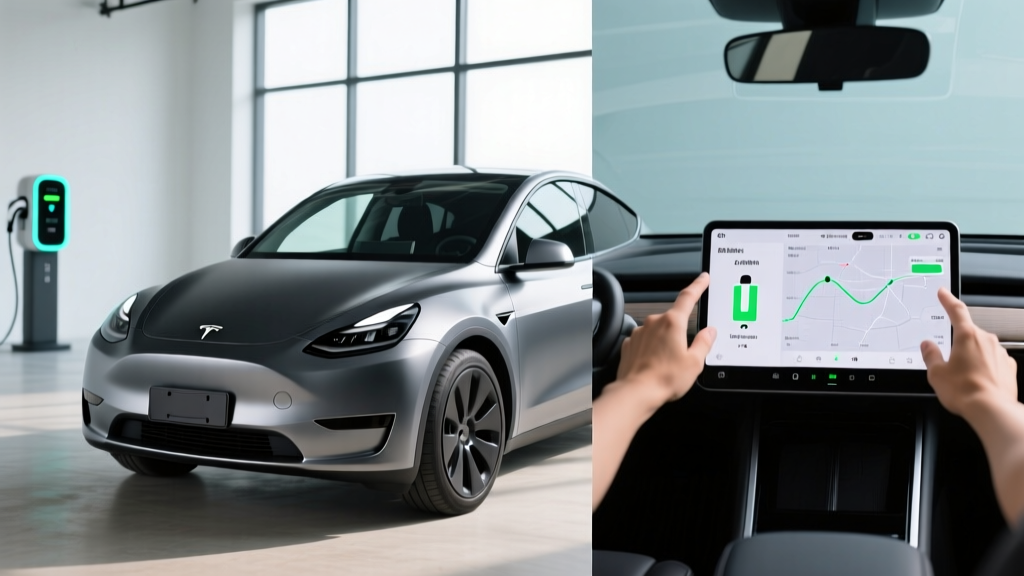
The Juniper interior is a meaningful step up from the 2020–2024 Model Y. The 15.4-inch center touchscreen remains, but Tesla has added:
- Ventilated front seats (finally)
- Ambient lighting strip across the dashboard
- An 8-inch rear touchscreen for passengers
- Power-folding second-row seats
- Improved sound insulation (noticeably quieter at highway speed)
- Turn-signal stalks returned (a welcome reversal from the 2025 button-only controversy)
On the driver-assistance front, the Model Y ships with Basic Autopilot (adaptive cruise + lane centering). Full Self-Driving (Supervised) remains an $8,000 option or $99/month subscription.
FSD (Supervised) has improved substantially in 2025–2026 with the end-to-end neural network architecture, handling urban intersections and unprotected left turns with fewer interventions. However, it still struggles with construction zones, faded lane markings, and adverse weather. Insurance data from the IIHS and HLDI continues to show that Level 2 systems reduce certain crash types but do not eliminate driver responsibility.
Pros and Cons: Honest Ownership Assessment
Pros
- Access to 6,000+ Tesla Supercharger stalls across North America — still the most reliable DC network
- Strong efficiency (122 MPGe combined) reduces per-mile electricity cost
- Over-the-air updates continue adding features years after purchase
- Spacious cargo area (72.1 cu ft with seats folded) rivals midsize SUVs
- Juniper interior upgrades address longstanding comfort complaints
- Strong performance: 4.8-second 0–60 in Long Range is sports-sedan quick
Cons
- Resale value has eroded significantly since 2022 peak due to price cuts and competition
- No Apple CarPlay or Android Auto — Tesla's ecosystem is closed
- FSD (Supervised) costs $8,000 and remains Level 2, not autonomous
- Panel gaps and paint quality, while improved, still trail Hyundai/Kia fit and finish
- Ride quality is firm; road imperfections transmit more than in the Ioniq 5 or Mach-E
- Supercharger stalls increasingly crowded as NACS adoption spreads
Who Should Buy the 2026 Model Y?
The 2026 Tesla Model Y Long Range AWD makes the most sense for:
- Home-charging commuters who drive 30–60 miles daily and want minimal public-charging dependency. At 11.5 kW Level 2, a full overnight charge covers days of commuting.
- Families needing cargo space — 72.1 cu ft with seats folded handles strollers, groceries, and camping gear. The frunk adds secure, separated storage.
- Road-trip enthusiasts who value Supercharger route planning integrated into the navigation. The 25-minute 10–80% charge keeps stops short.
It's a weaker fit for:
- Buyers prioritizing resale value certainty — the EV market is still volatile, and Tesla's pricing history makes depreciation harder to predict than a Toyota RAV4 Hybrid.
- Apple CarPlay loyalists — Tesla's infotainment is capable but closed. If you live in Apple Maps and Spotify on your phone, the lack of phone projection is a daily friction.
- Those in extreme cold climates — while the heat pump helps, NMC range loss in sub-zero temps is real. Consider a garage and preconditioning discipline.
Choose the Hyundai Ioniq 5 instead if: You want 800V ultra-fast charging (10–80% in ~18 min at 350 kW), Apple CarPlay, and potentially more stable resale from a legacy automaker with a dealer network.
Choose the Chevrolet Equinox EV if: Budget is the priority — starting under $35,000 with 315 miles of range and full §30D eligibility makes it the value leader in the compact EV SUV segment.
Frequently Asked Questions
What is the real-world range of the 2026 Tesla Model Y?
The EPA rates the Long Range AWD at 320 miles. In real-world mixed driving, expect 275–295 miles. Highway-only driving at 75+ mph reduces this to roughly 260–280 miles. Cold weather (below freezing) can drop range to 225–255 miles depending on cabin heating and whether you precondition the battery.
How fast does the Model Y charge at home and on the road?
On a Level 2 home charger (11.5 kW), the Model Y adds approximately 44 miles of range per hour, fully charging in about 8 hours. On a Tesla V3 Supercharger (250 kW peak), it charges from 10–80% in roughly 25 minutes. The sustained average from 10–60% is approximately 150 kW before the charging curve tapers significantly.
How much does the 2026 Model Y cost after the federal tax credit?
The Long Range AWD starts at $44,990 and can qualify for up to $7,500 under §30D, bringing the effective price to approximately $37,490 before destination and options. The Performance trim starts at $51,490, dropping to ~$43,990 after credit. Eligibility depends on buyer income (AGI caps), battery sourcing requirements, and MSRP limits. Verify at IRS.gov before purchasing.
Is the Tesla Model Y still worth buying vs. competitors in 2026?
It depends on your priorities. The Model Y's advantages are the Supercharger network, integrated software, and efficiency. Its disadvantages relative to the Ioniq 5, Mach-E, and Equinox EV include eroding resale value, no CarPlay, and increasingly crowded Superchargers. If charging convenience and software are your top criteria, the Model Y remains strong. If resale stability or interior luxury matter more, competitors have closed the gap.
What is the resale value of a Tesla Model Y after 3 and 5 years?
Based on 2025–2026 market data, a Model Y retains approximately 60–65% of its credit-adjusted purchase price after 3 years and 50–60% after 5 years, assuming average mileage (12,000 mi/year) and good condition. This is down from the 2021–2022 peak when used Model Ys sometimes sold above their original MSRP due to supply constraints. The current trajectory reflects normalized EV market conditions and increased competition.
Does the 2026 Model Y qualify for the federal EV tax credit?
Yes, the Long Range AWD with NMC battery sourced from Panasonic's US facilities qualifies for up to $7,500 under §30D as of early 2026, subject to buyer income caps ($150K single / $300K joint) and the $80,000 SUV MSRP cap. The credit can be transferred to the dealer at point of sale for an immediate price reduction. Standard Range models with LFP batteries from CATL may face sourcing-related credit limitations — check the IRS eligible vehicle list before ordering.
Final Verdict
The 2026 Tesla Model Y Juniper is a more refined, more comfortable vehicle than its predecessor, and it remains one of the most efficient and capable compact EV SUVs available. The Supercharger ecosystem, while no longer exclusive, is still the most reliable fast-charging network in North America. For buyers who can charge at home and who plan to hold the vehicle for four or more years, the Model Y Long Range AWD at ~$37,500 after credit is a compelling package.
However, the resale value of Tesla vehicles is no longer the guaranteed win it was in 2022. Price cuts, increased competition, and shifting brand perception have brought Tesla depreciation more in line with the broader EV market. Buyers who trade vehicles every 2–3 years should factor in a 35–45% depreciation hit and compare total cost of ownership against the Hyundai Ioniq 5 and Chevrolet Equinox EV before signing.