Quick Verdict: The 2026 Tesla Model Y at a Glance
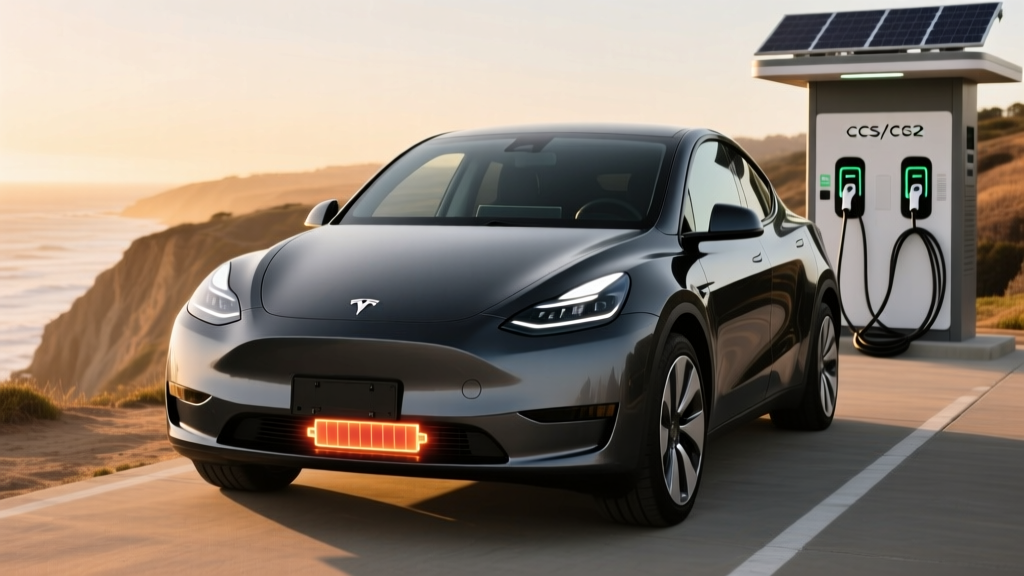
The 2026 Tesla Model Y remains the default compact electric SUV for buyers who want a proven charging ecosystem, strong efficiency, and Tesla's Vision Platform (VP) driver-assist suite. With a refreshed Juniper design, LFP battery option on the base trim, and access to the 20,000-plus Supercharger network, it's a rational pick for commuters and families. But the starting price has climbed, competitors have closed the range gap, and the VP system still requires full driver attention. Here's exactly what you get for the money.
| Spec | Long Range RWD | Long Range AWD | Performance |
|---|---|---|---|
| EPA Range | 320 mi | 308 mi | 285 mi |
| Battery (usable) | 75 kWh (LFP) | 75 kWh (NMC) | 75 kWh (NMC) |
| Peak DC Charge | 250 kW | 250 kW | 250 kW |
| 10–80% DC Time | ~27 min | ~25 min | ~25 min |
| 0–60 mph | 6.5 sec | 4.8 sec | 3.5 sec |
| Horsepower | 346 hp | 384 hp | 456 hp |
| MPGe (combined) | 123 MPGe | 117 MPGe | 111 MPGe |
| Base MSRP | $44,990 | $48,990 | $53,990 |
Range and Efficiency: EPA Numbers vs. Real-World Driving
The 2026 Model Y Long Range RWD posts an EPA-estimated 320 miles of range, with the dual-motor AWD at 308 miles and the Performance variant at 285 miles. Efficiency on the Long Range RWD comes in at 123 MPGe combined, which translates to roughly 27 kWh per 100 miles — among the best in the compact EV SUV class, per fueleconomy.gov.
EPA 320 mi (Long Range RWD). In practice, plan for:
- City/suburban driving (mild weather): 300–320 mi — regen braking and lower speeds help you match or approach the sticker.
- Highway at 70–75 mph: ~260–280 mi. Aerodynamic drag cuts range roughly 12–18% at sustained interstate speeds.
- Cold weather (below 30°F): ~220–260 mi. LFP chemistry in the RWD trim is slightly more sensitive to cold than NMC. Preconditioning while plugged in recovers 10–15% of that loss.
- Towing (up to 3,500 lb): ~160–190 mi. Trailer drag and weight crush efficiency to roughly 50–55% of EPA.
The LFP (lithium iron phosphate) battery in the RWD trim offers longer cycle life and tolerates regular 100% charging — Tesla actually recommends periodic full charges for LFP cells to maintain accurate state-of-charge calibration. The NMC packs in AWD and Performance trims deliver higher energy density but perform best when daily-charged to 80–90%.
Charging: Supercharger Speeds and Home Setup
All 2026 Model Y trims peak at 250 kW on DC fast charging via Tesla's NACS connector, native to the Supercharger network. The Long Range AWD and Performance trims can add up to ~175 miles in 15 minutes under ideal conditions. However, peak kW is not sustained kW — the charge curve tapers significantly above 60% SoC to protect the battery, which is why a 10–80% session takes 25–27 minutes rather than the ~15 minutes peak-rate math might suggest.
| Charging Level | Power (kW) | Speed (mi/hr added) | Typical Use Case |
|---|---|---|---|
| Level 1 (120V household) | ~1.4 kW | ~4 mi/hr | Overnight trickle, emergencies |
| Level 2 (240V Wall Connector, 48A) | 11.5 kW | ~37 mi/hr | Daily home charging |
| Level 2 (240V, 32A Mobile Connector) | 7.7 kW | ~25 mi/hr | Dryer outlet / NEMA 14-50 |
| DC Fast (Supercharger V3/V4) | Up to 250 kW | Up to ~1,000 mi/hr (peak) | Road trips, rapid top-ups |
At home, the Tesla Wall Connector on a 60-amp circuit delivers up to 11.5 kW, adding roughly 37 miles of range per hour. A full 10–100% charge from near-empty takes about 7 hours — easy to complete overnight on a time-of-use electricity plan. Installation of a 240V/60A circuit typically runs $800–$2,000 depending on panel proximity and local permit costs; budget an additional $500–$1,500 if your electrical panel needs upgrading from 100A to 200A service.
Non-Tesla DC chargers with NACS connectors (Electrify America, EVgo, and others have begun deploying NACS stalls) also work natively. If you encounter a CCS-only station, Tesla sells a CCS adapter, though NACS adoption across networks is accelerating through 2026.
Performance and Drivetrain
The Model Y lineup offers three distinct powertrain experiences:
- Long Range RWD: 346 hp, single rear motor, 0–60 in 6.5 seconds. Adequate for merging and passing; best efficiency of the bunch.
- Long Range AWD: 384 hp, dual-motor all-wheel drive, 0–60 in 4.8 seconds. The sweet spot for buyers in snow-belt states who want traction without the Performance price premium.
- Performance: 456 hp, dual-motor, 0–60 in 3.5 seconds. Track-mode capable, but you sacrifice ~35 miles of EPA range versus the RWD.
All trims use a single-speed reduction gear — no transmission shift lag. Regenerative braking offers two modes (standard and low), though Tesla removed the full one-pedal-driving stop-and-hold feature several model years ago; you'll still need the brake pedal for complete stops.
Vision Platform (VP): Driver-Assist Tech and Limitations
Tesla's Vision Platform (VP) is the camera-only sensor suite powering the 2026 Model Y's driver-assistance features. Tesla removed ultrasonic sensors and radar entirely, relying on eight external cameras processed through the HW5 computer for object detection, lane-keeping, and adaptive cruise control.
Both Basic Autopilot (included) and Full Self-Driving Supervised (FSD, $8,000 option or $99/mo subscription) are SAE Level 2 systems. The driver must remain fully engaged, keep hands on the wheel, and monitor the road at all times. These are not self-driving systems — that designation applies only to Level 4 services like Waymo.
In practice, VP-based Autopilot handles highway lane-centering and adaptive cruise competently. FSD Supervised adds automatic lane changes, on-ramp-to-off-ramp navigation, and traffic-light recognition. However, in heavy rain, construction zones with shifted lanes, or low-contrast lane markings, the system can hesitate or disengage abruptly. The camera-only architecture lacks the redundancy of lidar-equipped competitor systems (e.g., GM Super Cruise's HD maps or Ford BlueCruise's infrared driver monitoring).
- Drive without your attention — camera-based driver monitoring will issue warnings and slow the car if you look away.
- Handle all weather — heavy rain, fog, and direct sun glare can degrade camera performance.
- Navigate unmapped or poorly marked roads reliably.
- Replace an attentive driver. You are legally responsible for the vehicle at all times.
Interior, Cargo, and Practicality
The Juniper refresh brought a quieter cabin, ventilated front seats, ambient lighting, and a rear-seat touchscreen for climate and entertainment control. Build quality on 2026 models continues to improve over earlier Tesla production, though panel-gap consistency still trails Hyundai/Kia and German rivals.
| Measurement | Value |
|---|---|
| Cargo (rear seats up) | 30.2 cu ft |
| Cargo (rear seats folded) | 72.1 cu ft |
| Front trunk (frunk) | 4.1 cu ft |
| Front legroom | 41.8 in |
| Rear legroom | 37.5 in |
| Towing capacity | 3,500 lb (AWD/Performance) |
The 30.2 cu ft cargo area behind the second row is competitive with the Ford Mustang Mach-E (29.7 cu ft) and slightly smaller than the Hyundai Ioniq 5 (36.3 cu ft). The frunk adds useful space for charging cables or a small bag. For families, two rear-facing child seats fit without pushing front passengers uncomfortably forward, but three across is tight.
Pricing, Tax Credits, and Total Cost
The 2026 Model Y starts at $44,990 for the Long Range RWD, climbing to $48,990 for AWD and $53,990 for Performance. Tesla frequently adjusts pricing — these figures reflect MSRP as of early 2026 before destination charges ($1,390) and options.
| Trim | Base MSRP | With Destination | After §30D Credit* |
|---|---|---|---|
| Long Range RWD | $44,990 | $46,380 | ~$38,880 |
| Long Range AWD | $48,990 | $50,380 | ~$42,880 |
| Performance | $53,990 | $55,380 | ~$47,880 |
*Assumes full $7,500 §30D credit eligibility. Actual credit depends on battery sourcing, buyer income, and MSRP caps. Verify at IRS.gov or with a tax professional.
- MSRP cap: SUVs/vans must be ≤ $80,000. All Model Y trims qualify.
- Income cap: Modified AGI ≤ $150,000 (single), $225,000 (head of household), $300,000 (joint).
- Battery sourcing: Critical minerals and battery components must meet phased-in domestic/free-trade-partner thresholds — these tighten annually. Tesla's US-built LFP and NMC packs have historically met requirements, but verify the specific VIN at fueleconomy.gov.
- Point-of-sale transfer: You can transfer the credit to the dealer at purchase for an immediate price reduction rather than waiting to claim it on your tax return.
5-Year Ownership Cost Snapshot
Assuming 12,000 miles/year, home charging at $0.14/kWh, and no major repairs out of warranty:
- Electricity (5 years): ~$2,700 (vs. ~$7,500 in gasoline for a 25-MPG comparable SUV)
- Maintenance (5 years): ~$600 (cabin filter, wiper fluid, tire rotation — no oil changes)
- Insurance (avg): ~$9,000–$12,000 over 5 years (Model Y premiums run 15–25% above class average per IIHS data)
- Estimated 5-yr total operating cost: ~$12,300–$15,300 (fuel + maintenance + insurance), before depreciation
Warranty Coverage
| Coverage | Term |
|---|---|
| Basic vehicle | 4 years / 50,000 miles |
| Battery & drive unit (Long Range/Perf) | 8 years / 120,000 miles |
| Battery & drive unit (RWD LFP) | 8 years / 100,000 miles |
| Battery capacity retention guarantee | ≥ 70% SoH during warranty term |
Tesla's battery warranty guarantees at least 70% state-of-health (SoH) retention over the coverage period. In practice, Tesla fleet data and third-party analyses show most Model Y packs retaining 88–92% capacity at 100,000 miles under normal charging habits. Out-of-warranty battery replacement currently runs $12,000–$16,000 including labor — a worst-case scenario worth factoring into long-term ownership math if you plan to keep the vehicle past 150,000 miles.
- Class-leading Supercharger network access (20,000+ stalls in North America)
- Excellent efficiency: 123 MPGe combined on Long Range RWD
- Strong acceleration across all trims (3.5–6.5 sec 0–60)
- OTA software updates continuously add features
- LFP battery option allows daily 100% charging without degradation concern
- Competitive cargo space with frunk bonus
- Camera-only VP system can struggle in adverse weather and construction zones
- No Apple CarPlay or Android Auto — Tesla's proprietary infotainment only
- Insurance premiums 15–25% above compact SUV average
- Rear-seat comfort and ride quality still trail Hyundai Ioniq 5 and Kia EV6
- FSD is a $8,000 upsell that still requires full driver supervision
- Build quality improved but not yet at luxury-tier consistency
Who Should Buy the 2026 Tesla Model Y?
Choose the Model Y Long Range RWD if: You commute 30–60 miles daily, have home charging, want maximum range and efficiency, and live in a mild climate where LFP cold-weather loss is manageable.
Choose the Long Range AWD if: You deal with snow or rain regularly, need dual-motor traction, and value the balance of performance and range.
Choose the Performance if: Acceleration matters to you, you don't mind trading ~35 miles of range for 3.5-second sprints, and you'll use Track Mode.
Look at competitors if: You want Apple CarPlay (Hyundai Ioniq 5, Kia EV6), hands-free Level 2 highway driving with eyes-off capability (GM Super Cruise on the Cadillac Lyriq), or a lower entry price (Chevrolet Equus EV, Nissan Ariya).
Frequently Asked Questions
What is the real-world range of the 2026 Tesla Model Y?
The EPA rates the Long Range RWD at 320 miles, but real-world highway driving at 70–75 mph typically yields 260–280 miles. In freezing weather, expect 220–260 miles unless you precondition while plugged in. City driving in mild conditions can match the EPA sticker.
How fast does the Model Y charge at home and on the road?
On DC fast charging, the Model Y peaks at 250 kW and charges from 10–80% in roughly 25–27 minutes. At home on a Level 2 Wall Connector (11.5 kW), you add about 37 miles per hour, fully replenishing overnight in ~7 hours.
How much does the 2026 Model Y cost after tax credits?
The Long Range RWD starts at $46,380 with destination. If you qualify for the full $7,500 §30D federal tax credit (subject to income, MSRP, and battery-sourcing rules), the effective price drops to approximately $38,880. Verify eligibility on your specific VIN at fueleconomy.gov.
Is the Model Y worth buying vs. the Hyundai Ioniq 5 or Ford Mustang Mach-E?
The Model Y wins on Supercharger network access and efficiency. The Ioniq 5 offers faster 800V charging (up to 350 kW), more rear-seat room, and CarPlay. The Mach-E provides a more traditional driving feel and BlueCruise hands-free driving on approved highways. If charging infrastructure access is your top priority, the Model Y still holds the edge.
Does the 2026 Model Y qualify for the federal EV tax credit?
All trims fall under the $80,000 SUV MSRP cap. Whether you receive the full $7,500 depends on your modified adjusted gross income (≤$150K single / $300K joint), and whether the specific vehicle's battery meets 2026 critical-mineral and component sourcing thresholds. Tesla's US-built packs have generally qualified, but rules tighten annually — confirm at IRS.gov.
Is Tesla's Vision Platform actually self-driving?
No. VP-powered Autopilot and FSD Supervised are SAE Level 2 systems that require continuous driver attention and hands on the wheel. You remain legally responsible for all driving decisions. True self-driving (Level 4) is currently limited to geofenced robotaxi services like Waymo in select cities.