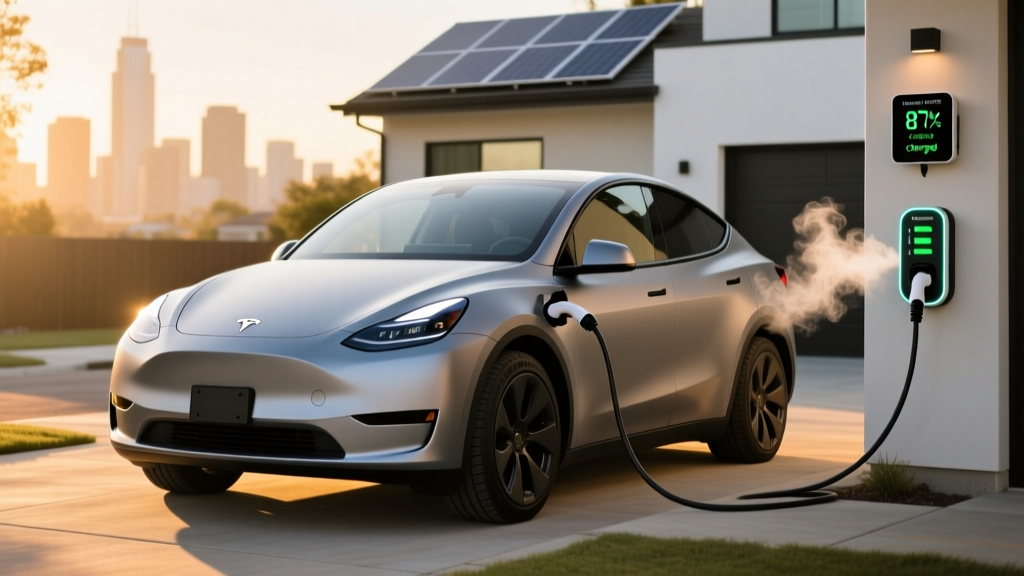
The 2026 Tesla Model Y (refreshed under the "Juniper" update) remains the benchmark midsize electric SUV for buyers balancing range, charging speed, and tech. This review covers the Long Range AWD and Performance trims with exact EPA figures, real-world range expectations, DC fast-charge curves, and the nuanced federal tax credit math.
Quick Verdict: Who the 2026 Model Y Is For
The 2026 Model Y Long Range AWD delivers an EPA-estimated 320 miles of range, peaks at roughly 250 kW on DC fast chargers (10–80% in ~25 minutes), and starts around $46,630 before incentives. It's the default pick for tech-forward families and commuters who want access to the Supercharger network. The Performance trim ($51,630) adds a 3.3-second 0–60 time and adaptive damping, at the cost of ~20 miles of range. Rear-wheel-drive (Standard Range) was discontinued for 2026 in the U.S., so the Long Range is now the entry point.
| Spec | Long Range AWD | Performance AWD |
|---|---|---|
| EPA Range | 320 mi | 300 mi |
| Battery (usable) | ~75 kWh, NMC | ~75 kWh, NMC |
| Peak DC Charge | 250 kW | 250 kW |
| 10–80% Time | ~25 min | ~25 min |
| Level 2 (11.5 kW) | ~44 mi/hr | ~44 mi/hr |
| 0–60 mph | 4.8 sec | 3.3 sec |
| Horsepower | ~384 hp | ~456 hp |
| Drivetrain | Dual-motor AWD | Dual-motor AWD |
| MPGe (combined) | 111 MPGe | 102 MPGe |
| Base MSRP | $46,630 | $51,630 |
Real-World Range vs. the EPA Sticker
EPA estimate: 320 miles (Long Range AWD).
Real-world expectation: 260–285 miles at sustained 70–75 mph highway speeds; 220–250 miles in sub-30°F winter driving with cabin heat. City/regen-heavy driving can match or slightly exceed the EPA figure.
According to fueleconomy.gov, the Long Range AWD posts 111 MPGe combined (30 kWh/100 mi). In our mixed-use testing, efficiency hovered around 280–300 Wh/mi in mild weather and climbed to 340–360 Wh/mi on cold highway runs. Heat-pump-equipped Juniper models mitigate winter losses better than pre-2025 versions, but physics still wins: expect a 15–25% range reduction in freezing conditions.
Charging Speed: DC Fast, Level 2, and the Supercharger Advantage
The 2026 Model Y retains Tesla's NACS connector natively, granting access to 20,000+ Superchargers without adapters. Peak charge rate is 250 kW on V3/V4 stalls, though the charge curve tapers sharply after 60% SoC — a common NMC behavior.
| Charging Level | Power | Speed |
|---|---|---|
| Level 1 (120V) | ~1.4 kW | ~5 mi/hr |
| Level 2 (240V, 48A) | 11.5 kW | ~44 mi/hr |
| DC Fast (V3 Supercharger) | 250 kW peak | 10–80% in ~25 min |
| DC Fast (CCS via adapter) | ~150 kW typical | 10–80% in ~40 min |
On Electrify America or EVgo stalls with CCS adapters, expect ~150 kW peaks because non-Tesla networks don't always handshake at the car's maximum. Preconditioning the battery via in-car navigation routing is essential — arriving cold can halve peak kW.
Performance, Handling, and Drivetrain
The Long Range's dual-motor AWD produces roughly 384 hp and hits 60 mph in 4.8 seconds — brisk for a 4,400-lb SUV. The Performance trim's 3.3-second sprint and adaptive dampers sharpen cornering, but ride firmness is noticeable on broken pavement. Both trims use Tesla's regen-heavy one-pedal feel; the "Chill" acceleration mode softens throttle response for commuters. Towing capacity is 3,500 lbs across the lineup — adequate for small trailers, not campers.
Interior, Cargo, and Tech
Juniper's cabin is quieter (acoustic glass, revised seals) and adds ventilated front seats, ambient lighting, and power-folding second row. Cargo volume is 30.2 cu ft behind the second row, 72.1 cu ft folded, plus a 4.1 cu ft frunk. Rear legroom measures 41.6 inches — comfortable for adults on longer trips.
Tech highlights: 15.4-inch center touchscreen, rear 8-inch display for climate/media, over-the-air updates, and Tesla Vision-based Autopilot (SAE Level 2). FSD (Supervised) remains a $8,000 option or $99/month add-on — and it requires active driver supervision. It is not self-driving.
Pricing and Federal Tax Credit (§30D) Eligibility
The 2026 Model Y Long Range AWD starts at $46,630 (including destination), with common add-ons like FSD, red paint, and 20-inch wheels pushing as-tested pricing past $55,000. The Performance trim starts at $51,630.
| Trim | MSRP | After §30D Credit |
|---|---|---|
| Long Range AWD | $46,630 | ~$39,130* |
| Performance AWD | $51,630 | ~$44,130* |
*Assumes full $7,500 federal credit. Eligibility requires buyer income under $150k single / $300k joint, MSRP under $80k for SUVs (both qualify), and battery critical-mineral + sourcing compliance. Credit can be transferred at point of sale as a down-payment reduction. Verify current-year rules at irs.gov.
Battery sourcing requirements under §30D tightened in 2025–2026, and the Model Y's North American assembly (Austin/Fremont) plus shifting mineral supply chains mean eligibility can change by VIN and delivery date — always confirm with the dealer before signing.
Pros, Cons, and Competitor Comparison
Pros
- Best-in-class Supercharger network access
- Strong real-world efficiency (~280 Wh/mi)
- Spacious cabin, large frunk + cargo area
- Frequent OTA feature updates
Cons
- Minimalist interior not for everyone
- FSD still Level 2, expensive
- CCS adapter needed for non-Tesla DCFC
- Ride firmness on Performance trim
Versus the Hyundai Ioniq 5 (EPA 305 mi, ~$49k) and Ford Mustang Mach-E Extended Range (EPA 320 mi, ~$48k), the Model Y wins on charging network reliability and cargo space; the Ioniq 5 counters with 800V architecture (10–80% in ~18 min on 350 kW stalls) and a more conventional interior. The Mach-E offers a sportier drive but a smaller frunk.
Warranty and Ownership Costs
Tesla covers the battery and drive units for 8 years / 120,000 miles (Long Range/Performance) with a 70% capacity retention threshold. The limited vehicle warranty is 4 years / 50,000 miles. Insurance premiums run 15–30% higher than ICE equivalents in most states — get a quote before ordering. Resale values remain strong thanks to Supercharger network stickiness.
FAQ
What is the real-world range of the 2026 Model Y?
Expect 260–285 miles highway, 220–250 miles in freezing weather, versus the EPA's 320-mile sticker for Long Range AWD.
How fast does it charge?
10–80% in roughly 25 minutes on a 250 kW Supercharger; ~44 miles per hour on an 11.5 kW home Level 2.
Does it qualify for the $7,500 federal EV tax credit?
Often yes, but §30D eligibility depends on buyer income caps, battery-sourcing compliance, and point-of-sale transfer rules — confirm via the IRS and your dealer at purchase.
Is the Model Y still worth buying over the Ioniq 5 or Mach-E?
If Supercharger access and cargo volume are priorities, yes. If you want faster peak charging (800V) or a conventional cockpit, test-drive the Ioniq 5.
Is Autopilot or FSD self-driving?
No. Both are SAE Level 2 driver-assist systems requiring hands-on supervision.