Quick Verdict: The Benchmark Compact Electric SUV
The 2026 Tesla Model Y remains the compact electric SUV to beat — not because it's flawless, but because no rival matches its combination of Supercharger network access, sustained DC charging speed, over-the-air updates, and cargo versatility. For buyers researching Tesla charge point cost — whether that means home Level 2 installation or public Supercharger sessions — the Model Y's efficiency and NACS-native architecture keep per-mile energy spend among the lowest in the segment.
This review covers the refreshed "Juniper" Model Y lineup sold in the US for the 2026 model year, including Long Range RWD, Long Range AWD, and Performance variants. We'll pair official EPA data with real-world range and charging observations so you can budget accurately.
2026 Tesla Model Y Specs at a Glance
| Spec | Long Range RWD | Long Range AWD | Performance AWD |
|---|---|---|---|
| EPA Range | 320 mi | 300 mi | 280 mi |
| Battery (usable) | ~75 kWh, NMC | ~75 kWh, NMC | ~75 kWh, NMC |
| Drivetrain | Rear-Wheel Drive | Dual-Motor AWD | Dual-Motor AWD |
| Horsepower | ~346 hp | ~384 hp | ~456 hp |
| 0-60 mph | 5.4 sec | 4.6 sec | 3.5 sec |
| MPGe (combined) | 122 MPGe | 115 MPGe | 108 MPGe |
| Max DC Fast Charge | 250 kW | 250 kW | 250 kW |
| 10-80% DCFC Time | ~24 min | ~24 min | ~24 min |
| Level 2 Charge Rate | 11.5 kW (44 mi/hr) | 11.5 kW (44 mi/hr) | 11.5 kW (44 mi/hr) |
| Base MSRP | $44,990 | $47,990 | $52,490 |
| Battery Warranty | 8 yr / 120,000 mi | 8 yr / 120,000 mi | 8 yr / 120,000 mi |
Source: fueleconomy.gov and Tesla US configurator, 2026 model year.
Real-World Range: What the EPA Number Doesn't Tell You
Real-World Expectation: ~270-285 miles highway (70-75 mph, mild weather); ~240-260 miles in freezing temperatures; ~290-310 miles city/suburban mixed driving.
The Long Range RWD's 320-mile EPA figure is competitive with the Hyundai Ioniq 5 (305 mi) and Ford Mustang Mach-E Extended Range (312 mi). However, EPA tests weight city driving heavily, which favors regenerative braking. On a 75-mph interstate run in 70°F weather, expect roughly 270-285 miles before hitting a 10% state of charge. In sub-30°F winter conditions without preconditioning, range can drop 15-25%, pulling the usable distance closer to 240 miles.
The Model Y's heat pump (standard across all trims) mitigates cold-weather losses better than resistive-heater rivals, but physics still wins: battery chemistry slows, cabin heating draws energy, and air density increases. Preconditioning the battery while plugged in — a feature accessible via the Tesla app's scheduled departure — recovers a meaningful 5-10% of range on cold mornings.
Efficiency is a genuine Model Y strength. The Long Range RWD's 122 MPGe translates to roughly 28 kWh per 100 miles, meaning a full charge from empty costs about $3.92 at the US average residential electricity rate of $0.14/kWh. That's approximately 4.2 cents per mile — roughly one-third the per-mile fuel cost of a 28-MPG gas crossover at $3.30/gallon.
Tesla Charge Point Cost: Home, Supercharger & Public Networks
Understanding Tesla charge point cost requires separating three scenarios: home Level 2 charging, Tesla Supercharger (DC fast) sessions, and third-party public charging.
Home Level 2 Charging
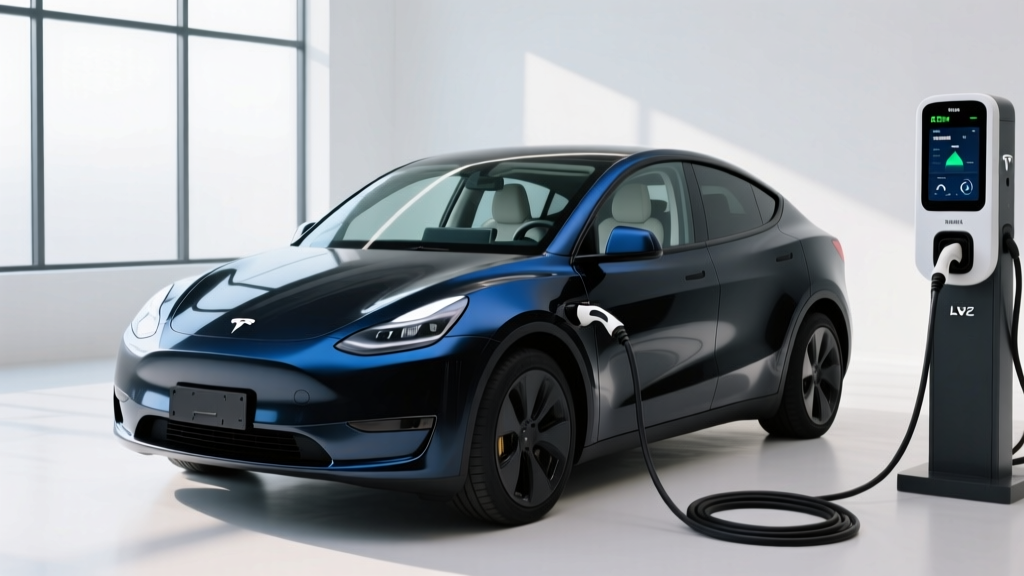
The Model Y accepts up to 11.5 kW on Level 2 AC via its NACS port. Tesla's Wall Connector ($420 hardware) delivers up to 48 amps on a 60-amp circuit, adding roughly 44 miles of range per hour. An overnight 8-hour session replenishes ~350 miles — more than a full battery.
| Charging Level | Power (kW) | Miles Added/Hour | Typical Session Cost* |
|---|---|---|---|
| Level 1 (120V / 12A) | ~1.4 kW | ~5 mi/hr | $0.14/kWh (residential) |
| Level 2 (240V / 48A) | 11.5 kW | ~44 mi/hr | $0.14/kWh (residential) |
| DC Fast (Supercharger V3) | 250 kW peak | ~1,000+ mi/hr (peak) | $0.28-$0.36/kWh avg |
| DC Fast (Electrify America, etc.) | Up to 350 kW | Varies by taper | $0.36-$0.56/kWh |
*Costs vary by utility rate, time-of-use pricing, and network membership. Residential rate shown is US average; Supercharger pricing varies by station and time of day.
Supercharger Network Pricing
Tesla's Supercharger network — now exceeding 6,000 US stalls — remains the most reliable DC fast-charging infrastructure in the country. Typical V3 Supercharger pricing ranges from $0.28 to $0.36 per kWh depending on location and time of day, though some urban stations now charge idle fees of $1/minute after reaching full charge.
A 10-80% session (~52 kWh added) at $0.32/kWh costs roughly $16.64 and takes about 24 minutes. For a 300-mile road trip with one Supercharger stop, that's approximately 5.5 cents per mile — still well below gasoline.
Third-Party Networks (CCS via Adapter)
Tesla now includes a NACS-to-CCS adapter or offers Magic Dock at select Superchargers, and Model Ys can charge on Electrify America, EVgo, and ChargePoint DC stations. Pricing on these networks tends to run $0.36-$0.56/kWh — making Superchargers the clear cost winner. The Model Y's peak 250 kW rate also means it won't fully exploit 350 kW EA stalls, though sustained charging curves remain competitive through 60% SoC.
Home Charger Installation Cost
Installing a Tesla Wall Connector requires a 240V / 60A circuit. If your electrical panel has capacity, expect $500-$1,500 for a licensed electrician to run conduit and install the outlet or hardwired unit. If your panel needs upgrading from 100A to 200A service, add $1,500-$3,000. Always consult a licensed electrician for final specs — panel load calculations vary by home.
Charging Speed and Battery Technology
The 2026 Model Y uses a ~75 kWh (usable) nickel-manganese-cobalt (NMC) lithium-ion battery pack. NMC chemistry delivers higher energy density than lithium iron phosphate (LFP), enabling the Long Range's 320-mile EPA rating from a relatively compact pack. The trade-off: NMC degrades slightly faster than LFP over thousands of cycles and prefers not to sit at 100% SoC for extended periods. Tesla recommends daily charging to 80-90% and reserving 100% for trips.
The DC fast-charging curve peaks at 250 kW around 10-20% SoC, then tapers progressively. From 10-80%, the average sustained rate is closer to 140-155 kW, which is why the 10-80% time is ~24 minutes rather than the theoretical minimum. Above 80%, charging slows sharply to protect battery health — a 80-100% top-off can add another 20-25 minutes. For road trips, the practical strategy is to charge to 80%, drive ~200 miles, and repeat.
Preconditioning is essential for maximizing charge speed. When you navigate to a Supercharger in the Tesla navigation system, the car automatically warms or cools the battery to optimal temperature. Arriving without preconditioning — especially in cold weather — can add 10-15 minutes to your session as the battery thermally manages before accepting peak power.
Performance, Efficiency, and Driving Dynamics
Even the "base" Long Range RWD hits 60 mph in 5.4 seconds with 346 hp — quicker than most gas-powered compact SUVs. The Long Range AWD drops that to 4.6 seconds, and the Performance trim shaves it to 3.5 seconds with 456 hp and adaptive dampers that sharpen cornering without ruining ride quality.
All trims feature one-pedal driving via aggressive regenerative braking, a low center of gravity from the floor-mounted battery, and precise electric steering. The Performance model adds Track Mode for closed-course use, 21-inch wheels, and larger brakes.
Ride comfort in the Juniper refresh improved noticeably over the pre-2025 Model Y: revised suspension tuning, acoustic glass, and additional sound deadening reduce highway noise and harshness. It still favors firmness over plushness — buyers seeking Lexus-soft isolation should test-drive before committing.
Interior, Cargo, and Technology
The 2026 Model Y's minimalist cabin centers on a 15.4-inch touchscreen handling virtually all vehicle functions — climate, mirrors, glovebox, and navigation. A rear-seat 8-inch touchscreen lets passengers control climate and entertainment. Build quality has improved with ambient lighting, ventilated front seats, and softer materials across the dashboard.
Cargo volume: 30.2 cu ft behind the second row, expanding to 72.1 cu ft with seats folded. The front trunk (frunk) adds 4.1 cu ft — enough for a charging cable bag and groceries. Total storage is among the best in the segment, though the sloping roofline cuts into tall-item practicality versus boxier rivals like the Kia EV9.
Passenger space: 41.8 inches of front legroom, 41.6 inches rear. The rear bench fits two adults comfortably on longer trips; the middle seat is best for children. Rear headroom can feel tight for passengers over 6'2" due to the panoramic glass roof's structural cross-member.
Tech highlights:
- Tesla Autopilot (standard): adaptive cruise, lane centering, automatic emergency braking — SAE Level 2, requires driver engagement
- Full Self-Driving (Supervised): $8,000 option adding automatic lane changes, traffic-light recognition, and parking assist — still SAE Level 2, not autonomous
- Over-the-air updates continuously add features
- Dashcam and Sentry Mode use the surround cameras for security recording
- Phone-as-key with Bluetooth proximity unlock
Pricing, Tax Credits, and Total Cost
| Trim | Base MSRP | Federal §30D Credit* | Effective Price* |
|---|---|---|---|
| Long Range RWD | $44,990 | Up to $7,500 | ~$37,490 |
| Long Range AWD | $47,990 | Up to $7,500 | ~$40,490 |
| Performance AWD | $52,490 | Up to $7,500 | ~$44,990 |
*All trims fall under the $80,000 SUV MSRP cap for §30D eligibility. Credit amount depends on battery component and critical-mineral sourcing requirements, which change annually. Buyer income caps apply: $150K single / $225K head of household / $300K joint filers. Point-of-sale transfer is available at participating dealers. Always verify current-year rules at irs.gov and consult a tax professional.
- Vehicle MSRP under $80,000 (SUVs/vans/pickups) — all Model Y trims qualify ✓
- Buyer AGI under income caps ($150K/$225K/$300K by filing status)
- Battery components manufactured or assembled in North America (percentage thresholds increase yearly)
- Critical minerals sourced from US or FTA-partner countries (percentage thresholds increase yearly)
- Vehicle assembled in North America — Model Y built in Fremont, CA and Austin, TX ✓
- Point-of-sale transfer available at time of purchase (reduces purchase price directly)
The Model Y's strongest ownership-cost advantage is its efficiency. At 28 kWh/100 mi and $0.14/kWh home electricity, fueling costs roughly $0.04/mile. Compare that to a 26-MPG gas SUV at $3.30/gallon ($0.13/mile) — the Model Y saves approximately $1,350 per year over 15,000 miles of home-charged driving. Insurance premiums, however, tend to run 15-25% higher than comparable gas SUVs, partially offsetting fuel savings.
Pros, Cons, and Competitor Comparison
- Best-in-class Supercharger network reliability
- Excellent efficiency (122 MPGe Long Range RWD)
- Strong cargo versatility (72.1 cu ft max)
- Continuous OTA improvements
- Competitive DC charging speed (250 kW peak)
- Low per-mile energy cost
- FSD option expensive and still Level 2 only
- Minimalist interior not for everyone
- No Apple CarPlay / Android Auto
- Firm ride quality vs some rivals
- Insurance premiums above segment average
- Rear headroom tight for tall passengers
vs Hyundai Ioniq 5 (305 mi, $42,600): The Ioniq 5 charges faster on paper (350 kW peak, 10-80% in ~18 min) and offers Vehicle-to-Load (V2L) power capability. But Tesla's Supercharger reliability and the Model Y's cargo advantage tilt the scales for road-trip-heavy buyers.
vs Ford Mustang Mach-E (312 mi, $42,995): The Mach-E delivers a more engaging driving feel and a traditional infotainment layout with Apple CarPlay. Its BlueCruise hands-free system works on pre-approved highways. However, Ford's DC charging real-world speeds and public network dependency make the Model Y more practical for frequent travelers.
Who Should Buy the 2026 Tesla Model Y?
- You road-trip frequently and want the most reliable DC fast-charging network
- You can install Level 2 home charging and want minimal per-mile cost
- You value OTA updates and tech-forward features over traditional luxury materials
- You need strong cargo capacity for family gear, bikes, or dogs
- You prefer physical buttons, Apple CarPlay, or a conventional dealer experience
- You want the absolute fastest DC charging (Ioniq 5 / EV6)
- You need three-row seating (Kia EV9, Rivian R1S)
- Soft, luxury ride quality is your top priority
Warranty and Long-Term Ownership
Tesla covers the Model Y's battery and drive unit for 8 years or 120,000 miles (whichever comes first) with a minimum 70% capacity retention threshold. The basic vehicle warranty is 4 years / 50,000 miles. Battery degradation data from Teslas in the field suggests most packs retain 85-90% capacity at 100,000 miles, well within warranty. A full pack replacement outside warranty currently costs $12,000-$16,000 depending on configuration — a number expected to decline as battery manufacturing scales.
Long-term ownership also benefits from Tesla's mobile service model: many repairs are handled at your home or office, reducing dealer-visit friction. However, body repair after collisions can take longer due to Tesla's parts supply chain and approved body-shop network limitations in some regions.
Frequently Asked Questions
What is the real-world range of the 2026 Tesla Model Y?
The Long Range RWD's EPA rating is 320 miles. In real-world highway driving at 70-75 mph in mild weather, expect 270-285 miles. In freezing temperatures, range drops to roughly 240-260 miles without preconditioning. City driving with regenerative braking can approach or match the EPA figure.
How fast does the Model Y charge at home and on the road?
On a 240V Level 2 home charger at 48 amps (11.5 kW), the Model Y adds about 44 miles of range per hour — a full overnight charge covers most daily needs. On a V3 Supercharger, it peaks at 250 kW and charges from 10-80% in approximately 24 minutes. Above 80%, the charge rate tapers significantly.
How much does a Tesla home charge point cost to install?
The Tesla Wall Connector hardware costs $420. Professional installation on an existing 240V/60A circuit runs $500-$1,500. If your electrical panel needs upgrading from 100A to 200A service, total cost can reach $2,000-$4,500. Always get a quote from a licensed electrician who will calculate your panel's available capacity.
Does the 2026 Model Y qualify for the federal EV tax credit?
All Model Y trims fall under the $80,000 SUV MSRP cap and are assembled in the US, meeting basic §30D requirements. The actual credit amount (up to $7,500) depends on battery-sourcing rules that tighten yearly, plus buyer income limits. Point-of-sale transfer is available. Verify current rules at irs.gov before purchasing.
Is the Model Y worth buying over the Hyundai Ioniq 5 or Ford Mach-E?
For road-trip-heavy drivers who value Supercharger reliability, the Model Y wins. For buyers prioritizing the fastest DC charging and V2L capability, the Ioniq 5 is compelling. For those wanting a more traditional cabin with CarPlay and hands-free highway driving, the Mach-E with BlueCruise is a strong alternative. Test-drive all three — the right choice depends on your specific use case.
Is Tesla's Full Self-Driving actually self-driving?
No. FSD (Supervised) is an SAE Level 2 driver-assistance system. You must remain fully attentive, keep hands on or near the wheel, and be prepared to take control at any moment. It does not make the car autonomous. Level 4 driverless operation currently exists only in geofenced robotaxi services like Waymo.
What is the Tesla charge point cost per mile on the road?
At an average Supercharger rate of $0.32/kWh and the Model Y Long Range's efficiency of 28 kWh/100 mi, road-trip charging costs approximately $0.09 per mile. This compares favorably to gasoline at roughly $0.12-$0.15 per mile for a comparable 26-MPG crossover.