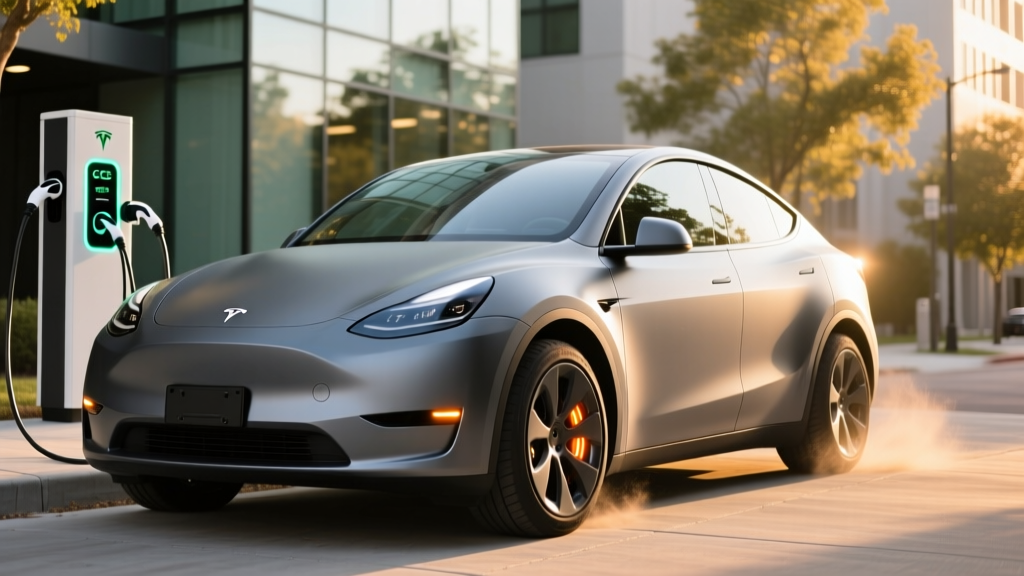
The Tesla Model Y has held its position as one of the best-selling electric vehicles globally for good reason. For 2026, Tesla refreshed the crossover with a redesigned interior, improved ride quality, and the latest iteration of its dual-motor Performance variant. But with growing competition from the Hyundai Ioniq 5, Ford Mustang Mach-E, and BMW iX3, the 2026 Tesla Model Y Performance needs to earn its premium. Here's everything you need to know — exact numbers, real-world expectations, and ownership economics — before you configure one.
Quick Verdict: Who Should Buy the 2026 Model Y Performance
Choose the 2026 Tesla Model Y Performance if:
- You want sports-sedan acceleration (3.5-second 0-60) in a practical family crossover
- You rely on the Tesla Supercharger network for frequent road trips
- You value over-the-air updates and best-in-class infotainment integration
- Your household qualifies for the §30D federal tax credit (income and sourcing rules apply)
Look elsewhere if:
- You prefer physical buttons and a traditional instrument cluster
- You want a luxury badge or more premium interior materials (consider the BMW iX or Genesis GV60)
- Your daily commute is short and you'd rather save $10,000+ on the Long Range AWD or RWD trims
Range, Efficiency, and the Real-World Reality Check
The 2026 Model Y Performance carries an EPA-estimated range of 285 miles on its 78.1 kWh (usable) NMC (nickel-manganese-cobalt) battery pack. That's a slight bump from the prior generation, attributable to improved aerodynamics from the refreshed body and a more efficient heat pump system.
EPA Range: 285 miles
Real-World Expectations:
- City/Mixed driving (55-65°F): 260-280 miles — regenerative braking recovers energy effectively in stop-and-go traffic
- Highway (70-80 mph, 55-65°F): 230-250 miles — aerodynamic drag dominates at sustained high speed
- Cold weather (20-35°F, highway): 190-220 miles — battery preconditioning helps, but expect 20-30% range loss
- Hot weather with A/C (90°F+, highway): 240-260 miles — thermal management is strong, but cabin cooling draws from the pack
Source: EPA estimates via fueleconomy.gov; real-world figures based on owner-reported data and independent testing.
Efficiency is rated at 111 MPGe combined (29 kWh/100 miles). That's competitive with the Ioniq 5 AWD (110 MPGe) and slightly behind the Mach-E GT (101 MPGe). Tesla's drivetrain efficiency remains a class benchmark, though the Performance trim's stickier tires and sport-tuned suspension add rolling resistance compared to the Long Range.
| Specification | Value |
|---|---|
| EPA Range | 285 miles |
| Battery (Usable) | 78.1 kWh, NMC chemistry |
| EPA Efficiency | 111 MPGe / 29 kWh/100 mi |
| Drivetrain | Dual Motor AWD |
| Horsepower | 456 hp (combined) |
| Torque | 497 lb-ft |
| 0-60 mph | 3.5 seconds |
| Top Speed | 155 mph |
| Max DC Fast Charge | 265 kW peak |
| 10-80% DC Charge Time | ~18 minutes |
| Level 2 Home Charging | 11.5 kW (44 mi/hr) |
| Cargo Volume (rear seats up) | 30.2 cu ft |
| Cargo Volume (rear seats down) | 72.1 cu ft |
| Front Trunk (Frunk) | 4.1 cu ft |
| Rear Legroom | 40.5 inches |
| Battery Warranty | 8 years / 120,000 miles |
| Base MSRP | $48,990 |
Charging: Supercharger Speeds and Home Setup
Tesla's charging ecosystem remains its strongest competitive advantage. The 2026 Model Y Performance supports a peak DC fast-charge rate of 265 kW on V4 Superchargers. In practice, that peak is sustained only between roughly 10-35% state of charge; the charge curve tapers progressively above 50%, which is typical for NMC chemistry.
| Charge Level | Power / Voltage | Miles Added per Hour | Notes |
|---|---|---|---|
| Level 1 (120V household) | ~1.4 kW | ~4-5 mi/hr | Emergency/trickle only; adds ~50 mi overnight |
| Level 2 (240V, Wall Connector) | 11.5 kW (48A) | ~44 mi/hr | Full charge in ~7-8 hours; ideal daily setup |
| Level 2 (240V, 32A public) | 7.7 kW | ~30 mi/hr | Common at workplaces and destination chargers |
| DC Fast (V4 Supercharger) | 265 kW peak | ~162 mi in 15 min | 10-80% in ~18 min; tapers above 50% SoC |
| DC Fast (V3 Supercharger) | 250 kW peak | ~155 mi in 15 min | Still widely available; nearly identical real-world speed |
| DC Fast (CCS adapter, Electrify America) | Up to 150 kW | ~90 mi in 15 min | Useful on non-Tesla networks; adapter included |
At home, Tesla's Gen 3 Wall Connector on a 60-amp circuit delivers 11.5 kW, replenishing roughly 44 miles of range per hour. A full overnight charge from 20% to 90% takes about 5-6 hours — more than adequate for daily driving.
Installation reality check: Expect to pay $800-$2,500 for a licensed electrician to install a NEMA 14-50 outlet or hardwired Wall Connector, depending on your panel proximity and whether a 200-amp service upgrade is needed. Older homes with 100-amp panels may face $3,000-$5,000 total costs including a panel upgrade. Always get a quote from a licensed electrician before committing.
Performance: 3.5 Seconds Never Gets Old
The dual-motor all-wheel-drive powertrain produces 456 horsepower and 497 lb-ft of torque, launching the Model Y Performance from 0-60 mph in 3.5 seconds. That's supercar territory from a five-seat crossover weighing over 4,300 pounds.
The Performance trim includes a sport-tuned adaptive suspension, lowered ride height (0.6 inches lower than Long Range), 21-inch Überturbine wheels with Pirelli P Zero summer tires, and high-performance brakes with red calipers. The result is genuinely sharp handling for an SUV — body roll is well-controlled, turn-in is immediate, and the torque-vectoring rear motor makes the car feel smaller than it is.
The trade-off: ride quality is firm. You'll feel expansion joints and potholes more than in the Long Range or in competitors like the Genesis GV60. For daily commuting on imperfect roads, that firmness may fatigue. For canyon carving or track days, it's the best-handling EV crossover under $60,000.
Pricing, Tax Credits, and What You'll Actually Pay
The 2026 Tesla Model Y Performance starts at a base MSRP of $48,990 (including destination). Key options include:
- Solid paint colors: Free (Stealth Grey) or $1,000-$2,000 (Ultra Red, Quicksilver)
- Full Self-Driving (Supervised): $8,000 one-time or $99/month subscription
- 21" Überturbine wheels: Included on Performance (standard)
| Configuration | MSRP | Est. Fed. Credit | Effective Price |
|---|---|---|---|
| Base (Stealth Grey) | $48,990 | Up to $7,500* | ~$41,490 |
| Ultra Red + FSD | $58,990 | Up to $7,500* | ~$51,490 |
| Quicksilver + FSD | $59,990 | Up to $7,500* | ~$52,490 |
*Federal tax credit (§30D) eligibility is NOT guaranteed. Under current IRS rules, the Model Y Performance must meet several requirements:
- MSRP cap: SUVs/vans/pickups must have an MSRP ≤ $80,000 — the Model Y Performance qualifies
- Buyer income cap: AGI must not exceed $150,000 (single), $225,000 (head of household), or $300,000 (joint) — check your tax return
- Battery sourcing: Critical minerals and battery components must meet escalating domestic-content thresholds — Tesla's sourcing has shifted to comply, but verify at the point of sale as requirements tighten annually
- Point-of-sale transfer: You can transfer the credit to the dealer at purchase for an immediate price reduction rather than waiting to claim it on your tax return
- Final assembly: Must occur in North America — the Fremont and Austin plants qualify
Always confirm eligibility with your tax professional before purchasing. The credit is non-refundable, meaning it can only reduce tax liability you actually owe — it cannot generate a refund on its own unless transferred at point of sale.
Interior, Tech, and Daily Livability
The 2026 Model Y Performance interior received a significant refresh: ventilated front seats (finally), ambient lighting, an 8-inch rear touchscreen for passengers, acoustic glass for improved cabin quietness, and revised materials that close the gap with luxury competitors — though the dashboard remains Tesla's signature minimalist slab.
The 15.4-inch center touchscreen runs Tesla's latest infotainment software, which remains the class leader in responsiveness, navigation integration, and over-the-air feature updates. Apple CarPlay and Android Auto are still not supported — Tesla's ecosystem is self-contained. For most users, the native navigation, Spotify/Apple Music integration, and built-in trip planner with Supercharger routing make this a non-issue. For CarPlay loyalists, it's a dealbreaker.
Cargo and space: With 30.2 cubic feet behind the rear seats and 72.1 cu ft with seats folded, the Model Y swallows more than the Ioniq 5 (27.2/59.3 cu ft) and rivals the Mach-E (29.7/60.2 cu ft). The 4.1 cu ft frunk is useful for charging cables and groceries. Rear legroom of 40.5 inches comfortably fits two adults on long trips, though the center seat is best for children due to the transmission tunnel hump (yes, even in an EV — it houses wiring).
Driver Assistance: Autopilot and FSD Supervised
SAE Automation Level: Level 2
Tesla Autopilot and Full Self-Driving (Supervised) are Level 2 driver-assistance systems, not self-driving. The driver must remain attentive, keep hands on the wheel (or demonstrate engagement via torque monitoring), and be prepared to take over at any moment. These systems do not replace an alert human driver.
Standard Autopilot includes Traffic-Aware Cruise Control and Autosteer (lane centering on marked highways). The optional FSD (Supervised) package adds automatic lane changes, Navigate on Autopilot (highway on-ramp to off-ramp), traffic light and stop sign recognition, and Autopark. In our experience, FSD has improved markedly but still requires active supervision — phantom braking, unexpected lane changes, and construction-zone confusion remain limitations.
What Autopilot/FSD Does NOT Do:
- Drive you to a destination without supervision
- Handle all construction zones, unmapped roads, or adverse weather
- Replace the need for an attentive, licensed driver in the driver's seat
- Qualify as SAE Level 3 or higher — no Tesla consumer vehicle currently offers conditional automation where the manufacturer accepts liability
Pros, Cons, and How It Stacks Up
Pros
- 3.5-second 0-60 mph — fastest crossover in its price class
- Tesla Supercharger network — most reliable DC fast-charging ecosystem in North America
- 265-kW peak charging; 10-80% in ~18 minutes on V4 chargers
- Best-in-class infotainment and OTA update cadence
- 72.1 cu ft cargo volume — genuinely practical for families
- Eligible for up to $7,500 federal tax credit (verify sourcing/income rules)
- Strong resale value relative to non-Tesla EVs
Cons
- Firm ride quality on Performance trim — fatiguing on rough roads
- No Apple CarPlay or Android Auto
- FSD ($8,000) is optional and still requires full driver supervision
- Minimalist interior not for everyone — no physical climate or volume controls
- Insurance premiums run 15-30% higher than comparable ICE crossovers
- 285-mile EPA range trails the Long Range AWD (320 mi) due to larger wheels and sport tuning
Competitor Comparison: Model Y Performance vs. the Field
| Spec | Tesla Model Y Perf. | Ford Mach-E GT | Hyundai Ioniq 5 N |
|---|---|---|---|
| EPA Range | 285 mi | 280 mi | 220 mi |
| 0-60 mph | 3.5 sec | 3.5 sec | 3.4 sec |
| Horsepower | 456 hp | 480 hp | 641 hp (N Grin Boost) |
| Peak DC Charge | 265 kW | 150 kW | 240 kW |
| 10-80% Charge | ~18 min | ~34 min | ~18 min |
| Base MSRP | $48,990 | $54,995 | $66,100 |
| Cargo (rear up) | 30.2 cu ft | 29.7 cu ft | 27.2 cu ft |
| Charging Network | Supercharger (native) | CCS (BlueOval network) | CCS (NACS adapter avail.) |
The Model Y Performance occupies a clear niche: it's the best value in this trio when you factor in charging speed, range, cargo space, and price. The Ioniq 5 N is the more engaging driver's car (simulated gear shifts, track modes) but costs $17,000 more and sacrifices range. The Mach-E GT is competitive on performance but charges significantly slower and costs $6,000 more at base.
Frequently Asked Questions
What is the real-world range of the 2026 Tesla Model Y Performance?
The EPA rates it at 285 miles, but real-world highway driving at 75 mph yields approximately 230-250 miles in mild weather. In cold conditions (below 35°F), expect 190-220 miles on a full charge. City driving with regenerative braking recovers more energy and typically delivers 260-280 miles.
How fast does the 2026 Model Y Performance charge?
On a V4 Tesla Supercharger, it peaks at 265 kW and charges from 10-80% in approximately 18 minutes. At home on a Level 2 Wall Connector (11.5 kW), a full overnight charge takes 7-8 hours. On non-Tesla DC networks with a CCS adapter, expect up to 150 kW and roughly 90 miles of range in 15 minutes.
Does the 2026 Model Y Performance qualify for the $7,500 federal EV tax credit?
It can, but eligibility depends on your adjusted gross income (≤$300,000 joint / ≤$150,000 single), the vehicle's MSRP (≤$80,000 for SUVs — it qualifies), and battery component/critical-mineral sourcing requirements that tighten each year. Check current IRS §30D guidance and confirm with a tax professional before purchasing. The credit can be transferred at the point of sale for an immediate price reduction.
Is the 2026 Model Y Performance worth buying over the Long Range AWD?
If you prioritize acceleration and handling, yes — the 3.5-second 0-60 and sport-tuned suspension are transformative. If you prioritize maximum range and ride comfort, the Long Range AWD (320 miles EPA, softer suspension, lower price by ~$5,000) is the more practical daily driver. Most buyers who don't plan to track-day their crossover are better served by the Long Range.
How long will the battery last?
Tesla warranties the Model Y Performance battery for 8 years or 120,000 miles, whichever comes first, with a guaranteed minimum 70% capacity retention. Independent data from high-mileage Teslas suggests NMC packs typically retain 85-90% capacity at 100,000 miles with normal use. Battery replacement, if needed out of warranty, currently ranges from $12,000-$16,000 at Tesla service centers.
Can I tow with the 2026 Model Y Performance?
Yes. The Model Y Performance is rated to tow up to 3,500 pounds with the optional tow hitch ($1,000 at time of order). Note that towing cuts range roughly in half — plan for 130-150 miles between charges when pulling a loaded trailer.
The 2026 Tesla Model Y Performance remains the benchmark for buyers who want sports-car thrust, Supercharger convenience, and crossover practicality in a single package — as long as they accept the firm ride, the screen-centric interior, and the understanding that "Full Self-Driving" still means you're driving. For the performance-minded EV buyer with access to home charging and a road-trip habit, it's still the one to beat.