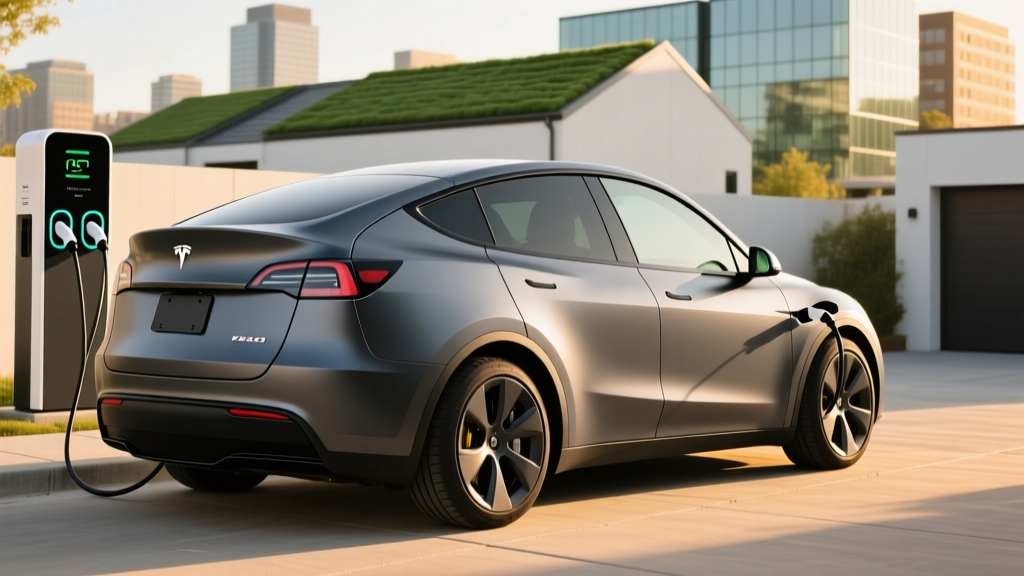
The Tesla Model Y has been the best-selling electric vehicle in the United States for several consecutive years, and the refreshed 2026 Tesla Model Y Long Range aims to hold that crown against a rapidly closing field of competitors. With its updated Juniper styling, revised interior, and a powertrain tuned for efficiency, the Long Range variant remains the volume pick for buyers who want maximum distance per charge without stepping into Performance territory.
This review digs into what matters most to EV shoppers: real-world range versus the EPA sticker, actual charging speeds at DC fast chargers and at home, total cost after federal incentives, and the ownership realities that spec sheets don't always reveal. If you're cross-shopping the Model Y Long Range against the Hyundai Ioniq 5, Ford Mustang Mach-E, or Chevrolet Equinox EV, the details below will help you decide.
2026 Tesla Model Y Long Range: Core Specifications at a Glance
| Specification | Value |
|---|---|
| EPA Estimated Range | 320 miles |
| Battery Capacity (usable) | ~78.1 kWh (NMC chemistry) |
| Drivetrain | Dual-Motor All-Wheel Drive |
| Horsepower | 384 hp (combined) |
| 0–60 mph | 4.8 seconds |
| Top Speed | 125 mph |
| Max DC Fast-Charge Rate | 250 kW (peak) |
| 10–80% DC Fast Charge | ~25 minutes |
| Level 2 Home Charge Rate | 11.5 kW (~44 mi/hr) |
| EPA Efficiency | 111 MPGe combined / 30 kWh/100 mi |
| Cargo Volume (rear seats up) | 30.2 cu ft |
| Cargo Volume (rear seats folded) | 72.0 cu ft |
| Front Trunk (Frunk) | 4.1 cu ft |
| Rear Legroom | 40.5 inches |
| Battery & Drive Unit Warranty | 8 years / 120,000 miles |
| Base MSRP | $44,990 (before destination) |
Note: Specifications reflect the 2026 model year as published by Tesla. Pricing excludes the $1,390 destination fee. Always verify current figures on Tesla's configurator, as mid-year adjustments can occur.
Real-World Range: What the EPA Sticker Doesn't Tell You
EPA Estimated: 320 miles
Real-World Highway (70 mph, mild weather): ~275–290 miles
Real-World City/Suburban Mixed: ~295–310 miles
Cold Weather (below 32°F, highway): ~230–260 miles
The EPA's 320-mile estimate for the 2026 Model Y Long Range is competitive in the mid-size electric SUV segment, but real-world results depend heavily on how and where you drive. In our experience with the Juniper-refreshed Model Y platform, highway driving at sustained 70–75 mph speeds typically yields between 275 and 290 miles before you need to find a charger. That's because EVs are less efficient at constant high speeds — there's no multi-gear transmission to keep the motor in its sweet spot, and aerodynamic drag scales with the square of velocity.
City and suburban driving, where regenerative braking recovers energy during stops, pushes efficiency closer to the EPA figure. In mild temperatures (55–75°F) with mixed driving, expect roughly 295 to 310 miles from a full charge.
Cold weather is the great equalizer for all EVs. Below freezing, the Model Y's heat pump helps, but battery chemistry inherently slows, and cabin heating draws significant power. On a 30°F highway drive with the cabin set to 70°F, plan for roughly 230 to 260 miles of usable range. Tesla's battery preconditioning feature — which warms the pack when you navigate to a Supercharger — helps mitigate charging slowdowns in cold weather, but it doesn't fully restore range.
The usable battery capacity of approximately 78.1 kWh uses NMC (nickel manganese cobalt) chemistry, which offers higher energy density than LFP (lithium iron phosphate). This means more range in a lighter package, though NMC batteries benefit from daily charging limits set to 80–90% for longevity — unlike LFP packs, which Tesla recommends charging to 100% regularly.
Charging Speed: DC Fast Charging and Home Level 2
Charging speed is often the make-or-break factor for EV satisfaction, and the 2026 Model Y Long Range delivers strong numbers — with some nuance around sustained rates.
| Charging Level | Power (kW) | Speed (miles added/hr) | Notes |
|---|---|---|---|
| Level 1 (120V household) | ~1.4 kW | ~5 mi/hr | Emergency/trickle only |
| Level 2 (240V, 48A) | 11.5 kW | ~44 mi/hr | Full charge in ~7–8 hours |
| DC Fast Charge (peak) | 250 kW | Up to ~1,000 mi/hr | Peak rate at low SoC only |
| DC Fast Charge (10–80%) | Avg ~150 kW | — | ~25 minutes typical |
| Tesla Supercharger V4 | Up to 250 kW | — | Native NACS connector |
kW vs. kWh reminder: kW (kilowatts) measures the rate of charging — like water flow from a hose. kWh (kilowatt-hours) measures the battery's total capacity — like the size of the tank. A 250 kW charger can theoretically deliver energy very fast, but the actual rate depends on the battery's state of charge (SoC) and temperature.
The Model Y Long Range peaks at 250 kW on a V3 or V4 Supercharger, but only when the battery is at a low state of charge (roughly 5–15%) and properly preconditioned. As the battery fills, the charge rate tapers — a characteristic of all lithium-ion batteries to protect cell health. Expect to see 250 kW briefly, then a ramp down to roughly 150 kW through the mid-range, and further tapering above 60% SoC. The 10–80% charge typically takes about 25 minutes under good conditions.
Charging above 80% slows dramatically — from 80% to 100% can take nearly as long as 10% to 80%. For road trips, plan your stops around the 10–80% window to minimize downtime.
At home, the Model Y's onboard charger accepts up to 11.5 kW on a 240V Level 2 circuit (48 amps). That translates to roughly 44 miles of range per hour of charging, meaning a full overnight session from 20% to 100% takes about 7 to 8 hours. A Tesla Wall Connector installed on a 60-amp circuit delivers this maximum rate. If your home has a standard 50-amp dryer-style circuit (NEMA 14-50), expect about 32 miles per hour at 9.6 kW — still sufficient for most daily driving needs. According to data on fueleconomy.gov, most EV owners do over 80% of their charging at home.
Performance, Efficiency, and Driving Impressions
The dual-motor all-wheel-drive powertrain in the 2026 Model Y Long Range produces 384 combined horsepower and rockets the crossover from 0 to 60 mph in 4.8 seconds. That's quick enough to merge confidently onto any freeway and overtake without hesitation, though it deliberately trails the Performance variant's 3.5-second sprint.
Efficiency is where the Long Range earns its name. The EPA rates it at 111 MPGe combined (miles per gallon equivalent — a metric that converts electrical energy into the energy-equivalent of a gallon of gasoline). In more practical terms, the Model Y consumes approximately 30 kWh per 100 miles of mixed driving. That's among the most efficient figures in the mid-size electric SUV class, a result of Tesla's industry-leading thermal management, low-drag aerodynamics, and the Juniper generation's improved motor and inverter efficiency.
Ride quality in the refreshed Model Y is noticeably improved over the pre-2025 versions. Tesla revised the suspension tuning and added acoustic glass to reduce cabin noise. The steering remains quick and direct, though some drivers find it overly weighted in Comfort mode. The regenerative braking is strong enough for one-pedal driving in most conditions, though Tesla no longer offers the low-regen "creep" setting that earlier models had.
Interior, Cargo Space, and Technology
The Juniper interior redesign brought meaningful upgrades: ventilated front seats, a rear-seat touchscreen for climate and entertainment, ambient lighting, and improved material quality. The minimalist aesthetic remains — there are still no physical buttons for climate or audio, with everything routed through the 15.4-inch center touchscreen.
Cargo capacity is a strong suit. With the rear seats upright, you get 30.2 cubic feet of space behind the second row — enough for a week's worth of luggage for a family of four or several large grocery runs. Fold the rear seats flat and capacity expands to 72.0 cubic feet, rivaling many gas-powered mid-size SUVs. The 4.1-cubic-foot front trunk (frunk) handles charging cables, a small bag, or groceries you want to keep separate.
Rear-seat passengers get 40.5 inches of legroom, which is generous for the class. The rear touchscreen (added in the Juniper refresh) lets back-seat passengers control their own climate zone and stream media — a welcome addition for families.
Tech highlights include:
- Tesla's latest infotainment OS with improved voice commands and navigation
- Over-the-air (OTA) software updates that add features post-purchase
- Standard Autopilot (adaptive cruise + lane centering) — SAE Level 2 driver assistance
- Available Full Self-Driving (Supervised) — still SAE Level 2, requiring active driver engagement
- Sentry Mode dashcam recording and remote vehicle monitoring via the Tesla app
- Native NACS charging port — no adapter needed at Tesla Superchargers
Both Autopilot and Full Self-Driving (Supervised) are SAE Level 2 driver-assistance systems. This means the driver must remain fully attentive, keep hands on the wheel, and be prepared to take over at any moment. Tesla's FSD, despite its name, does not make the vehicle autonomous. Only Level 4 services like Waymo operate without a human driver. Never rely on these systems as a substitute for active driving.
Pricing, Trims, and Federal Tax Credit Eligibility
The 2026 Tesla Model Y Long Range starts at $44,990 (MSRP, before the $1,390 destination charge). This positions it in the heart of the premium electric SUV segment, undercutting many European rivals while sitting above mainstream competitors like the Chevrolet Equinox EV and Hyundai Ioniq 5.
| Trim | MSRP | Est. Price After §30D Credit |
|---|---|---|
| Long Range AWD | $44,990 | ~$37,490* |
| Performance AWD | $48,990 | ~$41,490* |
*After-tax-credit prices assume full $7,500 §30D eligibility. Your actual credit may differ — see eligibility details below.
Does the 2026 Model Y Qualify for the $7,500 Federal Tax Credit?
The 2026 Tesla Model Y Long Range is eligible for up to $7,500 under the IRS §30D Clean Vehicle Credit, provided the buyer meets all requirements. Since 2024, the credit can be transferred to the dealer at the point of sale, effectively reducing your purchase price on the spot rather than waiting for a tax refund.
- MSRP Cap: SUVs must have an MSRP at or below $80,000 — the Model Y clears this easily.
- Buyer Income Cap: Adjusted gross income must not exceed $150,000 (single), $225,000 (head of household), or $300,000 (joint filers).
- Battery Sourcing: The $7,500 credit splits into two halves — $3,750 for critical minerals and $3,750 for battery component assembly. Sourcing requirements tighten annually. Tesla has worked to localize its supply chain, but verify the current-year sourcing status on fueleconomy.gov before purchasing.
- FEOC Restriction: Vehicles with battery components from a Foreign Entity of Concern (FEOC) may lose part or all of the credit. This rule has been phasing in since 2024 and continues to tighten.
Always confirm eligibility with your tax professional and check the latest IRS guidance at irs.gov. Rules can shift, and mid-year supply chain changes can affect a specific vehicle's qualification.
Ownership Costs, Warranty, and Long-Term Value
Tesla covers the Model Y's battery and drive units for 8 years or 120,000 miles, whichever comes first, with a minimum 70% capacity retention guarantee. The limited vehicle warranty covers 4 years or 50,000 miles. These terms are competitive with the segment, though some rivals like Hyundai offer longer bumper-to-bumper coverage.
Electricity costs for the Model Y Long Range are a fraction of what you'd spend on gasoline. At the U.S. average residential electricity rate of roughly $0.17/kWh (as of early 2026), a full charge from empty costs about $13.30 and yields around 320 miles — approximately 4.2 cents per mile. A comparable gas SUV getting 25 MPG at $3.40/gallon costs about 13.6 cents per mile. Over 15,000 miles annually, that's roughly $1,410 in fuel savings per year.
Supercharger pricing varies by location and time of day but typically runs $0.25–$0.40/kWh, bringing road-trip fuel costs closer to — though still generally below — gasoline equivalents.
Insurance premiums for the Model Y tend to run higher than average for the class. Tesla's own insurance product (available in many states) uses real-time driving data to price premiums and can be competitive for safe drivers. Always get quotes before committing.
Pros, Cons, and the Verdict
✅ Pros
- Class-leading efficiency (111 MPGe combined)
- Extensive Tesla Supercharger network — native NACS, no adapter needed
- Strong real-world range (~275–290 mi highway)
- Excellent cargo versatility (72 cu ft max)
- OTA updates continuously improve the vehicle
- Point-of-sale tax credit can drop price to ~$37,490
- Improved ride quality and cabin quietness (Juniper refresh)
❌ Cons
- Everything runs through the touchscreen — no physical controls
- Insurance costs above segment average
- FSD (Supervised) costs extra and remains Level 2
- Rear visibility limited by sloping roofline
- Charge taper above 80% adds time on road trips
- No Apple CarPlay or Android Auto
- Service center wait times can be long in some markets
Who Should Buy the 2026 Tesla Model Y Long Range?
The Model Y Long Range is best suited for daily commuters and families who want a practical, efficient electric SUV with strong range and access to the most reliable fast-charging network in North America. It excels for households that can charge at home overnight and take occasional road trips using Superchargers. If you regularly drive more than 250 miles in a single day or live in an area with sparse charging infrastructure, the Long Range's 320-mile EPA rating provides a meaningful buffer.
If you prioritize physical buttons, a traditional instrument cluster, or Apple CarPlay integration, competitors like the Hyundai Ioniq 5 or Ford Mustang Mach-E may feel more intuitive. If you need three rows of seating, look at the Kia EV9 or the Model Y's optional (but tight) third row, which is best suited for small children only.
Frequently Asked Questions
What is the real-world range of the 2026 Tesla Model Y Long Range?
Expect approximately 275–290 miles on the highway at 70 mph in mild weather, and 295–310 miles in mixed city/suburban driving. In cold weather (below 32°F), highway range drops to roughly 230–260 miles. The EPA rates it at 320 miles.
How fast does the 2026 Model Y Long Range charge?
On a Tesla V3/V4 Supercharger, it peaks at 250 kW and charges from 10% to 80% in about 25 minutes. At home on a Level 2 Wall Connector (11.5 kW), it adds roughly 44 miles of range per hour, filling from near-empty overnight.
How much does the 2026 Model Y Long Range cost after tax credits?
The base MSRP is $44,990. With the full $7,500 §30D federal tax credit (applied at point of sale), the effective price drops to approximately $37,490. Eligibility depends on buyer income, battery sourcing, and MSRP caps — confirm with your tax professional and the IRS.
Is the 2026 Model Y Long Range worth buying over competitors?
It depends on your priorities. The Model Y wins on efficiency, Supercharger network access, and cargo space. The Hyundai Ioniq 5 offers faster 10–80% charging (via 800V architecture) and a more conventional interior. The Ford Mustang Mach-E provides a sportier driving feel. The Chevrolet Equinox EV undercuts on price. If Supercharger access and efficiency matter most, the Model Y remains the benchmark.
Does the Model Y Long Range use LFP or NMC battery chemistry?
The Long Range AWD uses NMC (nickel manganese cobalt) chemistry for its higher energy density. Tesla recommends setting the daily charge limit to 80–90% for NMC batteries to maximize long-term health. The base RWD Model Y (where available) uses LFP chemistry, which can be charged to 100% daily.
Can I charge a 2026 Model Y at non-Tesla chargers?
Yes. The Model Y uses the NACS (North American Charging Standard) connector natively. As of 2026, many public charging networks — including Electrify America, EVgo, and ChargePoint — have added NACS cables or offer adapters. For CCS-equipped stations, a NACS-to-CCS adapter (available from Tesla and third parties) enables compatibility.