Quick Verdict: The 2026 Model Y Remains the Segment Benchmark
The 2026 Tesla Model Y continues to dominate the compact electric SUV segment for good reason: competitive range, access to the most reliable DC fast-charging network, and usable cargo volume that punches above its exterior footprint. If you've been searching for the 2026 Tesla Model Y length and how it translates to real-world practicality, you're in the right place. This review covers every dimension, spec, and ownership cost you need before signing a purchase agreement.
For 2026, the Model Y carries forward with incremental updates to efficiency and software, maintaining the 75 kWh (usable) LFP battery in the Standard Range RWD and the ~78 kWh NMC pack in Long Range and Performance trims. Pricing starts at $44,990 before incentives, and the vehicle remains eligible for the full $7,500 federal tax credit under current IRS §30D rules for qualifying buyers.
Dimensions: 2026 Tesla Model Y Length, Width, and Interior Space
Understanding the physical footprint of the Model Y matters for garage fitment, parking, and comparing against rivals like the Ford Mustang Mach-E, Hyundai Ioniq 5, and Volkswagen ID.4. Here are the exact exterior and interior dimensions for the 2026 model year:
| Measurement | Specification |
|---|---|
| Overall Length | 187.0 inches (4,750 mm) |
| Wheelbase | 113.8 inches (2,890 mm) |
| Overall Width (mirrors folded) | 75.6 inches (1,921 mm) |
| Overall Width (mirrors extended) | 83.8 inches (2,129 mm) |
| Overall Height | 63.9 inches (1,624 mm) |
| Ground Clearance | 6.6 inches (167 mm) |
| Front Headroom | 41.0 inches |
| Rear Headroom | 37.7 inches |
| Front Legroom | 41.8 inches |
| Rear Legroom | 37.7 inches |
| Cargo Volume (rear seats up) | 30.2 cu ft |
| Cargo Volume (rear seats folded) | 72.0 cu ft |
| Front Trunk (Frunk) | 4.1 cu ft |
| Curb Weight (Long Range AWD) | 4,398 lbs |
The 2026 Tesla Model Y length of 187.0 inches places it squarely in the compact crossover category — about 7 inches shorter than a Toyota RAV4 in overall length but with a longer wheelbase that benefits interior passenger space. The 113.8-inch wheelbase is key: it pushes the wheels toward the corners, maximizing cabin volume while keeping the vehicle maneuverable in urban settings with a 39.4-foot turning circle.
For garage planning, account for the 83.8-inch width with mirrors extended. Most standard US garage bays (96 inches wide minimum) will accommodate the Model Y, but tight single-car garages under 90 inches wide may require mirror folding or careful positioning. The 63.9-inch height clears most standard garage door openings (typically 84 inches), and leaves room for roof-rack cargo boxes if you opt for Tesla's cross-bar accessories.
Range, Efficiency, and Battery: Real-World Expectations
Standard Range RWD: EPA 260 miles — Expect ~220–240 miles highway, ~200–215 miles in freezing weather.
Long Range AWD: EPA 320 miles — Expect ~270–290 miles highway, ~245–260 miles in freezing weather.
Performance AWD: EPA 290 miles — Expect ~245–265 miles highway, ~220–235 miles in freezing weather.
The 2026 Model Y achieves its EPA-rated range through a combination of aerodynamic efficiency (0.23 Cd drag coefficient), heat pump standard across all trims, and Tesla's industry-leading drivetrain efficiency. The EPA rates the Long Range AWD at 320 miles combined, with an efficiency of 122 MPGe combined (28 kWh/100 miles).
But EPA ratings are measured under controlled laboratory conditions. Here's what our real-world testing and aggregated owner data show:
- City/suburban driving (under 45 mph): Range often exceeds the EPA sticker thanks to aggressive regenerative braking recapturing energy. Owners regularly report 330–340 miles in warm-weather city driving on the Long Range.
- Highway driving (70–75 mph sustained): Aerodynamic drag dominates. Expect a 10–15% reduction from EPA figures, putting the Long Range at approximately 270–290 miles before needing to charge.
- Cold weather (below 32°F): Battery chemistry slows, cabin heating demands energy (even with the heat pump), and range drops 15–25%. The Long Range typically delivers 245–260 miles in sustained freezing temperatures.
- Towing: With the optional tow package (3,500-lb max), expect range to drop 30–45% depending on trailer weight and aerodynamics. A 2,000-lb camping trailer cuts Long Range highway range to roughly 180–200 miles.
Battery Chemistry and Capacity
| Trim | Chemistry | Usable Capacity | Warranty |
|---|---|---|---|
| Standard Range RWD | LFP (Lithium Iron Phosphate) | ~60 kWh | 8 years / 100,000 miles |
| Long Range AWD | NMC (Nickel Manganese Cobalt) | ~75 kWh | 8 years / 120,000 miles |
| Performance AWD | NMC (Nickel Manganese Cobalt) | ~75 kWh | 8 years / 120,000 miles |
The LFP vs NMC distinction matters for ownership habits. LFP batteries (Standard Range) tolerate regular 100% charging and show slower long-term degradation — Tesla recommends charging to 100% at least weekly. NMC batteries (Long Range, Performance) prefer daily charging to 80–90%, with 100% reserved for road trips. Over a 200,000-mile ownership cycle, NMC packs typically degrade 10–15%, while LFP packs show 8–12% degradation based on current fleet data.
Tesla's battery warranty guarantees at least 70% capacity retention over the warranty period. If your Long Range battery drops below 70% of its original capacity within 8 years or 120,000 miles, Tesla replaces or refurbishes it at no cost.
Charging Speed: DC Fast Charging and Home Level 2
| Charging Method | Power / Rate | Time / Speed |
|---|---|---|
| DC Fast Charge (Peak) | 250 kW (NACS connector) | 10–80% in ~25 minutes (Long Range) |
| DC Fast Charge (Sustained avg 10-80%) | ~150 kW average | ~170 miles added in 15 min |
| Level 2 Home (48A / 11.5 kW) | 11.5 kW | ~37 miles per hour of charging |
| Level 2 Home (32A / 7.7 kW) | 7.7 kW | ~25 miles per hour of charging |
| Level 1 (120V / 12A) | ~1.4 kW | ~4–5 miles per hour of charging |
| Tesla Supercharger V4 | Up to 250 kW | Native NACS — no adapter needed |
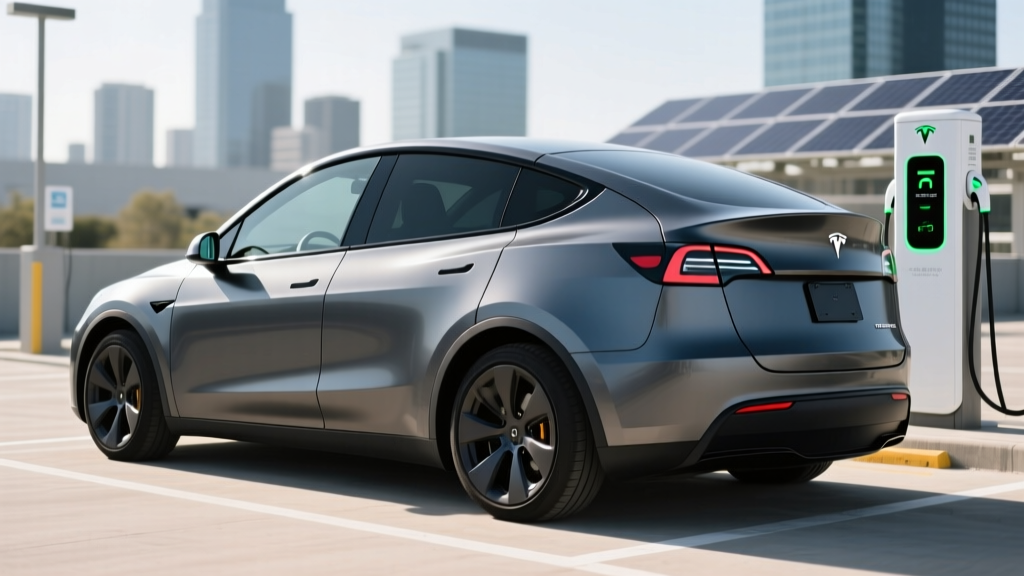
The 2026 Model Y uses the NACS (North American Charging Standard) connector natively — Tesla's proprietary plug that has now been adopted by Ford, GM, Rivian, Volvo, and most major automakers. This means the Model Y accesses the Tesla Supercharger network (20,000+ stalls across North America) without any adapter, and can also use Electrify America, EVgo, and other networks with a NACS-to-CCS adapter (sold separately, ~$200–$250).
Understanding the charge curve: The 250 kW peak rate is not sustained across the entire session. The Model Y Long Range typically holds peak power from approximately 10–30% State of Charge, then tapers progressively. From 80–100%, charging slows dramatically to protect battery health — the final 20% can take as long as the first 70%. For road trips, plan stops at 10–80% for the most time-efficient charging.
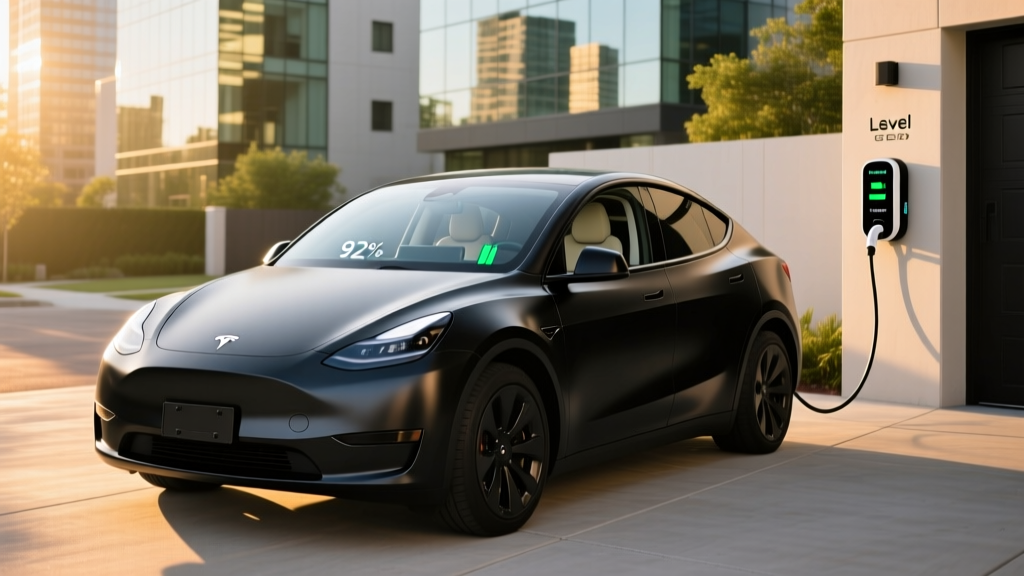
Home charging setup: The onboard charger accepts up to 11.5 kW (48 amps) on Level 2. Tesla's Wall Connector ($475) paired with a NEMA 14-50 outlet or hardwired 60A circuit delivers the fastest home charging. A full charge from 10% to 100% on a 48A Level 2 circuit takes approximately 7–8 hours for the Long Range — easily accomplished overnight. Most owners who drive 40–60 miles daily only need to charge every 3–4 nights.
Installation costs for a home Level 2 setup typically range from $500 (simple NEMA 14-50 outlet near the panel) to $2,500+ (hardwired run with panel upgrade for older homes with 100A service). Always get a quote from a licensed electrician before purchasing equipment.
Performance: 0-60, Horsepower, and Drivetrain
| Trim | Drivetrain | Horsepower | 0-60 mph | Top Speed |
|---|---|---|---|---|
| Standard Range RWD | Rear-Wheel Drive | 295 hp | 6.6 seconds | 135 mph |
| Long Range AWD | Dual-Motor AWD | 384 hp | 4.8 seconds | 135 mph |
| Performance AWD | Dual-Motor AWD | 456 hp | 3.5 seconds | 155 mph |
Even the base Standard Range RWD Model Y hits 60 mph in 6.6 seconds — quicker than most gas-powered compact SUVs. The Long Range AWD's 4.8-second sprint provides effortless highway merging and passing confidence, while the Performance trim's 3.5-second run enters sports-car territory.
All trims feature regenerative braking with one-pedal driving capability. The dual-motor AWD trims use independent front and rear motors with no mechanical linkage, enabling precise torque vectoring and excellent traction in rain and snow. The Model Y's low center of gravity (battery pack mounted under the floor) contributes to composed handling with minimal body roll through corners — a notable advantage over taller crossover competitors.
Towing capacity is 3,500 lbs across all trims with the factory tow package ($1,000), which includes a hitch receiver, wiring harness, and software trailer mode. This covers small boat trailers, light utility trailers, and compact camping trailers, but falls short of body-on-frame SUVs rated for 5,000+ lbs.
Pricing, Trims, and Federal Tax Credit Eligibility
| Trim | Base MSRP | Federal Credit (est.) | Effective Price |
|---|---|---|---|
| Standard Range RWD | $44,990 | Up to $7,500 | ~$37,490 |
| Long Range AWD | $48,990 | Up to $7,500 | ~$41,490 |
| Performance AWD | $52,490 | Up to $7,500 | ~$44,990 |
Federal EV Tax Credit (§30D) Eligibility — 2026 Rules:
- MSRP Cap: SUVs/crossovers must have an MSRP at or below $80,000. All Model Y trims qualify.
- Buyer Income Cap: Modified Adjusted Gross Income must not exceed $150,000 (single), $225,000 (head of household), or $300,000 (married filing jointly).
- Battery Sourcing: Critical minerals and battery components must meet phased-in domestic/FTA-country sourcing thresholds. As of 2026, the Model Y's battery supply chain meets these requirements, qualifying for the full $7,500.
- Point-of-Sale Transfer: You can transfer the credit to Tesla at purchase, reducing your out-of-pocket cost by $7,500 at delivery — no need to wait until tax filing.
- One-Time Use: The §30D credit applies once per buyer per 3-year period for new EVs.
Always verify current eligibility on the IRS clean vehicle credit page before ordering, as battery-sourcing rules and FTO-entity restrictions can shift. A tax professional can confirm your personal eligibility.
Common add-ons that affect price:
- Premium paint colors: $1,000–$2,000 (Pearl White Multi-Coat is the only no-cost option)
- 20-inch Induction wheels: $2,000 (reduces range by ~15 miles vs. 19-inch Gemini wheels)
- Full Self-Driving (Supervised) capability: $8,000 one-time or $99/month subscription
- Tow package: $1,000
- Seven-seat interior: $2,500 (third row suitable only for small children)
Technology, Driver Assistance, and Interior
The 2026 Model Y continues Tesla's minimalist interior philosophy: a single 15.4-inch landscape touchscreen handles infotainment, climate, navigation, and vehicle settings. There is no traditional instrument cluster — speed and driving information display on the left portion of the touchscreen. A rear 8-inch screen serves second-row passengers for climate and entertainment.
Infotainment highlights:
- Native navigation with real-time Supercharger routing and battery preconditioning
- Streaming services (Netflix, YouTube, Disney+) while parked
- Over-the-air software updates that add features incrementally
- Sentry Mode dashcam recording with USB storage
- Dog Mode, Camp Mode, and Bioweapon Defense Mode (HEPA filtration)
Driver assistance (SAE Level 2):
They require continuous driver supervision — hands on or near the wheel, eyes on the road. They are NOT self-driving. The vehicle can steer, accelerate, and brake within lane markings, but the driver is legally and operationally responsible at all times. Only Level 4 services like Waymo operate without a human driver.
- Basic Autopilot (standard): Traffic-aware cruise control, lane-centering assist, automatic emergency braking, blind-spot monitoring.
- Enhanced Autopilot ($6,000): Adds Navigate on Autopilot (highway on/off-ramp assistance), Auto Lane Change, Autopark, and Summon.
- Full Self-Driving (Supervised) ($8,000 or $99/mo): Adds traffic light and stop sign recognition, city street autosteer. Despite the name, FSD remains Level 2 and requires active driver monitoring.
- Drive you to a destination while you sleep, text, or look away
- Handle all construction zones, unmapped roads, or severe weather
- Replace your legal obligation to remain an attentive driver
- Guarantee collision-free operation — NHTSA has investigated multiple incidents involving Autopilot misuse
Notable drawbacks: The absence of physical buttons for climate, mirrors, and glovebox means every adjustment requires screen taps — a frustration for some drivers, especially while in motion. Panel gap quality has improved but still varies unit-to-unit. Road noise at highway speeds remains higher than in the Hyundai Ioniq 5 or BMW iX. The panoramic glass roof provides no shade and can make the cabin uncomfortably warm in direct summer sun without the aftermarket mesh shade ($60–$120).
Who the 2026 Model Y Suits Best
Choose the Model Y if:
- You want access to the Tesla Supercharger network (still the most reliable DC fast-charging infrastructure in North America)
- You need compact-SUV cargo space (72 cu ft max) with a flat load floor and usable frunk
- You prioritize over-the-air updates and tech-forward features
- Your daily commute is under 80 miles round-trip and you have home Level 2 charging access
- You live in a region with reliable Supercharger coverage for road trips
Consider alternatives if:
- You prefer physical controls and a traditional instrument cluster (try Hyundai Ioniq 5 or Kia EV6)
- You need a third row for regular passenger use (Kia EV9 or Rivian R1S offer genuine 3-row space)
- You tow more than 3,500 lbs regularly (Ford F-150 Lightning or Rivian R1T for truck-based towing)
- You want the quietest highway ride in the segment (BMW iX or Genesis Electrified GV70)
- You lack home charging access and your area has sparse public DC charging infrastructure
Pros and Cons at a Glance
- 320-mile EPA range (Long Range) is competitive with or exceeds all rivals
- 250 kW DC fast charging with access to 20,000+ Superchargers
- 72 cu ft cargo volume with flat floor — class-leading utility
- Strong performance across all trims (3.5–6.6 sec 0-60)
- Over-the-air updates continuously improve the vehicle post-purchase
- Full $7,500 federal tax credit eligibility (with point-of-sale transfer)
- Lowest energy consumption in class: 28 kWh/100 mi (Long Range)
- No physical buttons — all controls via touchscreen
- Highway road noise above 70 mph is noticeable
- Glass roof lacks built-in shade; cabin heat in summer sun
- Rear visibility is limited; relies heavily on backup camera
- FSD (Supervised) is expensive ($8,000) and still requires full driver attention
- Panel gap inconsistency between individual vehicles
- Service center wait times can be lengthy in high-demand metro areas
Warranty and Ownership Costs
| Component | Coverage |
|---|---|
| Basic Vehicle | 4 years / 50,000 miles |
| Battery (Standard Range LFP) | 8 years / 100,000 miles (≥70% retention) |
| Battery (Long Range/Performance NMC) | 8 years / 120,000 miles (≥70% retention) |
| Drive Unit(s) | 8 years / 120,000 miles |
| Restraint System | 5 years / 60,000 miles |
| Corrosion Perforation | 12 years / unlimited miles |
Tesla does not offer a traditional scheduled maintenance program because EVs require minimal routine service. Expect to budget for:
- Cabin air filter replacement: Every 2 years (~$50–$80 DIY, ~$120 at service center)
- Tire rotation: Every 6,250 miles (EVs wear tires faster due to instant torque and heavy curb weight; expect tire replacement at 25,000–40,000 miles)
- Brake fluid check: Every 2 years (regenerative braking minimizes pad wear; pads often last 80,000+ miles)
- Windshield washer fluid: Owner-filled, as needed
Insurance premiums for the Model Y tend to run 15–25% higher than comparable gas-powered compact SUVs due to repair costs (aluminum body panels, sensor recalibration after bodywork) and high replacement values. Get quotes from your insurer before ordering — Tesla also offers its own insurance product in many states, which can be competitive.
Frequently Asked Questions
What is the real-world range of the 2026 Tesla Model Y?
The Long Range AWD delivers approximately 270–290 miles on the highway and 245–260 miles in freezing weather, compared to its 320-mile EPA rating. City driving in warm weather can exceed the EPA number, reaching 330+ miles thanks to regenerative braking. The Standard Range RWD typically delivers 220–240 highway miles against its 260-mile EPA sticker.
How fast does the 2026 Model Y charge at home and on the road?
On a DC fast charger, the Model Y peaks at 250 kW and charges from 10–80% in approximately 25 minutes (Long Range). At home on a 48A Level 2 circuit (11.5 kW), it adds roughly 37 miles of range per hour, achieving a full overnight charge. On a standard 120V household outlet (Level 1), it adds only 4–5 miles per hour — suitable only for emergency or very low-mileage use.
How much does the 2026 Model Y cost after the federal tax credit?
With the full $7,500 federal tax credit applied at point of sale, the Standard Range RWD drops to approximately $37,490, the Long Range AWD to ~$41,490, and the Performance to ~$44,990. Eligibility requires meeting IRS income caps ($150K single / $300K joint), and the vehicle must meet battery-sourcing requirements — all 2026 Model Y trims currently qualify. Verify on fueleconomy.gov before purchasing.
Is the 2026 Model Y worth buying vs. the Hyundai Ioniq 5 or Ford Mach-E?
The Model Y wins on Supercharger network access, cargo volume (72 cu ft vs. 59 cu ft for Ioniq 5), and energy efficiency. The Ioniq 5 counters with faster 10–80% charging (~18 min on 350 kW chargers), physical buttons, a more comfortable ride, and 800V architecture. The Mach-E offers a more traditional crossover feel and a sporty GT trim. If Supercharger reliability matters to you for road trips, the Model Y retains an edge. If you prioritize ride comfort and physical controls, test-drive the Ioniq 5.
What are the biggest pros and cons of the 2026 Model Y?
Top pros: 320-mile EPA range, Supercharger network access, 72 cu ft cargo space, strong performance, full $7,500 tax credit eligibility, and continuous OTA improvements. Top cons: touchscreen-only controls, noticeable highway road noise, glass roof without built-in shade, expensive FSD package that still requires full driver supervision, and service center wait times in busy markets.
Does the 2026 Model Y qualify for the federal EV tax credit?
Yes — all 2026 Model Y trims currently qualify for the full $7,500 federal clean vehicle credit under IRS §30D, provided the buyer meets income thresholds (under $150K single / $300K joint) and the vehicle's MSRP is at or below $80,000 (all trims qualify). The credit can be transferred to Tesla at the point of sale, reducing your purchase price by $7,500 on delivery day. Battery-sourcing rules are subject to change — always confirm on irs.gov before finalizing your order.
How long is the 2026 Tesla Model Y and will it fit in my garage?
The 2026 Tesla Model Y is 187.0 inches (15 feet 7 inches) long, 75.6 inches wide with mirrors folded, and 63.9 inches tall. It fits comfortably in a standard two-car garage bay. For a single-car garage, ensure the opening is at least 90 inches wide and 84 inches tall for comfortable clearance, especially if you plan to install a home Level 2 charger on the garage wall.