If you have ever glanced at your dashboard and wondered, "What does that lane assist symbol mean?" you are not alone. In the 2026 Tesla Model Y, the lane assist symbol is the primary visual indicator for the vehicle's Lane Keeping System — a core component of Tesla's Autopilot suite. But understanding that icon is just the entry point to evaluating one of the best-selling electric vehicles on the road. This review breaks down the 2026 Model Y's range, charging, performance, pricing, and driver-assistance capabilities so you can decide whether it earns a spot in your driveway.
The Lane Assist Symbol Explained: What You See on Screen
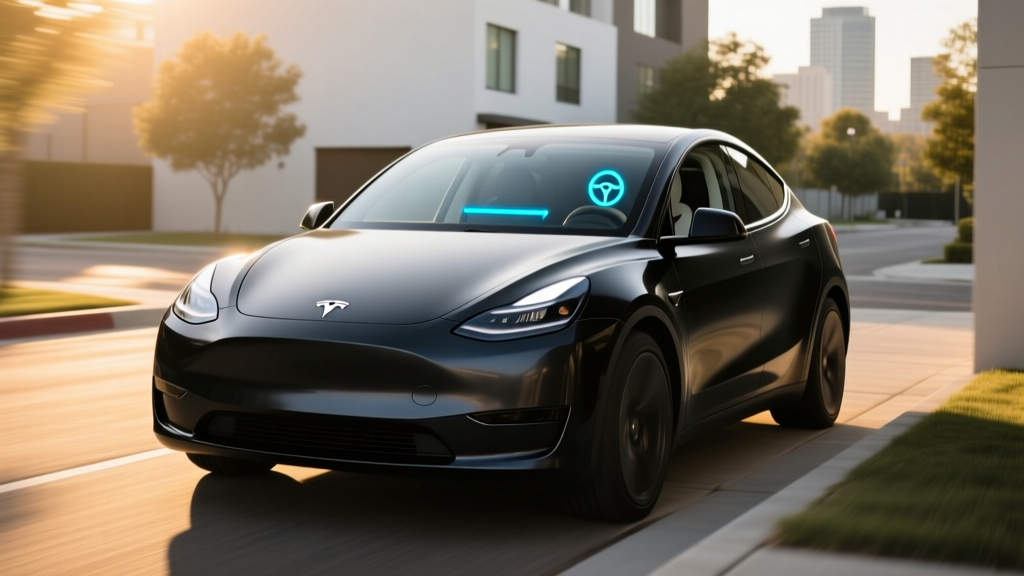
In the 2026 Tesla Model Y, the lane assist symbol appears on the instrument cluster display (or the main touchscreen, depending on your visualization settings) as a small icon depicting a vehicle between two lane lines. Its behavior changes based on system status:
- Gray lane lines: Lane Keeping is available but not actively steering.
- Blue lane lines: Autosteer is actively providing steering input within detected lanes.
- Red flashing lane lines with audible alert: Lane Departure Warning has triggered because the vehicle is drifting without a turn signal.
- Yellow lane lines: Emergency Lane Departure avoidance is intervening to prevent a potential collision or road departure.
Tesla Autopilot, including Autosteer and lane assist features, is classified as SAE Level 2 driver assistance. This means the system provides combined steering and acceleration/braking support, but the driver must remain fully engaged, keep hands on the wheel, and monitor the road at all times. It is not self-driving.
The lane assist symbol is part of a broader ADAS ecosystem that includes Traffic-Aware Cruise Control, Automatic Emergency Steering, and Blind Spot Monitoring. Tesla's vision-only approach (no lidar or radar in current models) relies on eight cameras and neural network processing to detect lane markings, vehicles, and road edges. In practice, the system performs well on clearly marked highways but can struggle with faded lane lines, construction zones, and heavy rain — situations where the lane assist symbol may flicker between gray and blue as the system loses and regains confidence.
Range, Battery, and Efficiency: Real-World Expectations
The 2026 Tesla Model Y Long Range AWD carries an EPA-estimated range of 320 miles from its 78.1 kWh usable battery pack (NMC chemistry). The base Rear-Wheel Drive model uses a 60 kWh LFP (lithium iron phosphate) battery and is EPA-rated at 260 miles. Here is the full spec breakdown:
| Specification | Long Range AWD | Rear-Wheel Drive |
|---|---|---|
| EPA Range | 320 miles | 260 miles |
| Battery (usable) | 78.1 kWh (NMC) | 60 kWh (LFP) |
| MPGe (combined) | 122 MPGe | 129 MPGe |
| Efficiency | 27 kWh/100 mi | 26 kWh/100 mi |
| Drivetrain | Dual-motor AWD | Single-motor RWD |
| Horsepower | 384 hp | 295 hp |
| 0-60 mph | 4.8 seconds | 6.6 seconds |
The EPA's 320-mile estimate for the Long Range AWD assumes mixed driving. Expect approximately 275-290 miles on a sustained highway trip at 70-75 mph, and 240-260 miles in cold weather (below 32°F) due to cabin heating demand and increased battery resistance. The LFP-equipped RWD model holds up well in daily commuting but shows more pronounced cold-weather range loss — plan for roughly 210-220 real-world miles in winter conditions.
The LFP battery in the RWD trim deserves special note. LFP chemistry trades energy density for longevity and cost — Tesla recommends charging LFP packs to 100% regularly (unlike NMC, where daily charging to 80% is preferred for long-term health). This makes the RWD model well-suited for owners who want maximum daily range from a smaller pack and plan to keep the vehicle for many years.
Charging Speed: DC Fast Charging and Home Level 2
Charging infrastructure access is a top concern for EV buyers, and the 2026 Model Y benefits from Tesla's Supercharger network — now the largest and most reliable DC fast-charging network in North America. With the native NACS (North American Charging Standard) port, the Model Y plugs directly into Superchargers without an adapter.
| Charging Level | Long Range AWD | RWD (LFP) |
|---|---|---|
| Level 1 (120V, 12A) | ~3 mi/hr | ~3 mi/hr |
| Level 2 (240V, 48A) | 11.5 kW / ~44 mi/hr | 7.6 kW / ~30 mi/hr |
| DC Fast Charge (peak) | 250 kW | 170 kW |
| 10-80% DC Fast Time | ~25 minutes | ~28 minutes |
A critical nuance: the 250 kW peak charge rate on the Long Range is not sustained across the entire session. The Model Y's charge curve peaks near 250 kW at low state of charge (around 10-20%), then tapers progressively — dropping to roughly 150 kW by 50% SoC and below 100 kW past 70%. This is why the 10-80% time is approximately 25 minutes rather than the ~18 minutes a sustained 250 kW rate would suggest. Always precondition the battery (the car does this automatically when you navigate to a Supercharger) to achieve peak charge speeds.
For home charging, the Long Range AWD's onboard charger accepts up to 11.5 kW on a 60-amp circuit (48A continuous), adding roughly 44 miles of range per hour. A full overnight charge from 20% to 80% takes about 5-6 hours. The RWD model's onboard charger maxes at 7.6 kW (32A), so plan for slightly longer home sessions. Most owners charging overnight on Level 2 will wake up to a full battery regardless.
Interior Space, Cargo, and Practicality
The 2026 Model Y remains a compact crossover, but Tesla's packaging maximizes interior volume. Here are the key dimensions:
- Cargo volume (rear seats up): 30.2 cu ft
- Cargo volume (rear seats folded): 72.1 cu ft
- Front trunk (frunk): 4.1 cu ft
- Front legroom: 41.8 inches
- Rear legroom: 41.6 inches (notably generous for the class)
- Seating: 5-passenger standard; optional 7-passenger (third row best suited for small children)
The flat floor (no transmission tunnel) and wide-opening hatch make the Model Y practical for family duty, grocery runs, and road-trip luggage. The optional third row adds versatility but significantly compromises cargo space when deployed. For buyers who regularly need three rows of seating, a larger SUV like the Kia EV9 or Rivian R1S is a better fit.
Pricing, Trims, and Federal Tax Credit Eligibility
The 2026 Tesla Model Y is available in two primary trims. Here is the pricing breakdown with federal tax credit context:
| Trim | Base MSRP | Est. §30D Credit | Effective Price* |
|---|---|---|---|
| Rear-Wheel Drive | $44,990 | Up to $7,500 | ~$37,490 |
| Long Range AWD | $48,990 | Up to $7,500 | ~$41,490 |
*Effective price assumes full §30D credit eligibility. Actual credit depends on buyer income, battery sourcing, and MSRP caps.
-
IRS §30D Federal Tax Credit Requirements (2026):
- Buyer AGI must not exceed $150,000 (single), $225,000 (head of household), or $300,000 (joint)
- Vehicle MSRP must be at or below $80,000 for SUVs (Model Y qualifies)
- Battery components must meet increasing domestic-content and critical-minerals sourcing thresholds — check IRS.gov for the latest sourcing requirements
- Credit can be transferred to the dealer at point of sale as an instant rebate (electing to reduce purchase price rather than claiming on your tax return)
As of early 2026, the Model Long Range AWD has met the battery-sourcing requirements for the full $7,500 credit, but these rules tighten annually. Always verify current eligibility on IRS.gov before purchasing, and consult a tax professional if your situation is complex.
Driver Assistance: Autopilot, Lane Assist, and FSD Supervised
Every 2026 Model Y comes standard with Tesla's Basic Autopilot, which includes:
- Traffic-Aware Cruise Control
- Autosteer (lane centering — the feature linked to the lane assist symbol)
- Lane Departure Warning and Avoidance
- Automatic Emergency Braking
- Blind Spot Monitoring with camera display
The optional Full Self-Driving (Supervised) package ($8,000 as of 2026) adds Navigate on Autopilot (automatic highway interchanges), Auto Lane Change, Smart Summon, and traffic light/stop sign recognition. Despite the "Full Self-Driving" branding, FSD Supervised remains SAE Level 2 — the driver must continuously supervise and be ready to take over instantly. Tesla's own Autopilot documentation makes this clear, and NHTSA's guidance on automated driving systems reinforces that no consumer vehicle currently sold offers unsupervised self-driving capability.
- They do not handle construction zones, unmapped road changes, or temporary lane shifts reliably
- They do not detect all obstacles — small objects, animals, and certain vehicle profiles may be missed
- They do not replace driver attention — Tesla's cabin camera monitors eye gaze and will issue escalating warnings, eventually disabling Autosteer for the remainder of the trip if ignored
- Performance degrades in heavy rain, fog, snow, or when camera lenses are obstructed
In our experience, the lane assist system works best on well-marked interstate highways. The steering inputs are smooth and confidence-inspiring on straightaways and gentle curves. However, on winding two-lane roads with faded markings, the system can hunt for lane boundaries — the lane assist symbol will oscillate between active (blue) and inactive (gray), which can feel disconcerting. We recommend treating Autosteer as a highway fatigue-reducer rather than a set-and-forget system.
Warranty and Long-Term Ownership
Tesla's warranty coverage for the 2026 Model Y:
- Basic Vehicle Limited Warranty: 4 years / 50,000 miles
- Battery & Drive Unit Warranty (Long Range AWD): 8 years / 120,000 miles (minimum 70% capacity retention)
- Battery & Drive Unit Warranty (RWD): 8 years / 100,000 miles (minimum 70% capacity retention)
The 70% retention threshold is industry-standard — it means Tesla will replace or repair the battery if it degrades below 70% of original capacity within the warranty period. Real-world data from Tesla's fleet suggests average degradation of roughly 10-12% over 150,000 miles for NMC packs, with LFP packs showing even slower degradation curves. Out-of-warranty battery replacement costs remain high — expect $12,000-$16,000 for a Long Range pack if needed beyond the warranty window.
Pros, Cons, and the Verdict
Pros
- Class-leading Supercharger network access (native NACS)
- Spacious rear legroom (41.6 in) and generous cargo area
- Strong real-world efficiency (26-27 kWh/100 mi)
- Smooth, responsive lane assist and Autopilot on highways
- Over-the-air updates continuously add features
- LFP option for cost-conscious, longevity-focused buyers
Cons
- No physical instrument cluster — all info on central screen
- FSD Supervised costs $8,000 and remains Level 2 only
- Ride quality can feel firm over rough pavement
- Vision-only ADAS struggles in heavy precipitation
- Turn-signal stalk removed — steering-wheel buttons take adjustment
- Optional third row is impractical for anyone over age 8
Who Should Buy the 2026 Model Y?
Choose the Model Y if: You want access to the best DC fast-charging network, prioritize efficiency and range, commute on well-marked highways where lane assist shines, and value OTA software updates.
Look elsewhere if: You need true hands-free driving on mapped highways (consider GM's Super Cruise or Ford's BlueCruise), want a traditional instrument cluster, frequently drive in heavy snow/rain where vision-only ADAS falters, or need a genuinely usable third row.
Frequently Asked Questions
What is the real-world range of the 2026 Tesla Model Y?
The Long Range AWD delivers approximately 275-290 miles on highway trips and 240-260 miles in cold weather, versus its 320-mile EPA estimate. The RWD model yields roughly 230-245 miles in moderate conditions and 210-220 in winter.
How fast does the 2026 Model Y charge?
On a V3/V4 Supercharger, the Long Range AWD peaks at 250 kW and charges from 10-80% in approximately 25 minutes. At home on a 48-amp Level 2 charger, it adds about 44 miles of range per hour (11.5 kW).
How much does the 2026 Model Y cost after tax credits?
The RWD starts at $44,990 and the Long Range AWD at $48,990. Eligible buyers can receive up to $7,500 via the §30D federal credit (transferred at point of sale), bringing effective prices to approximately $37,490 and $41,490 respectively. Verify eligibility on IRS.gov.
Is the 2026 Model Y worth buying vs. competitors?
The Model Y's Supercharger access, efficiency, and cargo space keep it competitive against the Hyundai Ioniq 5, Ford Mustang Mach-E, and Kia EV6. Its main trade-offs are the lack of a physical instrument cluster, vision-only ADAS limitations, and the $8,000 FSD cost for features that remain Level 2.
Does the lane assist symbol mean the car is driving itself?
No. The lane assist symbol indicates that Autosteer (SAE Level 2) is active or available. The driver must remain fully engaged, hands on the wheel, and eyes on the road at all times. Tesla's cabin camera enforces this with escalating warnings.
Does the 2026 Model Y qualify for the federal EV tax credit?
As of early 2026, both trims are eligible for the full $7,500 §30D credit, provided the buyer meets income thresholds ($150K single / $300K joint) and the vehicle's battery sourcing meets current-year requirements. Rules change annually — always confirm on IRS.gov before purchasing.