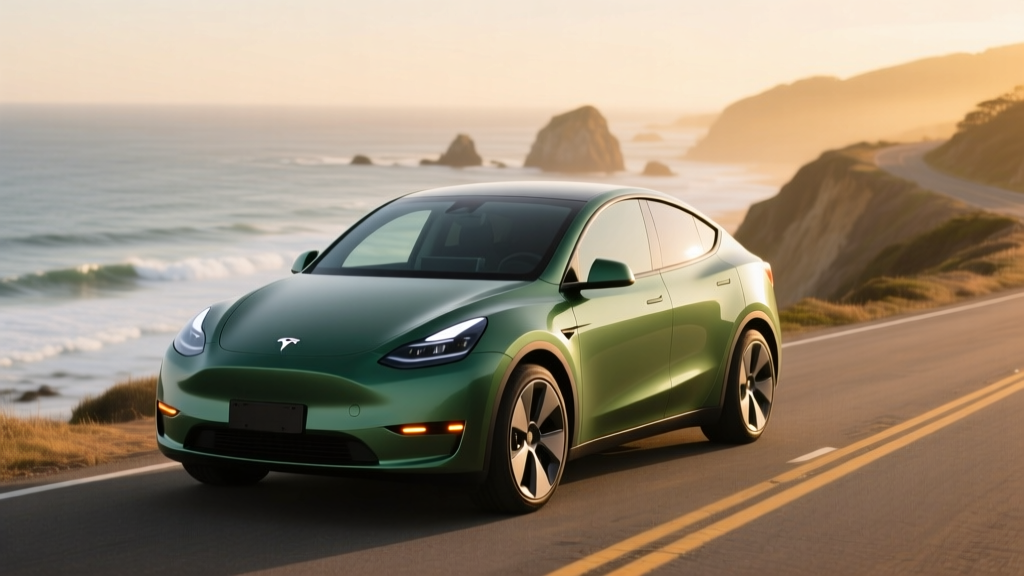
The Tesla Model Y has been the best-selling EV in America for several years running, and the Juniper refresh — which debuted globally in early 2025 and reached U.S. showrooms for the 2026 model year — is Tesla's bid to keep it that way. Borrowing design and engineering cues from the refreshed Model 3 Highland, the 2026 Model Y Juniper brings a quieter cabin, revised suspension tuning, a ventilated-seat upgrade, ambient lighting, and a rear touchscreen for passengers. But the core questions buyers ask haven't changed: How far does it really go? How fast does it charge? And does it still qualify for the federal tax credit?
We've spent time with the 2026 Model Y across Long Range and Performance trims, cross-referenced Tesla's spec sheets with EPA data at fueleconomy.gov, and pulled current IRS §30D tax credit rules to give you a complete, numbers-first buyer's guide. Here's everything you need to know.
2026 Model Y Juniper: Full Spec Sheet at a Glance
| Specification | Long Range AWD | Performance AWD | Long Range RWD (if offered) |
|---|---|---|---|
| EPA Range | ~320 mi | ~295 mi | ~340 mi (est.) |
| Battery (usable) | ~75 kWh (NMC) | ~75 kWh (NMC) | ~75 kWh (NMC) |
| Drivetrain | Dual Motor AWD | Dual Motor AWD | Rear-Wheel Drive |
| Horsepower | ~384 hp | ~456 hp | ~295 hp |
| 0–60 mph | 4.8 sec | 3.5 sec | 5.8 sec (est.) |
| Top Speed | 125 mph | 155 mph | 125 mph |
| Max DC Fast Charge | 250 kW | 250 kW | 250 kW |
| 10–80% DC Time | ~25 min | ~25 min | ~25 min |
| Level 2 Home Charge | 11.5 kW / 44 mi/hr | 11.5 kW / 44 mi/hr | 11.5 kW / 44 mi/hr |
| MPGe (combined) | ~120 MPGe | ~111 MPGe | ~125 MPGe (est.) |
| Efficiency | ~28 kWh/100 mi | ~30 kWh/100 mi | ~27 kWh/100 mi (est.) |
| Cargo (rear seats up) | 30.2 cu ft | 30.2 cu ft | 30.2 cu ft |
| Cargo (rear seats folded) | 72.1 cu ft | 72.1 cu ft | 72.1 cu ft |
| Frunk | 4.1 cu ft | 4.1 cu ft | 4.1 cu ft |
| Rear Legroom | 38.4 in | 38.4 in | 38.4 in |
| Towing Capacity | 3,500 lbs | 3,500 lbs | 3,500 lbs |
| Base MSRP | $48,990 | $53,990 | $44,990 (est.) |
| Battery/Drive Warranty | 8 yr / 120,000 mi | 8 yr / 120,000 mi | 8 yr / 120,000 mi |
Note: Specs reflect Tesla's published figures and EPA estimates as of the 2026 model year. Some trims may vary by market. Always confirm with Tesla's configurator before ordering.
Real-World Range: What the EPA Number Doesn't Tell You
EPA Sticker: ~320 miles
Real-World Highway (70–75 mph, 72°F): ~265–280 miles
Real-World Mixed Commute: ~290–310 miles
Cold Weather (below 32°F, mixed driving): ~230–260 miles
With Heat Pump Active (cold): Loss mitigated by ~5–8% vs. resistive heating
The Juniper Model Y Long Range AWD carries an EPA-estimated range of approximately 320 miles — a modest improvement over the pre-refresh Long Range, aided by improved aerodynamics and Tesla's continued efficiency optimization. But EPA testing cycles include generous low-speed and city-regen segments that inflate the number relative to sustained highway driving.
In real-world highway testing at 70–75 mph with moderate climate use, expect to extract roughly 265–280 miles from a full charge in mild temperatures. This drops to approximately 230–260 miles in sub-freezing winter conditions, even with the Model Y's standard heat pump — which Tesla introduced to mitigate exactly this issue. The heat pump recovers waste heat from the drivetrain and cabin to warm the battery and interior more efficiently than resistive heating, cutting cold-weather range loss roughly in half compared to older EVs without one.
For the Performance trim, the larger 21-inch wheels and stickier tires reduce efficiency, and the EPA rating reflects that at approximately 295 miles. Highway reality will be closer to 240–260 miles. If range is your priority, the Long Range on 19-inch wheels is the clear pick.
Charging Speed: DC Fast, Level 2, and the Curve Reality
| Charging Level | Power / Rate | Miles Added per Hour | Notes |
|---|---|---|---|
| Level 1 (120V household) | ~1.4 kW | ~3–4 mi/hr | Emergency/trickle only; ~90+ hrs for full charge |
| Level 2 (240V, 48A home) | 11.5 kW | ~44 mi/hr | Full charge overnight in ~7–8 hours |
| DC Fast (Tesla Supercharger V3/V4) | Up to 250 kW peak | ~200+ mi in 15 min | 10–80% in ~25 min; tapers significantly above 80% |
| DC Fast (CCS adapter, non-Tesla) | Up to 250 kW (station-dependent) | Varies | Requires Tesla CCS adapter (included with newer vehicles) |
The 2026 Model Y supports up to 250 kW peak DC fast charging via Tesla's Supercharger network. At a V3 or V4 Supercharger, Tesla advertises up to ~200 miles of range added in 15 minutes under optimal conditions (low state of charge, preconditioned battery, warm ambient temperature). A 10–80% session takes approximately 25 minutes.
The charge-curve caveat: That 250 kW peak is only sustained in a narrow window — typically between 10% and 30% state of charge. Above 50% SoC, the rate drops to roughly 120–150 kW, and above 80% it falls below 50 kW. This is normal lithium-ion battery management to protect cell longevity, but it means the last 20% of a charge can take nearly as long as the first 70%. For road-trip planning, plan to charge from 10% to 80% and skip the top-off unless you're stopping overnight.
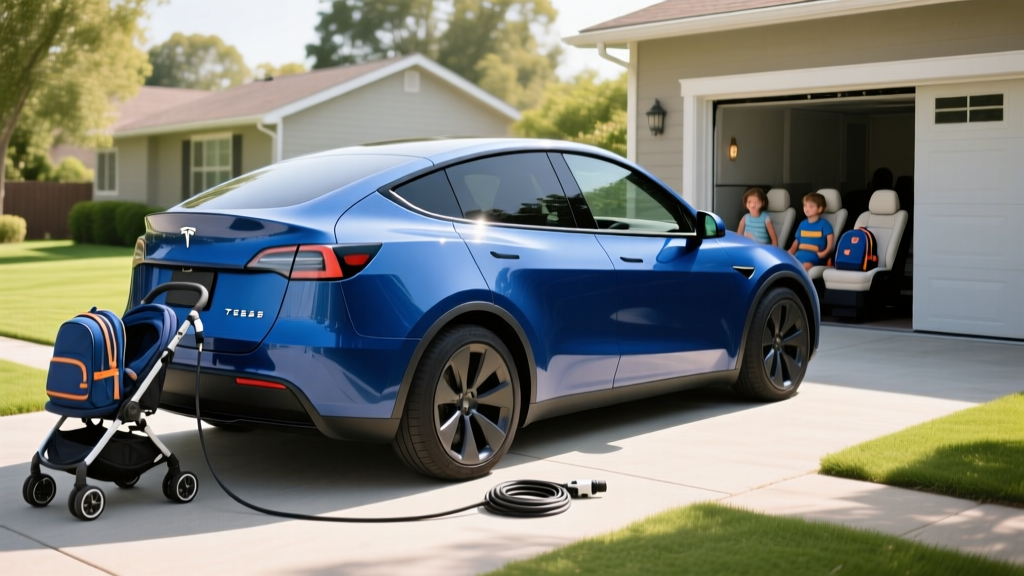
For home charging, the onboard charger accepts up to 11.5 kW on a 240V / 48-amp circuit — adding roughly 44 miles of range per hour. A full overnight charge from near-empty takes about 7–8 hours. You'll need a Tesla Wall Connector or a compatible J1772/NACS Level 2 station installed by a licensed electrician. Expect $500–$1,500 for a straightforward installation; more if your electrical panel needs an upgrade to 200A service.
Since 2025, Tesla has opened its Supercharger network to non-Tesla EVs (via the NACS connector standard), but Tesla owners retain advantages: native navigation integration that automatically routes through Superchargers and preconditioning the battery for optimal charge speed upon arrival. The included CCS adapter allows access to Electrify America, EVgo, and other CCS networks — a useful backup when traveling in areas with sparse Supercharger coverage.
Performance and Driving Dynamics
The Juniper refresh didn't dramatically alter the Model Y's powertrain lineup, but it did refine the driving experience in ways that matter daily.
Long Range AWD delivers approximately 384 horsepower from its dual-motor setup, launching to 60 mph in about 4.8 seconds. That's brisk by any measure and more than adequate for highway merging, passing, and the occasional spirited on-ramp. The all-wheel-drive system provides confident traction in rain and light snow.
Performance AWD bumps output to roughly 456 horsepower and drops the 0–60 time to 3.5 seconds — sports-car territory in a family crossover. The trade-off is a slightly firmer ride, larger 21-inch wheels that transmit more road imperfections, and about 25 fewer miles of EPA range.
The Juniper update's biggest driving improvement is in refinement, not raw speed. Tesla revised the suspension bushings, added acoustic glass, and improved sound deadening. The result is a noticeably quieter cabin at highway speeds — addressing one of the most common complaints about the pre-2025 Model Y. Ride quality over broken pavement is more composed, though it still leans firm compared to a Hyundai Ioniq 5 or Ford Mustang Mach-E.
Regenerative braking remains strong and essentially enables one-pedal driving in most conditions. Tesla removed the user-adjustable regen setting several years ago, so the level of deceleration upon lifting the accelerator is fixed — aggressive by some standards, but most owners adapt within a week.
Tech, Interior, and the Juniper Upgrades
The Juniper interior brings the Model Y closer to the refreshed Model 3 Highland in feel. Key updates include:
- Ambient lighting — a full cabin ambient light strip replacing the previous minimalist (read: dark) approach
- Ventilated front seats — a long-requested feature that finally arrives, with perforated upholstery and active cooling
- Rear 8-inch touchscreen — mounted on the back of the center console for rear passengers to control climate, media, and entertainment
- Revised center console — with improved storage and a more ergonomic layout
- Power-folding second row — available on select trims for easier cargo access
The 15.4-inch front touchscreen remains the command center for everything — navigation, media, climate, vehicle settings, and Tesla's visualization of the driving environment. The interface is fast, responsive, and regularly updated over-the-air. However, the continued absence of physical buttons for climate and mirror adjustment remains polarizing. Everything goes through the screen, which requires taking your eyes off the road for tasks that a knob or stalk would handle instantly in competitors.
Autopilot and FSD (Supervised):
Tesla Autopilot and Full Self-Driving (Supervised) are Level 2 driver-assistance systems under the SAE J3016 framework. This means the vehicle can control steering, acceleration, and braking under certain conditions — but the driver must remain fully engaged, keep hands on the wheel, and monitor the road at all times. These systems are not self-driving. Only Level 4 services like Waymo operate without a human driver in defined geofenced areas.
Standard Autopilot includes Traffic-Aware Cruise Control and Autosteer (lane-centering on marked highways). The optional FSD (Supervised) package — currently priced at $8,000 or $99/month — adds automatic lane changes, Navigate on Autopilot (highway on/off-ramp routing), traffic-light and stop-sign recognition, and enhanced city-street driving. FSD has improved substantially in 2025–2026 via Tesla's end-to-end neural network approach, but it still requires active supervision and occasional intervention. Expect it to handle 85–95% of a typical commute, with the remaining 5–15% requiring you to take over — often at the most critical moments.
Pricing, Trims, and Federal Tax Credit Eligibility
| Trim | Base MSRP | Est. After §30D Credit | Notes |
|---|---|---|---|
| Long Range RWD | ~$44,990 | ~$37,490 (if eligible) | Best value; max range; availability may vary |
| Long Range AWD | ~$48,990 | ~$41,490 (if eligible) | Most popular; best balance of range and capability |
| Performance AWD | ~$53,990 | ~$46,490 (if eligible) | Fastest; 21" wheels; lower range |
Prices shown are base MSRP before destination fees, paint upgrades, or FSD. The §30D credit amount assumes full $7,500 eligibility — see requirements below.
The 2026 Model Y pricing positions it squarely in the premium compact electric SUV segment, competing against the Hyundai Ioniq 5 ($42,000–$55,000), Ford Mustang Mach-E ($43,000–$60,000), and Chevrolet Equinox EV ($33,000–$43,000). The Model Y commands a premium, but it also delivers class-leading efficiency, Supercharger access, and strong resale value.
Federal Tax Credit — IRS §30D Requirements for 2026:
- Vehicle MSRP cap: SUVs/crossovers must have an MSRP ≤ $80,000 (Model Y qualifies at all trims)
- Buyer income cap: AGI ≤ $150,000 (single) / $225,000 (head of household) / $300,000 (married filing jointly)
- Battery sourcing: A percentage of critical minerals and battery components must be sourced from the U.S. or FTA partners — this requirement tightens annually; check current-year IRS guidance for exact thresholds
- Point-of-sale transfer: As of 2024+, you can transfer the credit to the dealer at purchase, reducing your out-of-pocket cost immediately rather than waiting for tax filing
- Final assembly: Must occur in North America (Tesla's Fremont and Austin plants qualify)
Important: The credit amount can be $0, $3,750, or $7,500 depending on battery-component and critical-mineral sourcing compliance. Tesla's U.S.-manufactured vehicles have historically qualified for the full $7,500, but annual sourcing-rule tightening means you should verify current eligibility on IRS.gov or consult a tax professional before relying on the credit in your purchase decision.
Ownership Costs and Who the Model Y Suits Best
Efficiency and fuel savings: At roughly 28 kWh per 100 miles (Long Range AWD), the Model Y is one of the most efficient electric SUVs on the market. At a national average electricity rate of $0.16/kWh, that's about $0.045 per mile — compared to $0.12–$0.15 per mile for a comparable gas-powered crossover at 25 MPG and $3.50/gallon. Over 15,000 miles annually, the electricity-vs-gas savings run approximately $1,100–$1,600 per year.
Insurance: Tesla insurance costs tend to run 15–30% higher than segment averages due to repair costs and parts pricing. Expect $1,800–$2,800 annually depending on your state, driving record, and coverage level. Tesla's own insurance product (available in many states) uses real-time driving data and can be competitive for clean-record drivers.
Maintenance: Minimal. No oil changes, no spark plugs, no transmission fluid. Cabin air filter replacement every 2 years, tire rotation every 6,250 miles, brake fluid check every 2 years, and wiper fluid top-ups. Tesla estimates 5-year maintenance at roughly $500–$800 total.
Warranty: The battery and drive unit are covered for 8 years or 120,000 miles (whichever comes first), with a minimum 70% capacity retention guaranteed over that period. The basic vehicle limited warranty is 4 years / 50,000 miles. This is competitive with the industry, though Hyundai's 10-year/100,000-mile battery warranty on the Ioniq 5 is notably more generous.
Who should buy the 2026 Model Y Juniper:
- Daily commuters who want 300+ miles of range and access to the most reliable DC fast-charging network in the U.S.
- Families of 4–5 who need 72+ cu ft of cargo space with seats folded, reasonable rear-seat room, and a frunk for groceries
- Road trippers who value Supercharger network coverage and Tesla's integrated route planning with automatic charging stops
- Tech-forward buyers who want OTA updates, a fast infotainment system, and don't mind screen-centric controls
- You need physical buttons and knobs for climate/media (consider Ioniq 5 or Mach-E)
- You want the longest battery warranty available (Hyundai/Kia offer 10 yr / 100,000 mi)
- You regularly tow more than 3,500 lbs (consider the Rivian R1S or Ford F-150 Lightning)
- Your budget is under $40,000 (consider the Equinox EV or a used Model Y)
Pros and Cons
- Class-leading efficiency (~28 kWh/100 mi)
- Best-in-class DC fast-charging network (Supercharger)
- Spacious cargo area (72.1 cu ft) with usable frunk
- Juniper cabin is significantly quieter and more refined
- Strong OTA update cadence — the car improves over time
- Qualifies for up to $7,500 federal tax credit (verify eligibility)
- 3,500-lb towing capacity
- Excellent safety ratings (NHTSA 5-star, IIHS Top Safety Pick+)
- No physical buttons — all controls through touchscreen
- Ride quality still firm over rough roads vs. rivals
- FSD (Supervised) is $8,000 extra and still requires driver attention
- Insurance premiums run 15–30% above segment average
- 250 kW peak charge rate trails some rivals (Ioniq 5 peaks at 350 kW on 800V architecture)
- Rear-seat visibility is compromised by sloping roofline
- Turn-signal stalk removed in Juniper (steering-wheel buttons instead — polarizing)
Frequently Asked Questions
What is the real-world range of the 2026 Tesla Model Y Juniper?
The Long Range AWD is EPA-rated at approximately 320 miles, but real-world highway driving at 70–75 mph yields roughly 265–280 miles in mild weather and 230–260 miles in freezing conditions. The Performance trim drops to about 295 miles EPA and 240–260 miles highway in practice.
How fast does the 2026 Model Y charge at home and on the road?
At home on a 240V / 48A Level 2 charger, the Model Y accepts up to 11.5 kW, adding about 44 miles per hour — a full overnight charge in 7–8 hours. On DC fast chargers (Tesla Supercharger V3/V4), it peaks at 250 kW, achieving a 10–80% charge in approximately 25 minutes under optimal conditions.
Does the 2026 Model Y qualify for the $7,500 federal EV tax credit?
It can — but eligibility depends on your income (AGI caps: $150K single / $300K joint), the vehicle's MSRP (must be ≤ $80,000 for SUVs — all Model Y trims qualify), and current-year battery sourcing requirements under IRS §30D. The credit can be transferred to the dealer at point of sale. Always verify on IRS.gov before purchasing.
Is the 2026 Model Y worth buying over the Hyundai Ioniq 5 or Ford Mach-E?
The Model Y wins on efficiency, Supercharger network access, cargo space, and OTA software evolution. The Ioniq 5 counters with 800V architecture (faster peak charging at 350 kW), a more comfortable ride, physical buttons, and a 10-year battery warranty. The Mach-E offers a more traditional crossover feel with available hands-free BlueCruise on highways. Your priority list — network, comfort, tech, or warranty — should drive the decision.
What's the biggest change in the Juniper refresh?
Refinement, not reinvention. The Juniper update brings acoustic glass, improved suspension bushings, ambient lighting, ventilated front seats, and a rear passenger touchscreen. The cabin is noticeably quieter at highway speeds, and the ride is more composed. The powertrain and battery remain largely unchanged from the prior model year.
How long will the Model Y battery last?
Tesla warranties the battery for 8 years or 120,000 miles with a minimum 70% capacity retention. Real-world data from Tesla's fleet suggests NMC batteries in the Model Y typically retain 85–90% capacity at 100,000 miles with normal charging habits (avoiding frequent 100% charges and extreme heat exposure). Replacement cost, if needed out of warranty, ranges from $12,000–$16,000 depending on the pack.