The Juniper Refresh: What Changed and Why It Matters
Tesla's mid-cycle refresh of its best-selling SUV — internally codenamed "Juniper" — arrived for the 2025 model year and carries into 2026 with minor trim and pricing adjustments. For buyers evaluating new Tesla products, the refreshed Model Y is the volume leader: it remains the default compact electric crossover for American families, and the Juniper updates address the most common complaints about the pre-refresh car (ride harshness, cabin noise, dated interior). This review covers the 2026 lineup as it stands today: the Long Range AWD and the Performance AWD. The base RWD variant was discontinued in the U.S. market after a brief 2025 run.
The 2026 Model Y Long Range AWD starts at $44,990 before incentives and delivers an EPA-rated 320 miles of range. The Performance trim starts at $48,990 with 303 miles EPA. Both use a 78.1 kWh (usable) NMC battery pack and support 250 kW DC fast charging on Tesla's Supercharger network. Below, we break down what those numbers mean in practice — on the highway, in cold weather, and at the charger.
Spec Table: 2026 Tesla Model Y Lineup at a Glance
| Spec | Long Range AWD | Performance AWD |
|---|---|---|
| EPA Range | 320 mi | 303 mi |
| Battery (usable) | 78.1 kWh, NMC | 78.1 kWh, NMC |
| MPGe (combined) | 111 MPGe | 107 MPGe |
| Efficiency | 30 kWh/100 mi | 31 kWh/100 mi |
| 0–60 mph | 4.8 sec | 3.5 sec |
| Horsepower | 384 hp | 456 hp |
| Drivetrain | Dual-motor AWD | Dual-motor AWD |
| Max DC Charge Rate | 250 kW | 250 kW |
| 10–80% DC Time | ~27 min | ~27 min |
| Level 2 Home Rate | 11.5 kW (~44 mi/hr) | 11.5 kW (~44 mi/hr) |
| Cargo (rear up / folded) | 30.2 / 72.1 cu ft | 30.2 / 72.1 cu ft |
| Rear Legroom | 41.6 in | 41.6 in |
| Battery Warranty | 8 yr / 120,000 mi | 8 yr / 120,000 mi |
| Base MSRP | $44,990 | $48,990 |
Sources: EPA fueleconomy.gov, Tesla.com.
Real-World Range: What the EPA Number Doesn't Tell You
Real-World Highway (70–80 mph, moderate temps): ~265–285 mi
Cold Weather (below 30°F, highway): ~220–250 mi
City / Commuter Driving: ~300–320 mi (regen-friendly)
The Model Y's 320-mile EPA rating is among the highest in its segment, but EPA testing cycles favor mixed driving with substantial low-speed and regenerative-braking segments. On a sustained 75 mph highway run in 65–75°F weather, expect roughly 265–285 miles before the battery hits 10% State of Charge (SoC). Pushing 80+ mph or climbing mountain grades will compress that further.
Cold weather is the bigger variable. At 20°F, lithium-ion cells experience higher internal resistance, and cabin heating draws significant energy even with the Model Y's standard heat pump. In our experience and consistent with third-party cold-weather testing, expect a 20–30% range reduction in sustained sub-freezing highway driving. Preconditioning the battery while plugged in — a feature Tesla enables via the app and scheduled departure — recovers some of that loss by warming the pack before you drive.
For daily commuters covering under 60 miles round-trip, range is a non-issue regardless of climate. The 320-mile EPA figure matters most for road-trippers who want to minimize charging stops on 300+ mile journeys.
Charging Speed: Supercharger Network and Home Level 2
| Charging Level | Power | Speed (approx.) | Typical Use Case |
|---|---|---|---|
| Level 1 (120V) | ~1.4 kW | ~5 mi/hr | Emergency / trickle |
| Level 2 (240V, 48A) | 11.5 kW | ~44 mi/hr | Home overnight |
| DC Fast (Supercharger V3) | Peak 250 kW | 10–80% in ~27 min | Road trips |
| DC Fast (Supercharger V4) | Peak 250 kW* | 10–80% in ~27 min | Road trips (newer stations) |
*The Model Y Juniper's onboard architecture caps at ~250 kW. V4 Supercharger posts can deliver higher power, but the vehicle is the bottleneck.
Tesla's 250 kW peak charge rate is competitive but not class-leading — the Hyundai Ioniq 5 peaks at ~240 kW on a 350 kW charger but sustains a flatter charge curve, often matching or beating the Model Y in real-world 10–80% times. The Model Y's charge curve tapers noticeably above 60% SoC. You'll see 250 kW briefly in the 10–25% range, then a step down to ~170 kW through 50%, and further reduction to ~100 kW by 70%. Plan road-trip charging stops around 10–80% windows to avoid the slow tail above 80%.
At home on a Tesla Wall Connector (or any 48A Level 2 EVSE on a 60A circuit), the Model Y adds roughly 44 miles of range per hour. A full overnight charge from 20% to 80% takes about 4 hours — well within a typical overnight window. Installation costs for a 240V/60A circuit range from $500 to $2,500 depending on panel proximity and local permitting; budget $1,200–$1,800 for a typical single-family home with a 200A panel. Homes with older 100A panels may need a $2,000–$4,000 panel upgrade — consult a licensed electrician for a site assessment.
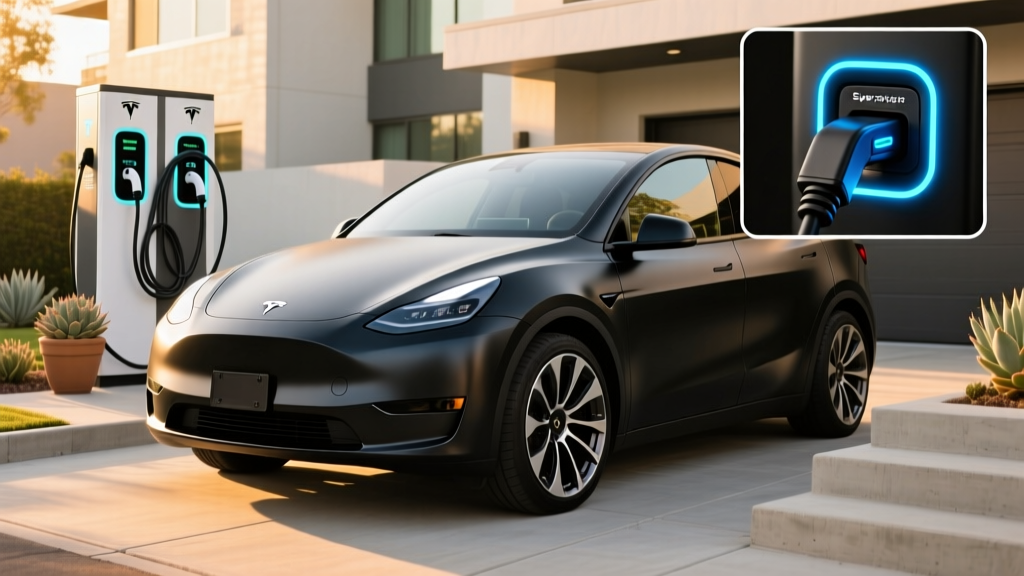
One significant Juniper advantage: the 2026 Model Y now ships with a NACS (North American Charging Standard) port natively, eliminating the need for the CCS-to-NACS adapter that earlier Tesla owners used at non-Tesla DC chargers. With Ford, GM, Rivian, and others now accessing Superchargers via NACS, the network is busier — but it remains the most reliable DC fast-charging network in the U.S. by uptime metrics.
Performance, Ride, and the Juniper Refinement
The Long Range AWD's 4.8-second 0–60 mph time is brisk for a family crossover, and the dual-motor setup provides confident all-weather traction. The Performance trim's 3.5-second sprint puts it in sports-car territory, though at the cost of ~17 miles of EPA range and a firmer suspension tune.
The Juniper refresh's most meaningful changes aren't on the spec sheet. Tesla added acoustic laminated glass all around, revised the suspension bushings and damping, and redesigned the seats with better bolstering and ventilation. The result: the Model Y is noticeably quieter at highway speed (roughly 2–3 dB reduction in cabin noise by our estimation) and no longer crashes over expansion joints the way the pre-2025 car did. It's still not Lexus-quiet, but it's competitive with the BMW iX3 and Genesis GV60 now.
The 15.4-inch center touchscreen remains the sole interface for virtually all vehicle controls — no physical instrument cluster, no stalks (turn signals are on the steering wheel rim, a change from the pre-refresh car). This minimalist approach divides buyers. Those who adapt quickly appreciate the clean dash; others find the lack of physical HVAC or wiper controls frustrating, especially while driving.
Pricing, Tax Credits, and Total Cost
| Trim | Base MSRP | Est. After §30D Credit | Notes |
|---|---|---|---|
| Long Range AWD | $44,990 | ~$37,490* | Below $50,000 SUV cap |
| Performance AWD | $48,990 | ~$41,490* | Below $50,000 SUV cap |
*Assumes full $7,500 federal tax credit under IRS §30D. Eligibility requires: buyer AGI under $150K single / $300K joint; vehicle MSRP under $80K for SUVs (Model Y qualifies); battery components and critical minerals meeting 2026 sourcing thresholds. The credit can now be transferred to the dealer at point of sale as an instant rebate. Verify eligibility with a tax professional — rules are subject to change.
The Model Y's pricing sits in a sweet spot: well under the $80,000 MSRP cap for SUVs and eligible for the full $7,500 credit assuming the buyer meets income limits and the battery sourcing requirements are satisfied for the specific build week. Tesla's U.S.-built packs (from Gigafactory Nevada and Texas) have generally met critical-mineral and component thresholds, but Tesla does not publish per-VIN sourcing data publicly — check the dealer or Tesla's website at time of purchase.
On a 5-year total-cost-of-ownership basis, the Model Y Long Range remains one of the most affordable electric SUVs to operate. Electricity costs average $0.16/kWh nationally, putting a full charge at roughly $12.50 — versus $50–$65 for a comparable gas crossover at 25 MPG and $3.50/gallon. Insurance runs higher than gas equivalents (budget $1,800–$2,400/year depending on state and driving record), and Tesla's direct-to-consumer service model means fewer service centers but also fewer dealer markups.
Tech, Driver Assistance, and Interior
The Model Y's tech stack is anchored by Tesla's proprietary infotainment system — fast, responsive, and integrated with navigation, Supercharger routing, and over-the-air updates. Juniper adds a second 8-inch screen for rear passengers (climate and media control), ventilated front seats, power-folding second row, and ambient lighting.
On driver assistance: Tesla's Autopilot (standard) and Full Self-Driving Supervised ($8,000 option or $99/month) remain SAE Level 2 systems. The driver must keep hands on the wheel and eyes on the road at all times. FSD Supervised handles city streets, stop signs, and highway lane changes competently in many scenarios, but it is not autonomous — it makes errors at construction zones, unprotected left turns, and unusual intersections. Tesla's camera-only "Tesla Vision" approach (no LiDAR, no radar) works well in clear conditions but can struggle in heavy rain, fog, or direct low-angle sun.
Cargo space remains generous: 30.2 cubic feet behind the second row and 72.1 cubic feet with the rear seats folded — competitive with the Ford Mustang Mach-E (29.7/59.7 cu ft) and slightly behind the Hyundai Ioniq 5 (27.2/59.3 cu ft). The front trunk (frunk) adds another 4.1 cubic feet for charging cables or a small bag.
Pros and Cons
Pros
- Class-leading EPA range (320 mi) in Long Range trim
- Access to Tesla Supercharger network — highest uptime in the U.S.
- Excellent efficiency (30 kWh/100 mi) keeps charging costs low
- Strong performance (4.8 sec 0–60) with standard AWD
- OTA updates continuously add features
- Juniper ride and noise improvements are substantial
Cons
- No physical controls — all functions through the touchscreen
- Turn signals on the steering wheel rim take significant adaptation
- FSD Supervised is expensive ($8,000) and still requires full driver attention
- 250 kW peak charge rate is no longer class-leading
- Service center availability varies widely by region
- Insurance premiums run 15–30% higher than gas equivalents
Who Should Buy the 2026 Model Y — and Who Should Look Elsewhere
- You want maximum range and efficiency in a compact electric SUV
- You road-trip regularly and value Supercharger network access
- You prefer minimal, tech-forward interiors with strong OTA support
- You can charge at home (Level 2) and your daily commute is under 80 miles
- You want physical buttons and a traditional instrument cluster (BMW iX3, Genesis GV60)
- You need faster DC charging for frequent long-distance driving (Hyundai Ioniq 5, Kia EV6)
- You want a third row (Kia EV9, though it's a larger, pricier vehicle)
- You prefer a traditional dealership experience with local service (Ford Mustang Mach-E)
The 2026 Model Y remains the default recommendation for buyers entering the EV market for the first time — it's the Toyota RAV4 of electric crossovers, refined enough for most use cases and backed by the strongest charging infrastructure available. Among new Tesla products, it's the most practical and broadly appealing. The Juniper refresh closes the refinement gap that competitors had exploited, and the 320-mile EPA range keeps it at the top of the segment. If you can charge at home and don't need physical controls, it's hard to beat on value after the federal tax credit.
Frequently Asked Questions
What is the real-world range of the 2026 Tesla Model Y?
Expect 265–285 miles on the highway in moderate temperatures, dropping to 220–250 miles in sustained sub-freezing conditions. City and commuter driving with regenerative braking can approach the 320-mile EPA sticker. Preconditioning the battery while plugged in helps recover cold-weather range.
How fast does the Model Y charge at home and on road trips?
On a 48A Level 2 home charger, the Model Y adds about 44 miles of range per hour — a 20–80% charge takes roughly 4 hours overnight. On a V3 or V4 Supercharger, 10–80% takes approximately 27 minutes, though the charge curve tapers above 60% SoC. Plan stops around the 10–80% window for best efficiency.
Does the 2026 Model Y qualify for the $7,500 federal EV tax credit?
The Model Y qualifies as an SUV under the $80,000 MSRP cap. Buyers must meet income limits ($150K single, $300K joint AGI) and the vehicle must meet battery-sourcing requirements under IRS §30D. The credit can be applied at point of sale as an instant discount. Verify your specific eligibility with a tax professional.
Is the Model Y worth buying vs. the Hyundai Ioniq 5 or Ford Mach-E?
The Model Y wins on EPA range (320 vs. 303 mi for Ioniq 5, 290 mi for Mach-E Extended Range) and Supercharger access. The Ioniq 5 charges faster on non-Tesla networks and offers physical controls. The Mach-E provides a more traditional dealership and service experience. If Supercharger access and maximum range are your priorities, the Model Y is the strongest pick.
What is the battery warranty on the 2026 Model Y?
Tesla covers the battery and drive unit for 8 years or 120,000 miles (whichever comes first) on the Long Range and Performance trims, with a minimum 70% capacity retention guarantee over that period. This is competitive with Hyundai's 10-year/100,000-mile warranty but shorter in years. Real-world degradation data from Tesla's fleet suggests most packs retain 85–90% capacity at 100,000 miles.
Is Tesla's FSD actually self-driving?
No. FSD (Supervised) is an SAE Level 2 driver-assistance system. It can navigate highways, city streets, and parking lots, but the driver must remain fully engaged — hands on the wheel, eyes on the road — at all times. It is not autonomous, and the driver is legally responsible for the vehicle's operation.