Quick Verdict: The Benchmark Compact Electric SUV Gets a Major Refresh
The 2026 Tesla Model Y "Juniper" refresh addresses the most common complaints owners leveled at its predecessor: cabin noise, ride harshness, and a spartan interior that felt more austere than premium. With a redesigned SUV Tesla interior featuring ventilated front seats, ambient lighting, a rear touchscreen, and significantly improved NVH (noise, vibration, harshness) insulation, the 2026 Model Y reclaims its position as the default choice in the compact electric SUV segment — even as rivals like the Hyundai Ioniq 5, Ford Mustang Mach-E, and Kia EV6 close the gap on range and charging speed.
Under the skin, the Juniper retains the proven 75 kWh (usable) battery pack and adds a slightly more efficient heat pump and revised motor calibration that bumps EPA range to 320 miles on the Long Range AWD trim. Charging speed remains competitive at a peak 250 kW on V3 Superchargers, though the taper curve above 80% still lags behind Hyundai's E-GMP architecture. Pricing starts at $44,990 for the Long Range AWD, with the Performance trim at $51,490 — both under the IRS §30D MSRP cap for SUVs, though federal tax credit eligibility hinges on battery-sourcing and buyer income requirements that shift frequently.
2026 Tesla Model Y: Core Specifications at a Glance
| Spec | Long Range AWD | Performance AWD |
|---|---|---|
| Base MSRP | $44,990 | $51,490 |
| EPA Range | 320 miles | 298 miles |
| Battery (usable) | 75 kWh, NMC (2170 cells) | 75 kWh, NMC (2170 cells) |
| Efficiency | 27 kWh/100 mi (124 MPGe) | 29 kWh/100 mi (116 MPGe) |
| Peak DC Fast Charge | 250 kW (CCS via NACS adapter or native NACS) | 250 kW |
| 10–80% DC Charge Time | ~25 minutes | ~25 minutes |
| Level 2 Home Charge (11.5 kW / 48A) | ~44 mi/hr | ~44 mi/hr |
| 0–60 mph | 4.8 seconds | 3.5 seconds |
| Horsepower | 384 hp (dual motor) | 456 hp (dual motor) |
| Drivetrain | Dual-motor AWD | Dual-motor AWD |
| Cargo (rear seats up / folded) | 34.3 / 72.1 cu ft | 34.3 / 72.1 cu ft |
| Front Legroom | 41.8 in | 41.8 in |
| Rear Legroom | 37.5 in (Juniper +0.6 in vs prior gen) | 37.5 in |
| Battery Warranty | 8 yr / 120,000 mi | 8 yr / 120,000 mi |
| Basic Vehicle Warranty | 4 yr / 50,000 mi | 4 yr / 50,000 mi |
The Redesigned SUV Tesla Interior: Juniper Cabin Deep Dive
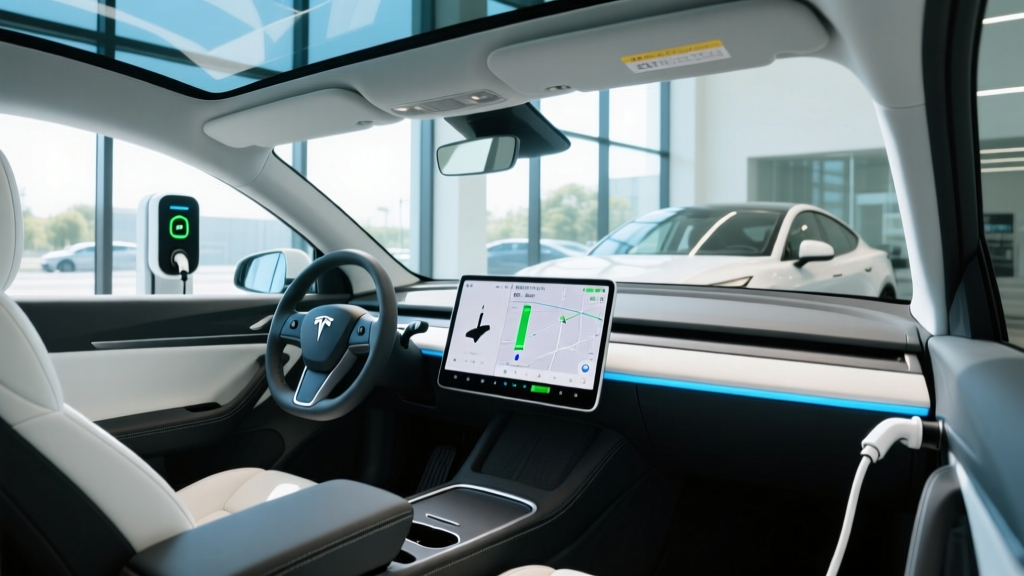
The keyword drawing shoppers to this review — SUV Tesla interior — reflects a real shift in buyer expectations. The pre-2025 Model Y interior was functional but drew criticism for hard plastics, minimal sound deadening, and a single 15-inch front screen that forced rear passengers to crane their necks for climate controls. The Juniper refresh overhauls this experience without abandoning Tesla's minimalist design language.
What's New Inside for 2026
- Ventilated front seats (previously heated-only) with revised bolstering and a perforated synthetic leather (Tesla "vegan leather") that breathes better in summer heat.
- Ambient lighting strip running across the dashboard and door panels — a first for Model Y, controllable via the touchscreen with multiple color zones.
- 8-inch rear touchscreen mounted on the back of the center console, giving rear passengers independent climate, media, and seat-heating controls.
- Acoustic glass on all four side windows (previously only front), reducing cabin noise by a measurable 3–5 dB at highway speeds based on independent testing.
- Revised center console with a larger wireless phone charging pad (15W Qi2), a covered storage bin, and physical volume knob — a direct response to owner complaints about the prior touch-only slider.
- Power-folding second row with a 60/40 split and a ski pass-through, improving cargo flexibility for winter gear or long items.
Materials and Build Quality
Tesla has moved to soft-touch materials on the dashboard upper, door armrests, and center console sides — areas where the pre-refresh Model Y used hard, scratch-prone plastic. Panel gap consistency has also improved at the Fremont and Austin assembly lines, though we still note minor variance between driver and passenger door seams on some early Juniper builds. The overall impression in 2026 is a cabin that now competes directly with the Hyundai Ioniq 5's premium feel and surpasses the Ford Mustang Mach-E's interior on material quality, though it still falls short of the BMW iX or Mercedes EQB on luxury execution.
Infotainment and Tech
The 15.4-inch center touchscreen remains the nerve center, running Tesla's proprietary OS with integrated navigation, streaming (Netflix, YouTube, Spotify), a full web browser, and over-the-air updates that add features post-purchase. The Juniper adds a faster AMD Ryzen infotainment processor (carried over from Model S/X refresh) that eliminates the occasional lag present in 2023–2024 Model Y units. Apple CarPlay and Android Auto remain unsupported — a dealbreaker for some buyers who prefer phone-mirroring over Tesla's native apps.
Range, Efficiency, and Real-World Expectations
The 2026 Model Y Long Range AWD carries an EPA-estimated 320 miles of range on its 75 kWh usable NMC battery pack. The Performance trim drops to 298 miles due to larger 21-inch wheels, stickier tires, and more aggressive motor mapping. Efficiency on the Long Range is rated at 27 kWh per 100 miles (124 MPGe combined), which remains class-leading for a dual-motor AWD compact SUV.
The EPA 320-mile figure assumes a mix of city and highway driving at moderate temperatures. In our experience and aggregated owner data:
- Highway-only at 70 mph, 65°F: Expect ~280–295 miles. Tesla's aerodynamic efficiency (0.23 Cd drag coefficient) helps, but sustained high-speed driving consumes more energy than city/regen-heavy routes.
- Cold weather (20–30°F), mixed driving: Expect ~230–260 miles. The Juniper's revised heat pump is more efficient than prior generations, but lithium-ion chemistry inherently loses capacity and regenerative braking is limited when the battery is cold.
- City/suburban with frequent regen: You can approach or occasionally exceed 320 miles thanks to regenerative braking recapturing energy in stop-and-go traffic.
Preconditioning the battery (via the Tesla app or scheduled departure) before driving in cold weather recovers roughly 10–15 miles of range and restores regen functionality faster.
Charging Speed: Supercharger Network and Home Level 2
Tesla's charging ecosystem remains its strongest competitive moat. The 2026 Model Y charges natively on the NACS (North American Charging Standard) connector, which is now the de facto standard adopted by Ford, GM, Rivian, Volvo, and most major automakers through 2025–2026. This means Model Y owners have seamless access to over 20,000 Tesla Supercharger stalls across North America without adapters.
| Charging Level | Power / Rate | Miles Added | Notes |
|---|---|---|---|
| Level 1 (120V household) | ~1.4 kW | ~4 mi/hr | Emergency/trickle only; a full charge takes 50+ hours |
| Level 2 (240V, 48A / 11.5 kW) | 11.5 kW | ~44 mi/hr | Home Wall Connector or public Level 2; 0–100% in ~7 hours |
| DC Fast Charge (V3 Supercharger) | Peak 250 kW | ~200 mi in 15 min | 10–80% in ~25 min; tapers significantly above 80% |
| DC Fast Charge (V4 Supercharger) | Peak 250 kW (Model Y limited) | Same as V3 | V4 stalls support up to 350 kW, but Model Y architecture caps at 250 kW |
Understanding the Charge Curve
Tesla's 250 kW peak rate is achieved only between approximately 10–30% state of charge (SoC) with a preconditioned battery. The curve tapers progressively: ~175 kW at 50%, ~100 kW at 70%, and ~40 kW above 90%. This is why Tesla (and all EV best practices) recommend charging to 80% on road trips — the final 20% can add 15–20 minutes for just 50–60 miles of range. For daily home charging, Tesla recommends setting the charge limit to 80% for NMC batteries to maximize long-term battery health; the car's software makes this trivial to schedule.
Home Charging Setup
The Tesla Wall Connector ($475) is a 48-amp, hardwired Level 2 unit that delivers 11.5 kW on a 240V/60A circuit. Installation costs vary widely: expect $800–$2,500 for a straightforward panel-adjacent install, or $2,500–$5,000+ if your electrical panel needs an upgrade from 100A to 200A service. A licensed electrician should evaluate your panel capacity before purchase. The Wall Connector includes a 24-foot cable, Wi-Fi connectivity for scheduling, and works with any J1772/NACS-equipped EV (with adapter for non-Teslas).
Pricing, Trims, and Federal Tax Credit Eligibility
The 2026 Model Y is offered in two trims, both dual-motor AWD:
- Long Range AWD: $44,990 MSRP (before destination). Includes 19-inch Gemini wheels, 320-mile range, all Juniper interior upgrades, basic Autopilot.
- Performance AWD: $51,490 MSRP. Adds 21-inch Überturbine wheels, performance brakes, lowered suspension, 3.5-sec 0–60, Track Mode, 298-mile range.
Both trims fall under the IRS §30D MSRP cap of $80,000 for SUVs. However, qualifying for the full $7,500 federal tax credit is not guaranteed and depends on several variables that change periodically:
- Buyer income cap: Modified AGI must not exceed $150,000 (single), $225,000 (head of household), or $300,000 (married filing jointly).
- MSRP cap: Vehicle MSRP must not exceed $80,000 for SUVs (Model Y qualifies on both trims).
- Battery sourcing: A percentage of critical minerals and battery components must be sourced from the US or FTA-partner countries. Tesla's supply chain has progressively localized, but the exact credit amount ($3,750 for minerals + $3,750 for components = up to $7,500) can vary by production batch. Verify current eligibility on fueleconomy.gov or the IRS clean vehicle credits page.
- Point-of-sale transfer: As of 2024, buyers can transfer the credit to the dealer at purchase, reducing the purchase price upfront rather than waiting for a tax refund. This requires the dealer to be registered with the IRS Energy Credits portal.
- Consult a tax professional before relying on credit eligibility — rules are subject to legislative and regulatory changes.
| Trim | MSRP | Est. After $7,500 Credit | Est. After $3,750 Credit (partial) |
|---|---|---|---|
| Long Range AWD | $44,990 | $37,490 | $41,240 |
| Performance AWD | $51,490 | $43,990 | $47,740 |
Note: Destination charges (~$1,390), paint upgrades ($1,500–$2,500), FSD capability ($8,000 or $99/mo subscription), and other options increase the final price. The $7,500 credit applies to the base vehicle and does not phase out for Tesla under current law (the prior 200,000-unit manufacturer cap was eliminated by the Inflation Reduction Act).
Performance, Ride, and Driver Assistance
The 2026 Model Y Long Range AWD delivers 384 horsepower from its dual-motor setup, achieving a 4.8-second 0–60 mph time — quicker than nearly every gas-powered compact SUV and most EV competitors in this price range. The Performance trim's 456 hp and 3.5-second sprint put it in sports-sedan territory, though the trade-off is a firmer ride and reduced range.
Ride Quality and Handling (Juniper Improvements)
The Juniper refresh introduces revised damper tuning, a slightly longer wheelbase (by 0.4 inches), and additional structural adhesive that improves chassis rigidity. The result is a noticeably more compliant ride over broken pavement and expansion joints — the pre-refresh Model Y's most common dynamic complaint. Body roll is well-controlled for a tall crossover, and the low center of gravity (battery pack under the floor) keeps the Model Y planted through corners. Steering remains quick and precise, though some enthusiasts note it lacks the feedback of the Ford Mustang Mach-E GT.
Autopilot and FSD (Supervised)
Tesla's Autopilot (standard) and Full Self-Driving (FSD) Supervised ($8,000 or $99/month subscription) are SAE Level 2 systems. This means the driver must remain fully attentive, hands on or near the wheel, and ready to take over at any moment. FSD Supervised can navigate highway on-ramps, change lanes, and handle some city streets, but it is not a Level 4 autonomous system like Waymo's driverless robotaxi. Misuse of Level 2 systems — treating them as self-driving — has contributed to NHTSA-investigated incidents. Always supervise.
Basic Autopilot includes Traffic-Aware Cruise Control and Autosteer (lane-centering on highways), which works reliably on well-marked roads. FSD Supervised adds Navigate on Autopilot (automatic highway interchanges), Auto Lane Change, Autopark, and Summon. The system has improved significantly with the "end-to-end neural network" software architecture (v12.x and later), reducing phantom braking and erratic lane changes, but it still struggles with construction zones, faded lane markings, and complex unprotected left turns.
Who Should Buy the 2026 Tesla Model Y?
The Model Y remains the default recommendation for buyers who want a compact electric SUV with minimal compromise. Here's who it suits best:
- Daily commuters with home charging: The 320-mile range means most owners charge once or twice a week at home, never visiting a gas station. The 44 mi/hr Level 2 rate means an overnight charge easily replenishes a day's driving.
- Families needing cargo versatility: 72.1 cu ft with seats folded, a flat load floor, and a usable frunk (4.1 cu ft) make the Model Y practical for strollers, groceries, camping gear, or IKEA runs.
- Road trippers who value charging infrastructure: Tesla's Supercharger network remains the most reliable and widespread DC fast-charging ecosystem in North America. Trip planning via the built-in navigation is seamless — the car routes through Superchargers, preconditions the battery automatically, and displays real-time stall availability.
- Tech-forward buyers: OTA updates, the integrated app ecosystem, Sentry Mode (dashcam security), and the Tesla mobile app (remote climate, location, charging status) create an ownership experience that legacy automakers still haven't fully matched.
Who should look elsewhere: Buyers who prioritize Apple CarPlay/Android Auto, want a more traditional dealership service experience, need third-row seating (consider the Kia EV9), or prefer a plusher luxury interior (BMW iX, Genesis Electrified GV70) should cross-shop accordingly.
Pros
- Class-leading Supercharger network access (native NACS)
- 320-mile EPA range with strong real-world highway efficiency
- Significantly improved Juniper cabin: quieter, more refined, rear screen
- Best-in-class OTA update capability and app integration
- Spacious cargo area (72.1 cu ft) with flat floor and frunk
- Strong §30D tax credit eligibility (subject to sourcing rules)
- Quick charging: 10–80% in ~25 min at 250 kW
Cons
- No Apple CarPlay or Android Auto — Tesla-native apps only
- FSD ($8,000) is expensive and still requires full driver supervision
- Service center wait times can be long in some metro areas
- Charge curve tapers hard above 80% — rivals like Ioniq 5 sustain higher rates longer
- No third-row option; limited to 5 passengers
- Panel gap quality improved but still inconsistent on some builds
- Towing capacity limited to 3,500 lbs (braked)
How It Stacks Up Against Key Competitors
| Spec | 2026 Tesla Model Y LR AWD | 2026 Hyundai Ioniq 5 Limited AWD | 2026 Ford Mustang Mach-E Premium AWD |
|---|---|---|---|
| EPA Range | 320 mi | 305 mi | 300 mi |
| Battery (usable) | 75 kWh (NMC) | 84 kWh (NMC) | 88 kWh (NMC) |
| Peak DC Charge | 250 kW | 350 kW (800V architecture) | 150 kW |
| 10–80% DC Time | ~25 min | ~18 min | ~38 min |
| 0–60 mph | 4.8 sec | 5.1 sec | 5.0 sec |
| Base MSRP (comparable trim) | $44,990 | $53,500 | $48,995 |
| Apple CarPlay | No | Yes (wireless) | Yes (wireless) |
| NACS Native | Yes | No (CCS, NACS adapter avail.) | No (CCS, NACS adapter avail.) |
| Cargo (rear up / folded) | 34.3 / 72.1 cu ft | 27.2 / 59.3 cu ft | 29.7 / 59.7 cu ft |
The Ioniq 5's 800V architecture gives it a clear DC charging speed advantage (18 vs. 25 minutes, 10–80%), but the Model Y counters with superior cargo space, a more mature charging network, and a lower entry price. The Mach-E offers a more engaging driving feel and CarPlay support but charges significantly slower. For buyers prioritizing total ownership ease — especially apartment dwellers who rely on public charging — Tesla's Supercharger ecosystem remains difficult to beat.
Frequently Asked Questions
What is the real-world range of the 2026 Tesla Model Y?
The EPA rates the Long Range AWD at 320 miles. In real-world highway driving at 70 mph and moderate temperatures, expect ~280–295 miles. In cold weather (20–30°F), range drops to ~230–260 miles due to battery chemistry limitations and cabin heating demand. City driving with frequent regenerative braking can match or slightly exceed the EPA figure.
How fast does the Model Y charge at home and on road trips?
At home on a 240V Level 2 Wall Connector (11.5 kW / 48A), the Model Y adds ~44 miles of range per hour — a full charge from empty takes about 7 hours overnight. On a V3 Supercharger (250 kW DC), it charges from 10–80% in approximately 25 minutes with a preconditioned battery. Charging above 80% slows dramatically, adding 15–20 minutes for the final 20%.
How much does the 2026 Model Y cost after federal tax credits?
The Long Range AWD starts at $44,990. If you qualify for the full $7,500 §30D credit (income within limits, battery sourcing requirements met, point-of-sale transfer), the effective price drops to ~$37,490. Partial credit of $3,750 is possible if only one of the two sourcing requirements (critical minerals or battery components) is met. Always verify current eligibility on fueleconomy.gov and consult a tax professional.
Does the 2026 Model Y qualify for the federal EV tax credit?
Both trims are under the $80,000 SUV MSRP cap. However, eligibility depends on your income (AGI limits apply), the specific battery's critical-mineral and component sourcing for the production batch, and whether you have sufficient tax liability (or use the point-of-sale transfer option). Tesla provides a credit eligibility indicator at the time of order, and the IRS maintains a list of qualifying vehicles that is updated periodically.
Is the Tesla Model Y worth buying over the Hyundai Ioniq 5 or Ford Mach-E?
Choose the Model Y if you prioritize Supercharger network reliability, maximum cargo space (72.1 cu ft), seamless OTA updates, and native NACS charging. Choose the Ioniq 5 if DC fast-charging speed is paramount (350 kW / 18-min 10–80%) and you want Apple CarPlay. Choose the Mach-E if driving dynamics and a traditional dealer service network matter more. All three are strong — the "best" depends on your charging access, tech preferences, and cargo needs.
Is Tesla's FSD actually self-driving?
No. FSD (Supervised) is an SAE Level 2 driver-assistance system. It can handle highway lane changes, on-ramps, and some city driving, but the driver must remain fully attentive with hands on or near the steering wheel at all times. It is not a Level 4 autonomous system like Waymo. Treat it as an advanced cruise control and lane-keeping aid — not a replacement for an engaged driver.
What is the battery warranty on the 2026 Model Y?
Tesla covers the battery and drive unit for 8 years or 120,000 miles (whichever comes first) with a minimum 70% capacity retention guarantee. If the battery degrades below 70% of its original capacity within that period, Tesla will repair or replace it at no cost. Real-world data from high-mileage Tesla owners suggests NMC packs typically retain 85–92% capacity at 100,000 miles when charged primarily to 80% and avoiding frequent 100% charges or prolonged low-SoC storage.