Quick Verdict: The Benchmark Gets a Major Refresh
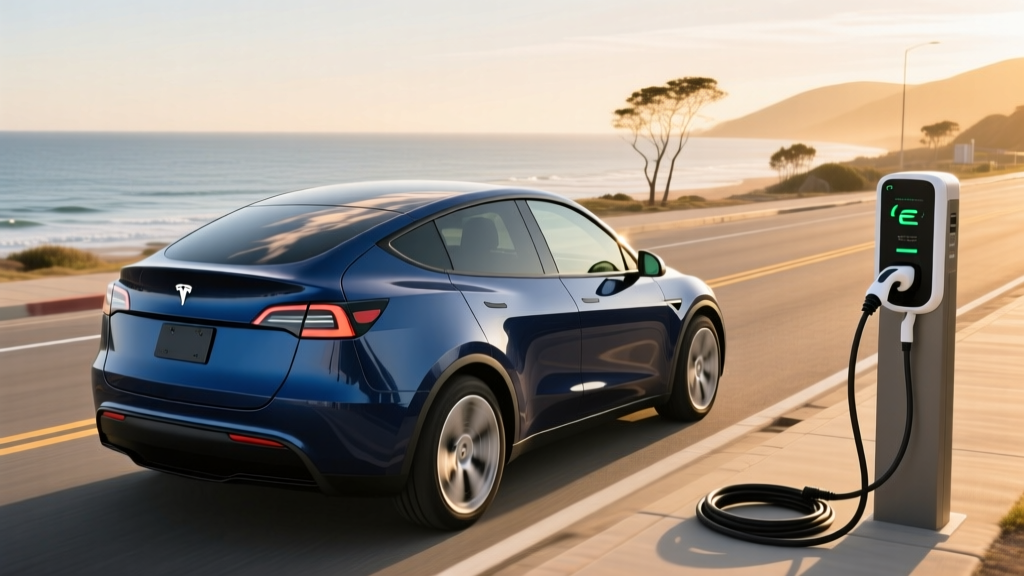
The refreshed Tesla Model Y — internally dubbed "Juniper" — entered the 2025 model year with substantial changes to styling, suspension tuning, cabin materials, and noise isolation. For 2026, Tesla has carried over the Juniper platform with minor software and battery-management refinements. The result is an electric crossover that remains the segment's efficiency king while finally addressing the ride-quality complaints that plagued earlier Model Y builds.
If you're researching a Tesla drive experience in the compact luxury EV SUV segment, the Model Y Long Range AWD delivers 320 miles of EPA range, peaks at 250 kW on DC fast chargers, and starts at $44,990 before incentives. It is not the most exciting EV to drive — that title goes to the Hyundai Ioniq 5 N or Porsche Macan Electric — but it is arguably the most rational purchase when you factor in Supercharger network access, over-the-air updates, and class-leading cargo volume.
| Spec | Long Range AWD | Performance |
|---|---|---|
| EPA Range | 320 mi | 295 mi |
| Battery (usable) | ~75 kWh, NMC | ~75 kWh, NMC |
| Drivetrain | Dual-Motor AWD | Dual-Motor AWD |
| Horsepower | 384 hp | 456 hp |
| 0–60 mph | 4.8 sec | 3.5 sec |
| Peak DC Charge Rate | 250 kW | 250 kW |
| 10–80% DC Fast Charge | ~25 min | ~25 min |
| Level 2 Charge Rate | 11.5 kW (~44 mi/hr) | 11.5 kW (~44 mi/hr) |
| MPGe (combined) | 122 MPGe | 111 MPGe |
| Efficiency | 28 kWh/100 mi | 30 kWh/100 mi |
| Cargo (rear seats up) | 30.2 cu ft | 30.2 cu ft |
| Cargo (rear seats folded) | 72.1 cu ft | 72.1 cu ft |
| Base MSRP | $44,990 | $51,490 |
| Battery Warranty | 8 yr / 120,000 mi | 8 yr / 120,000 mi |
Real-World Range: What the EPA Sticker Doesn't Tell You
The EPA rates the 2026 Model Y Long Range AWD at 320 miles. In mixed suburban and city driving at moderate temperatures (55–75°F), owners consistently report achieving 300–315 miles on a full charge. The Juniper generation's improved thermal management and slightly lower drag coefficient (now approximately 0.22 Cd) help it hold closer to its sticker number than the pre-2025 Model Y.
EPA Range: 320 miles (Long Range AWD)
Real-World Expectations:
- City/suburban mixed: 300–315 mi
- Highway (70–75 mph sustained): 265–285 mi
- Cold weather (below 32°F, highway): 220–250 mi
- Cold weather + cabin heat, city: 250–275 mi
Highway driving at 75 mph reduces range by roughly 12–18% versus the EPA combined figure. In sub-freezing temperatures, expect an additional 15–25% reduction depending on speed, cabin heat usage, and whether you precondition the battery. The Model Y uses a heat pump (standard), which significantly reduces cold-weather HVAC energy draw compared to resistive heaters found in older EVs.
The ~75 kWh usable battery pack uses NMC (nickel manganese cobalt) chemistry, which prioritizes energy density over cycle life compared to LFP (lithium iron phosphate). This is the trade-off: you get more range in a lighter package, but Tesla recommends daily charging to 80% for longevity rather than 100%. For road trips, a 100% charge is fine — just don't make it a daily habit.
Charging Speed: Supercharger Network Advantage
Charging infrastructure remains Tesla's strongest competitive moat. The Supercharger network now exceeds 60,000 stalls globally, and the Model Y's native NACS connector means zero adapter hassle at Tesla stalls. Non-Tesla DC networks (Electrify America, EVgo) require the included CCS adapter or a third-party NACS-to-CCS cable.
| Charging Level | Power | Speed / Time |
|---|---|---|
| Level 1 (120V household) | ~1.4 kW | ~5 mi/hr |
| Level 2 (240V home, 48A) | 11.5 kW | ~44 mi/hr |
| Level 2 (240V, 32A Mobile Connector) | 7.7 kW | ~30 mi/hr |
| DC Fast Charge (V3 Supercharger) | Peak 250 kW | 10–80% in ~25 min |
| DC Fast Charge (V4 Supercharger) | Peak 250 kW | 10–80% in ~25 min |
| DC Fast Charge (CCS adapter, non-Tesla) | Up to 250 kW | Varies by station |
Charging curve reality check: The 250 kW peak rate is not sustained across the entire session. The Model Y typically holds above 200 kW from roughly 10% to 35% state of charge, then tapers to ~150 kW by 50%, and drops below 100 kW above 65%. This is normal lithium-ion behavior — the battery management system protects cell health by reducing current as voltage rises. A 10–80% session takes approximately 25 minutes at a V3 or V4 Supercharger; a 10–90% session extends to roughly 38 minutes due to the steep taper above 80%.
For home charging, a Wall Connector on a 60-amp circuit delivers the full 11.5 kW (48 amps continuous), adding about 44 miles of range per hour. An overnight session (8 hours) replenishes roughly 350 miles — more than a full battery. Expect to pay $500–$1,500 for a professional Level 2 installation depending on panel proximity and whether your electrical panel needs an upgrade. Always consult a licensed electrician for final specifications.
Performance and Driving Dynamics
The Long Range AWD pairs a permanent-magnet rear motor with an induction front motor, producing a combined 384 hp. The 0–60 mph sprint takes 4.8 seconds — brisk enough for confident highway merging without being neck-snapping. The Performance trim bumps output to 456 hp and drops the 0–60 to 3.5 seconds, but the ride becomes noticeably firmer and the 19-inch wheels swap for 21-inch alloys that sacrifice some range and comfort.
The Juniper refresh brought meaningful suspension improvements. Tesla retuned the dampers, added frequency-selective damping, and improved bushing compliance. The result is a ride that absorbs sharp impacts (expansion joints, potholes) far better than the pre-2025 Model Y, which was widely criticized for being overly stiff. Road noise has also dropped noticeably thanks to acoustic glass and additional sound deadening.
Regenerative braking remains strong and single-pedal driving is intuitive once you adjust to the aggressive deceleration. Tesla removed the user-adjustable regen setting several years ago — you get one calibration, and it's strong. The brake pedal feel is firm and linear, a welcome change from the vague pedal tuning in some competitor EVs.
Interior, Tech, and Cargo
The Juniper cabin is a significant step up from the spartan pre-refresh interior. Ambient lighting, ventilated front seats, a rear-seat touchscreen for climate and media control, and improved material quality (soft-touch surfaces, better panel gaps) bring the Model Y closer to the premium compact SUV experience buyers expect at this price point.
The 15.4-inch center touchscreen remains the command center for virtually all vehicle functions. The infotainment system is responsive, the navigation with real-time Supercharger routing is best-in-class, and the app ecosystem (Netflix, YouTube, Arcade) is unmatched for parked-time entertainment. However, the absence of physical buttons for climate, wipers, and glovebox continues to frustrate some drivers — everything requires screen taps or voice commands.
Cargo space is a Model Y hallmark. With rear seats up, you get 30.2 cubic feet — enough for a week's groceries or two large suitcases. Fold the 60/40 split rear bench and capacity expands to 72.1 cubic feet, rivaling midsize SUVs. The front trunk (frunk) adds 4.1 cubic feet for charging cables or a small bag. Rear legroom measures 40.5 inches, adequate for adults on longer trips, though the sloping roofline limits headroom for passengers over six feet tall.
Pricing, Tax Credits, and Ownership Cost
The 2026 Model Y Long Range AWD starts at $44,990 (including destination). The Performance trim begins at $51,490. Common options include Full Self-Driving (Supervised) capability at $8,000, premium paint colors ($1,000–$2,500), and 20-inch wheels ($1,500). A well-equipped Long Range typically lands between $47,000 and $52,000 before incentives.
| Trim | Base MSRP | §30D Credit (if eligible) | Effective Price |
|---|---|---|---|
| Long Range AWD | $44,990 | Up to $7,500 | From ~$37,490 |
| Performance AWD | $51,490 | Up to $7,500 | From ~$43,990 |
Federal tax credit eligibility (§30D) — critical caveats: The Model Y qualifies for up to $7,500 under the Inflation Reduction Act's new clean vehicle credit, but eligibility depends on several factors that change periodically. As of 2026, the key requirements include:
- MSRP cap: The vehicle must have an MSRP at or below $80,000 for SUVs — the Model Y clears this easily.
- Buyer income cap: Modified adjusted gross income must not exceed $150,000 (single), $225,000 (head of household), or $300,000 (married filing jointly).
- Battery sourcing: A percentage of critical minerals and battery components must be sourced from the U.S. or free-trade-agreement countries. Tesla has shifted significant supply chain sourcing to qualify, but the exact credit amount ($3,750 or $7,500) depends on current-year sourcing thresholds.
- Point-of-sale transfer: Since 2024, buyers can transfer the credit to the dealer at purchase, reducing the purchase price directly rather than waiting for a tax refund.
Always verify current eligibility on IRS.gov before purchasing, as battery-sourcing rules tighten annually and can change a vehicle's credit status mid-year. Consult a tax professional for your specific situation.
The Model Y's 8-year/120,000-mile battery and drive unit warranty is competitive, though not class-leading — Hyundai offers 10 years/100,000 miles on the Ioniq 5's battery. Tesla warrants that the battery will retain at least 70% of its original capacity during the warranty period. Real-world degradation data from fleet sources suggests most Model Y packs lose approximately 8–12% capacity over the first 100,000 miles, well within the warranty threshold.
Autopilot and Driver Assistance: Level 2, Not Self-Driving
SAE Automation Level: Level 2
Tesla's Autopilot (standard) and Full Self-Driving (Supervised) ($8,000 option) are Level 2 driver-assistance systems under the SAE J3016 framework. This means the system can simultaneously control steering and acceleration/braking, but the driver must remain fully engaged, monitor the road at all times, and be prepared to take over instantly. These are not self-driving systems. Only Level 4 services like Waymo operate without a human driver in defined areas.
Standard Autopilot includes Traffic-Aware Cruise Control and Autosteer (lane-centering on divided highways). It performs reliably on well-marked interstates but can struggle in construction zones, faded lane markings, and heavy rain. FSD (Supervised) adds automatic lane changes, city-street navigation, traffic light and stop sign recognition, and more assertive routing through intersections. FSD has improved substantially through neural-network-based "end-to-end" software (v13+), but it still requires active supervision and occasionally makes puzzling decisions in complex urban environments.
What Autopilot and FSD (Supervised) do NOT do:
- They do not eliminate the need for driver attention — you are legally responsible for the vehicle at all times.
- They do not reliably handle construction zones, emergency vehicles stopped in travel lanes, or unmapped road changes.
- They are not approved for hands-off or eyes-off operation anywhere in the United States.
- FSD (Supervised) performance varies significantly by geography, weather, and road infrastructure quality.
For safety data, the Model Y earns a 5-star overall rating from NHTSA and has historically performed well in IIHS crash testing, though buyers should check the latest model-year ratings as testing protocols evolve.
Pros, Cons, and Who Should Buy
Pros
- Class-leading efficiency (122 MPGe combined, 28 kWh/100 mi)
- Supercharger network access — the most reliable DC fast-charging ecosystem in North America
- Best-in-class cargo capacity (72.1 cu ft seats folded)
- Strong over-the-air update cadence — the car improves post-purchase
- Improved ride quality and cabin quietness in Juniper generation
- Low running costs: ~$0.04–$0.06 per mile on home electricity vs. ~$0.12–$0.16/mi for comparable gas SUVs
Cons
- No physical buttons — all climate, wiper, and vehicle controls are screen-dependent
- FSD (Supervised) costs $8,000 and still requires full driver attention
- Build quality, while improved, still shows occasional panel-gap inconsistencies
- Aggressive regenerative braking with no user adjustment
- Sloping roofline cuts rear headroom for taller passengers
- Insurance premiums run 15–30% higher than comparable gas crossovers in many states
Who the Model Y suits best: The Model Y Long Range AWD is ideal for tech-savvy commuters and small families who prioritize efficiency, cargo versatility, and reliable fast-charging access for road trips. If you drive 30–60 miles daily, have home Level 2 charging, and take 2–4 road trips per year, the Model Y's combination of range, Supercharger routing, and low operating costs is difficult to beat. It is less suited for buyers who want a traditional luxury interior experience, physical controls, or who regularly carry tall rear-seat passengers.
Competitor Comparison: Is the Model Y Still the Best Choice?
The compact electric SUV segment has matured significantly. The Hyundai Ioniq 5 offers 303 miles of range, 800V architecture for faster peak charging (up to 350 kW), and a more conventional interior with physical buttons — starting around $42,000. The Ford Mustang Mach-E provides engaging driving dynamics and BlueCruise hands-off highway driving (on approved routes), though its charging speed and efficiency trail the Tesla. The Kia EV6 shares the Ioniq 5's 800V platform with similarly quick charging and a sportier design.
Where the Model Y still wins: Supercharger network reliability, software integration, cargo space, and efficiency per kWh. Where it loses: the Ioniq 5 and EV6 charge faster on compatible 350 kW stations, Hyundai/Kia offer longer battery warranties, and competitors like the Mach-E and Ioniq 5 offer more conventional control layouts. According to fueleconomy.gov, the Model Y Long Range's 122 MPGe combined edges out the Ioniq 5 Long Range AWD's 110 MPGe, translating to roughly $50–$80 per year in electricity savings depending on local rates.
Frequently Asked Questions
What is the real-world range of the 2026 Tesla Model Y?
The EPA rates the Long Range AWD at 320 miles. In real-world mixed driving at moderate temperatures, expect 300–315 miles. Sustained highway driving at 75 mph drops that to 265–285 miles, and cold weather (below freezing) can reduce range to 220–250 miles depending on speed and cabin heat usage.
How fast does the Model Y charge at home and on DC fast chargers?
On a home Level 2 Wall Connector (11.5 kW), the Model Y adds approximately 44 miles of range per hour — a full overnight charge covers more than the battery's total capacity. On a V3 or V4 Supercharger, it peaks at 250 kW and charges from 10–80% in approximately 25 minutes, though the charge rate tapers significantly above 65% state of charge.
Does the 2026 Tesla Model Y qualify for the $7,500 federal tax credit?
The Model Y is eligible for up to $7,500 under the §30D clean vehicle credit, subject to buyer income limits ($150K single / $300K joint), the $80K SUV MSRP cap, and battery critical-mineral and component sourcing requirements that tighten annually. The credit can be transferred at point of sale to reduce the purchase price directly. Verify current eligibility at IRS.gov before purchasing.
Is the Tesla Model Y worth buying over the Hyundai Ioniq 5 or Ford Mach-E?
If Supercharger access, cargo space, software integration, and efficiency are your top priorities, the Model Y remains the strongest all-around choice. If you prefer faster peak charging (800V architecture), physical buttons, a longer battery warranty, or a more conventional driving experience, the Ioniq 5 or EV6 are compelling alternatives at similar or lower prices.
How long will the Model Y battery last?
Tesla warranties the battery for 8 years or 120,000 miles (whichever comes first) with a minimum 70% capacity retention guarantee. Real-world fleet data shows typical degradation of 8–12% over 100,000 miles. Many high-mileage Tesla packs retain 85%+ capacity at 150,000 miles. Charging habits matter: avoiding frequent 100% charges, minimizing DC fast charging when Level 2 is available, and keeping the pack between 20–80% for daily use all help preserve long-term health.
Is Tesla's Full Self-Driving worth the $8,000 cost?
For most buyers, no — at least not yet. FSD (Supervised) is a Level 2 system that requires your full attention at all times. It performs impressively on highways and has improved in city driving, but it does not eliminate driver workload and occasionally requires intervention. Standard Autopilot (included) handles highway cruising well. Consider FSD only if you regularly drive in complex urban environments and understand its limitations.