Quick Verdict: The 2026 Tesla Model Y in Deep Blue Metallic
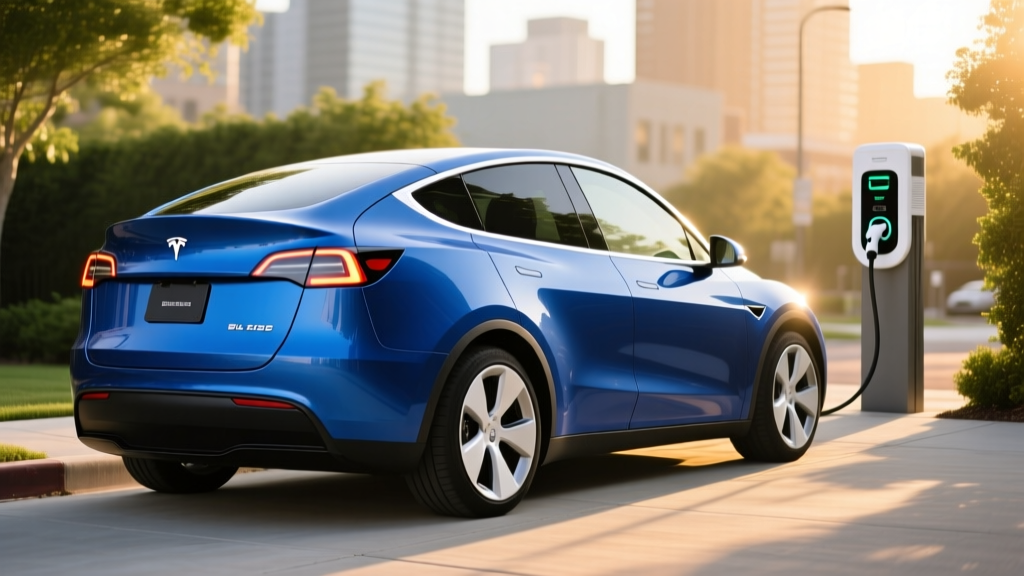
The 2026 Tesla Model Y remains the benchmark compact electric SUV, and the Deep Blue Metallic paint option continues to be one of its most popular aesthetic choices. Underneath that striking blue finish, Tesla's refreshed Model Y (internally codenamed "Juniper") delivers up to 320 miles of EPA-estimated range, a peak 250 kW DC fast-charging rate, and the Supercharger network advantage that still defines Tesla ownership. But with the Hyundai Ioniq 5, Ford Mustang Mach-E, and Chevrolet Equinox EV closing the gap on range and undercutting on price, the 2026 Model Y Blue must earn its premium through efficiency, charging infrastructure, and software — not just brand cachet.
This review covers every spec, real-world range expectation, charging curve reality, and tax-credit nuance you need before configuring a Deep Blue Metallic Model Y in 2026.
2026 Tesla Model Y Blue: Full Specifications at a Glance
| Specification | Long Range AWD | Performance | Rear-Wheel Drive |
|---|---|---|---|
| EPA Range | 320 miles | 295 miles | 300 miles |
| Battery Capacity (usable) | ~78 kWh (NMC) | ~78 kWh (NMC) | ~60 kWh (LFP) |
| Drivetrain | Dual-Motor AWD | Dual-Motor AWD | Single-Motor RWD |
| Horsepower | 384 hp | 456 hp | 295 hp |
| 0–60 mph | 4.8 seconds | 3.5 seconds | 6.6 seconds |
| Peak DC Fast Charge | 250 kW | 250 kW | 175 kW |
| 10–80% DC Charge Time | ~25 minutes | ~25 minutes | ~30 minutes |
| Level 2 Home Charge Rate | 11.5 kW (~44 mi/hr) | 11.5 kW (~44 mi/hr) | 11.5 kW (~44 mi/hr) |
| Efficiency (combined) | 122 MPGe / 28 kWh/100mi | 111 MPGe / 30 kWh/100mi | 128 MPGe / 26 kWh/100mi |
| Base MSRP | $48,990 | $54,490 | $44,990 |
| Deep Blue Metallic Add-On | +$2,000 | +$2,000 | +$2,000 |
Source: fueleconomy.gov and Tesla configurator, 2026 model year. Specs subject to EPA final certification.
Real-World Range: What 320 EPA Miles Actually Means
- EPA Sticker: 320 miles
- Real-World Highway (70 mph, 72°F): ~270–290 miles
- Real-World City/Suburban: ~295–310 miles
- Cold Weather (20°F, highway): ~220–245 miles (30–35% reduction)
- Towing (1,500 lb trailer): ~180–210 miles
The Model Y's heat pump standard on 2026 models mitigates cold-weather losses compared to earlier generations, but physics still applies — expect meaningful range compression below freezing.
Tesla's efficiency engineering is industry-leading. The 2026 Model Y Long Range achieves 28 kWh per 100 miles combined, which translates to roughly 3.6 miles per kWh — among the best in the compact electric SUV segment. For context, the Hyundai Ioniq 5 AWD returns about 3.0 mi/kWh, and the Ford Mustang Mach-E Extended Range AWD sits at approximately 2.9 mi/kWh.
On a 300-mile highway road trip in moderate temperatures, you'll realistically arrive with 10–15% state of charge remaining in the Long Range AWD. In winter conditions, that same trip requires a mid-route DC fast-charge stop. Plan accordingly.
Charging Speed and Infrastructure: The Tesla Advantage
| Charging Level | Power / Rate | Miles Added per Hour | Notes |
|---|---|---|---|
| Level 1 (120V household) | ~1.4 kW | ~3–5 mi/hr | Emergency/trickle only |
| Level 2 (240V, 48A home) | 11.5 kW | ~44 mi/hr | Full overnight charge in ~7–8 hrs |
| DC Fast Charge (Supercharger V3/V4) | Up to 250 kW peak | ~1,000 mi/hr at peak | 10–80% in ~25 min; tapers above 80% |
| DC Fast Charge (CCS adapter at non-Tesla) | Up to 250 kW peak | ~1,000 mi/hr at peak | Requires Tesla CCS adapter (included 2026) |
Charging curve reality: The 250 kW peak rate on the Long Range and Performance trims holds from roughly 10% to 35% state of charge, then gradually tapers. From 35–60% SoC, expect sustained rates around 150–180 kW. Above 80%, the rate drops sharply to protect battery longevity — charging from 80–100% at a DC fast charger can take as long as 10–80%. For road trips, the 10–80% window is your practical charging band.
The RWD trim's LFP (lithium iron phosphate) battery charges at a lower peak of 175 kW, but LFP chemistry tolerates regular 100% charging without the degradation concerns of NMC batteries. Tesla recommends daily charging to 100% for LFP-equipped vehicles — a meaningful ownership advantage for commuters with predictable daily routes.
The 2026 Model Y uses the NACS (North American Charging Standard) connector natively. With Tesla opening the Supercharger network to other brands, you may occasionally find queues at popular stations — a trade-off that didn't exist two years ago. However, the network's uptime reliability (consistently above 95% per third-party audits) remains a significant differentiator over Electrify America and other CCS networks.
Performance, Efficiency, and Daily Driving
Even the base RWD Model Y delivers 295 hp and a 6.6-second 0–60 mph time — quicker than most gas-powered compact SUVs in the segment. The Long Range AWD drops that to 4.8 seconds with 384 hp, while the Performance variant hits 3.5 seconds with 456 hp. All trims feature Tesla's single-speed reduction gear, so power delivery is instant and linear with no shift interruptions.
The Juniper-refreshed Model Y introduced a revised suspension tuning that noticeably improves ride quality over pre-2025 models. Road noise insulation has also improved, though the frameless windows still generate more wind noise at highway speeds than the Hyundai Ioniq 5 or Kia EV6.
Regenerative braking: Tesla's one-pedal driving remains best-in-class for modulation. The 2026 Model Y offers adjustable regen strength through the touchscreen, and the stop-mode regen can bring the vehicle to a complete hold without touching the brake pedal in most traffic scenarios.
Efficiency highlight: The RWD trim's LFP battery and lighter curb weight (~4,200 lbs vs ~4,400 lbs for Long Range AWD) push its combined efficiency to 128 MPGe — making it the most energy-efficient Model Y variant and the one we'd recommend for cost-conscious buyers who don't need all-wheel drive.
Pricing, Tax Credits, and Total Cost
| Trim | Base MSRP | Blue Metallic | Destination | As-Configured | After §30D Credit* |
|---|---|---|---|---|---|
| Rear-Wheel Drive | $44,990 | +$2,000 | $1,390 | $48,380 | ~$40,880 |
| Long Range AWD | $48,990 | +$2,000 | $1,390 | $52,380 | ~$44,880 |
| Performance | $54,490 | +$2,000 | $1,390 | $57,880 | ~$50,380 |
*Federal §30D credit eligibility requires meeting ALL of the following criteria per IRS guidelines:
- Buyer income caps: Modified AGI ≤ $150,000 (single), $225,000 (head of household), $300,000 (joint filing)
- MSRP cap: Vehicle MSRP must not exceed $80,000 for SUVs (all Model Y trims qualify)
- Battery sourcing: Critical minerals and battery components must meet phased-in domestic/free-trade-agreement sourcing percentages (Tesla has restructured supply chains to maintain eligibility through 2026, but verify at point of purchase)
- Point-of-sale transfer: As of 2024+, you can transfer the credit to the dealer at purchase for an immediate price reduction rather than waiting for tax filing
Critical caveat: Battery component and critical mineral sourcing requirements tighten annually under the Inflation Reduction Act. Tesla has maintained §30D eligibility for the Model Y through supply-chain adjustments, but the Performance trim's eligibility can shift mid-year based on battery cell sourcing changes. Always confirm credit eligibility on the Tesla configurator at the time of order and consult IRS.gov or a tax professional before relying on the credit.
Interior, Cargo, and Technology
The Juniper refresh brought meaningful interior improvements to the Model Y. The cabin now features ventilated front seats (previously a common complaint), ambient lighting, a rear-seat touchscreen for climate and media control, and improved material quality on the dashboard and door panels.
Cargo volume:
- Behind second row: 30.2 cu ft
- Second row folded: 72.1 cu ft
- Front trunk (frunk): 4.1 cu ft
- Total max cargo: 76.2 cu ft
Passenger space:
- Front legroom: 41.8 inches
- Rear legroom: 39.5 inches (improved ~1 inch over pre-Juniper)
- Front headroom: 40.0 inches
- Rear headroom: 38.5 inches
The 15.4-inch center touchscreen runs Tesla's latest software, which includes wireless Apple CarPlay via a third-party workaround (Tesla still does not offer native CarPlay or Android Auto). Navigation, media, climate, and vehicle settings are all touchscreen-controlled — a dealbreaker for buyers who prefer physical knobs and buttons.
Driver assistance: The 2026 Model Y ships with Tesla's Enhanced Autopilot hardware (HW4). Basic Autopilot (traffic-aware cruise control + autosteer) is standard. Full Self-Driving (Supervised) remains an $8,000 add-on or $99/month subscription.
Both Autopilot and FSD (Supervised) are SAE Level 2 driver-assistance systems. The driver must remain fully engaged, hands on or near the wheel, and eyes on the road at all times. These systems are NOT self-driving. Tesla's camera-only vision approach performs well on well-marked highways but can struggle in construction zones, heavy rain, and unmapped areas. Only Level 4 services like Waymo operate without a human driver.
Warranty and Long-Term Ownership
Tesla's warranty structure for the 2026 Model Y:
- Basic vehicle: 4 years / 50,000 miles
- Battery & drive unit (Long Range/Performance, NMC): 8 years / 120,000 miles, with minimum 70% capacity retention
- Battery & drive unit (RWD, LFP): 8 years / 100,000 miles, with minimum 70% capacity retention
The LFP battery in the RWD trim offers a distinct longevity advantage. LFP chemistry typically degrades more slowly than NMC and tolerates frequent 100% charging without accelerated wear. Independent data from fleet operators suggests LFP packs retain 90%+ capacity after 150,000 miles — making the RWD variant the strongest choice for high-mileage commuters planning to keep the vehicle 8+ years.
NMC packs in the Long Range and Performance trims show typical degradation of 8–12% over the first 100,000 miles based on aggregated owner data. Tesla's 70% retention threshold at 120,000 miles is conservative — most packs retain 85–90% at that interval under normal use.
Pros, Cons, and Who Should Buy the 2026 Model Y Blue
- Best-in-class efficiency (28 kWh/100mi Long Range)
- Supercharger network reliability (95%+ uptime)
- Class-leading cargo volume (76.2 cu ft max)
- Strong performance across all trims (3.5–6.6 sec 0–60)
- LFP option (RWD) for maximum battery longevity
- OTA software updates add features post-purchase
- Deep Blue Metallic is a premium, resale-friendly color choice
- No native Apple CarPlay or Android Auto
- Touchscreen-only controls frustrate some drivers
- FSD (Supervised) is expensive ($8,000) and still Level 2
- Ride quality improved but still firmer than Ioniq 5 / EV6
- Supercharger queues increasing as network opens to other brands
- $2,000 paint premium for Deep Blue Metallic
- No physical buttons for climate or volume
- Choose the RWD ($44,990 + Blue): If you're a commuter with home charging, don't need AWD, and want the longest-lasting LFP battery at the lowest price point. Best value in the lineup.
- Choose the Long Range AWD ($48,990 + Blue): If you take regular road trips, live in a cold/snowy climate, or need the 320-mile EPA range for peace of mind. The sweet spot for most buyers.
- Choose the Performance ($54,490 + Blue): If you want 3.5-second 0–60 thrills and track-mode capability, and you're willing to sacrifice 25 miles of range and pay a $5,500 premium over Long Range.
- Look elsewhere if: You need native smartphone mirroring, prefer physical controls, want a softer ride, or your budget is under $40,000 after credits (consider the Chevrolet Equinox EV or Hyundai Ioniq 5).
2026 Tesla Model Y Blue vs. Key Competitors
| Attribute | Tesla Model Y LR AWD | Hyundai Ioniq 5 AWD | Ford Mach-E ER AWD |
|---|---|---|---|
| EPA Range | 320 mi | 290 mi | 290 mi |
| Peak DC Charge | 250 kW | 240 kW (800V) | 150 kW |
| 10–80% Time | ~25 min | ~18 min | ~36 min |
| Efficiency | 122 MPGe | 110 MPGe | 101 MPGe |
| 0–60 mph | 4.8 sec | 5.0 sec | 5.1 sec |
| Base MSRP (AWD) | $48,990 | $50,100 | $48,995 |
| Apple CarPlay | No | Yes (wireless) | Yes (wireless) |
| Charging Network | Supercharger (native) | NACS (Supercharger access) | NACS (Supercharger access) |
The Model Y Long Range AWD wins on range and efficiency. The Ioniq 5 wins on DC charging speed (its 800V architecture enables a faster 10–80% time) and interior ergonomics with physical controls and standard CarPlay. The Mach-E trails on charging speed but offers a more traditional crossover feel with Ford dealer service support.
Frequently Asked Questions
What is the real-world range of the 2026 Tesla Model Y Blue?
The EPA rates the Long Range AWD at 320 miles. In real-world highway driving at 70 mph in moderate temperatures, expect 270–290 miles. City driving with regenerative braking recovers more energy, yielding 295–310 miles. In cold weather below freezing, highway range drops to roughly 220–245 miles due to battery resistance and cabin heating demands, even with the standard heat pump.
How fast does the 2026 Model Y charge at home and on the road?
At home on a Level 2 (240V/48A) charger, the Model Y adds approximately 44 miles of range per hour, fully charging from empty overnight in 7–8 hours. On DC fast chargers (Tesla Superchargers or CCS stations with the included adapter), the Long Range and Performance trims peak at 250 kW, reaching 10–80% in approximately 25 minutes. The RWD trim peaks at 175 kW with a 10–80% time of roughly 30 minutes. Remember: kW is the charge rate (power), while kWh is battery capacity (energy) — they are not interchangeable.
How much does the 2026 Tesla Model Y Blue cost after tax credits?
A Long Range AWD in Deep Blue Metallic lists at approximately $52,380 including destination. If you qualify for the full $7,500 federal §30D credit (meeting income caps of $150K single / $300K joint, and the vehicle meets battery sourcing requirements), the effective price drops to roughly $44,880. The credit can be transferred at point of sale for an immediate reduction. Verify current eligibility on IRS.gov before purchasing, as sourcing rules tighten annually.
Does the 2026 Tesla Model Y qualify for the federal EV tax credit?
As of early 2026, the Model Y qualifies for the federal §30D clean vehicle credit, but eligibility depends on your income, the vehicle's MSRP (must be under $80,000 for SUVs — all trims qualify), and battery component/critical mineral sourcing compliance. Tesla has maintained eligibility through supply-chain restructuring, but this can change mid-year. Always confirm on Tesla's configurator and the IRS website at the time of purchase.
Is the 2026 Model Y worth buying vs. the Ioniq 5 or Mach-E?
The Model Y wins on EPA range (320 vs 290 mi), efficiency (122 vs 110 MPGe), cargo space (76.2 vs 56.2 cu ft for Ioniq 5), and Supercharger network reliability. The Ioniq 5 wins on DC charging speed (18 vs 25 min to 80%), interior physical controls, standard wireless CarPlay, and a slightly more compliant ride. The Mach-E is the most conventional-feeling but trails in charging speed and efficiency. If range and charging infrastructure are your top priorities, the Model Y still leads. If interior ergonomics and smartphone integration matter more, test-drive the Ioniq 5.
What are the biggest drawbacks of the 2026 Model Y?
The touchscreen-only interface (no physical volume knob or climate buttons) remains polarizing. Apple CarPlay and Android Auto are not supported. FSD (Supervised) costs $8,000 extra and is still a Level 2 system requiring full driver attention. The $2,000 Deep Blue Metallic premium adds up when combined with other options. And as the Supercharger network opens to non-Tesla EVs, popular stations may see longer wait times during peak travel periods.
Is the Deep Blue Metallic paint worth the $2,000 premium?
Deep Blue Metallic is a multi-coat finish with noticeably more depth than Tesla's solid colors. It photographs well, hides minor swirl marks better than black, and historically holds a slight resale premium over less popular colors like solid black or white. If you plan to keep the vehicle 5+ years and care about aesthetics, it's a justifiable upgrade. If you prioritize value, the free Pearl White Multi-Coat is also attractive and hides road grime well.