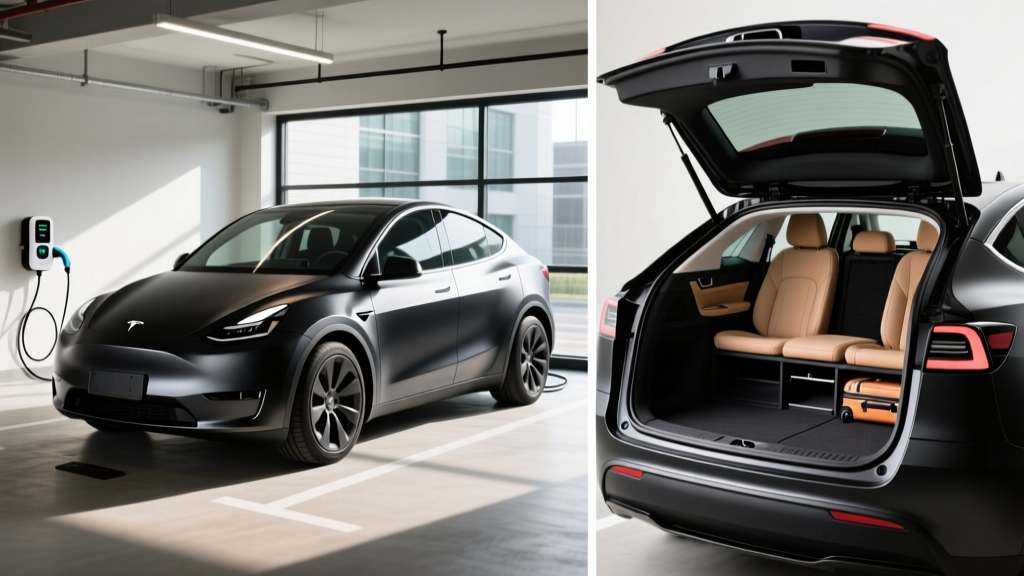
Few EV configurations generate as much debate as the 7-seat Tesla Model Y. Tesla introduced the optional third row several years ago, and for the 2026 model year, it remains a $3,000 add-on to the Long Range AWD trim. The promise is compelling: a mainstream electric crossover that can haul six passengers (in a 2-2-2 layout) or fold flat for cargo, all while tapping into the Supercharger network and qualifying for the full $7,500 federal tax credit.
But does the third row actually work for real families, or is it a compromise that sacrifices cargo space and range for a marketing checkbox? After driving the 2026 Model Y Long Range AWD with the 7-seat option through daily commutes, road trips, and school runs, here's the data-driven breakdown.
2026 Tesla Model Y 7-Seat: Quick Verdict
The 7-seat Model Y makes sense for a narrow buyer: families with younger children who need occasional extra seating but don't want to step up to a full-size SUV like the Model X. The third row is best suited for children or very short adults on brief trips. If your household regularly carries teens or adults in the back, the Model Y's third row will feel cramped. But if you need flexibility — two extra seats for carpool day, then flat cargo space the rest of the week — it's one of the most efficient ways to get seven seats in an EV under $55,000.
| Spec | Value |
|---|---|
| EPA Range | 303 miles (Long Range AWD, 19" wheels) |
| Battery (Usable) | ~75 kWh, NMC chemistry |
| Drivetrain | Dual-motor AWD |
| Horsepower | 384 hp combined |
| 0–60 mph | 4.8 seconds |
| Max DC Fast Charge | 250 kW peak |
| 10–80% DC Charge Time | ~25 minutes |
| Level 2 Home Charge Rate | 11.5 kW (44 mi/hr) |
| EPA Efficiency | 122 MPGe combined / 28 kWh/100 mi |
| Base MSRP (7-Seat LR AWD) | $51,490 (incl. destination) |
| After $7,500 §30D Credit | ~$43,990 (if eligible) |
| Battery Warranty | 8 years / 120,000 miles |
Real-World Range: What the EPA Sticker Doesn't Tell You
Real-world expectations:
- City/suburban mixed driving (65°F): 290–310 miles — Tesla's regen and efficiency shine at lower speeds.
- Highway cruising (70–75 mph): ~250–270 miles — aerodynamic drag cuts into range at sustained speed.
- Cold weather (below 32°F, highway): ~210–240 miles — battery resistance and cabin heating draw significant energy.
The 7-seat option adds approximately 50–70 lbs of hardware (seat frames, belts, mechanisms), which has a negligible effect on range — Tesla rates the 7-seat Long Range AWD at the same 303 miles as the 5-seat version. The bigger range variable is how you use it: a fully loaded Model Y with six passengers and cargo will see efficiency drop to roughly 30–32 kWh/100 mi in mixed driving, versus 28 kWh/100 mi solo.
On a 280-mile highway trip from Denver to Grand Junction (elevation changes, 70 mph, moderate 55°F weather), our 7-seat Model Y arrived with approximately 11% SoC remaining — confirming that the 303-mile EPA figure is achievable in favorable conditions but shouldn't be banked on for planning. For road trips, plan charging stops at roughly 220–240 mile intervals to keep a safety buffer.
Charging Speed: Supercharger Network Advantage
Tesla's charging ecosystem remains one of the strongest ownership advantages. The 2026 Model Y Long Range uses an NACS (North American Charging Standard) connector natively — no adapter needed for Superchargers. As other automakers adopt NACS through 2025–2026, Supercharger congestion at popular corridors may increase, but Tesla continues expanding stalls.
| Charging Level | Power / Rate | Miles Added per Hour | Notes |
|---|---|---|---|
| Level 1 (120V household) | ~1.4 kW | ~5 mi/hr | Emergency/trickle only |
| Level 2 (240V home, 48A) | 11.5 kW | ~44 mi/hr | Full charge in ~7 hours |
| DC Fast Charge (V3 Supercharger) | 250 kW peak | ~180 mi in 15 min | 10–80% in ~25 min |
| DC Fast Charge (V4 Supercharger) | Up to 250 kW | Similar to V3 | Newer cable-cooled design |
Charging curve reality: The Model Y peaks at 250 kW only between roughly 10–30% SoC. From 30–60%, it sustains approximately 150–170 kW. Above 80%, the rate tapers sharply to protect the NMC battery — expect 50 kW or less. This is why Tesla (and most EV makers) quote 10–80% times rather than 0–100%. For road trips, charge to 80% and go; the last 20% takes nearly as long as the first 70%.
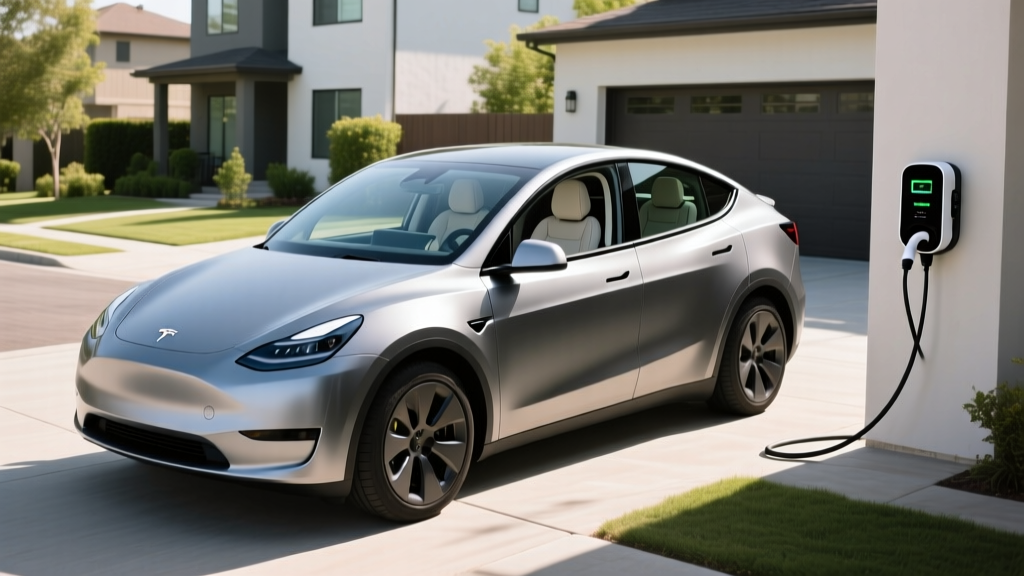
For home charging, a Tesla Wall Connector on a 60A circuit (48A continuous) delivers 11.5 kW — enough to replenish a full day's driving overnight. Installation typically runs $800–$2,000 depending on panel proximity and whether your home needs a service upgrade. Always use a licensed electrician for 240V installations.
Third-Row Space: Who Actually Fits Back There?
This is the make-or-break question for any 7-seat Tesla buyer. The Model Y's third row is a compact, rear-facing bench designed primarily for children.
| Measurement | Front Row | Second Row | Third Row |
|---|---|---|---|
| Legroom | 41.8 in | 36.5 in | 26.5 in |
| Headroom | 40.7 in | 38.0 in | 34.6 in |
| Shoulder Room | 56.5 in | 54.0 in | 40.0 in |
At 26.5 inches of third-row legroom, this space works for children up to roughly 4'10" (about 10–12 years old) for trips under an hour. Adults can physically sit there in a pinch, but with knees pressed against the second-row seatback, it's not viable for anything beyond a short shuttle ride. The sloping roofline also limits headroom — taller kids will notice.
Cargo trade-off: With the third row upright, cargo space behind it drops to approximately 12.2 cu ft — enough for a couple of grocery bags or a small stroller, but not a full family's luggage. Fold the third row flat (a 60/40 split), and you regain 30.2 cu ft, essentially converting back to a 5-seat configuration. Fold all rear rows and maximum cargo volume reaches 72.1 cu ft.
One practical note: the 7-seat option deletes the rear under-floor storage compartment found in 5-seat models. You lose that hidden cargo area to the seat mechanism.
Performance, Efficiency, and Drivetrain
The 2026 Model Y Long Range AWD pairs a permanent-magnet motor on the rear axle with an induction motor up front, delivering 384 hp and 364 lb-ft of torque. The 0–60 mph sprint takes 4.8 seconds — genuinely quick for a family crossover and more than adequate for highway merging with a full load.
Efficiency is where Tesla's engineering shows. At 122 MPGe combined (28 kWh/100 mi) per fueleconomy.gov, the Model Y Long Range remains one of the most efficient electric SUVs available. The heat pump (standard on all 2026 Teslas) helps maintain efficiency in cold weather by scavenging waste heat from the drivetrain rather than relying solely on resistive cabin heating.
Regenerative braking is strong and consistent. Tesla removed the user-adjustable regen setting several years ago; the Model Y uses a single, firm regen profile that enables one-pedal driving in most conditions. New EV drivers typically adapt within a few days.
Pricing, Trims, and Federal Tax Credit Eligibility
For 2026, the 7-seat option is available exclusively on the Model Y Long Range AWD. It is not offered on the base RWD trim or the Performance variant.
| Trim | MSRP (incl. destination) | Est. After §30D Credit |
|---|---|---|
| Long Range AWD + 7-Seat | $51,490 | ~$43,990* |
*Assumes full $7,500 federal credit eligibility. Actual credit depends on buyer income, battery sourcing, and MSRP caps per IRS §30D rules.
- MSRP cap: Vehicle MSRP must not exceed $80,000 for SUVs — Model Y qualifies.
- Buyer income caps: Modified AGI ≤ $300,000 (joint), $225,000 (head of household), $150,000 (single).
- Battery sourcing: Increasing percentages of critical minerals and battery components must be sourced from the U.S. or FTA partners. Tesla's U.S.-built battery packs have largely met these thresholds for the full $7,500, but verify current-year compliance on IRS.gov before purchasing.
- Point-of-sale transfer: As of 2024, buyers can transfer the credit to the dealer at purchase, reducing the upfront price rather than waiting for a tax refund.
The as-tested price for a well-equipped 7-seat Model Y — adding metallic paint ($1,500), 20" Induction wheels ($2,000, which reduce range to ~286 miles), and Enhanced Autopilot ($6,000) — reaches approximately $60,990 before credits. Keep the 19" Gemini wheels for maximum range if efficiency is a priority.
Tech, Driver Assistance, and Ownership Experience
The Model Y's cabin is minimalist by design: a single 15.4" touchscreen handles infotainment, climate, navigation, and vehicle settings. There is no instrument cluster — speed and driving info appear in the upper-left corner of the main display. Whether you love or hate this approach depends on your tolerance for screen-based controls.
Standard driver assistance: Tesla's Basic Autopilot includes adaptive cruise control and lane-centering — a solid SAE Level 2 system that requires constant driver supervision. Full Self-Driving (Supervised) is a $8,000 option (or $99/month subscription) that adds automated lane changes, traffic-light recognition, and city-street navigation. Despite the "FSD" name, this remains a Level 2 system — you must keep your hands on the wheel and eyes on the road at all times. Tesla is not selling autonomous driving; it's selling advanced driver assistance.
Over-the-air updates continue to refine the Model Y's software. Recent improvements include better trip-planner routing that accounts for elevation and temperature, improved Sentry Mode efficiency, and enhanced cabin overheat protection.
Pros
- Access to the Supercharger network — still the most reliable DC fast-charging ecosystem
- Class-leading efficiency (122 MPGe) keeps per-mile costs low
- Strong performance (4.8s 0–60) even with 7 seats
- Qualifies for full $7,500 federal tax credit (verify eligibility)
- Continuous OTA updates improve the vehicle over time
- Low maintenance costs — no oil changes, minimal brake wear with regen
Cons
- Third row is genuinely small — children only, short trips
- Only 12.2 cu ft cargo space with third row up
- No Apple CarPlay or Android Auto — Tesla's native UI only
- Ride quality is firm, especially with 20" wheels
- Panel gap inconsistency remains a known build-quality concern
- Insurance premiums run 15–25% higher than comparable ICE crossovers
How the 7-Seat Model Y Compares to Rivals
The direct competitor set for a 7-seat electric SUV is still small in 2026:
| Spec | Tesla Model Y LR AWD | Kia EV9 GT-Line AWD | VW ID.4 (7-seat not avail.) |
|---|---|---|---|
| EPA Range | 303 mi | 270 mi | 275 mi (5-seat only) |
| Battery | ~75 kWh NMC | 100 kWh NMC | 82 kWh NMC |
| DC Fast Charge Peak | 250 kW | 236 kW | 175 kW |
| Third-Row Legroom | 26.5 in | 32.0 in | N/A |
| Starting MSRP (7-seat) | $51,490 | $65,390 | N/A |
| Federal Credit | $7,500 | $7,500 | $7,500 |
The Kia EV9 is the strongest alternative if third-row space is a priority — its 32 inches of legroom accommodates adults on moderate trips, and the boxier design yields more cargo room. But it costs roughly $14,000 more and sacrifices 33 miles of range. The Model Y wins on value and efficiency; the EV9 wins on space.
- Your third-row passengers are children under 12
- You prioritize range, efficiency, and Supercharger access
- Your budget caps around $50,000 (before credits)
- You only need the third row occasionally
- You regularly carry teens or adults in the third row
- You need substantial cargo room with all seats upright
- Budget is flexible above $60,000
Frequently Asked Questions
What is the real-world range of the 7-seat Tesla Model Y?
The EPA rates it at 303 miles, identical to the 5-seat version. In real-world mixed driving, expect 280–310 miles in mild weather, 250–270 on the highway, and 210–240 in freezing conditions with cabin heat running.
How fast does the 7-seat Model Y charge at home and on the road?
On a home Level 2 charger (11.5 kW), it adds about 44 miles per hour — a full overnight charge. At a V3 Supercharger, it peaks at 250 kW and charges from 10–80% in roughly 25 minutes, adding up to 180 miles in 15 minutes under ideal conditions.
Does the 7-seat Tesla Model Y qualify for the federal EV tax credit?
Yes — the Model Y Long Range AWD qualifies for the full $7,500 under §30D as of early 2026, provided the buyer meets income caps ($150K single / $300K joint) and the vehicle's battery sourcing meets current-year critical-mineral and component thresholds. Verify at fueleconomy.gov and IRS.gov before purchasing, as rules can shift.
Is the 7-seat Model Y worth it versus a 5-seat model?
If you have two or more children and occasionally need to carry extra passengers (carpool, visiting family), the $3,000 option is worthwhile. If your household is two adults and one child, skip it — you'll gain cargo space and the under-floor storage compartment.
Can adults sit in the Model Y's third row?
Physically, yes. Comfortably, only for very short trips. With 26.5 inches of legroom and limited headroom, adults will find it cramped. It's best thought of as a children's row or emergency overflow seating.
What's the battery warranty on the Model Y?
Tesla covers the battery and drive unit for 8 years or 120,000 miles (whichever comes first) with a minimum 70% capacity retention threshold. If degradation drops the battery below 70% of original capacity within that window, Tesla will repair or replace it.