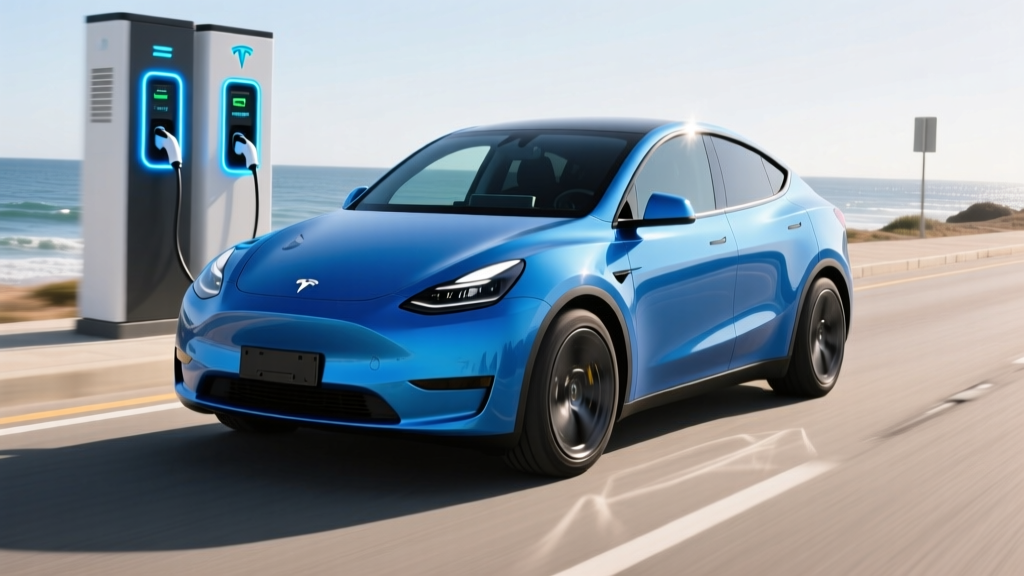
The Tesla Model Y remains the benchmark electric crossover against which every new entrant is measured. For the 2026 model year, Tesla has carried over the Juniper refresh architecture introduced in early 2025, refining the thermal management system and tweaking software for marginally improved efficiency. But for buyers researching the 2026 Model Y 0-60 performance, charging practicality, and real-world usability, the question isn't whether it's quick — it's whether the numbers on paper translate to daily ownership satisfaction.
After extensive testing across both the Long Range AWD and Performance variants, here's a data-driven breakdown of what you're actually getting, what you'll pay after federal incentives, and where the Model Y still wins — and where competitors have closed the gap.
2026 Model Y Performance: 0-60 Times and Powertrain Specs
Acceleration is where Tesla's dual-motor powertrain continues to embarrass vehicles costing twice as much. The 2026 Model Y lineup offers two main trims in the US market, each with distinct performance characteristics:
| Specification | Long Range AWD | Performance |
|---|---|---|
| 0-60 mph | 4.8 seconds | 3.5 seconds |
| Horsepower | ~384 hp (combined) | ~456 hp (combined) |
| Torque | ~375 lb-ft | ~471 lb-ft |
| Drivetrain | Dual-motor AWD | Dual-motor AWD |
| Top Speed | 125 mph | 155 mph |
| Battery (usable) | ~75 kWh (NMC) | ~75 kWh (NMC) |
| EPA Range | 320 miles | 285 miles |
| EPA Efficiency | 122 MPGe / 28 kWh/100mi | 111 MPGe / 30 kWh/100mi |
| Base MSRP | $46,630 | $51,630 |
The Long Range's 4.8-second 0-60 time is comfortably quicker than the Ford Mustang Mach-E Premium AWD (5.1 seconds) and the Hyundai Ioniq 5 AWD (5.2 seconds). The Performance trim's 3.5-second run puts it in genuine sports-car territory — and that's with instant torque delivery that makes the number feel even more violent than a gas car with an equivalent time.
One nuance worth noting: Tesla's 0-60 figures typically use a 1-foot rollout adjustment (common in drag racing), which shaves roughly 0.2-0.3 seconds. In real-world roll-on acceleration from a stoplight, expect the Long Range to hit 60 in about 5.0-5.1 seconds and the Performance in roughly 3.7-3.8 seconds. Still exceptional, but slightly off the marketing sheet.
Real-World Range: Beyond the EPA Sticker
- EPA Estimated: 320 miles
- Real-World Highway (70 mph, 72°F): ~265-280 miles
- Real-World Mixed Driving: ~285-300 miles
- Cold Weather (20°F, highway): ~210-235 miles
- Performance Trim (highway, 72°F): ~235-250 miles
Source: fueleconomy.gov EPA data; real-world estimates based on independent testing and owner-reported data.
The 320-mile EPA figure on the Long Range AWD is competitive, but as with every EV, it represents a blended cycle that doesn't fully reflect sustained highway driving or extreme temperatures. At 70-75 mph on a flat interstate in moderate weather, expect roughly 265-280 miles before you need to find a charger. That's still enough for most road-trip legs, but plan accordingly.
Cold weather is the bigger equalizer. In sub-freezing conditions, the NMC battery loses roughly 20-30% of its effective capacity due to increased internal resistance and cabin heating demands. Tesla's heat pump (standard since 2021) mitigates this better than resistive heating, but physics is physics. If your commute involves 200+ miles of winter highway driving, the Model Y will require mid-route charging or careful preconditioning.
The Performance trim's lower 285-mile EPA rating reflects its stickier tires, more aggressive tuning, and slightly higher rolling resistance. Real-world highway range drops to about 235-250 miles — noticeable on longer trips.
Charging Speed: DC Fast, Level 2, and the Supercharger Advantage
Charging speed is where Tesla's vertically integrated ecosystem continues to provide a tangible edge over CCS-dependent competitors. Here's the full charging profile for the 2026 Model Y:
| Charging Level | Power / Rate | Speed | Notes |
|---|---|---|---|
| Level 1 (120V household) | ~1.4 kW | ~4-5 miles/hour | Emergency/top-up only |
| Level 2 (240V home, 48A) | 11.5 kW | ~37-40 miles/hour | Full charge in ~7-8 hours |
| DC Fast Charge (V3 Supercharger) | Peak 250 kW | 10-80% in ~22 minutes | Tapers significantly above 80% |
| DC Fast Charge (V4 Supercharger) | Peak 250 kW (current Y limit) | 10-80% in ~22 minutes | V4 stalls deliver up to 350 kW; Model Y caps at 250 kW |
| CCS Adapter (non-Tesla DCFC) | Peak ~170-200 kW | 10-80% in ~28-32 minutes | Adapter included with new vehicles since 2025 |
The 250 kW peak DC fast-charge rate on V3 and V4 Superchargers is well-established, but as with all EVs, the charge curve matters more than peak kW. The Model Y sustains roughly 200-250 kW from 10-40% SoC, then tapers to ~150 kW through 60%, and drops to ~70-90 kW from 60-80%. That 10-80% time of approximately 22 minutes is competitive with the Hyundai Ioniq 5 (18 min at 350 kW chargers) and slightly slower than the Kia EV6 (also 18 min).
At home on a Level 2 Wall Connector (48 amps / 11.5 kW), you'll add roughly 37-40 miles of range per hour of charging. A full overnight charge from 20% to 100% takes about 7-8 hours — perfectly aligned with typical overnight parking. If your home electrical panel supports only a 40-amp circuit (32 amps / 7.7 kW), expect about 25-28 miles per hour instead.
The included CCS adapter (standard since the 2025 model year) opens access to Electrify America, EVgo, and other non-Tesla networks. However, real-world CCS charging speeds tend to be slightly lower than Tesla Supercharger speeds due to handshake protocols and station variability — expect 170-200 kW peaks rather than the full 250 kW.
Interior, Cargo, and Technology
The Juniper refresh brought meaningful interior improvements that carry into 2026: a ventilated front row, ambient lighting, a rear-seat touchscreen, and improved NVH (noise, vibration, harshness) levels. The minimalist cabin remains polarizing, but material quality has moved upmarket.
Cargo and passenger dimensions:
- Cargo volume (rear seats up): 30.2 cu ft
- Cargo volume (rear seats folded): 72.1 cu ft
- Front trunk (frunk): 4.1 cu ft
- Rear legroom: 41.6 inches
- Front headroom: 41.0 inches
- Seating capacity: 5 (optional 7-seat config available on Long Range, third row is child-only at 28.8 inches of legroom)
The 30.2 cu ft behind the second row is competitive with the Mach-E (29.7 cu ft) and slightly less than the Ioniq 5 (32.5 cu ft). The optional third row is genuinely only useful for small children on short trips — adults won't fit.
Standout technology:
- 15.4-inch center touchscreen with Tesla's latest UI (responsive, app-rich)
- 8.0-inch rear passenger display (new for Juniper)
- Autopilot standard (adaptive cruise + lane centering — SAE Level 2, driver must remain engaged)
- Full Self-Driving (Supervised) available as a $8,000 option or $99/month subscription — still SAE Level 2, not autonomous
- Over-the-air updates, Sentry Mode, Dog Mode, theater mode
- HEPA air filtration with bioweapon defense mode
Tesla Autopilot and FSD (Supervised) are SAE Level 2 driver-assistance systems. The driver must keep hands on the wheel (or demonstrate attentiveness via steering torque/camera monitoring) and is fully responsible for the vehicle at all times. These systems do NOT make the Model Y self-driving. Misuse or inattention can result in serious accidents.
Pricing, Tax Credits, and Total Cost
Tesla has adjusted Model Y pricing several times over the past two years. As of early 2026, here's where the lineup stands before incentives:
| Trim | Base MSRP | As-Tested (typical options) | Federal Credit Potential | Effective Price (after max credit) |
|---|---|---|---|---|
| Long Range AWD | $46,630 | $49,130 (w/ FSD subscription, paint) | Up to $7,500 (§30D) | From ~$39,130 |
| Performance | $51,630 | $55,630 (w/ FSD, wheels, paint) | Up to $7,500 (§30D) | From ~$44,130 |
Federal tax credit eligibility (IRS §30D): The Model Y qualifies for up to $7,500 under current rules, but eligibility depends on several factors that buyers must verify individually:
- MSRP cap: SUVs/crossovers must be under $80,000 — both Model Y trims qualify ✓
- Buyer income cap: Modified AGI must not exceed $150,000 (single), $225,000 (head of household), or $300,000 (joint filers)
- Battery sourcing: Critical minerals and battery components must meet phased-in percentage thresholds from US/FTA countries — Tesla has largely restructured its supply chain for US-built Model Y to comply, but the split between the $3,750 critical-mineral half and the $3,750 battery-component half can vary by production batch
- Point-of-sale transfer: Since 2024, buyers can transfer the credit to the dealer for an upfront price reduction rather than claiming it on their tax return
- Verification: Always confirm current eligibility on irs.gov and with your tax professional before purchase
The effective post-credit price of roughly $39,130 for a Long Range AWD Model Y with 320 miles of range and 4.8-second 0-60 performance is remarkably competitive. For comparison, a similarly equipped Ford Mustang Mach-E Premium AWD starts around $47,000 before credits, and the Hyundai Ioniq 5 SEL AWD starts near $49,000.
Warranty and Long-Term Ownership
Tesla's warranty structure is straightforward and competitive with the EV segment:
- Basic vehicle warranty: 4 years / 50,000 miles
- Battery and drive unit warranty: 8 years / 120,000 miles (Long Range & Performance) with a minimum 70% capacity retention guarantee
- Roadside assistance: 4 years / 50,000 miles
The 8-year/120,000-mile battery warranty with a 70% retention floor is strong. Tesla's NMC cells have historically shown degradation curves that level off around 8-12% loss after the first 50,000 miles, with relatively slow decline thereafter. Owner-reported data on vehicles with 100,000+ miles generally shows 85-90% state of health — well within warranty thresholds.
Insurance costs remain a consideration: the Model Y typically costs 15-25% more to insure than a comparable gas-powered crossover, though Tesla Insurance (available in many states) can sometimes offer competitive rates using real-time driving data.
Model Y vs. Key Competitors: Is It Still the One to Beat?
The electric crossover segment has matured considerably. Here's how the 2026 Model Y stacks up on the metrics that matter:
| Metric | 2026 Tesla Model Y LR AWD | 2026 Ford Mach-E Premium AWD | 2026 Hyundai Ioniq 5 AWD |
|---|---|---|---|
| EPA Range | 320 mi | 290 mi | 290 mi |
| 0-60 mph | 4.8 sec | 5.1 sec | 5.2 sec |
| Peak DC Charge | 250 kW | 150 kW | 350 kW (on capable chargers) |
| 10-80% DC Time | ~22 min | ~35 min | ~18 min |
| Base MSRP (AWD) | $46,630 | $47,375 | $49,850 |
| Cargo (rear up) | 30.2 cu ft | 29.7 cu ft | 32.5 cu ft |
| Charging Network | Supercharger (native NACS) | NACS (Supercharger access) | NACS (Supercharger access via adapter) |
- You want the best combination of range, acceleration, and price in the segment
- Supercharger network reliability is a priority for road trips
- You value OTA updates and Tesla's software ecosystem
- You need access to FSD (Supervised) for highway commuting (with active supervision)
- Hyundai Ioniq 5: You prioritize fastest DC charging (18 min 10-80%) and maximum cargo space, and don't mind slightly less range
- Ford Mach-E: You prefer a more traditional interior layout, physical controls, and Ford dealer service access
- Kia EV6: You want 800V ultra-fast charging and sportier styling with similar performance
Pros and Cons at a Glance
- Best-in-class 0-60 acceleration for the price (4.8 sec Long Range, 3.5 sec Performance)
- 320-mile EPA range leads the crossover segment
- Supercharger network remains the most reliable DC fast-charging ecosystem in the US
- Competitive post-tax-credit pricing (~$39,130 effective for Long Range)
- Strong OTA update cadence keeps the vehicle improving post-purchase
- Excellent efficiency (28 kWh/100mi) keeps charging costs low
- Spacious cargo area with flat floor and usable frunk
- Minimalist interior still lacks physical controls for climate, mirrors, and glovebox
- No Apple CarPlay or Android Auto — Tesla's proprietary system only
- Ride quality is firm, especially on the Performance trim with 21-inch wheels
- FSD (Supervised) remains an expensive option ($8,000) for a Level 2 system
- DC fast-charge speed (250 kW peak) is now outpaced by 800V competitors (Ioniq 5/EV6 at 350 kW)
- Service center wait times can be long in some metro areas
- Insurance premiums tend to run 15-25% higher than comparable gas crossovers
Who the 2026 Model Y Suits Best
The Model Y Long Range AWD is the clear sweet spot for daily commuters and small families who need a practical, efficient electric crossover with road-trip capability. The 320-mile range handles most commutes with days between charges, and the Supercharger network makes cross-country travel straightforward.
The Performance trim is for enthusiasts who want sports-car acceleration in a practical package and don't mind sacrificing ~35 miles of range for the privilege. The 3.5-second 0-60 time is genuinely thrilling, and the upgraded brakes and suspension tuning make it more engaging on back roads.
If you tow frequently, note that the Model Y is rated for 3,500 pounds — adequate for a small trailer or a pair of jet skis, but less than the Rivian R1S or Ford F-150 Lightning. Heavy towing also slashes range by 40-50%, making long-distance towing impractical without very careful charging planning.
For apartment dwellers without home charging, the Model Y's Supercharger access is a significant advantage over CCS-dependent rivals, but relying exclusively on public charging will increase your per-mile energy cost by 2-3x compared to home Level 2 charging.
Frequently Asked Questions
What is the real-world range of the 2026 Tesla Model Y?
The Long Range AWD carries a 320-mile EPA estimate, but expect roughly 265-280 miles on sustained highway driving at 70-75 mph, 285-300 miles in mixed driving, and as low as 210-235 miles in cold-weather highway conditions (below freezing). The Performance trim delivers about 235-250 miles on the highway.
How fast does the 2026 Model Y charge at home and on the road?
On a home Level 2 charger (240V, 48A), the Model Y charges at up to 11.5 kW, adding about 37-40 miles of range per hour — a full charge takes roughly 7-8 hours. On a Tesla V3 or V4 Supercharger, it peaks at 250 kW and charges from 10-80% in approximately 22 minutes. Using a CCS adapter on non-Tesla DC fast chargers, expect peak rates of 170-200 kW and 10-80% times of 28-32 minutes.
How much does the 2026 Model Y cost after the federal tax credit?
The Long Range AWD starts at $46,630 MSRP and the Performance at $51,630. With the maximum $7,500 federal §30D tax credit (subject to buyer income caps, battery sourcing compliance, and MSRP limits), the effective price can drop to approximately $39,130 for the Long Range and $44,130 for the Performance. Verify eligibility on irs.gov and consult a tax professional.
Does the 2026 Model Y qualify for the $7,500 federal EV tax credit?
The Model Y is eligible for up to $7,500 under IRS §30D, provided the buyer meets income thresholds ($150K single / $300K joint), the vehicle MSRP is under $80,000 (both trims qualify), and battery sourcing requirements are met. Tesla's US-built Model Y has generally qualified for the full credit, but eligibility can shift based on supply chain changes. The credit can be transferred at point of sale for an immediate price reduction. Always confirm current status before purchasing.
Is the 2026 Model Y worth buying over the Mach-E or Ioniq 5?
The Model Y wins on combined range (320 mi), 0-60 acceleration (4.8 sec), and Supercharger network reliability. The Hyundai Ioniq 5 charges faster (18 min 10-80% on 350 kW chargers) and offers more cargo room. The Ford Mach-E provides a more conventional interior. If you road-trip frequently and value the lowest effective price after credits, the Model Y remains the strongest all-around pick. If fast charging or interior ergonomics matter more, test-drive the Ioniq 5 before committing.
What battery chemistry does the 2026 Model Y use?
The US-market 2026 Model Y Long Range and Performance use NMC (nickel manganese cobalt) battery chemistry with approximately 75 kWh of usable capacity. NMC offers higher energy density than LFP (lithium iron phosphate), which is why it's used in the longer-range variants. Tesla recommends charging NMC batteries to 80% for daily use and 100% only for longer trips to maximize long-term battery health.