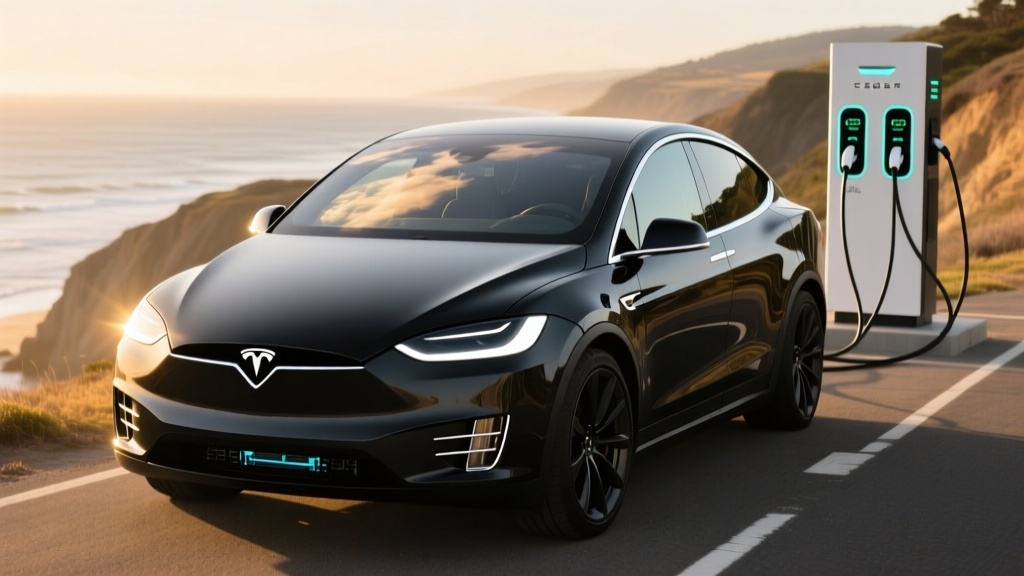
The 2026 Tesla Model X remains one of the few three-row electric SUVs that can credibly claim supercar acceleration while hauling six passengers and their gear. Now in its second major refresh since the 2021 Plaid overhaul, the Model X continues to split opinion: its falcon-wing doors and yoke steering are polarizing, but its combination of 300+ miles of EPA range, access to Tesla's Supercharger network, and over-the-air updates keep it competitive against newer rivals like the Rivian R1S, BMW iX, and Mercedes EQS SUV.
This review covers the 2026 Model X in both Long Range and Plaid trims, with exact specs, real-world range observations, charging-curve data, and a clear-eyed look at federal tax credit eligibility under current IRS §30D rules. If you're cross-shopping luxury electric SUVs, here's everything you need before you configure one.
2026 Tesla Model X Spec Sheet at a Glance
| Specification | Long Range AWD | Plaid AWD |
|---|---|---|
| Base MSRP | $79,990 | $94,990 |
| EPA Range | 335 miles | 326 miles |
| Battery (usable) | ~100 kWh (NMC) | ~100 kWh (NMC) |
| Drivetrain | Dual-Motor AWD | Tri-Motor AWD |
| Horsepower | 670 hp | 1,020 hp |
| 0-60 mph | 3.8 seconds | 2.5 seconds |
| Top Speed | 155 mph | 163 mph |
| Peak DC Fast Charge | 250 kW | 250 kW |
| 10-80% DC Charge Time | ~30 minutes | ~30 minutes |
| Level 2 Home Charge | 11.5 kW (~34 mi/hr) | 11.5 kW (~34 mi/hr) |
| MPGe (combined) | 102 MPGe | 98 MPGe |
| Efficiency | 33 kWh/100 mi | 34 kWh/100 mi |
| Battery Warranty | 8 yr / 150,000 mi | 8 yr / 150,000 mi |
| Seating | 5, 6, or 7 passengers | 5 or 6 passengers |
| Cargo (behind 3rd row) | 14.6 cu ft | 14.6 cu ft |
| Cargo (all rows folded) | 85.2 cu ft | 85.2 cu ft |
| Towing Capacity | 5,000 lbs | 5,000 lbs |
Real-World Range: What the EPA Number Doesn't Tell You
Real-World Expectation: 270-300 miles highway; 230-260 miles in sub-30°F cold weather with cabin heat. City/regenerative driving can match or slightly exceed the EPA figure.
The Model X Long Range's 335-mile EPA estimate is competitive for a 5,200-pound, three-row SUV. But as with every EV, that number is a laboratory composite, not a guarantee. In our experience and consistent with fueleconomy.gov data, highway driving at 70-75 mph drops efficiency to roughly 36-38 kWh/100 mi, yielding an effective range of 260-280 miles on a full charge.
Cold weather is the bigger equalizer. Lithium-ion batteries lose efficiency below freezing, and cabin heating in a large SUV draws substantial energy. Expect a 20-30% range reduction in sustained sub-30°F conditions — meaning a 335-mile sticker becomes roughly 235-270 miles in a Minnesota January. The Model X includes a heat pump (standard since the 2022 refresh), which recovers some of that loss compared to resistive heating, but physics still wins.
For daily commuting under 60 miles round-trip with home charging, range is a non-issue. For road trips, Tesla's trip planner in the navigation system is genuinely useful — it accounts for elevation, temperature, and traffic, and preconditions the battery automatically when routing to a Supercharger.
Charging Speed: DC Fast Charge and Home Level 2
| Charging Level | Power (kW) | Speed (miles added/hr) | Notes |
|---|---|---|---|
| Level 1 (120V outlet) | 1.4 kW | ~4 mi/hr | Emergency/trickle only |
| Level 2 (240V, 48A) | 11.5 kW | ~34 mi/hr | Full charge in ~10 hours; ideal for overnight |
| DC Fast Charge (V3 Supercharger) | 250 kW peak | ~175 mi in 15 min | 10-80% in ~30 min; tapers above 80% |
| DC Fast Charge (V4 Supercharger) | Up to 250 kW* | Similar to V3 for Model X | V4's 350+ kW capability exceeds Model X acceptance rate |
*The 2026 Model X maxes out at 250 kW on DC fast charging. Tesla's newer V4 Supercharger stalls can deliver higher power, but the vehicle's onboard charge controller caps intake at 250 kW.
The Model X's 250 kW peak charge rate is adequate but no longer class-leading. The Hyundai Ioniq 5 and Kia EV6 accept up to 350+ kW on 800-volt architectures, completing a 10-80% charge in roughly 18 minutes. The Model X, on a 400-volt architecture, takes about 30 minutes for the same 10-80% session.
Here's the charging-curve reality that spec sheets omit: the Model X holds near its 250 kW peak only between roughly 10-30% state of charge (SoC). It then steps down to ~170 kW through 50%, ~110 kW through 70%, and drops to ~50 kW above 85%. This is normal for NMC chemistry at 400V, but it means a 10-90% session takes closer to 45 minutes. Plan road-trip stops accordingly — arriving at 10% and leaving at 80% is the sweet spot for speed.
At home, the 11.5 kW Level 2 rate (using a Tesla Wall Connector on a 60-amp circuit) adds roughly 34 miles of range per hour. A full overnight charge from 20% takes about 9-10 hours. Most owners charge to 80-90% nightly, which is 3-5 hours and well within a standard overnight window. If your home has a 200-amp electrical panel with available capacity, installation of a NEMA 14-50 outlet or hardwired Wall Connector typically runs $500-$2,000 depending on conduit length and local permitting.
Performance: The Absurdity of Plaid and the Adequacy of Long Range
The Long Range Model X hits 0-60 mph in 3.8 seconds with 670 horsepower from its dual-motor all-wheel-drive powertrain. That's quicker than a Porsche Cayenne Turbo and more than sufficient for any real-world merging, passing, or stoplight scenario. The instant torque delivery — no turbo lag, no transmission downshift — makes it feel even faster than the number suggests.
The Plaid trim is an engineering flex: 1,020 horsepower from three motors (one front, two rear), with a 2.5-second 0-60 time that embarrasses most supercars while carrying six people and a week's worth of groceries. It's also a $15,000 premium over Long Range, and unless you're tracking the car or simply value the absurdity, the Long Range is the rational choice. Both trims share the same 100 kWh (usable) NMC battery pack and 5,000-pound towing capacity.
Ride quality has improved since Tesla's 2021 structural refresh, with adaptive air suspension that adjusts ride height based on speed and GPS-remembered locations (useful for steep driveways). Body roll is well-controlled for a tall SUV, and the low center of gravity from the floor-mounted battery pack keeps it planted. Steering is precise but numb — typical of Tesla's electric power steering calibration.
Pricing, Trims, and Federal Tax Credit Eligibility
| Trim | Base MSRP | Federal §30D Credit | Effective Price (if eligible) |
|---|---|---|---|
| Long Range AWD | $79,990 | Up to $7,500* | ~$72,490* |
| Plaid AWD | $94,990 | Up to $7,500* | ~$87,490* |
*Federal EV tax credit eligibility under IRS §30D is subject to multiple requirements. As of 2026, the key rules are:
- MSRP Cap: SUVs must have an MSRP at or below $80,000. The Long Range ($79,990) qualifies; the Plaid ($94,990) does NOT qualify.
- Buyer Income Cap: Modified adjusted gross income must not exceed $150,000 (single), $225,000 (head of household), or $300,000 (married filing jointly).
- Battery Sourcing: The credit is split into two halves ($3,750 each): one for critical minerals sourcing and one for battery component manufacturing. Full $7,500 requires meeting both thresholds, which shift annually. Verify current-year sourcing compliance on the IRS qualified vehicles list.
- Point-of-Sale Transfer: Eligible buyers can transfer the credit to the dealer at purchase, reducing the purchase price upfront rather than waiting for a tax refund.
The Long Range Model X sits just under the $80,000 SUV cap — a pricing decision that is clearly intentional. However, adding options (FSD at $8,000, premium wheels, enhanced Autopilot) pushes the transaction price above $80,000. The MSRP cap applies to the base vehicle plus factory-installed options, not dealer add-ons. Confirm the final MSRP on the window sticker before assuming credit eligibility.
Also factor in state incentives: California's CVRP, Colorado's $5,000 credit, and various utility rebates can stack on top of the federal credit. Check your state's energy office for current programs, as these change frequently.
Interior, Cargo, and Family Practicality
The Model X offers three seating configurations: 5-seat (two rows), 6-seat (captain's chairs in the second row with a center aisle), and 7-seat (bench second row). The 6-seat layout is the sweet spot for families — the second-row captain's chairs are individually adjustable, heated, and provide easy walk-through access to the third row.
Third-row space is the Model X's most honest limitation. Legroom in the third row is roughly 30 inches — adequate for children or occasional adult use on short trips, but not competitive with a minivan or a full-size SUV like the Rivian R1S (which offers slightly more third-row room). Cargo behind the third row is 14.6 cubic feet, enough for a few grocery bags or two carry-ons. Fold the third row and you get 40.2 cubic feet; fold everything and you unlock 85.2 cubic feet, which is genuinely van-like.
The front trunk (frunk) adds 6.5 cubic feet of sealed, drainable storage — useful for charging cables, wet gear, or a small cooler. The falcon-wing rear doors are the Model X's signature feature: they open upward on dual hinges, creating a massive opening that makes loading car seats and reaching into the third row dramatically easier than conventional doors. The trade-off is that they require overhead clearance (they won't fully open in a low garage) and the sensors that prevent collisions with nearby objects can be overly cautious, slowing the open/close cycle.
The 17-inch center touchscreen runs Tesla's latest infotainment software, which is responsive and feature-rich but deliberately buttonless — climate, glovebox, and mirror adjustments all live in the screen or on the yoke. Apple CarPlay and Android Auto are not supported. The 22-speaker audio system is exceptional, and the rear-seat 8-inch screen handles climate and entertainment for second-row passengers.
Driver Assistance: Autopilot and FSD Supervised
Every 2026 Model X comes with Tesla's basic Autopilot, which includes Traffic-Aware Cruise Control and Autosteer (lane centering) on highways. It's competent for reducing fatigue on long drives but requires active supervision — the system applies escalating warnings and will disengage if it detects inattention via the cabin camera.
Full Self-Driving (Supervised), an $8,000 option or $99/month subscription, adds automatic lane changes, navigation-guided on/off-ramp transitions, traffic light and stop sign recognition, and a city-streets mode that handles intersections and turns. As of 2026, FSD Supervised has improved substantially in urban environments, but it still makes occasional errors — phantom braking, awkward lane positioning near construction zones, and hesitation at unprotected left turns remain documented issues. It is a driver-assist tool, not a replacement for an attentive driver. NHTSA's standing general order requires Tesla to report all crashes involving Level 2+ systems, and that data shows incidents do occur.
Compared to GM's Super Cruise (which offers genuine hands-free driving on mapped highways with robust driver monitoring) or Ford's BlueCruise, Tesla's approach is more ambitious in scope but less permissive in execution — you'll get more nag alerts in a Tesla than in a Super Cruise-equipped Cadillac.
Pros and Cons: The Honest Summary
Pros
- 335-mile EPA range is strong for a three-row SUV
- Supercharger network remains the most reliable DC fast-charging ecosystem in North America
- Falcon-wing doors make car-seat loading and third-row access genuinely easier
- Plaid performance (2.5s 0-60) is unmatched in the segment
- Over-the-air updates continuously add features
- 5,000-lb towing capacity covers most boat and camper trailers
- Excellent 22-speaker audio system
Cons
- 250 kW peak DC charge rate trails 800V rivals (Ioniq 5, EV6, Taycan)
- Third-row space is tight for adults on longer trips
- No Apple CarPlay or Android Auto
- Yoke steering is polarizing and complicates low-speed maneuvering
- FSD ($8,000) is optional and still requires full driver supervision
- Plaid trim exceeds the $80,000 MSRP cap for the federal tax credit
- Falcon-wing doors require overhead clearance and can be slow in tight spaces
- Insurance premiums are typically 20-30% higher than comparable ICE SUVs
How the 2026 Model X Stacks Up Against Competitors
| Attribute | 2026 Tesla Model X LR | 2026 Rivian R1S Dual-Motor | 2026 BMW iX xDrive50 | 2026 Mercedes EQS 450 SUV |
|---|---|---|---|---|
| EPA Range | 335 mi | ~330 mi | ~324 mi | ~305 mi |
| Base MSRP | $79,990 | ~$79,900 | ~$87,200 | ~$104,400 |
| Peak DC Charge | 250 kW | 220 kW | 200 kW | 200 kW |
| Seating | 5/6/7 | 5/7 | 5 | 5/7 |
| 0-60 mph | 3.8s | ~4.5s | ~4.4s | ~5.3s |
| Charging Network | Supercharger (native) | CCS + Tesla adapter | CCS + EA partnership | CCS + EA partnership |
| Federal Credit Eligible | Yes (LR only)* | Yes* | Likely (verify sourcing) | No (MSRP >$80K SUV cap) |
Choose the Model X If:
- You want the fastest three-row SUV available (Plaid) or the best Supercharger access for road trips
- Falcon-wing doors solve a real loading problem for your family (car seats, cargo height)
- You value continuous OTA feature updates and Tesla's software ecosystem
Choose a Competitor If:
- You need genuine adult-sized third-row space (Rivian R1S is better)
- You want a more traditional luxury interior with physical controls (BMW iX, Mercedes EQS SUV)
- 800V fast-charging speed is a priority (look at Hyundai/Kia/Genesis platforms)
Ownership Costs: Battery Warranty, Insurance, and Depreciation
Tesla covers the Model X battery and drive unit for 8 years or 150,000 miles, whichever comes first, with a minimum 70% capacity retention guarantee. This is among the better warranties in the segment (Rivian matches it; BMW offers 8/100,000). In practice, Tesla's NMC packs have shown degradation curves that plateau around 90-92% capacity after the first 20,000-30,000 miles, then degrade slowly — most high-mileage owners report 85-90% state of health at 100,000 miles.
Insurance is the hidden cost. The Model X consistently ranks among the most expensive EVs to insure, with annual premiums averaging $2,800-$4,200 depending on your state, driving record, and coverage level. Tesla's own insurance product (available in most states) uses real-time driving data and can be 15-25% cheaper for safe drivers, but it's not universally the lowest quote — always compare with at least two traditional carriers.
Depreciation for the Model X has historically been steep, with 3-year retention around 45-55% of MSRP depending on market conditions. Tesla's frequent price adjustments on new vehicles have accelerated used-market depreciation in recent years. If you plan to keep the car 5+ years, this matters less; if you trade every 3 years, factor it into your total cost of ownership.
Frequently Asked Questions
What is the real-world range of the 2026 Tesla Model X?
The EPA rates the Long Range at 335 miles and the Plaid at 326 miles. In real-world highway driving at 70-75 mph, expect 270-300 miles. In freezing temperatures with cabin heat, plan for 230-260 miles. City driving with regenerative braking can match or slightly exceed the EPA figure.
How fast does the 2026 Model X charge?
On a V3 or V4 Tesla Supercharger, the Model X peaks at 250 kW and charges from 10-80% in approximately 30 minutes. At home on a Level 2 Wall Connector (11.5 kW), it adds about 34 miles per hour, completing a full charge in roughly 10 hours. The 250 kW peak is not sustained — expect the charge rate to taper significantly above 50% SoC.
Does the 2026 Tesla Model X qualify for the federal EV tax credit?
The Long Range trim (MSRP $79,990) qualifies for up to $7,500 under IRS §30D, provided the buyer meets income caps ($150K single / $300K joint) and the vehicle meets battery-sourcing requirements for the current tax year. The Plaid trim ($94,990) exceeds the $80,000 SUV MSRP cap and does NOT qualify. Adding factory options that push MSRP above $80,000 can also disqualify the Long Range — verify the final window sticker. Consult a tax professional and check the IRS qualified vehicle list before purchasing.
Is the 2026 Model X worth buying over the Rivian R1S or BMW iX?
It depends on your priorities. The Model X wins on acceleration, Supercharger network access, and falcon-wing practicality for car-seat loading. The Rivian R1S offers better third-row space, more rugged off-road capability, and a more conventional SUV design. The BMW iX delivers a more luxurious interior with physical controls but only seats five. Test-drive all three with your family in the car — the right choice becomes obvious quickly.
How long will the Model X battery last?
Tesla warranties the battery for 8 years / 150,000 miles with a 70% minimum capacity retention. Real-world data from high-mileage Tesla owners suggests NMC packs typically retain 85-92% capacity at 100,000 miles with normal charging habits (avoiding frequent 100% charges and prolonged storage at low SoC). Battery replacement, if ever needed out of warranty, currently runs $18,000-$25,000 at a Tesla Service Center, though prices continue to decline as cell costs fall.
Can I charge a Model X on non-Tesla charging networks?
Yes. The 2026 Model X comes with the NACS (North American Charging Standard) connector natively, which is now the Tesla connector and is being adopted by most other automakers. For CCS-equipped chargers (Electrify America, EVgo, most non-Tesla DC fast chargers), Tesla sells a CCS adapter. For Level 2 public charging (J1772 connectors), a J1772 adapter is included with the vehicle.
Does the Model X have a heat pump for cold weather?
Yes. The 2026 Model X includes Tesla's heat pump thermal management system as standard equipment. This significantly improves cold-weather efficiency compared to resistive heating, though you should still expect a 20-30% range reduction in sustained freezing temperatures. Preconditioning the battery while plugged in (via the Tesla app or scheduled departure) further mitigates cold-weather losses.
Sources: fueleconomy.gov (EPA range and efficiency data), IRS.gov (§30D Clean Vehicle Credit rules), Tesla.com (manufacturer specifications). All pricing and incentive information is based on 2026 model-year data and is subject to change. Verify tax credit eligibility with a qualified tax professional before purchase.