Quick Verdict: The 2026 Model X at a Glance
The 2026 Tesla Model X remains one of the few three-row electric SUVs that can credibly tow 5,000 pounds, supercharge at 250 kW, and hit 60 mph in under four seconds — all while offering a cabin that Tesla has incrementally refined with ventilated seats, a rear touchscreen, and improved material quality. But at a starting MSRP of $79,990 (before incentives), the Model X occupies a narrow lane: premium family hauler for buyers who need tri-row seating, Supercharger network access, and blistering performance, yet find the Rivian R1S too compact in the third row and the BMW iX lacking a third row entirely.
This review focuses on what the 2026 Tesla Model X interior actually delivers in daily use — space, tech, comfort, and practicality — alongside the hard numbers on range, charging speed, efficiency, and ownership cost that should drive any six-figure EV purchase.
Range, Battery & Real-World Efficiency
The 2026 Model X Long Range AWD pairs a ~100 kWh usable battery pack (NMC lithium-ion chemistry) with a dual-motor all-wheel-drive system. The EPA rates it at 335 miles of combined range. The Plaid variant, with its tri-motor setup and higher power draw, drops to an EPA-estimated 326 miles.
EPA 335 mi (Long Range AWD). In our mixed-driving experience and corroborated by owner data, expect ~280–305 miles on a typical highway road trip at 70–75 mph. In freezing temperatures (below 32°F), range can drop an additional 15–25%, putting realistic winter highway range around 240–265 miles unless you precondition the battery while plugged in. City driving with regenerative braking recovers closer to the EPA sticker or slightly above.
| Spec | Long Range AWD | Plaid |
|---|---|---|
| EPA Range | 335 mi | 326 mi |
| Battery Capacity (usable) | ~100 kWh (NMC) | ~100 kWh (NMC) |
| MPGe (combined) | 102 MPGe | 98 MPGe |
| Efficiency (kWh/100 mi) | ~33 kWh/100 mi | ~34 kWh/100 mi |
| Drivetrain | Dual-Motor AWD | Tri-Motor AWD |
| 0–60 mph | 3.8 sec | 2.5 sec |
| Horsepower | 670 hp | 1,020 hp |
Efficiency hovers around 33–34 kWh per 100 miles, which is respectable for a 5,100+ pound SUV with a frontal area that punishes aerodynamics. For context, the smaller Model Y uses roughly 28 kWh/100 mi. Source: fueleconomy.gov.
Charging Speed: DC Fast Charge & Home Level 2
The Model X uses the NACS (North American Charging Standard) connector natively — Tesla's own plug, now adopted industry-wide. This gives it first-party access to the entire Supercharger network without adapters.
| Charging Level | Power / Rate | Speed (mi/hr) | Notes |
|---|---|---|---|
| Level 1 (120V) | ~1.4 kW | ~3–4 mi/hr | Emergency/trickle only |
| Level 2 (240V, 48A) | 11.5 kW | ~30–34 mi/hr | Home Wall Connector; full charge in ~10 hr |
| DC Fast Charge (V3 Supercharger) | Peak 250 kW | ~175 mi in 15 min (Tesla est.) | 10–80% in ~28–32 min; tapers above 80% |
| DC Fast Charge (V4 Supercharger) | Peak 250 kW (current vehicle limit) | Same as V3 for Model X | V4 hardware capable of more; Model X architecture caps at 250 kW |
Charging curve reality: The Model X peaks near 250 kW only between roughly 10–30% state of charge (SoC). From 50–80%, expect sustained rates closer to 80–120 kW. A 10–80% session at a V3 Supercharger takes approximately 28–32 minutes, which is competitive but not class-leading — the Hyundai Ioniq 5 and Porsche Macan EV both hit 10–80% in under 20 minutes thanks to higher-voltage architectures.
At home, Tesla's Gen 3 Wall Connector at 48 amps adds about 30–34 miles of range per hour. A full overnight charge from 10% to 90% takes roughly 8–9 hours. Installation typically requires a 60-amp dedicated circuit; budget $500–$2,000 for professional installation depending on your electrical panel's proximity to the garage.
Inside the 2026 Tesla Model X: Interior, Space & Tech
The keyword drawing buyers to this review — the 2026 Tesla Model X interior — reflects genuine curiosity about whether Tesla's minimalist cabin philosophy works in a $80,000+ family SUV. Here is the honest assessment after examining current production specifications and owner feedback.
Seating & Passenger Dimensions
The Model X is offered in five-seat, six-seat (with second-row captain's chairs), and seven-seat configurations. The six-seat layout is the most popular for families, providing a center aisle to the third row.
- Front legroom: 41.2 inches
- Second-row legroom: 38.4 inches (captain's chairs) / 37.1 inches (bench)
- Third-row legroom: 32.7 inches — usable for children or short trips; tight for adults on longer drives
- Front headroom: 41.7 inches (panoramic windshield creates an airy feel)
- Second-row headroom: 40.9 inches
Cargo Volume
- Behind third row: 15.0 cu ft (enough for a few grocery bags or a compact stroller)
- Behind second row (third row folded): 42.5 cu ft
- Behind front seats (all rear rows folded): 74.4 cu ft
- Front trunk (frunk): 6.6 cu ft — useful for a charging cable bag or small duffel
Compared to the Rivian R1S (which offers ~18 cu ft behind the third row), the Model X is slightly tighter in the way back. But the Model X's falcon-wing rear doors make third-row access dramatically easier in tight parking spots — a genuine advantage for loading children into car seats.
Materials & Comfort Upgrades
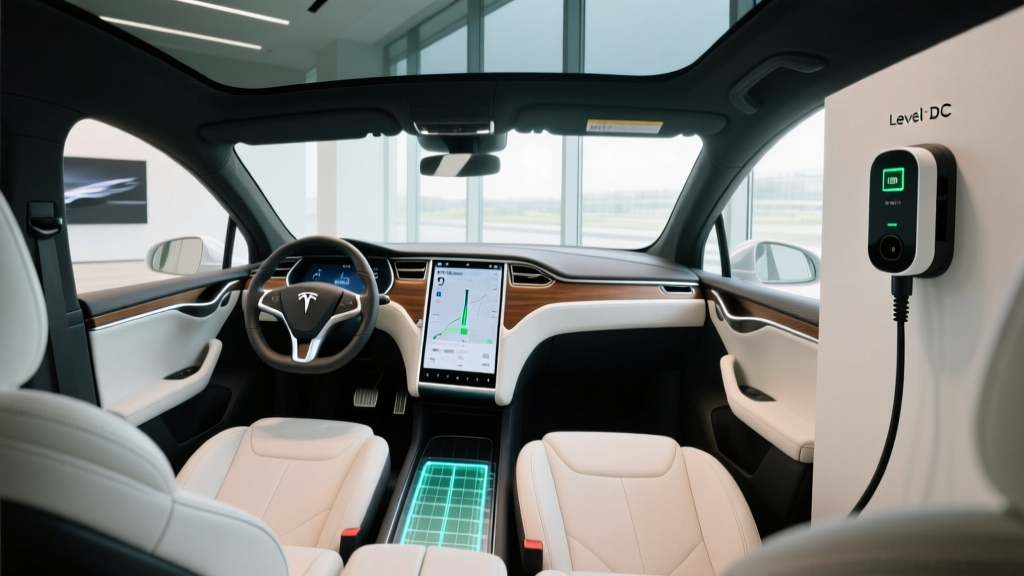
For 2026, Tesla continues to refine interior quality. Ventilated front seats are now standard across trims, addressing a frequent complaint in hot climates. The synthetic leather upholstery has improved in texture and durability. The steering wheel is a yoke-style unit by default, though a conventional round wheel is available at no extra charge. Panel gap consistency and soft-touch materials have improved from earlier production years, though the Model X still doesn't match the Mercedes EQS SUV or BMW iX for traditional luxury material richness.
Infotainment & Screens
- Front: 17-inch center touchscreen (tilt-adjustable) running Tesla's proprietary OS — fast, responsive, with Netflix/YouTube/arcade gaming while parked
- Rear: 8-inch touchscreen for second-row passengers (climate control, media, gaming)
- Driver display: No traditional instrument cluster; all driving info is rendered on the left edge of the center screen
- Audio: 22-speaker premium audio system with active noise cancellation
Notable omission: Apple CarPlay and Android Auto remain unavailable. Tesla's native navigation and media integration are robust, but buyers deeply invested in Apple or Google ecosystems should test-drive and confirm comfort with Tesla's walled garden.
Driver Assistance: Autopilot & FSD
Tesla Autopilot and Full Self-Driving (Supervised) are SAE Level 2 driver-assistance systems. The driver must remain fully attentive, keep hands on the wheel (or demonstrate engagement via camera monitoring), and be prepared to take over at any moment. These are not self-driving systems. Only Level 4 robotaxi services like Waymo operate without a human driver in defined zones.
Autopilot (standard) includes adaptive cruise control, lane-centering, and automatic emergency braking. FSD (Supervised), a $8,000 add-on or $99/month subscription, adds automated lane changes, on-ramp to off-ramp highway navigation, traffic light/stop sign recognition, and limited city-street steering. Real-world FSD performance varies significantly by geography and road complexity — it excels on well-marked highways but can be unpredictable in construction zones or poorly marked rural roads.
Pricing, Trims & Federal Tax Credit Eligibility
| Trim | Base MSRP | As-Tested (typical options) | §30D Credit Eligibility |
|---|---|---|---|
| Long Range AWD | $79,990 | $85,000–$92,000 | Up to $7,500 (see caveats below) |
| Plaid | $94,990 | $100,000–$110,000 | Up to $7,500 (see caveats below) |
- MSRP cap: SUVs/vans/pickups must be ≤ $80,000 MSRP to qualify. The Model X Long Range AWD at $79,990 clears this threshold; the Plaid at $94,990 does not.
- Buyer income cap: Modified AGI ≤ $300,000 (married filing jointly), $225,000 (head of household), $150,000 (single).
- Battery sourcing: Critical minerals and battery component requirements phase in annually. Confirm current-year compliance on irs.gov or via Tesla's checkout page, which displays eligibility in real time.
- Point-of-sale transfer: Eligible buyers can transfer the credit to the dealer at purchase, reducing the upfront price by up to $7,500 instead of waiting for a tax refund.
- Final authority: Tax situations vary. Consult a tax professional before relying on credit eligibility.
Bottom line on price: A Long Range AWD with the $7,500 point-of-sale credit effectively starts around $72,490, making it more competitive with the Rivian R1S ($75,900 base) and significantly undercutting the Mercedes EQS SUV ($104,400 base). The Plaid does not qualify for the federal credit due to the MSRP cap.
Warranty, Ownership Costs & Longevity
- Basic vehicle warranty: 4 years / 50,000 miles
- Battery & drive unit warranty: 8 years / 150,000 miles (whichever comes first), with Tesla guaranteeing minimum 70% capacity retention over that period
- Expected battery replacement cost (out of warranty): $15,000–$22,000 based on current service center pricing, though NMC packs in Tesla vehicles have demonstrated strong longevity — many high-mileage Model S/X vehicles report 85–90% capacity at 150,000+ miles
Insurance premiums for the Model X tend to run 20–35% higher than comparable gas SUVs, reflecting repair cost data and the vehicle's performance profile. Average annual premiums land in the $2,800–$3,600 range depending on state, driving record, and coverage level.
Maintenance is minimal: no oil changes, no transmission fluid, cabin air filter replacement every 2 years, brake fluid checks, tire rotations every 6,250 miles. Tesla recommends (but does not require for warranty) an annual service inspection. Budget roughly $400–$600/year in maintenance — a fraction of what a comparable BMW X5 or Mercedes GLE would demand.
Who Should Buy the 2026 Model X — And Who Shouldn't
- You need a third row and want Supercharger network access for road trips
- Falcon-wing doors solve a real problem for your garage or car-seat loading routine
- You want 335 miles of EPA range in a three-row EV with 5,000-lb towing capacity
- You value over-the-air updates and a tech-forward infotainment experience
- Third-row adult comfort is a priority (consider the Rivian R1S or a three-row PHEV like the Toyota Grand Highlander Hybrid)
- Traditional luxury materials and dealer service matter more than tech (Mercedes EQS SUV, BMW iX — though neither has a third row)
- You want the fastest DC charging in the segment (Hyundai/Kia E-GMP vehicles or Porsche Macan EV charge faster)
- Budget is under $70,000 (the Model Y or a used Model X may be more realistic)
- 335 mi EPA range with NMC battery and proven longevity
- Supercharger network — still the most reliable DC fast-charging ecosystem
- Falcon-wing doors ease third-row and car-seat access
- 670 hp (Long Range) or 1,020 hp (Plaid) — absurd performance for a family SUV
- OTA updates continuously add features post-purchase
- Qualifies for $7,500 federal credit (Long Range trim only)
- 250 kW peak DC charging is no longer class-leading
- Third-row legroom (32.7 in) is tight for adults
- No Apple CarPlay or Android Auto
- FSD remains a Level 2 system despite the "Full Self-Driving" name
- Plaid trim exceeds the $80K MSRP cap, losing federal credit eligibility
- Insurance costs significantly above segment average
Frequently Asked Questions
What is the real-world range of the 2026 Tesla Model X?
The EPA rates the Long Range AWD at 335 miles. In real-world highway driving at 70–75 mph, expect roughly 280–305 miles. In cold weather (below freezing), plan for 240–265 miles of highway range. Preconditioning the battery while plugged in helps recover some of that winter loss.
How fast does the Model X charge at home and on the road?
At home on a Level 2 Tesla Wall Connector (48A, 11.5 kW), you'll add about 30–34 miles of range per hour, fully charging overnight in ~8–10 hours. On a V3 Supercharger (peak 250 kW), 10–80% takes approximately 28–32 minutes. The charging curve tapers significantly above 80% SoC to protect battery health.
Does the 2026 Model X qualify for the $7,500 federal EV tax credit?
The Long Range AWD, at $79,990 MSRP, falls under the $80,000 SUV cap and is eligible — provided the buyer meets income thresholds (≤ $300K joint, $150K single) and the vehicle meets current-year battery sourcing requirements. The Plaid trim at $94,990 exceeds the MSRP cap and does not qualify. Always verify on irs.gov and consult a tax professional.
Is the Model X worth buying over the Rivian R1S or Mercedes EQS SUV?
The Model X wins on Supercharger access, performance, and range. The Rivian R1S offers a more traditional SUV interior, better off-road capability, and slightly more third-row space, but with ~321 miles of range and access to the Supercharger network only via adapter (though native NACS adoption is rolling out). The Mercedes EQS SUV delivers superior luxury and ride comfort but starts at $104K+, has no third row, and charges slower. Your priority — tech and speed vs. luxury vs. adventure capability — dictates the right choice.
What is the biggest drawback of the 2026 Model X interior?
The third row is best suited for children or short-trip adult passengers, with only 32.7 inches of legroom. Cargo space behind the third row (15 cu ft) is also modest for a vehicle this size. The lack of Apple CarPlay/Android Auto is a dealbreaker for some buyers. Material quality, while improved, still doesn't match legacy luxury brands at this price point.
How long will the Model X battery last?
Tesla warranties the battery and drive unit for 8 years / 150,000 miles with a minimum 70% capacity retention guarantee. Real-world data from high-mileage Tesla owners suggests NMC packs in the Model X/S platform typically retain 85–90% capacity at 150,000 miles when charged primarily on Level 2 and kept between 20–80% SoC for daily use. Out-of-warranty replacement runs $15,000–$22,000 if needed.